- A silver medal with a longer story behind it
- Reading the two performances
- The arithmetic of a partnership
- Two different paths to the same rink
- An Olympic disappointment, a world breakthrough and a return from injury
- A sport built on trust and musical timing
- How Japan built a place in international pairs skating
- The road to Chongqing
A silver medal with a longer story behind it
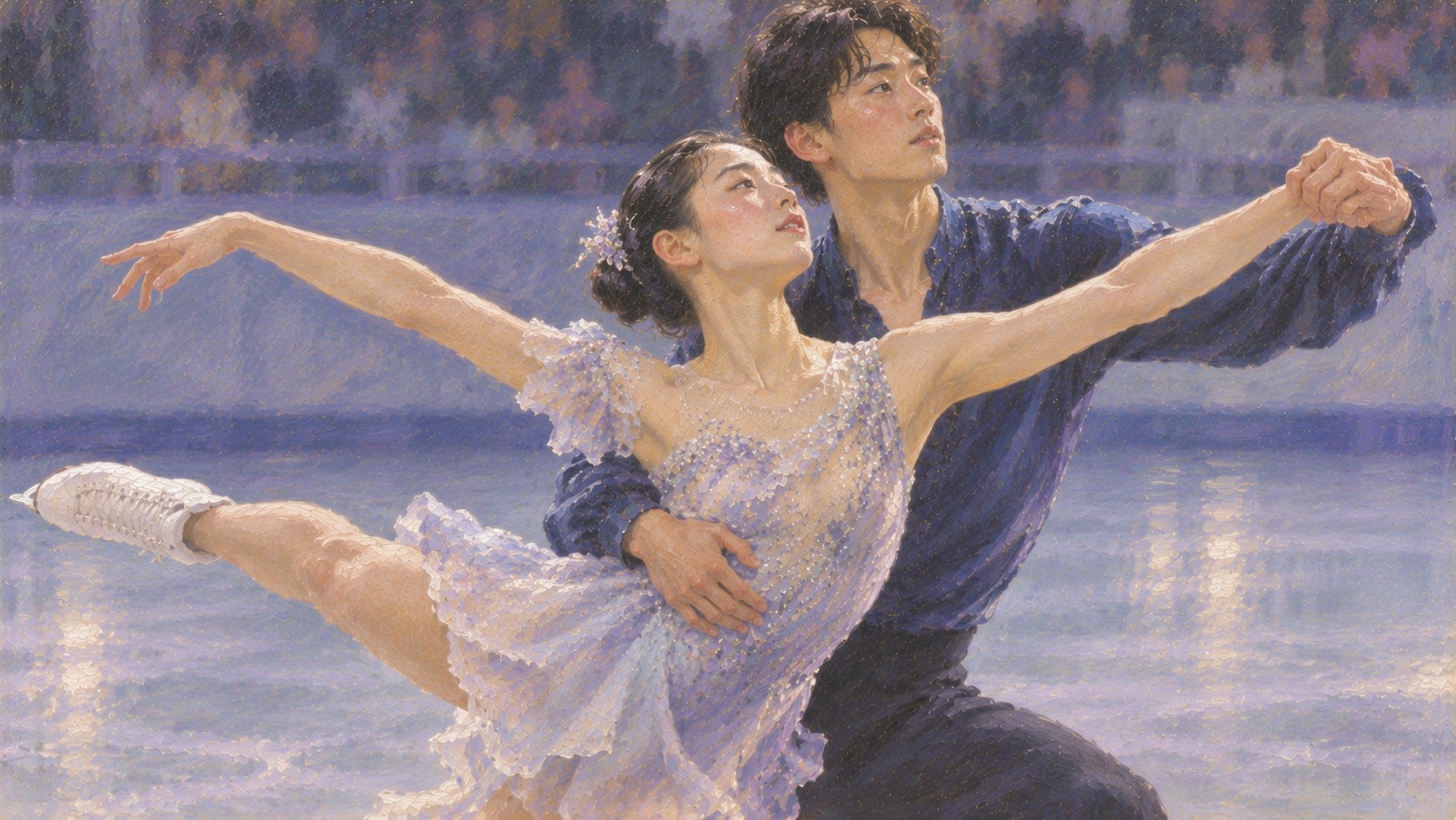
At the NHK Trophy in Tokyo on November 28, Yuna Nagaoka and Sumitada Moriguchi finished second in both segments of the pairs competition. Their 195.69 combined points earned Japan a silver medal and secured a place in the Grand Prix Final for the first time in their partnership. The result followed bronze at the Cup of China earlier in November.
Germany's Minerva Fabienne Hase and Nikita Volodin won with 213.08, while Armenia's Karina Akopova and Nikita Rakhmanin took bronze with 178.39. The Japanese pair stood almost exactly midway between those two totals. They had room to improve, but they had also established a clear margin over the rest of the eight-team field.
For a country whose international skating reputation was built largely around singles, this was more than a home competition medal. It illustrated the continuing development of a discipline in which finding the right partner is only the beginning. Nagaoka and Moriguchi had finished eighth at the same event in their first season together. Three years later, they were on its podium.
| Rank | Pair | Total |
|---|---|---|
| 1 | Hase / Volodin | 213.08 |
| 2 | Nagaoka / Moriguchi | 195.69 |
| 3 | Akopova / Rakhmanin | 178.39 |
Reading the two performances
The short program brought 69.78 points, including 38.80 for technical elements and 30.98 for program components. Their opening level-three triple twist lift earned 6.27 points, and their side-by-side triple loop earned 6.02. The throw triple Salchow received a negative grade of execution, bringing its value down to 3.65.
In the free skate, the pair began with another level-three triple twist, earning 6.68. A side-by-side triple loop followed by a double Axel received 7.99, with a quarter-turn landing call on the Axel. Their triple toe loop earned 5.22, and their throw triple loop 5.36. Their level-four death spiral earned 6.03, and a Group 5 lift received 8.49. The throw Salchow again proved more costly, receiving 3.33 after a negative execution adjustment.
There were no separate deductions in either segment. That is a different statement from saying the performances were flawless: negative execution grades already reduce individual element scores. The protocols reveal a team that can earn substantial points in supported elements while still having room to improve some jump landings.
The arithmetic of a partnership
Figure skating's judging system separates the difficulty and execution of elements from the broader quality of a performance. A technical panel identifies what was performed and, for applicable elements, its level. Judges then assess execution. A separate set of component marks considers composition, presentation and skating skills. The two totals, less any applicable deductions, determine a segment score.
In Tokyo, the Japanese pair's free-skating technical score of 60.88 was 5.64 below the German champions' 66.52. Their component score of 65.03 was 6.32 below the winners' 71.35. The difference therefore did not come from one isolated mistake. Both the technical and expressive sides of the program offer opportunities for improvement.
Pairs skating adds a problem of coordination to every ordinary skating challenge. A clean solo jump must also match a partner's timing and direction. A lift must appear continuous and controlled while two bodies move through space. Even a difficult element that is successfully completed needs to fit the musical structure of the program.
Two different paths to the same rink
Nagaoka was born in Hokkaido in July 2005 and began skating in 2012. Her academy records show a junior singles career that included victory in the 2022 Tohoku-Hokkaido championships. Moriguchi, born in Kyoto in December 2001, started in 2010. Before their partnership, he had already finished fourth at the World Junior Championships with Haruna Murakami.
Nagaoka and Moriguchi joined forces in spring 2023. Their experience in individual skating provided a useful base, but the transition to pairs demanded a distinct set of skills. They won the Japanese national championship in December 2023, placed second the following year and regained the title in December 2025.
The official biography records a coaching change in spring 2025 and training in Kyoto and Berlin. Their coaching team includes international specialists as well as Japanese-based instructors. This arrangement demonstrates how an athlete-development system can draw on expertise that crosses national borders. It does not mean that the cost or availability of such training is the same for every aspiring pair.
An Olympic disappointment, a world breakthrough and a return from injury
The results of 2026 show how uneven elite sporting progress can be. Nagaoka and Moriguchi won bronze at the Four Continents Championships, then finished nineteenth at the Milan Cortina Olympics, missing qualification for the free skate. At the World Championships in March, they returned to finish fourth with a personal best of 209.13.
Their subsequent preparation was disrupted by injury. TBS reported a heel stress fracture in April and a leg fracture in a traffic accident in August; the ISU biography independently records the summer accident. These publicly reported setbacks provide context for their competition return without establishing any private medical details or recovery prognosis.
At the Cup of China they scored 181.50. Three weeks later, Tokyo brought 195.69, an improvement of 14.19 points. The November results are a useful indicator of restored competitive performance, although scores from different judging panels and events are not perfectly interchangeable.
A sport built on trust and musical timing
Pairs is not the same discipline as ice dance. A twist lift, a throw jump and an overhead lift are characteristic of pairs competition. In a twist, one partner launches the other into a rotating airborne movement before catching her. A throw jump ends with an independent landing. These elements require specialized coaching, controlled training progressions and appropriate safety measures.
For the 2026–27 season, senior pairs have a short program of about two minutes and forty seconds and a free skate of about four minutes. Seven prescribed elements in the short and ten in the free demand a balance of individual skills and supported movements. Transitions, changes of speed and synchronization help connect these elements into a coherent performance.
Their updated ISU biography lists the first movement of Sergei Rachmaninov's Second Piano Concerto for the short program. The free skate uses Hiba by Worakls and Lux and Rush by Ryan Taubert. Cathy Reed and Benoit Richaud are listed as the respective choreographers. Different musical structures give the partners different opportunities to express tension, release and shared movement. The artistry is not a decorative addition to the technical program; it is an evaluated part of the competition.
How Japan built a place in international pairs skating
Japan's pairs history took a significant step forward in 2012 when Narumi Takahashi and Marvin Tran won world bronze representing Japan. Their achievement demonstrated that Japanese skating development could extend beyond the singles events that had attracted much of the country's attention.
Riku Miura and Ryuichi Kihara formed their partnership in 2019 and subsequently won the Grand Prix Final in 2022, world titles in 2023 and 2025, and Olympic gold in 2026. They retired from competition in April 2026. Their career created a visible example for younger skaters and coaches considering the discipline.
The challenge now is to develop a broader base rather than depend on one exceptional team. Pairs requires matching prospective partners, finding coaches with specific expertise, access to suitable ice and off-ice conditioning, and funding travel and medical support. A national system that can offer those opportunities over many years is more likely to sustain a competitive field. The silver medal in Tokyo is one measurable milestone, not evidence that every structural challenge has been solved.
The road to Chongqing
The Grand Prix began in 1995 and consists of six international stops. Skaters normally contest no more than two, receiving ranking points according to their finishing positions. The top six eligible pairs progress to the Final. A second place earns 13 points and a third place earns 11; these qualification points are distinct from the judges' performance scores.
Nagaoka and Moriguchi earned 24 points from their two assignments. The ISU standings dated November 28 list them sixth with a qualification marker. The Final is scheduled in Chongqing in December. Unlike a single home event, qualification rewards performance across two competitions against different fields.
Their world championship personal best remains 209.13, above their Tokyo score. Fans following the Final can watch for the accuracy of side-by-side jumps, the landings of throws, the flow of lifts and the closeness of the partners' musical timing. Neither a first qualification nor a previous world result guarantees a medal. But the steady progression from eighth to seventh, fourth and second at the NHK Trophy offers a compelling record of a partnership learning to compete at the highest level.
Related reporting
Mone Chiba wins NHK Trophy silver
Sources and further reading
- ISU — NHK Trophy final results
- ISU — Short program
- ISU — Free skating
- ISU — Competition protocol
- ISU — Grand Prix standings
- 日本スケート連盟・強化選手
- ISU — Athlete biography
- 木下スケートアカデミー・長岡柚奈
- 木下スケートアカデミー・森口澄士
- ISU — Cup of China results
- ISU — World Championships results
- TBS NEWS DIG — 2026年11月28日
- 笹川スポーツ財団・日本のフィギュアスケート
- ISU — Miura and Kihara career history
- ISU — Competition programs explained
- ISU — Grand Prix explained