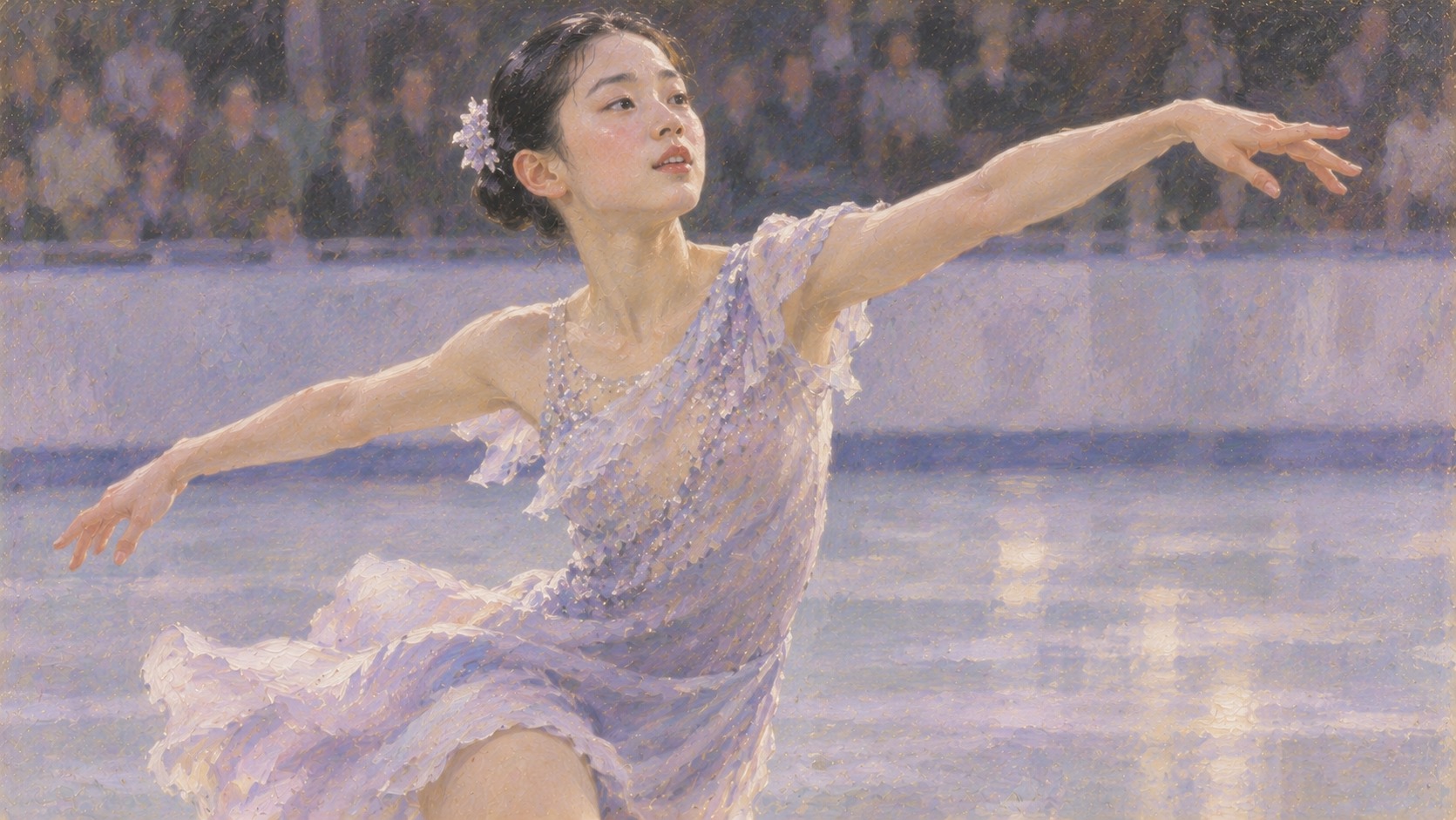
- A silver medal that tells two stories
- Reading the short program as a performance
- The costly loop in Clair de Lune
- How the numbers are built
- From Sendai to a Kyoto training base
- The long climb toward the world podium
- The tournament that brought the world to Japan
- Five Japanese victories, then a Korean breakthrough
- Why Chongqing is a different competition
A silver medal that tells two stories
Mone Chiba arrived at the last regular Grand Prix stop of the season with a victory in China already behind her. At Tokyo's Keio Arena on November 28, the 21-year-old earned a second result that mattered just as much for her winter campaign: silver at the NHK Trophy, with 214.57 points, and a place in the Grand Prix Final.
Her competition was not a simple progression from a commanding short program to an equally commanding free skate. Chiba led on Friday with 77.12, then scored 137.45 on Saturday. South Korea's Jia Shin overtook her with 220.84 overall, while Young You secured bronze. Japan's Yuna Aoki and Mako Yamashita placed fourth and sixth.
The official record deserves particular attention. Shin's initial total of 219.02 was revised after the calculation of a second-half jump bonus. The ISU's corrected free-skating score is 145.53. That makes the final margin 6.27 points, rather than the smaller margin reported immediately after the event.
| Place | Skater | Total |
|---|---|---|
| 1 | Jia Shin | 220.84 |
| 2 | Mone Chiba | 214.57 |
| 3 | Young You | 199.99 |
| 4 | Yuna Aoki | 198.98 |
| 5 | Alina Gorbacheva | 193.87 |
| 6 | Mako Yamashita | 190.85 |
Reading the short program as a performance
Chiba's choice of music takes audiences into the world of James Bond. Her short program combines Skyfall with the Bond theme. Fuji Television's athlete profile identifies Jeffrey Buttle as its choreographer. The arrangement gives a skater opportunities to work with changes of pace, sharp accents and sustained movement.
Her opening triple flip–triple toe loop combination received 10.33 points despite an edge-attention call on the flip. The double Axel and late triple Lutz both earned positive grades of execution. Her level-four step sequence alone contributed 5.68 points, and her level-four layback spin added 4.43.
The most revealing comparison is with Shin. Chiba's technical score was 0.14 lower, but her component score was 1.95 higher. Her skating skills mark of 8.86 helped establish a lead of 1.81. A viewer who watches only the jumps would miss much of the explanation for that first-place finish.
The costly loop in Clair de Lune
For her free program, Chiba turns to Debussy's Clair de Lune, with choreography credited by Fuji Television to Kaitlyn Weaver. The musical contrast is striking: a program organized around a quietly evolving piano piece rather than the tension of a film score. Maintaining the flow of movement while preparing difficult elements is one of the central challenges.
The judges' sheet records an opening triple flip–triple toe loop worth 11.09, followed by a triple Salchow worth 5.47. The third jump, a triple loop attempt, was downgraded and received a fall call. Its score was just 0.85, and a separate one-point fall deduction applied to the program. Later jumps received rotation-related calls as well.
A fall does not erase everything that precedes or follows it. Chiba's level-four step sequence and combination spin earned substantial positive execution scores. Her closing choreographic spin received 5.64. Her free-skating component total, 68.38, actually exceeded Shin's 67.98, but the difference in technical scores was decisive.
How the numbers are built
Modern figure skating combines measurable technical requirements with evaluation of the performance as a whole. Technical officials identify the elements performed and determine their difficulty levels and relevant calls. Judges then evaluate how well each element was executed. The grade of execution, or GOE, modifies its base value.
The three current program components assess composition, presentation and skating skills. The scores are weighted for the particular segment and added to the technical element total. Deductions, including falls, are subtracted. The two segment totals together determine the final standings.
A downgraded jump therefore has consequences beyond the visible interruption to the performance: its base value is reduced, its execution score can be negative, and a fall may also incur a separate deduction. Conversely, strong edges, turns, spins and transitions contribute to the overall score in different ways. The public protocol lets spectators see those distinctions without guessing at the judges' intentions.
From Sendai to a Kyoto training base
Born on May 1, 2005, in Sendai, Chiba began skating in 2009, according to the ISU biography. Her present training base is Kyoto. The biography lists Mie Hamada, Hiroaki Sato and Cathy Reed among her coaches. The Kinoshita Group announced in July 2025 that her affiliation would change from its academy to the group itself while her practice base remained the academy's Kyoto rink.
The arrangement illustrates the importance of infrastructure to an elite skating career. Ice time, specialist instruction, choreography and the ability to travel for competitions all require resources. A skater's development is not solely the product of an individual talent or a single coach.
The Japanese Olympic Committee identified Chiba as a Waseda University student at the opening of the 2026 Winter Olympics. Outside competition, the ISU profile lists interests including reading, bead embroidery and films. These documented details offer a glimpse of a young athlete whose life extends beyond the rink.
The long climb toward the world podium
Chiba's international championship record shows how a contender can develop over successive seasons. She earned bronze at the 2023 Four Continents Championships and won the 2024 edition. Her World Championship results progressed from seventh in 2024 to bronze in 2025 and silver in 2026. At the Milan Cortina Winter Olympics she finished fourth in women's singles.
Her personal best of 228.47 was recorded at the March 2026 World Championships. That provides useful context for Tokyo's 214.57: the silver medal was a successful qualifying result, but it was below her established scoring ceiling. Her previous Grand Prix Finals brought silver in 2024 and fifth place in 2025. Neither past medals nor personal bests guarantee a particular result in December.
The tournament that brought the world to Japan
The NHK Trophy began in 1979, marking the fiftieth anniversary of the Japan Skating Federation. A retrospective exhibition held in 2018 traced its role in bringing international competitors to Japanese audiences. Over time the event became part of the international circuit that connects the country's domestic skating culture with global competition.
Japan's prominence in women's skating has been built across generations: Midori Ito's pioneering jumping, Shizuka Arakawa's Olympic victory, Mao Asada's technical and artistic achievements, and Kaori Sakamoto's championship career. The athletes are distinct, but their visibility has helped make skating a familiar part of the Japanese sporting calendar.
The NHK Trophy also offers audiences something that a national championship cannot: direct comparison between athletes developed within different sporting systems. In Tokyo, Korean skaters occupied two of the three podium positions, a reminder that international competition is central to the event's identity.
Five Japanese victories, then a Korean breakthrough
Japan won the first five regular Grand Prix women's events this season through Ami Nakai, Mao Shimada and Chiba. Shin's victory in Tokyo prevented a clean sweep. Rather than treating that as a national disappointment alone, it is worth recognizing the competitive depth shown by athletes from both countries.
South Korea's Olympic champion Yuna Kim helped transform the visibility of women's skating in East Asia in 2010. The latest generation now competes in a landscape shaped by international coaching, choreography and junior competitions. A single event cannot measure the strength of a country's entire development system, but the results in Tokyo demonstrate how competitive the leading field has become.
Why Chongqing is a different competition
The Grand Prix series is not decided by adding the raw scores from every event. Skaters earn ranking points for their placements at assigned competitions. Chiba's Cup of China win provided 15 points and her NHK silver supplied another 13. The ISU standings published on November 28 list her third with 28 points, behind Shimada and Nakai, who each earned 30. All three are marked as qualified.
The six leading women's qualifiers are due to meet in Chongqing in December. Unlike the qualifying series, the Final is a separate competition: previous points secure entry but do not become part of the new competition score. The Tokyo result therefore gives Chiba an opportunity, not an advantage carried into the judging sheets.
Her contrasting programs, and the detailed record of their strengths and weaknesses, offer a useful way to follow that next event. The question is how consistently she can combine the technical execution demonstrated in her best performances with the quality of skating that led the short program in Tokyo.
Sources and further reading
- ISU event results
- Women final results
- Short program classification
- Free skating classification
- Short program judging sheets (PDF)
- Revised free skating judging sheets (PDF)
- Grand Prix standings
- Japan Skating Federation athlete profile
- ISU athlete biography
- Kinoshita Group affiliation announcement
- Japanese Olympic Committee profile
- ISU judging system
- NHK Trophy historical exhibition
- ISU season guide
- Nikkan Sports revised results
- Fuji TV athlete profile
- Official event protocol