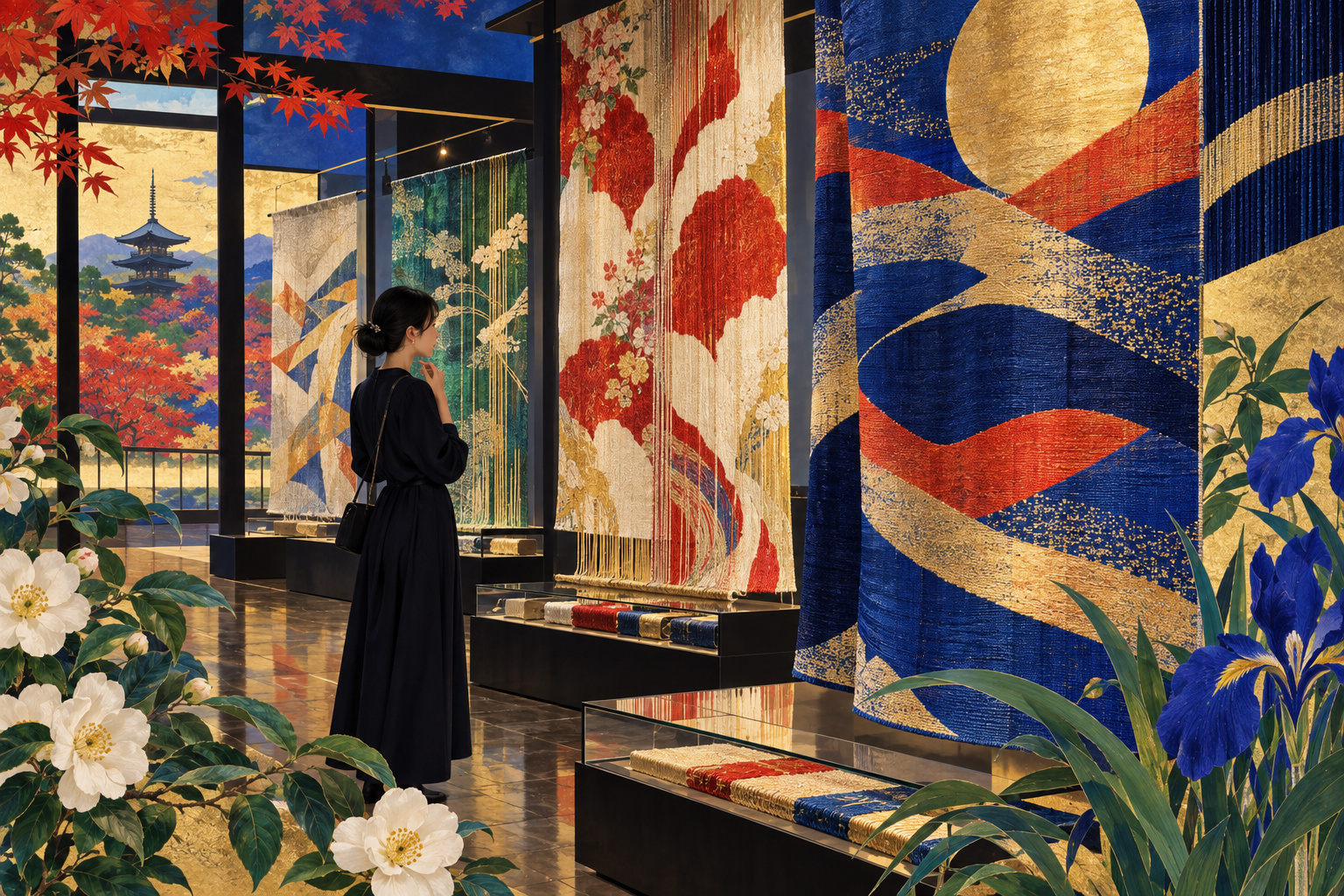
Rockets and Tokyo Tower may not be the first subjects associated with traditional Japanese textiles. A Yamaga Seika retrospective at the Kyoto City KYOCERA Museum of Art uses his career to explore how weaving could engage with modern life as well as inherited imagery. “Yamaga Seika: Boundless Imagination in Textile Art” runs from September 19 to December 20.[5]
The artist across the whole process
Born in Kyoto in 1885, Yamaga studied Nishijin textile design and Japanese painting before becoming a pupil of Kamisaka Sekka in 1910. A special prize at the 1927 Imperial Art Exhibition helped establish his direction as a textile artist. He died in 1981.[2]
Central to his practice was teori-nishiki. The museum explains this term through his way of working: the artist carried a project from conception and preparatory drawing through yarn selection and weaving. It describes authorship across the process, rather than simply naming one weave.[1]
That approach offers a useful perspective on craft. Technical knowledge and individual expression can be examined together, through the decisions that turn a design into a material object.
Modern subjects, woven forms
The exhibition checklist includes Tokyo Tower and the work titled 星座・月・ロケット, both dated 1958. These teori-nishiki wall hangings belong to the Kyoto City Museum of Art collection and are scheduled for display throughout the exhibition. A small preparatory drawing for the latter work is also listed, allowing visitors to consider the relationship between an initial design and its woven realization.[3]
Yamaga’s repertoire also encompassed traditional festival imagery. The contrast with locomotives and rockets makes his work a way to consider craft as a response to its own era, not solely as the preservation of older patterns.[4]
Textiles as part of shared spaces
His work extended to festival hangings, curtains, hotels and ocean-liner interiors, including collaboration with architect Murano Togo. These commissions place textile art within the spaces people used and the occasions they shared.[4]
The retrospective’s wider interest lies in those connections: between making an artwork, sustaining a ceremonial tradition and shaping an architectural setting. It invites attention to what textiles do in public life as well as what they depict.
Visiting
The exhibition occupies the Main Building’s South Wing, first floor. Hours are 10 a.m.–6 p.m., with last admission at 5:30 p.m.; the museum closes on Mondays except public holidays. Standard adult admission is ¥1,800. Junior-high-school students and younger enter free.[5]
Some works rotate: the first display period ends November 1, and the second begins November 3. Check the museum’s artwork list for individual display dates.[1][3]
