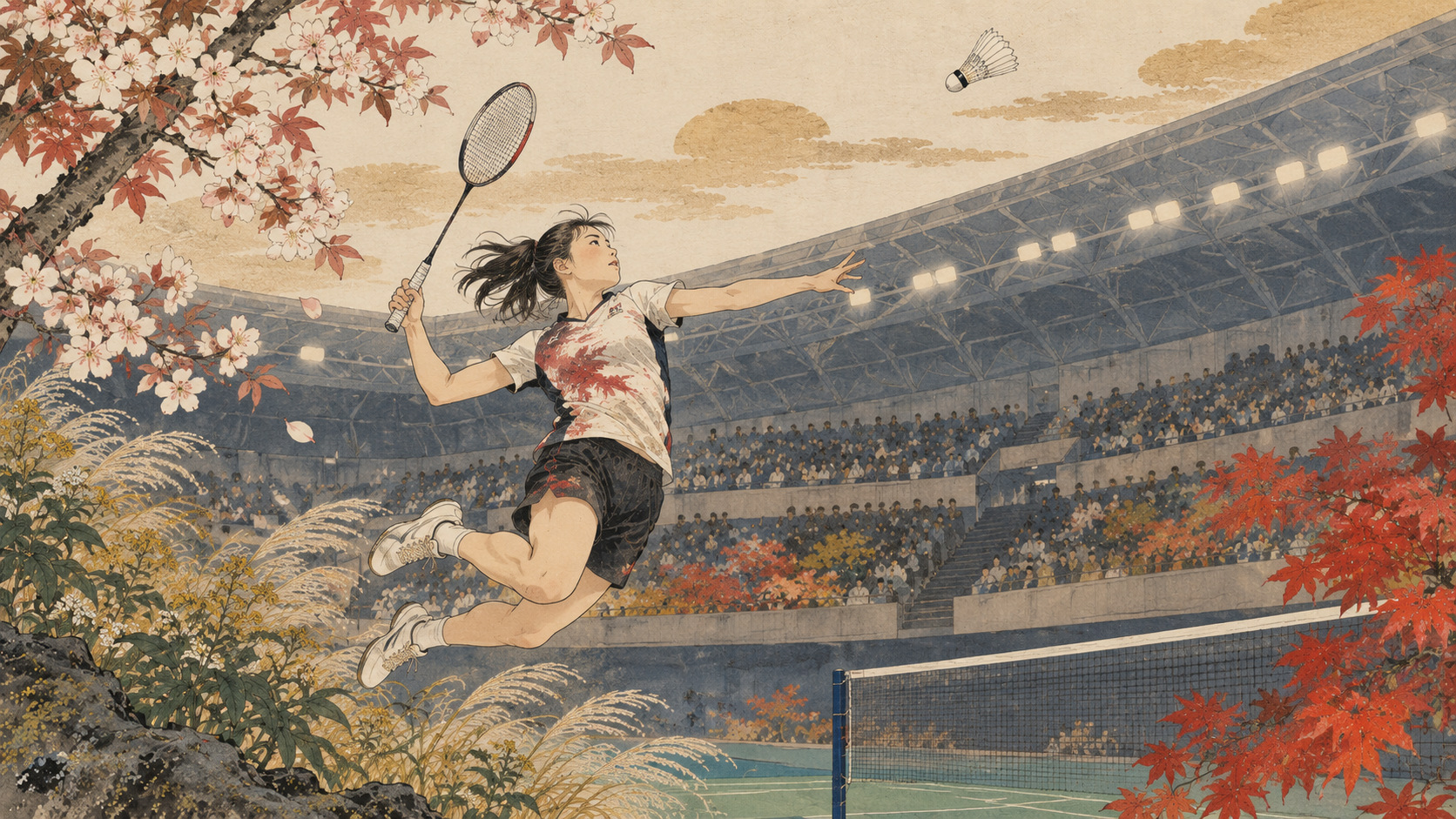
In a hall in Cairo, a shuttlecock can turn a teenager's domestic reputation into a first encounter with the highest level of international competition. Japan has sent junior badminton representatives to Egypt for the 2026 World Junior Championships, a combined program whose team competition ran October 5–10 and whose individual event is scheduled for October 11–17. The Japanese association announced its delegation in August and updated its dispatch information on September 29.
That is the verifiable starting point for this feature. Official schedules and delegation announcements establish who was selected in the initial roster, but the latest Japanese match-by-match results have not been independently confirmed at this editorial cutoff. Rather than invent victories or build a personality profile on an unverified bracket, this article examines how the Cairo tournament fits into Japan's sporting history and the international pathways available to its young players.
Who Japan sent—and what can be confirmed
The Japan Badminton Association's August 6 announcement included, among the boys selected for the team competition, Daiki Masuda of Keihō High School in Nagasaki, Haruka Masuda and Masato Yamashiro of Futaba Future School in Fukushima, Mayu Oku of Takaoka Daiichi High School in Toyama, Takumu Terashima of Futaba Future School, and Shunki Hagiwara, Mayu Matsumoto and Akio Yamaguchi of Saitama Sakae High School. Taisei Kushima, listed as a junior-high-school student at Futaba Future School, was also among those originally named.
Those names and school affiliations are taken from the association's initial announcement, not from a verified final individual-event entry list. The association subsequently revised its dispatch information on September 29. Any claim that a named player entered or won a particular match needs to be checked against the updated roster and the official draw.
Two competitions, different forms of pressure
World Junior Championships is an umbrella title covering a mixed-team event and the individual disciplines. The team competition awards the Suhandinata Cup. The individual championship covers men's and women's singles, men's and women's doubles and mixed doubles. In one competition, players carry the result of a national lineup; in the other, they and their partners advance through an individual draw.
For 2026, international badminton organizers introduced distinctive scoring arrangements, including a relay format for the team competition and best-of-three 15-point games for the individual event, according to published tournament information. These changes may increase the importance of short scoring runs. They cannot, without supporting match analysis, be said to favor Japan or any specific tactical school.
From a nineteenth-century pastime to global competition
Modern international badminton grew through organized national associations and the International Badminton Federation, founded in 1934. The sport's inclusion as a full Olympic medal event at Barcelona in 1992 helped establish a widely recognized peak for professional careers. World junior competition, which also began in 1992, developed into a place where national systems could test emerging talent against players of similar age from different continents.
For Japan the route to elite competition has frequently led through schools, university programs and company-backed teams. Its women's and men's international successes have made badminton a recognizable part of the country's wider sporting identity. Yet the transition from exceptional youth player to consistent adult professional is neither automatic nor linear: physical development, coaching, injury management, education and economic opportunities all matter.
Japan's regional badminton pipeline
There is an overlooked geographical story inside the provisional selection list. Futaba Future School in Fukushima, Keihō High School in Nagasaki, Takaoka Daiichi in Toyama and Saitama Sakae in Saitama show how Japan's development system extends far beyond Tokyo. These schools operate in different communities, and their players have taken different routes toward international selection.
A school affiliation is not evidence of a particular athlete's background, family finances or daily workload. Those details require interviews, especially when covering minors. But the prominence of several regional schools demonstrates that nurturing elite athletes depends on a network of education and coaching institutions, not merely on the success of one nationally famous champion.
Why Cairo matters
Cairo provides a stage away from the Asian centers that dominate much of the international badminton conversation. Hosting a global junior event in Egypt gives athletes, organizers and spectators in Africa an opportunity to participate directly in a championship involving delegations from many regions. The Cairo Stadium indoor complex offers an environment in which players meet unfamiliar opponents and styles.
International travel also involves logistics that spectators rarely see: acclimatization, equipment, transport, food and court access. It would be irresponsible to invent a particular Japanese player's travel difficulties or emotional reactions. The larger point remains: an international youth tournament is part of learning how to perform outside the familiar rhythms of home competition.
What a 15-point game changes
For many international badminton followers, games played to 21 points are a familiar reference. A three-game match using 15-point games compresses the time available to recover from a slow start. A few consecutive errors may represent a greater share of the available points. Conversely, decisive attacking play may carry greater reward before an opponent has time to adjust.
These are plausible tactical implications, not tournament-specific findings. Establishing whether the scoring format changed rally lengths, upset rates or injury exposure would require systematic study. Junior sport is particularly complex because players develop at different physical and technical rates, even within a single age category.
The danger of predicting stars too early
There is a temptation to describe every promising junior as a future Olympic medalist. An excellent week in Cairo may generate that hope, but it cannot guarantee a professional trajectory. Some athletes reach their peak while young; others grow more effective after entering universities or company teams. Partnerships in doubles can change as players mature. An athlete may choose a different career entirely.
Good reporting should respect both the immediate stakes and the longer horizon. The score matters. So do the educational institutions, coaches and support networks that make the opportunity possible. A junior championship is a real test, but it is not a definitive verdict on a young person's potential.
Japan's next generation is a continuing story
The most useful future coverage will follow what happens after the brackets close. Which players return to domestic competition? Who enters senior tournaments? How does experience against different playing styles alter their development? Who remains involved in badminton as a coach or mentor, even without a professional playing career?
For the October 15 edition, any reported progression in Cairo must be matched to BWF's official draws, scores and the Japanese association's final delegation records. Until that check is complete, this is a researched feature about Japan's young international competitors and the system behind them—not a claim about medals already won. The shuttle's flight is brief; the development of an athlete takes years.
Sources and reporting basis
- 日本バドミントン協会:世界ジュニア選手権大会2026 選手団派遣(2026年8月6日)
- 日本バドミントン協会:選手団派遣情報更新(2026年9月29日)
- 日本バドミントン協会:2026年10月大会一覧
- BWF:2026年世界ジュニア団体戦
- BWF:2026年世界ジュニア個人戦
- アフリカバドミントン連盟:大会日程
- BWF:国際バドミントン連盟の競技史
Research cutoff: October 13, 2026. Latest match scores and the updated final roster have not been independently verified.