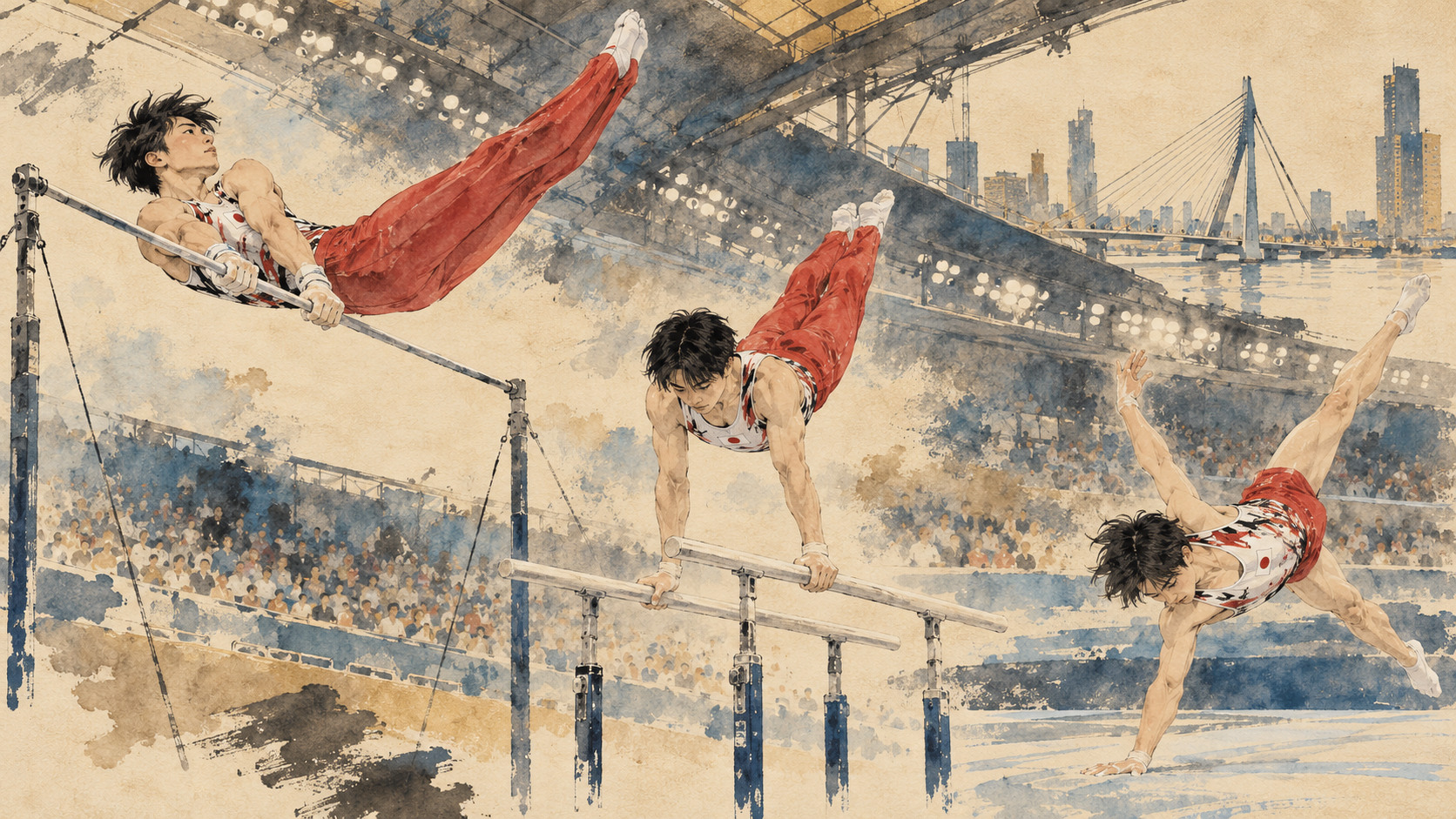
The qualifying lead is real. The world title will be decided in the final.
First in qualifying is not the same as world champion
Japan topped completed men’s qualification at the 54th Artistic Gymnastics World Championships in Rotterdam with 254.529 points. Great Britain followed on 251.460, a gap of 3.069, with a team of Russian athletes shown as WG2 next on 249.162. China, the United States, Switzerland, the Netherlands and Colombia completed the eight finalists. These are verified qualification standings, not final medals. The men’s team final is scheduled for the evening of October 20 in the Netherlands, which is early October 21 in Japan. The final scores must be added after official publication, rather than inferred from qualifying form.
Two apparatuses built Japan’s advantage
Japan led the team qualification rankings on parallel bars with 44.466 and horizontal bar with 42.800. Britain scored 42.899 and 40.132 respectively. The horizontal-bar difference alone was 2.668 points, nearly as large as the countries’ overall 3.069-point separation. This helps explain how Japan topped the table even though Britain outscored it on floor, pommel horse, rings and vault. A breakdown across all six apparatuses tells a more useful story than the headline number.
What the individual routines reveal
Shinnosuke Oka posted 14.866 on parallel bars, 14.500 on high bar and 14.066 on rings, and headed all-around qualification with 85.098. Daiki Hashimoto was second in the all-around on 84.632, including 14.533 on pommel horse and 14.800 on parallel bars. Shohei Kawakami recorded 14.600 on high bar and 14.800 on parallel bars. Ryosuke Doi contributed 14.033 on floor; Fusuke Maeda scored 13.566 on high bar. Nao Ojima was also on the Japanese team roster. All scores describe qualification only, not the final.
Why six apparatuses create six different risks
Men’s artistic gymnastics comprises floor exercise, pommel horse, still rings, vault, parallel bars and horizontal bar. Routines receive scores principally based on difficulty and execution, with applicable bonuses and penalties. A team needs more than a single spectacular performance: errors on an apparatus can wipe out gains made elsewhere. Judges are measuring distinct forms of control, strength, speed, flight and precision. A small slip in a landing or a fall can matter more to the national standings than a gymnast’s individual reputation.
The legacy of Paris 2024
Japan won Olympic men’s team gold at Paris 2024, part of a particularly successful Games in which its men also took gold in the all-around and horizontal bar. The Japan Gymnastics Association identifies those achievements in its own planning documents. Japan’s tradition in men’s gymnastics stretches back much further, through generations of internationally successful teams. The modern challenge, however, is not simply to reenact historic triumphs. It is to integrate Olympic champions with emerging talent, in a sport where the code of points and performance demands continue to evolve.
Hashimoto and Oka embody two chapters of excellence
Hashimoto emerged as an Olympic all-around champion at Tokyo 2020, while Oka became a central figure for Japan at Paris 2024. Their presence together in Rotterdam underlines both continuity and generational renewal. Yet Kawakami’s high-bar result, Doi’s floor contribution and Maeda’s specialist routine show how the team depends on a wider supporting cast. The official Japanese association’s 2026 roster provides authoritative Japanese names, an important safeguard against transliteration mistakes in international results feeds.
Why Britain and the field remain dangerous
Britain had the better qualifying team score on four of six apparatuses, including vault at 42.799 to Japan’s 42.599 and pommel horse at 42.199 to Japan’s 41.966. The fact that Britain nevertheless trailed overall shows how much Japan’s strongest events mattered. A team of Russian gymnasts, China, the United States, Switzerland, the hosts and Colombia also qualified. Their scores do not predict a fixed finishing order. Finalists must produce new performances, and the team medals are determined there.
The road to Los Angeles is longer than one final
The championships are an important measuring point in the international cycle leading toward the Los Angeles Olympics in 2028. But Olympic team-qualification pathways have their own rules and stages. Finishing first in the Rotterdam qualifying round should not be presented as an automatic new Olympic berth. The deeper issue for Japan is whether its gymnasts, coaches and training system can retain consistency through rule changes, injuries, turnover and the pressure of repeated high-stakes finals.
A seven-hour time difference changes the news cycle
The men’s final is scheduled for October 20 from 7:30 to 10:40 p.m. CEST, which corresponds to October 21 from 2:30 to 5:40 a.m. JST. That timing is crucial for a Japanese morning publication. At this article’s reporting cutoff on October 19, official finals results were not yet available. A responsible October 21 edition must replace the qualification-led headline and paragraphs with verified outcome reporting if the official result has been published before release.
What to measure after the last routine
Gold matters, but the story also lies in the components of victory or defeat. Did Japan repeat its commanding parallel-bars and high-bar output? Could the team protect weaker margins elsewhere? How did Britain, China and the rest respond under finals pressure? A complete follow-up should compare the six apparatus totals, analyze decisive routines, and state precisely when the result was confirmed. Until then, Japan’s qualification lead is an achievement, not a verdict.
Reporting cutoff: October 19, 2026. The men’s team final has not yet been held. Before an October 21 release, verify the official final and update headline, result, analysis and modification time.
Sources and documentation
- 日本体操協会:第54回世界体操競技選手権大会/JGA event and official results
- World Gymnastics: men’s team qualification, final standings
- Swiss Timing: six-apparatus team score breakdown
- Local organizing committee: opening day and athlete remarks
- 日本体操協会:2026年度ナショナル選手/National athlete roster
- World Gymnastics: complete competition schedule
- Japan Gymnastics Association: Olympic qualification background