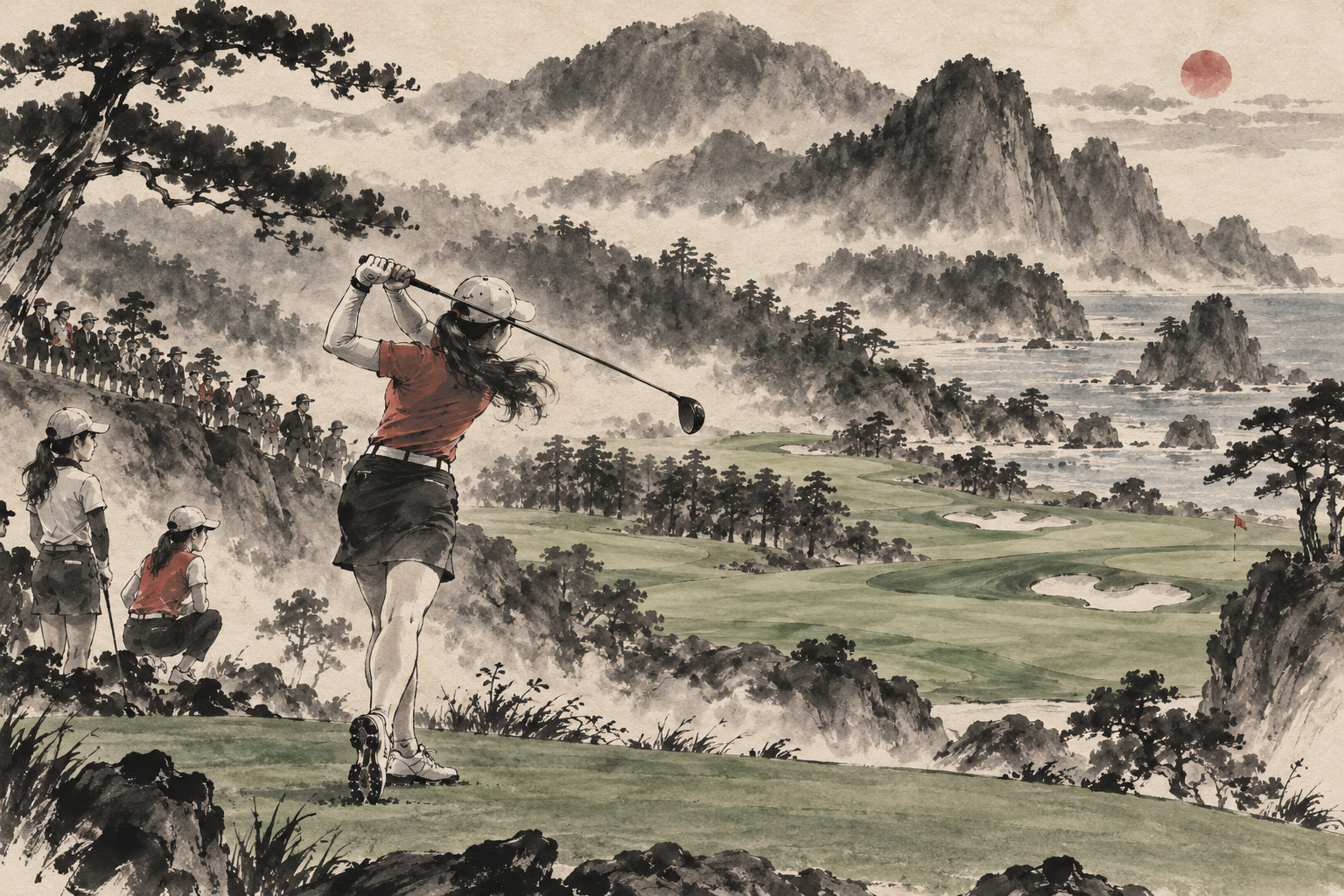
The shot line runs through pine trees and, on a clear day, toward Mount Hakusan. On Thursday morning that landscape becomes a national measuring ground. The Japan Ladies Professional Golfers’ Association opens its Sony Japan Women’s Professional Golf Championship at Katayamazu Golf Club, bringing together domestic tour leaders and a substantial returning contingent from the U.S. tour.
This is the 26th event of the 2026 JLPGA season and one of the association’s four official championships. A field of 132 will play for ¥200 million over four rounds, with ¥36 million reserved for the winner. Only the leading 60 and ties after Friday’s second round will be allowed into the weekend.
The English shorthand “national championship” needs one important qualification. This is the JLPGA-run Japan Women’s Professional Golf Championship. It is not the Japan Women’s Open, which is governed by the Japan Golf Association and will be played October 1–4 at Takarazuka Golf Club’s Old Course in Hyogo. The names are similar, but the organizers, eligibility routes and institutional histories are different.
A field shaped in Japan and overseas
Defending champion Shina Kanazawa arrives with an unusual origin story for a title defense. At Oarai Golf Club last September, she and Shiho Kuwaki finished 72 holes tied at 10 under par. Kanazawa won the playoff, turning her first JLPGA Tour victory into one of the circuit’s major titles.
Kuwaki returns transformed by what happened in England five weeks ago. She won the 2026 AIG Women’s Open at Royal Lytham & St Annes in a playoff, earning her first U.S. tour victory at a global major. She became the third Japanese winner of that championship and the seventh Japanese golfer to win an overseas women’s major.
The tournament’s promotional material says 11 Japanese players based primarily on the U.S. tour are scheduled to compete. Miyuu Yamashita, Ayaka Furue, Nasa Hataoka, Akie Iwai, Chisato Iwai and Rio Takeda are among the entrants. They join 2026 domestic winners including Shuri Sakuma and Fuka Suga, plus Asian invitees and the deepest ranks of the JLPGA membership.
The result is not a neat contest between a “home” team and an “overseas” team. Many of Japan’s global players developed on the JLPGA Tour, while domestic regulars now arrive with extensive major-championship experience. The field reflects a system in which the route from Japan to world golf is heavily traveled in both directions.
A rematch, a newly crowned world major champion and a returning U.S.-tour cohort all meet on one Ishikawa leaderboard.
Katayamazu rewards position before power
The Hakusan Course opened in 1957, designed by Giichi Sato to use Katayamazu’s natural movement rather than erase it. The club describes a gently sloping outward nine and a flatter inward nine, framed by mature pines and views toward Mount Hakusan and the Sea of Japan. Tournament play is on foot with caddies, making recovery between shots physical as well as tactical.
The numbers show how the examination has evolved. When this championship last came to Hakusan in 2008, the course measured 6,545 yards at par 72. The 2026 setup is 210 yards longer with par unchanged. More length places a premium on carry and approach distance, but it also magnifies the importance of choosing the correct side of a fairway and leaving a playable angle into guarded greens.
South Korea’s Shin Hyun-ju won the 2008 championship. JLPGA’s contemporary report noted that only four players remained under par after the third round, evidence that Hakusan is far more than a scenic backdrop. Pines compress sight lines, subtle elevation changes complicate yardage, and protected green complexes punish the impatient miss. A player must distinguish holes that permit aggression from those that demand acceptance.
| Hakusan championship | 2008 | 2026 |
|---|---|---|
| Tournament name | Japan Women’s Professional Golf Championship Konica Minolta Cup | Sony Japan Women’s Professional Golf Championship |
| Setup | 6,545 yards / par 72 | 6,755 yards / par 72 |
| Field | 131 players | 132 players scheduled |
| Champion | Shin Hyun-ju | To be decided |
The championship that began in 1968
The first edition was played at Amagi Country Club in Shizuoka in 1968. Hisako Higuchi won it, then won the next six as well. With further victories in 1976 and 1977, she claimed nine of the first ten championships—an era of dominance that also records how small and formative the women’s professional game remained.
The women’s division separated from the Professional Golfers’ Association of Japan in 1974 to form the Japan Ladies Professional Golfers’ Association. Champions in the decades that followed included Ayako Okamoto, Tatsuko Ohsako and Yuko Moriguchi, followed by an increasingly international list from South Korea, Taiwan and elsewhere. Moving the championship from course to course made adaptability—not mastery of one annual venue—part of the title.
The commercial name has changed with its partners. Sony became title partner in 2024 and in February 2026 extended the agreement for five more years, covering 2027 through 2031. Sony and JLPGA also have an official digital-transformation partnership focused on competition data and the spectator experience. The presentation continues to evolve; the core remains the association’s oldest championship.
1968 — First championship at Amagi Country Club; Hisako Higuchi wins.
1974 — The women’s association becomes independent from the PGA of Japan.
2008 — Shin Hyun-ju wins the championship at Katayamazu’s Hakusan Course.
2024 — Sony becomes title partner.
2025 — Shina Kanazawa earns her first tour victory in a playoff.
2026 — The championship returns to Hakusan after 18 years.
What the Ishikawa setting means
Kaga, in southern Ishikawa, is home to the Kaga Onsen hot-spring region. Katayamazu operates 54 holes across its Hakusan, Kaga and Nihonkai courses, making the club one of the largest golf complexes on the Sea of Japan side of the country. A championship brings players, staff, media and spectators through that regional visitor economy, although no official estimate of this event’s economic impact had been published before play.
The Kaga City Tourism Exchange Organization says part of the proceeds from official player-message towels will be donated for disaster recovery in Ishikawa and Kumamoto. The initiative links the tournament to communities beyond the ropes, but the final donation cannot be known before sales are completed.
For spectators, the appeal is unusually concentrated: world major champions and domestic tour leaders can be followed on the same walking course. Ticket dates, admission conditions, transport and gallery-bus arrangements should be confirmed on the tournament page before travel because operating details can change.
Four rounds, one unsentimental test
A championship is not won with a compelling first-round narrative. The field is reduced after 36 holes, then firmer greens, more demanding hole locations, wind, fatigue and leaderboard pressure accumulate through Sunday. Walking Hakusan adds physical load to the repeated task of choosing where not to miss.
Kanazawa carries the obligations of a defender. Kuwaki arrives with the authority—and extra attention—of a new world major champion. The U.S.-based contingent must translate its international form to a different grass, course rhythm and setup. The domestic regulars bring current knowledge of JLPGA tournament conditions. None of those advantages posts a score by itself.
The title will not identify Japan’s most famous golfer. It will identify the player who solves 6,755 yards in the fewest strokes over four days. The endurance of a championship founded in 1968 rests on that severe simplicity: every generation receives a new venue, a new field and the same demand to prove itself shot by shot.
- JLPGA, “Sony Japan Women’s Professional Golf Championship opens on the 10th,” September 7, 2026 — dates, venue, yardage, purse, field and cut.
- JLPGA, 2026 scheduled player list — player names and affiliations.
- JLPGA, Sony title-partnership extension, February 27, 2026 — championship status, sponsorship and organizer.
- JLPGA, association history — institutional timeline and the inaugural championship.
- JLPGA, past championships and winners — champions and host courses.
- JLPGA, 2008 championship coverage — the previous Katayamazu setup and tournament conditions.
- JLPGA, Shiho Kuwaki’s AIG Women’s Open victory, August 3, 2026 — result and historical context.
- JLPGA, 2025 championship leaderboard — Kanazawa’s victory and final scores.
- Katayamazu Golf Club, course guide — Hakusan’s designer, opening, landscape and playing format.
- Ishikawa Prefecture, championship courtesy-visit briefing, May 20, 2026 — official Japanese event name, host and schedule.
- Japan Golf Association, 2026 championship schedule — Japan Women’s Open dates, venue and separate governing structure.
- Kaga City Tourism Exchange Organization, tournament announcement, September 3, 2026 — overseas-based entrants, local programming and disaster-relief merchandise.
Editor’s note: The official event, organization and course names; player names and readings; and competition terminology were checked against Japanese primary sources. The report distinguishes the JLPGA championship from the JGA-run Japan Women’s Open and treats scheduled participation as provisional until players start.