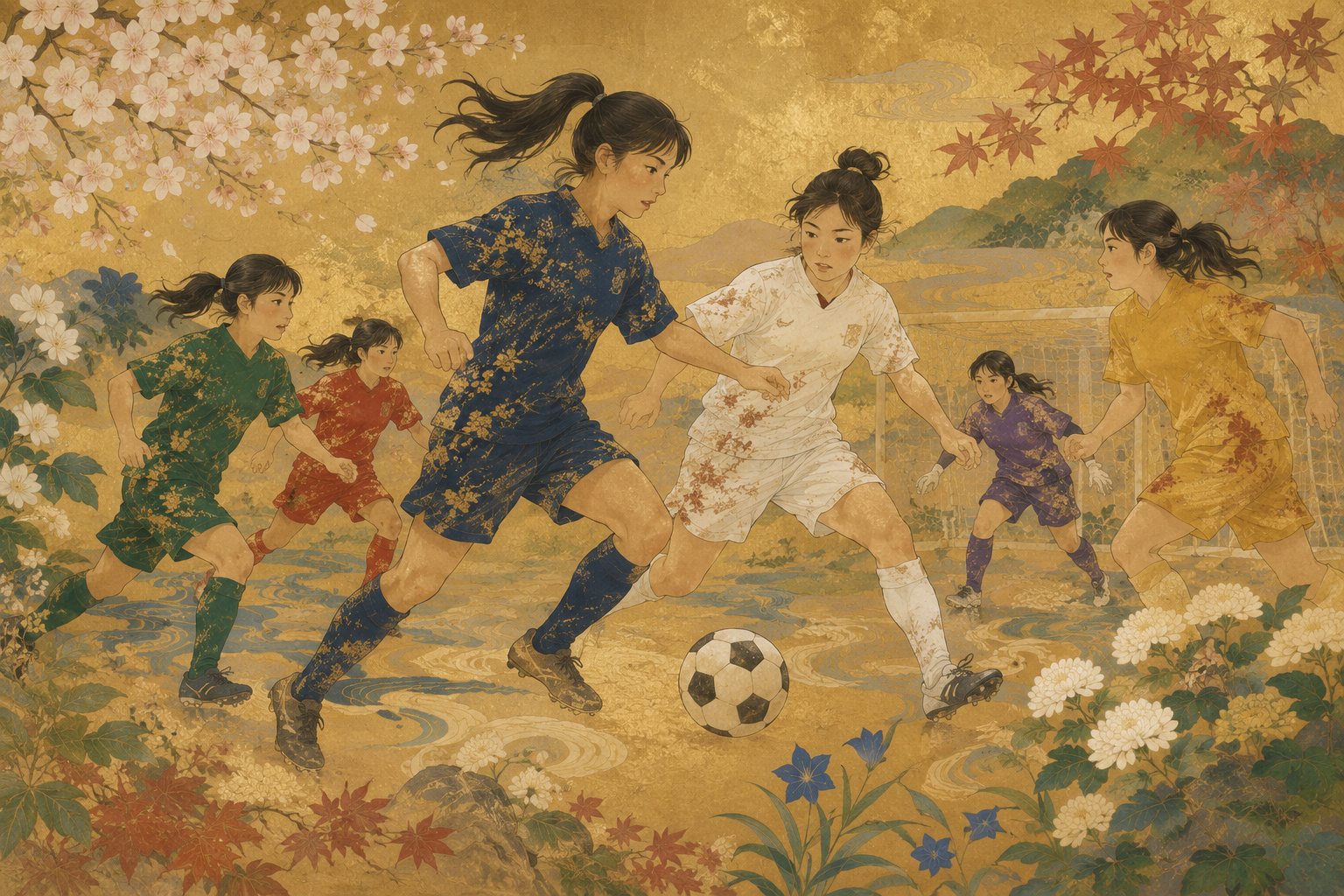
A girl can spend elementary school playing football alongside boys, then reach junior high school and discover that the next team does not exist. Her school may have no girls’ football club. The nearest girls’ U-15 side may require a long commute. Continuing with boys may remain possible, but as physical differences widen, some players want a girls’ team of their own. Japan’s HER TEAM project was created for that transition point—the age when the problem is not discovering football, but finding somewhere to keep playing it.
The problem is not that girls never start football
JFA’s own explanation begins earlier. At elementary-school age, many girls play in mixed or boys’ teams. The structural break comes around junior high school, when differences in size and physical development become more significant and more girls seek female-team environments.
JFA’s HER TEAM materials in recent years have used a stark access indicator: girls’ teams at the junior-high-school age level amount to only 2.8% of the number of boys’ teams. A 2025 JFA release also said that seven prefectures, in the U-15 context it was discussing, had no girls’ team registered at the time.
The project connects that shortage with another figure repeated by both JFA and adidas: one in five girl football players leaves the sport when she reaches 13.
That does not mean every departure is caused by team scarcity. Adolescents stop sports for many reasons—school pressure, injury, changing interests, cost or other activities. But HER TEAM is built around a narrower, fixable problem: players who want to continue should not be forced out because the local pathway disappears.
The first year drew 67 applications from 29 prefectures
HER TEAM began in 2020. In that first round, 67 prospective teams from 29 prefectures applied. JFA and adidas selected ten new teams for support; three were in municipalities that had not had a team specifically focused on junior-high-school-age girls.
By the 2022 recruitment, the cumulative program had supported 20 teams in 18 municipalities. By 2023, the cumulative figure was 30. JFA’s 2025 launch announcement said 88 teams had been created over the first five years. In September 2026, the official total rose to 102 across 37 prefectures over six completed years.
The project is deliberately aimed at new supply. Current eligibility excludes simply restarting a former team or reviving a dormant one. Existing organizations registered in another JFA category can qualify if they create and register a new women’s-category team, but the intent is to add places to play rather than count old capacity again.
The 2026 package is designed to support an organization, not only buy kits
For the 2026 recruitment cycle, eligible organizations must create a new team in FY2027 in which junior-high-school-age girls can play. The team must complete registration in JFA’s Women category between April 2027 and March 2029 and be established with continuing operation in mind. School club activities can qualify.
Support includes recruiting materials, uniforms for roughly 20 players, a football clinic with coaching support from Coerver Coaching Japan, priority invitations to JFA and adidas football activities, administrative support and online information-exchange meetings among teams. The announced support window runs from December 1, 2026 through March 31, 2029.
That matters because a new girls’ team has problems beyond kit cost. It has to recruit enough players, convince parents, find coaches and training space, register with the association, locate opponents, schedule matches and survive after the launch publicity ends.
JFA has not disclosed how many teams will be selected in the 2026 round, and the published package does not identify a cash-grant amount. Applications close September 30, with supported teams to be announced after review.
One new team does not make a competitive ecosystem
A single girls’ club can solve the first problem—somewhere to train—but create another: who does it play? If nearby girls’ teams remain scarce, league matches and friendlies can require long travel. A squad with barely enough members is vulnerable to injury, school conflicts and normal turnover.
HER TEAM CUP addresses part of that isolation. In 2024, supported teams gathered for joint training and matches at JFA’s YUME Field in Chiba and J-GREEN Sakai in Osaka. Similar east–west events continued in 2025.
Those events have sporting value, but also social value. A girl who is one of only a small number of players in her local area sees that there is a national peer group. Coaches of small new clubs can compare recruitment, training and operating problems with people facing the same challenge elsewhere.
The program’s next scaling problem is therefore density. A national count of 102 is useful; what matters for everyday competition is whether several teams exist within a realistic travel radius.
Even JFA’s registration data cannot be reduced to one “women players” number
JFA’s 2025 registration table lists 27,662 players in the Women team category. But JFA explicitly notes that team category is not the same thing as player gender. Girls registered in boys’ teams, mixed structures or other categories do not appear inside that Women-category total.
JFA’s Women’s Empowerment Principles Report 2025 counts by sex across registration categories and reports 51,194 female football players, 6.2% of the player population measured in that report.
The difference is analytically important. A girl playing on an elementary boys’ team is a female player, but she may not be visible in the Women-category team count. When she reaches adolescence and seeks a girls’ team, the shortage becomes visible as an infrastructure problem.
A team also needs women—and men—who will keep it operating
JFA’s 2025 empowerment report counted 3,992 women among registered football coaches, or 3.8%, and 15,390 women among referees, or 5.4%. Both shares were below the 6.2% female-player share reported in the same document.
HER TEAM does not require a team to be coached only by women. But the broader figures show why JFA’s new women’s-football strategy includes more than players. Sustainable teams need coaches, referees, administrators, parents, association staff and volunteers.
That is also why the 2026 HER TEAM package includes administrative support and team-to-team meetings. Creating a team is an organization-building problem as much as a sporting one.
The U-15 gap HER TEAM is trying to bridge
| Stage | Typical opportunity | Structural risk |
|---|---|---|
| Elementary / U-12 | Many girls can play in boys’ or mixed teams | Women-category registration alone understates actual female participation |
| Junior high / U-15 | More players seek girls’ teams as adolescence changes the playing environment | Too few girls’ teams; JFA/adidas cite a one-in-five age-13 dropout |
| High school / U-18 | School girls’ teams, club youth and stronger specialized pathways | A player who leaves at U-15 never reaches these opportunities |
| Senior / elite | Nadeshiko League, WE League, national teams | Elite success does not automatically create a local pathway for a 13-year-old |
Japan became world champion before it solved the local-access problem
Women’s football in Japan has made extraordinary progress at the top. The Japan Women’s Football Federation was formed in 1979. A national women’s league began in 1989. Japan appeared at the inaugural FIFA Women’s World Cup in 1991.
In 2011, Nadeshiko Japan won the Women’s World Cup in Germany, defeating the United States on penalties after a 2–2 final. The title made women’s football nationally visible in a way no grassroots campaign could have achieved alone.
The next structural leap was professionalization. JFA announced the Women Empowerment League in 2020, and the WE League opened in September 2021 as Japan’s first women’s professional football league.
Those achievements create aspiration. But aspiration is not infrastructure. A girl can watch a World Cup champion or dream of the WE League and still discover that no suitable team exists within commuting distance when she enters junior high school.
1979: Japan Women’s Football Federation established.
1989: Japan Women’s Football League begins.
1991: Japan appears in the inaugural FIFA Women’s World Cup.
2011: Nadeshiko Japan wins the FIFA Women’s World Cup.
2020: JFA and adidas launch HER TEAM; ten new teams receive first-round support.
2021: WE League begins play.
2023: HER TEAM cumulative creation count reaches 30.
2025: Five-year cumulative count reaches 88.
2026: JFA reports 102 teams in 37 prefectures and launches a strategy to double the wider women’s-football population.
A new U-16 category gave every prefecture another reason to build the base
The youth environment has also been changed by competition structure. In 2022, Japan’s National Sports Festival added a girls’ youth category at U-16. That forced every prefectural football association to think more concretely about identifying and developing teenage female players.
JFA cited the change in its 2023 HER TEAM announcement as one reason it was working with all 47 prefectural associations to improve U-15 playing environments and competitions.
The logic is straightforward. A prefecture cannot build a strong U-16 representative squad if girls have nowhere to train and compete every week at ages 13 to 15. Elite selection depends on ordinary local participation.
HER TEAM is not the only attempt to build the missing middle
JFA is also working with MS&AD Holdings on the Nadeshiko “Tsubomi” Project, another program supporting the creation and operation of girls’ clubs at junior-high-school age.
That initiative places the problem inside a broader decline in school-age football infrastructure. JFA says registered players at junior-high-school age fell 22.1% over the decade from 2014, compared with a 9.2% decline in the underlying age population; registrations through the junior-high-school sports federation fell 38.5%.
The decline affects boys as well, but girls start with far fewer teams. When one school can no longer field a side, the geographic gap can become enormous.
As Japan shifts school club activities toward regional structures, community clubs may become even more important. A child should be able to keep playing a sport even if her own school cannot sustain a team.
How many girls actually stayed in football because of the 102 teams?
That is the next question the program should eventually answer. JFA publishes the number of teams created, but the September 1 release does not say how many players are currently enrolled across the 102, how many teams survived for three or five years, or how many players would otherwise have quit.
If the policy objective is continuation, the strongest future metrics would include one- and three-year team survival, active player counts, retention into U-18 football, travel distance to training, league participation and the number of competitive fixtures available locally.
The 102-team figure is meaningful as a measure of new capacity. But JFA president Tsuneyasu Miyamoto’s own September message emphasized that creating a team is not enough; the team has to take root in the community and connect to the next generation.
Is a girls-only team “special treatment”?
One response to the shortage is to ask why girls cannot simply keep playing with boys. In many elementary-age environments, mixed football works well and should remain available.
But having one option is not the same as having a choice. HER TEAM is aimed at girls who want a girls’ team and do not have one nearby. Adding girls’ teams does not require eliminating mixed teams.
A dedicated girls’ environment can provide a stable route into girls’ competitions, a peer group of the same age and, depending on the club, coaching better adapted to health and development issues affecting female athletes. In very small communities, however, a standalone girls’ side may still be unrealistic; combined-area clubs and other flexible models may be necessary.
JFA’s 2031 “double” target starts with fixing the point where the line breaks
In August 2026, JFA made expansion of women’s football one of the central goals of its 2026–31 growth strategy. The women’s strategy aims to double the broader women’s-football population, alongside ambitions to win major international competitions and raise the sport’s recommendation/brand measures.
The “population” target is deliberately wider than registered players. It includes people who play, support the game as coaches and referees, and watch or follow it.
HER TEAM fixes only one segment of that system. That is precisely why it matters. A pipeline is constrained by its narrowest point.
The real test of the 2026 recruitment will come years later. Are the new teams still operating? Did their players move on to U-18 football? Did second and third teams appear nearby so matches no longer require exceptional travel?
A 13-year-old does not experience women’s-football policy as a strategy diagram. She experiences it as a simple question on a weekday afternoon: is there a team I can go to practice with next week?
The value of the 102 teams will ultimately be measured by how many girls can answer yes.
Sources & Reporting Notes
- Japan Football Association, HER TEAM 2026 recruitment — Primary September 1, 2026 release: 102 teams in 37 prefectures, one-in-five dropout at age 13, support package and application rules.
- adidas Japan, HER TEAM PROJECT — Project statement on the U-15 team-access gap and the one-in-five age-13 dropout figure.
- Japan Football Association, Women’s Overall Strategy — August 2026 strategy to double the broader women’s-football population and expand participation, support roles, audiences and opportunity.
- JFA Growth Strategy 2026–2031 — Official KGI/KSF framework for women’s football.
- JFA Women’s Empowerment Principles Report 2025 — Female player, coach and referee participation figures; says HER TEAM supported 88 teams over its first five years.
- JFA player-registration data — 2025 category registrations, including 27,662 players registered in the Women category, with category definitions.
- JFA, HER TEAM 2025 recruitment — Earlier cumulative count of 88 teams and JFA’s published U-15 access indicators.
- JFA, HER TEAM 2023 recruitment — Explains the transition from mixed elementary-age football to a shortage of girls’ U-15 teams.
- JFA, HER TEAM 2022 recruitment — Early program scale: support for 20 teams across 18 municipalities.
- JFA, HER TEAM 2021 recruitment — First-year applications from 67 teams in 29 prefectures and support for 10 new teams.
- JFA, Why adidas launched HER TEAM — 2020 English JFA interview on teenage girls’ sports-continuation barriers.
- JFA Women’s Football Day 2024 — HER TEAM CUP as a shared training, match and peer-connection event.
- JFA Women’s Football Day 2025 — Continuation of HER TEAM CUP in Osaka and Chiba.
- JFA, Nadeshiko Japan World Cup/Olympic history — History from early national-team competition through the 1989 league and 1991 World Cup.
- JFA, 2011 Germany — Official history of Japan’s 2011 Women’s World Cup title.
- WE League, launch of Japan’s first women’s professional football league — League announced in 2020 and launched in September 2021.
- JFA–MS&AD Nadeshiko Tsubomi Project — A complementary initiative addressing the shortage and sustainability of U-15 girls’ clubs.
This article was checked against public material available by 2:24 AM JST on September 3, 2026. The cumulative 102-team / 37-prefecture count, support package, eligibility rules and one-in-five age-13 dropout figure follow JFA and adidas primary materials. The phrase “102 teams created” is treated as a cumulative creation count; the September release does not publish a current roster, player total or survival rate for all 102, so the article does not claim every supported team remains active. The 2.8% U-15 team ratio and seven-prefecture gap are identified as JFA’s 2025 published context rather than silently converted into 2026 data. JFA’s 27,662 Women-category player registrations and the WEP report’s 51,194 female players use different counting systems and are explained separately. The WE League was announced in 2020 and began competition in September 2021, following the league’s official history.
Image rights: © 2026 Japan.co.jp. AI-assisted editorial illustration. Reproduction or reuse without permission is prohibited. For licensing, see the contact page.