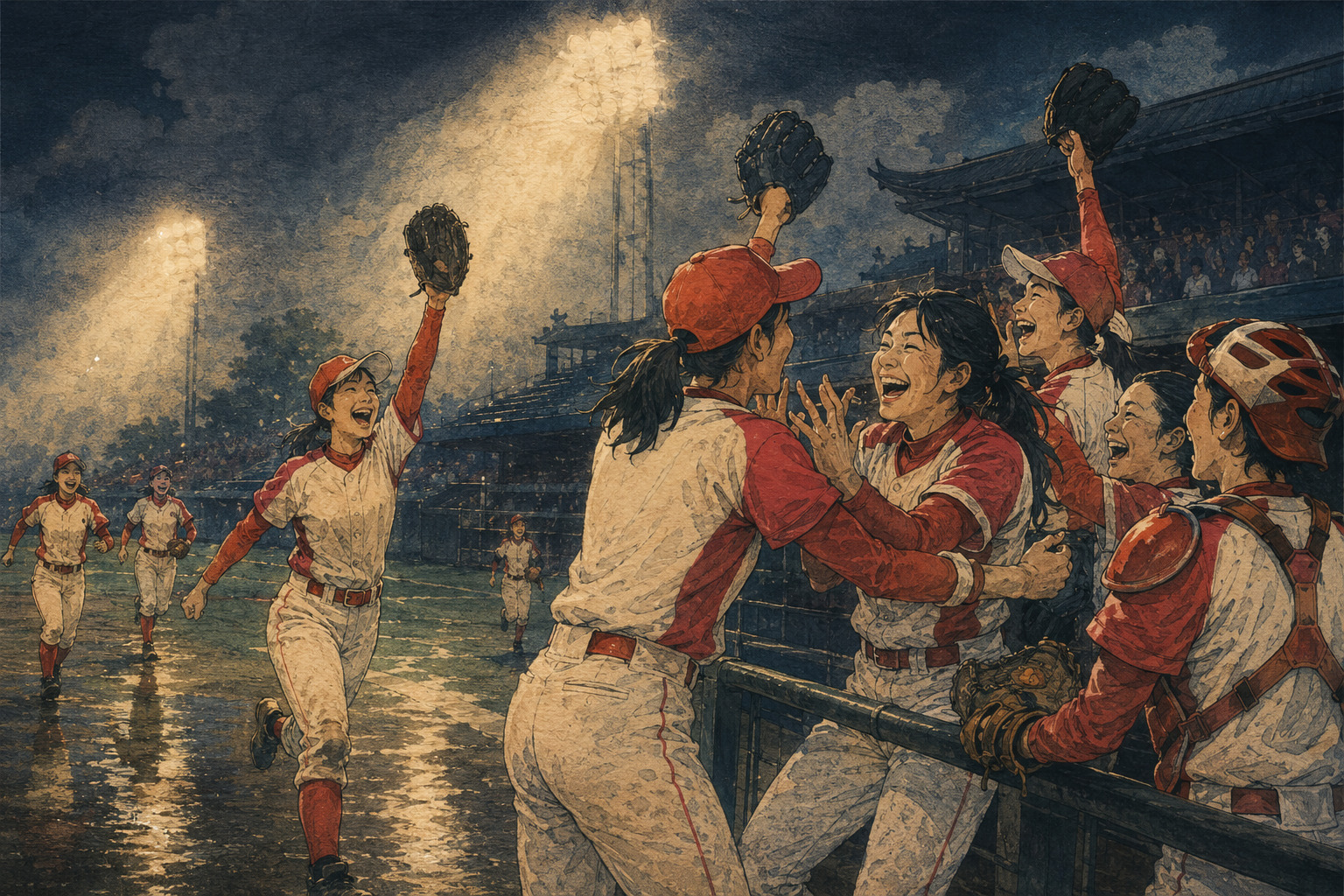
For ten and a half hours, Japan's first opponent was uncertainty. Rain in Tainan kept the team in its hotel on August 25. Officials first said there would be no game that day, then summoned the players to face the Philippines late at night. The first pitch finally came at 10 p.m. local time.
The tournament then lurched from waiting to overload. Japan began five games between 11 p.m. JST on August 25 and 6 p.m. on August 27—a 43-hour span—with doubleheaders on both full days. Manager Risa Nakashima needed to protect arms, rebuild routines and keep a newly assembled team alert when sleep and meal schedules had been stripped of predictability.
Japan responded with five wins: 3-0 over the Philippines, 23-0 over Great Britain, 4-0 over Venezuela, 13-0 over Cuba and 11-2 over Chinese Taipei. The official scores add to 54 runs for and two against. The Cuba victory guaranteed a place in the 2027 Finals; the last win preserved a perfect record and first place in the Tainan group.
A small opening win carried the largest lesson
Twenty-three runs against Great Britain supplied the viral number. The three against the Philippines offered the better scouting report on Japan.
Ruri Adachi opened with a bunt single, stole second, moved to third on a wild pitch and scored on Yaya Kojima's groundout. In the second, Harue Yoshii and Kokoa Azuma created the chance and Adachi executed a squeeze bunt. In the third, co-captain Nanako Hanabusa doubled, a sacrifice moved her over and fellow captain Haruna Tadano drove her home with another double.
None of the three runs required an opponent to surrender a home run. Japan converted contact, speed and outs into movement. That matters in a Finals where elite pitching can erase the middle of a lineup. Miyu Shimizu made the margin feel larger: she retired every hitter she faced across three innings and struck out eight consecutive batters before Michi Takemura worked a perfect fourth. The lighting failure prevented the fifth from beginning, but the four completed innings made the game official.
The next day brought a different kind of correction. Japan loaded the bases with no outs against Great Britain and failed to score in the first. In the second, Sakura Okamoto's squeeze opened a 12-run inning. Azuma, promoted from ninth to leadoff, finished with six runs batted in. Minami Obara, Kana Onodera and Mika Tai combined to keep every Great Britain hitter off base. The valuable sequence was not simply 23 runs; it was the transition from a wasted first inning to an organized second.
| Start (JST) | Result | What Japan demonstrated | Context |
|---|---|---|---|
| Aug. 25, 11 p.m. | Japan 3–0 Philippines | Shimizu retired all nine hitters; speed, bunts and Tadano's double produced the runs | 10½-hour delay; floodlight failure ended it after four |
| Aug. 26, 1 p.m. | Great Britain 0–23 Japan | Azuma drove in six; three pitchers allowed no baserunner | Four innings under the 15-run rule |
| Aug. 26, 5 p.m. | Japan 4–0 Venezuela | Sawa Kashizaki and Takemura shut out the strongest group rival; two squeeze bunts broke the game | Japan had needed a 5–4 walk-off to win the 2023 meeting |
| Aug. 27, 10 a.m. | Cuba 0–13 Japan | Azuma had four RBI, Miu Shiraishi three; Shimizu allowed one hit in four innings | Clinched a top-two finish and Finals berth |
| Aug. 27, 6 p.m. | Japan 11–2 Chinese Taipei | Three two-out hits opened the scoring; Akari Hoshikawa went 3-for-3 with three RBI | Japan committed three errors and allowed its only runs |
The four-run game is the one Rockford should study
Venezuela arrived as the fifth-ranked program in the world and as the opponent most likely to test Japan in Tainan. In Hiroshima three years earlier, Venezuela had forced the defending champions into a 5-4 walk-off. In the rematch, right-hander Yenny Tovar attacked with velocity in the mid-to-upper 120-kilometer range and two distinct sliders. Japan struck out five times in the first two innings.
Japan changed the geometry instead of waiting for a mistake over the plate. Yoshii singled in the third, stole second and reached third on a ground ball. Adachi squeezed her home. Tovar's hurried throw then allowed Adachi to race to third, and Eri Sakaguchi laid down a second squeeze. Two more runs followed in the fourth.
Kashizaki, making her World Cup debut, disrupted timing and survived traffic; Takemura closed the shutout. It was the least gaudy score after the opener and the most useful template for the Finals: enough pitching to stay level, enough speed to create pressure, and enough precision to score against a pitcher who was not issuing easy walks.
Qualification came with a correction—and a warning
Nakashima had criticized Japan's first-inning offense. Against Cuba, the response came on the first pitch. Azuma doubled to left, Okamoto moved her to third and 2024 World Cup MVP Miu Shiraishi delivered a sacrifice fly. A ten-run second inning removed the suspense. Azuma finished with four RBI, Shiraishi with three; Shimizu allowed one hit in four scoreless innings, and Obara completed the 13-0 qualification win.
The final against Chinese Taipei began even better. With two outs and nobody on, Sakaguchi singled and stole second. Hanabusa won a long at-bat and doubled her home. Hoshikawa and Tadano followed with run-scoring hits. Nakashima called them “three meaningful runs.” Four more followed in the second and another four in the fourth. Hoshikawa had three hits and three RBI; Adachi tripled in a run; Tai struck out all three hitters in the fifth.
But Japan made three errors and surrendered two runs in the third. Those were the only runs it allowed all week. Against an 11-run cushion, the damage was statistical. Against the United States or Canada next July, one extended inning can change a championship.
Tadano said as much in the official postgame report, noting that one error can decide a Finals game and that players must return to their clubs ready to prepare individually. Nakashima praised the team's concentration, then delivered the more important verdict: Japan's national teams often come together late, she said, but waiting that long next year would leave this one behind. Cohesion must exist at camp speed, not arrive after several tournament games.
The dynasty began with two silver medals
Calling Japan the inevitable power of women's baseball erases the formative part of its history. The Women's Baseball World Cup began in Edmonton in 2004. The United States won the inaugural final 2-0 over Japan. Japan finished second again in 2006.
The break came at home in Matsuyama in 2008. Japan won its first world championship, then retained it in 2010, 2012, 2014, 2016 and 2018. After the pandemic disrupted the calendar, the team won again in Thunder Bay in 2024: seven titles in seven consecutive editions.
2004 and 2006 — Japan finishes runner-up in the first two World Cups.
2008 — The first title, won in Matsuyama, starts the championship run.
2010–2018 — Five more titles carry Japan to six straight.
2024 — The United States ends Japan's 39-game World Cup winning streak, 4-3 in an extra-inning super-round game. Japan answers by beating the U.S. 11-6 in the final.
2026 — A 5-0 group stage earns the right to defend the title in Rockford.
The 2024 tournament is the honest measure of the modern field. Canada took Japan to an extra-inning 7-6 game. The U.S. beat Japan once. American pitchers were reaching and exceeding 130 kilometers per hour, and power was no longer exceptional across the competition. Nakashima's own review called for Japanese hitters with more over-the-fence power and Japanese pitchers with greater velocity.
Japan entered Tainan ranked No. 1, ahead of a group that included No. 5 Venezuela and No. 6 Chinese Taipei. Ranking describes accumulated results; it does not preserve a lead in real time. The dynasty has lasted because Japan has combined its old skills—contact, running, situational defense—with new demands, not because the old formula remained sufficient.
One national team, many domestic homes
The 20-player Tainan roster reveals how Japan sustains that renewal. Players came from Yomiuri Giants and Hanshin Tigers Women, Saitama Seibu Lions Ladies, ZENKO BEAMS, Agekke, Kyushu Honeys, Tokai NEXUS, Sunblaze and other clubs. Catcher Rika Okada of the International Pacific University was the only university-affiliated player.
They do not train together through a domestic season. They compete in different organizations, then compress signs, pitching plans, defensive language and leadership into national-team camps. After several senior players retired following 2024, the staff brought 42 candidates to a final selection camp in June 2026. Hanabusa, a catcher, and Tadano, an infielder, were appointed co-captains to connect a roster with both returning champions and first-time World Cup players.
The high-school base below them is visibly larger than it was when the title streak began. Japan's national high-school girls' hardball championship started in 1997. Since 2021, its final has been played at Koshien Stadium, the symbolic center of Japanese high-school baseball. The 30th championship in 2026 drew a record 70 teams.
That growth does not automatically create an international champion. It does create more innings, more coaching relationships and more places for a girl to continue playing rather than exit the sport. The national team is the narrowest point of a much wider system. Its competitive edge comes partly from bringing different domestic baseball cultures into one dugout, then agreeing on the same detail at speed.
- Continuity: Shimizu, Hanabusa, Tadano, Hoshikawa and Tai carried Finals experience.
- Turnover: Azuma became an offensive center in her first World Cup appearance.
- Depth: Japan used all six pitchers across a late opener and consecutive doubleheaders.
- Distributed development: University, company, independent club and NPB-affiliated women's teams all supplied players.
In Rockford, the run differential returns to zero
The Finals are scheduled for July 19–25, 2027, in Rockford, Illinois. Japan, Venezuela and Chinese Taipei will join the United States, Australia and Canada, which qualified from the first group in Rockford in July 2026. Every finalist has at least a year to change.
So does Japan. The 20 players who qualified the country are not guaranteed the 20 places in the Finals. They returned home on August 28 to rejoin their clubs. Health, domestic form, tactical needs and the development of other candidates will shape the next selection. The late withdrawal of Yuzuha Nakamura for a condition-related reason, and Okamoto's replacement call, was a reminder that tournament rosters remain provisional until the end. No more specific diagnosis was officially given and none should be inferred.
Three questions should follow Japan through the next year. Can the staff add velocity and power without losing the running and situational precision that decided the Venezuela game? Can a rebuilt roster reach full competitive intensity at the beginning of camp? Can the defense eliminate the extra outs that Chinese Taipei received?
Detailed competition procedures and Japan's 2027 roster had not been announced by the reporting cutoff. What is settled is narrower: Japan owns one of six places, not an eighth title.
There is a temptation to make 54-2 the entire story. The team refused that temptation before everyone else. It discussed a rigid first inning after scoring 23, three errors after scoring 11, and a slow-forming identity after five consecutive victories. That appetite for correction is less visible than a run differential. It is also the part most likely to survive the trip to Rockford.
- Samurai Japan — Tainan event overview, standings, schedule and roster
- Samurai Japan — Final 42-player selection camp and construction of the new national team
- Samurai Japan — Official practice, Shimizu's opening assignment and qualification terms
- Samurai Japan — Philippines game report
- Samurai Japan — Great Britain game report
- Samurai Japan — Venezuela game report
- Samurai Japan — Cuba game and qualification report
- Samurai Japan — Chinese Taipei game and post-tournament comments
- WBSC — 2026/27 two-stage format and group qualification
- WBSC — Rockford host announcement and 2027 Finals dates
- WBSC — United States, Australia and Canada qualify from Rockford
- WBSC — Japan's 11-6 victory over the United States in the 2024 final
- Samurai Japan — 2024 review, the end of the 39-game streak and rising international standards
- Samurai Japan — National-team history, the 2004 World Cup launch and 2008 first title
- Women's Baseball Federation of Japan — History of the national high-school competitions
- Women's Baseball Federation of Japan — Record 70 teams in the 2026 high-school championship