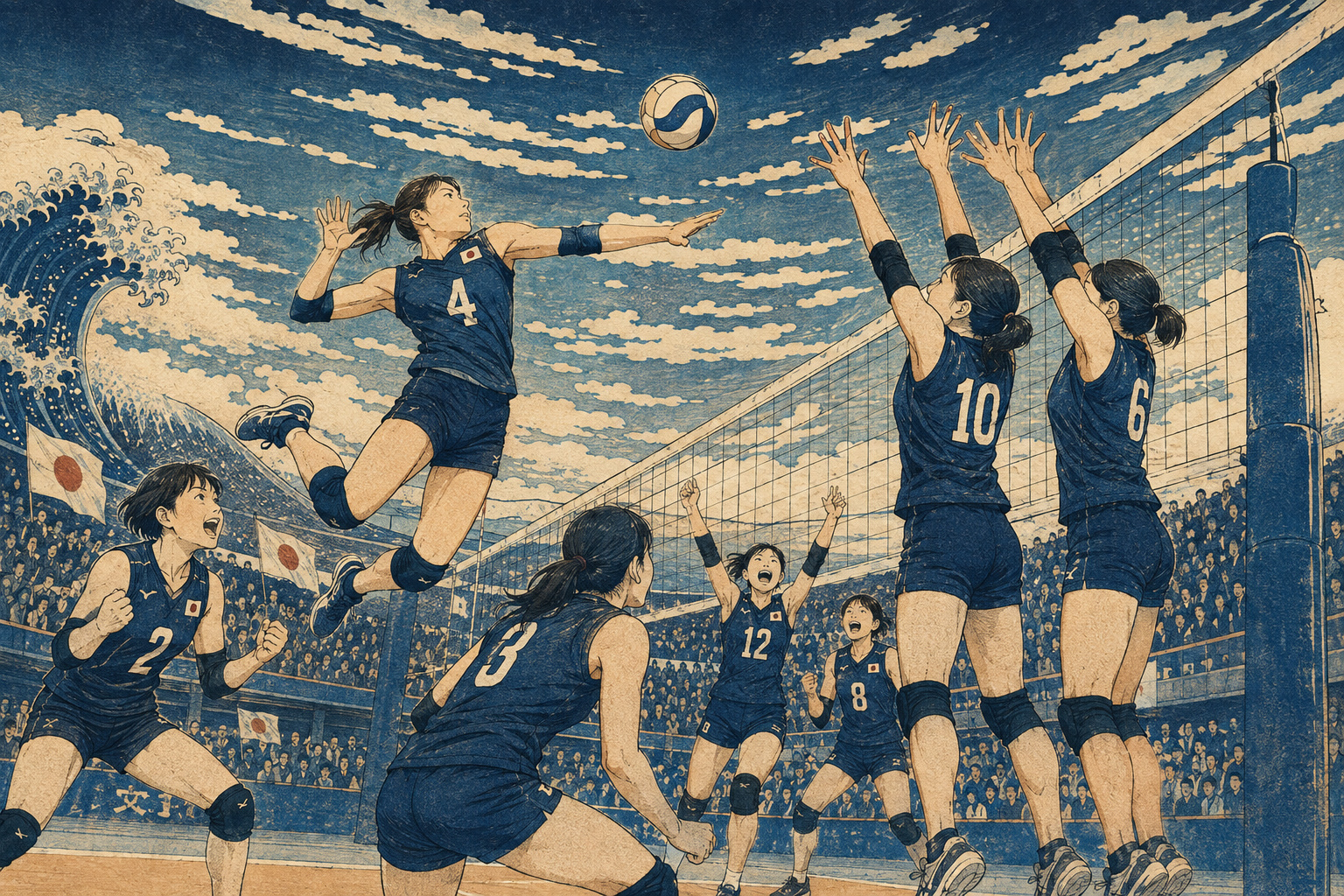
The bronze medal did two jobs at once. It secured Japan’s place in the 2027 FIVB Volleyball Women’s World Cup, and it made it impossible to ignore what the team had failed to secure one day earlier. Japan beat Iran 3–0 in Tianjin on August 30, taking the third and final Asian berth for the next global championship. But Thailand’s semifinal victory over Japan had already removed the continental title—and Asia’s direct Los Angeles 2028 Olympic quota—from reach.
The apology after qualification
When head coach Ferhat Akbas and Mayu Ishikawa faced reporters after returning to Japan, neither treated the bronze medal as a convenient ending. Akbas thanked supporters and apologized for the result. He said the failure to win the championship meant Japan had missed the “shortest road” to LA28. Ishikawa spoke of disappointment, responsibility and the need to claim one of the remaining Olympic opportunities with the team’s own work.
That response was not false modesty. Japan had entered Tianjin with two overlapping objectives: win Asia and secure the Olympic quota that came with the title; at minimum, finish high enough to reach the 2027 world event. It accomplished the second and missed the first.
Yukiko Wada’s reaction after the bronze match captured the other side. She described Iran as a match leading to the next world competition and said the team had managed to finish it in straight sets. The tears that followed belonged to a team relieved to preserve one route while still feeling the loss of the more direct one.
Five sweeps, one match that controlled the bracket
Japan’s overall record looks dominant. It opened with a 3–0 victory over Hong Kong China, survived a 33–31 first set before sweeping Korea, then beat Vietnam in straight sets to complete pool play unbeaten. Chinese Taipei fell 3–0 in the quarterfinals. Iran was also swept in the bronze-medal match.
The only opponent to take a set from Japan was Thailand. The defending champions took the semifinal 25–21, 25–20, 20–25, 25–20. Japan extended the match in the third set but could not force a decider. In a round-robin table, five sweeps might compensate for one defeat. In a knockout semifinal, they could not.
| Date and round | Opponent | Result | Set scores | Consequence |
|---|---|---|---|---|
| Aug. 21 · Pool | Hong Kong China | 3–0 | 25–9, 25–15, 25–12 | Comfortable opening win |
| Aug. 23 · Pool | Korea | 3–0 | 33–31, 25–19, 25–20 | Won a long first-set test |
| Aug. 25 · Pool | Vietnam | 3–0 | 25–23, 25–17, 25–21 | Finished pool play 3–0 |
| Aug. 27 · Quarterfinal | Chinese Taipei | 3–0 | 25–14, 25–21, 25–13 | Advanced to semifinal |
| Aug. 29 · Semifinal | Thailand | 1–3 | 21–25, 20–25, 25–20, 20–25 | Lost title and direct LA28 route |
| Aug. 30 · Bronze match | Iran | 3–0 | 25–21, 25–16, 26–24 | Won bronze and World Cup berth |
The derived totals—five wins, one loss and a 16–3 set record—are useful descriptions of consistency. They are not a substitute for tournament position. The semifinal was the highest-leverage match Japan played, and it ended with Thailand advancing.
Thailand turned the opportunity into history
Thailand then defeated host China in five sets, recovering from a 2–1 deficit to win 99–98 in total points. The title was Thailand’s fourth in Asia and delivered the women’s program its first Olympic berth.
For Japan, that final sharpened the semifinal result. The team that had blocked its path did not merely survive the next round; it completed the entire qualification task. Thailand, China and Japan all reached the 2027 World Cup, but only Thailand left Tianjin already assured of LA28.
The result also challenged the habit of describing Asian women’s volleyball through a narrow Japan–China frame. Thailand arrived as defending champion and proved that its 2009, 2013 and 2023 titles were not historical exceptions. Iran, meanwhile, reached the semifinals for the first time and finished fourth—its best continental result.
How third place became a global berth
The 2026 continental championships are the first formal qualification stage of the LA28 cycle. Each of the five continental champions earns an Olympic quota. Separately, the three highest-placed eligible teams in each continental championship qualify for the 2027 World Cup. Those results allocate 15 of the 32 places in each global tournament.
In Asia, Thailand and China secured the first two World Cup positions by reaching the final. The bronze-medal match therefore carried the last available berth. Japan’s victory over Iran was not ceremonial placement; it protected a place in the event that will provide the next major Olympic qualification opportunity.
The word eligible matters because teams can hold places through other routes, including host or champion status. Allocation rules must account for teams already qualified. In Tianjin, the FIVB formally confirmed Thailand, China and Japan as the three AVC representatives produced by the championship.
The World Cup name now means something different
For generations of Japanese fans, the Volleyball World Cup meant a stand-alone tournament closely associated with Japan. The women’s event began in 1973 and, from 1977 through the 2019 edition, was staged exclusively in Japan. It became part of the rhythm of the domestic sports calendar and, in several cycles, an Olympic qualifier.
The event awaiting Japan in 2027 is not a simple revival of that competition. The FIVB removed the old stand-alone World Cup during its calendar reform. It expanded the World Championship to 32 teams, moved it to a biennial schedule beginning in 2025, and then approved a new name: from 2027, the flagship Volleyball World Championship will be called the FIVB Volleyball World Cup.
The women’s 2027 tournament will be co-hosted by the United States and Canada. The final rounds are scheduled for Honda Center and OCVIBE in Anaheim, California, with additional pool-stage and round-of-16 cities to be confirmed. The format contains 32 teams, 64 matches and 17 days of competition.
The name change in three lines
- Old World Cup: a separate event, strongly identified with Japan, last played in 2019.
- World Championship: the FIVB’s flagship global title event, expanded to 32 teams and staged every two years from 2025.
- 2027 World Cup: the World Championship under its new name—not the old tournament resumed unchanged.
The Olympic route Japan has left
Under the announced LA28 structure, the United States qualifies as host. The five 2026 continental champions take the next five places. At the 2027 World Cup, the three highest-finishing teams not already qualified will take Olympic berths. The final three positions are scheduled to go to the highest-ranked unqualified teams after the preliminary phase of the 2028 Volleyball Nations League.
Japan has therefore moved from the shortest route to the more crowded routes. A top finish in 2027 could settle the matter directly. Failure there would make the ranking window in 2028 decisive, with every ranking match and every rival’s movement affecting the calculation.
World Cup qualification is valuable because it guarantees Japan access to the next stage. It is not an Olympic place in waiting. To turn access into qualification, Japan must finish ahead of enough elite teams that do not already hold quotas—a moving target determined by results across continents and at the world event itself.
A country that once defined the standard
Japan’s women carry an unusual historical burden because qualification has rarely been the country’s preferred measure of success. Japan finished second at the 1960 World Championship, won the world title in 1962, 1967 and 1974, and won the inaugural Olympic women’s volleyball gold medal at Tokyo 1964. Another Olympic gold followed in Montreal in 1976.
Those achievements grew from a distinctive postwar system of company teams, concentrated coaching and national attention. They also came with a training culture whose severity should not be converted into uncomplicated nostalgia. The history matters not as a manual to reproduce, but because it established the expectation that Japan could shape the sport rather than merely participate in it.
Later generations produced different forms of renewal. Japan won bronze at the 2010 World Championship. At London 2012, it swept Korea in the bronze-medal match to earn its first Olympic medal since Los Angeles 1984, ending a 28-year gap.
The current team cannot borrow points from those eras. It can only inherit the question they created: what does a modern Japanese advantage look like when every major program has video, analytics, international club experience and professionalized physical preparation?
The bronze match showed recovery, not completion
Japan controlled the main scoring categories against Iran: 50–41 in attack, 7–4 in blocks and 4–3 in aces. Wada scored a match-high 19 points, Shimamura added 14, and Wada was later named the tournament’s Best Opposite. Japan recovered from a 15–18 deficit in the third set and closed the match 26–24 through consecutive points by Ishikawa.
That performance deserves weight. The team had less than a full day to process the semifinal defeat, reset emotionally and play a match that determined its world-event future. It did not drift into a fourth set. It completed the task in three.
But the bronze match cannot answer the semifinal questions by itself. Akbas’ comments emphasized trust, continued work and match management. Ishikawa spoke about the need for the team to examine what had surfaced in its play rather than look away from it. Those are not tactical diagnoses in enough detail to prove a solution. They are evidence that the team did not confuse qualification with completion.
Asia is becoming a wider competitive system
Japan entered Tianjin as a five-time Asian champion. China carried 13 titles. Yet the 2026 bracket showed how much more distributed the competition has become. Thailand defended its championship. Iran reached unprecedented territory. Vietnam and Korea arrived with recent regional progress, while Chinese Taipei again proved capable of pressuring higher-ranked teams.
The FIVB said eight of the 12 participating federations had received direct technical assistance through its Volleyball Empowerment program, including coaching, equipment and knowledge transfer. Funding does not mechanically produce a medal, and the support figures cannot explain individual matches. They do show that more federations are building structured high-performance programs.
For Japan, the consequence is clear: reputation no longer provides a quiet early path to the decisive rounds. Different opponents present different problems—height, tempo, serving risk, defensive persistence and emotional freedom. A team built only to solve one traditional rival will be vulnerable to the rest of the continent.
The immediate test comes at home
The national-team season continues almost immediately. Japan begins a training camp in Satsumasendai, Kagoshima Prefecture, on September 4 before the Aichi-Nagoya Asian Games women’s tournament begins September 16 in Komaki and Okazaki.
The Asian Games will not award FIVB world-ranking points, according to the JVA. It still matters. Japan is the host country; Akbas has set a medal target; and the tournament offers a near-term laboratory for improved match management. The coach has also indicated that veteran players may receive rest, making roster depth and workload management part of the evaluation.
Japan.co.jp analysis: four tests before 2027
- Closing the high-leverage match: Can Japan convert late-set adjustments when a title or quota depends on one knockout result?
- Depth with continuity: Can overseas-based players, domestic-club players, veterans and emerging athletes form more than a sequence of temporary lineups?
- Measurable identity: Can “Japanese connection” be translated into repeatable serving, blocking, transition and attack-efficiency advantages?
- Planning backward from the quota: Can the program treat the 2027 World Cup not as the destination but as the next Olympic qualifying examination?
A ticket is permission to face the next test
Japan left Tianjin with something concrete: bronze, Asia’s third World Cup berth and a guaranteed place on the global stage in the United States and Canada. It also left without the continental title and without the direct Olympic place it had made the season’s priority.
Those outcomes do not cancel one another. The five sweeps demonstrate consistency. The Thailand loss identifies the match Japan could not solve. The Iran victory demonstrates recovery under consequence. Together they are a more useful record than either celebration or disappointment alone.
The 2027 ticket is not proof that Japan has returned to the summit. It is permission to take the next examination. The question now is whether the team can arrive in North America ready not only to remember Japan’s world-title history, but to produce a result that changes its Olympic future.
Sources and documentation
- Japan Volleyball Association, Japan defeats Iran and qualifies for the 2027 World Cup (August 30, 2026; Japanese)
- Japan Volleyball Association, post-Asian Championship press conference (September 1, 2026; Japanese)
- Japan Volleyball Association, 2026 Women’s Asian Championship overview (Japanese)
- Japan Volleyball Association, results and final standings (Japanese)
- FIVB, Continental Championships set the course for LA28 and World Cup qualification
- FIVB, Thailand retains the Asian title and secures its first Olympic berth
- FIVB, Asian Championship preview and development context
- FIVB, The Volleyball World Cup takes the sport into a new era (2027 renaming)
- FIVB, USA and Canada to co-host the women’s 2027 edition
- FIVB, 2025–2028 calendar and LA28 qualification structure
- FIVB, history of the former Volleyball World Cup
- Japan Volleyball Association archive, women’s World Championship records (Japanese)
- Japan Volleyball Association archive, women’s Olympic teams and finishes (Japanese)
- Japan Volleyball Association archive, London 2012 women’s tournament (Japanese)
This report checked materials published by 3:30 a.m. JST on September 2, 2026. Japanese JVA primary sources were prioritized for names, match terminology, scorelines and comments. The 5–1 record and 16–3 set differential were calculated by Japan.co.jp from the JVA’s six official match results. The article distinguishes World Cup qualification from Olympic qualification and the former stand-alone World Cup from the World Championship that will adopt the World Cup name in 2027.
Image rights: © 2026 Japan.co.jp. This is an AI-assisted editorial illustration. Unauthorized republication or reuse is prohibited. For licensing, use the contact page.