- A new chemistry enters an old industrial problem
- The middle link between a battery cell and a working power plant
- Semi-solid is not another name for solid-state
- The NIO milestone—and why cars are not power stations
- The safety case will be won at system level
- Japan’s battery strategy has moved beyond the cell
- The three markets require three different value propositions
- Wintest’s diversification is a business test, too
- What evidence would make this a real breakthrough?
A new chemistry enters an old industrial problem
The most consequential battery in Japan may not be the one that travels farthest in an electric car. It may be the one that holds a factory’s electricity costs in check, keeps emergency communications alive during a blackout, or makes renewable energy useful after sunset. Those jobs reward reliability, safety engineering and the economics of thousands of charge-discharge cycles—not simply impressive laboratory energy density.
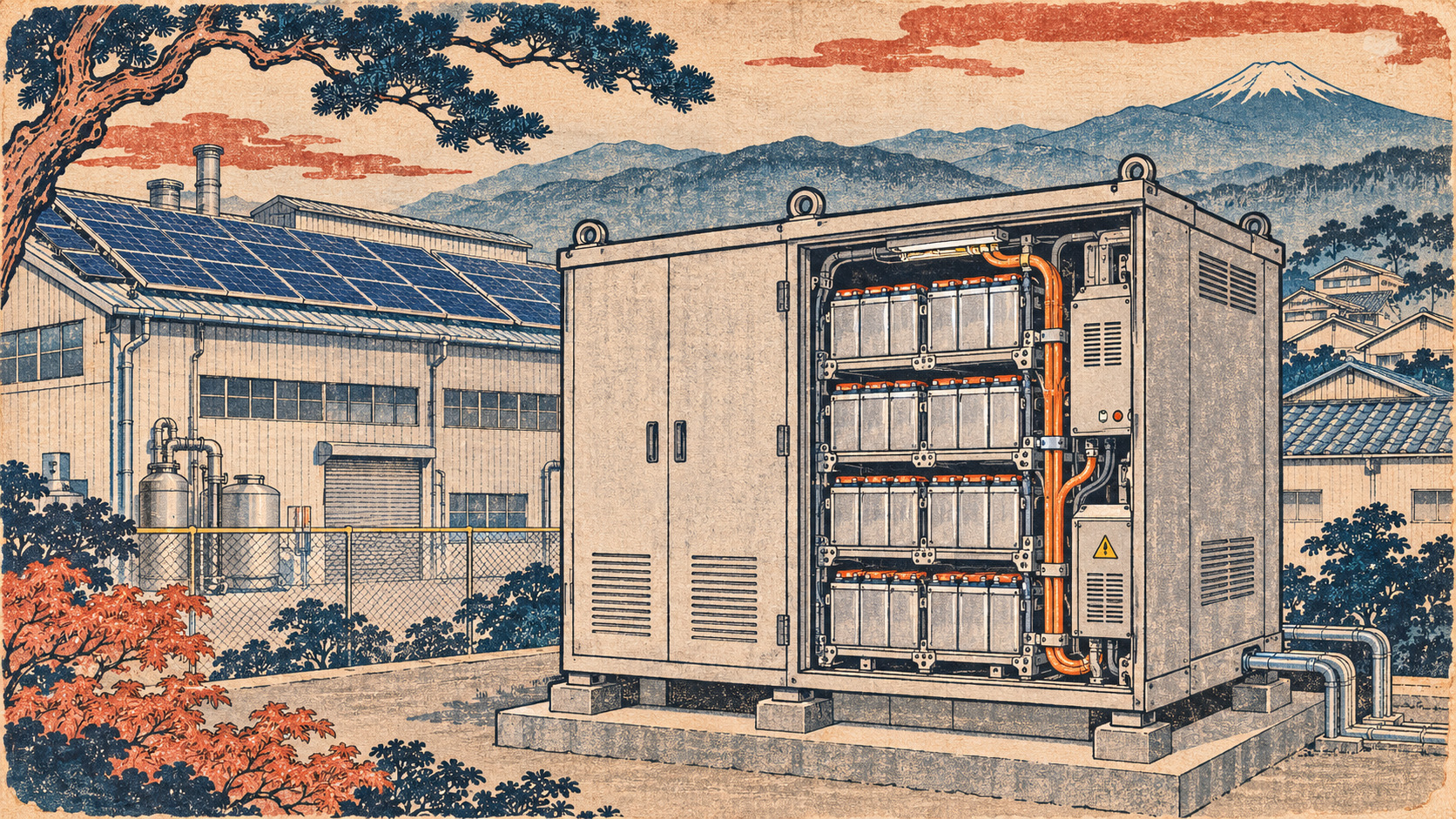
On November 19, 2026, Yokohama-based semiconductor-test equipment manufacturer Wintest announced plans to develop, assemble, inspect and sell stationary energy-storage systems built around semi-solid lithium battery cells supplied by Chinese developer WeLion, or Beijing WeLion New Energy Technology. The intended manufacturing hub is Wintest’s existing Osaka facility. Proposed end products span home storage, industrial battery cabinets and containerized systems for the electricity grid.
The headline may sound like a battery manufacturing alliance. The underlying agreement tells a more precise story: Wintest signed a basic transaction contract on November 11 with A Holdings, WeLion’s exclusive distributor in Japan. It is an industrial integration and sales framework, not a disclosed order for a fixed number of cells or a proven new domestic cell factory.
The middle link between a battery cell and a working power plant
Three businesses occupy different positions in the announced chain. WeLion develops and makes the cells. A Holdings acts as the Japanese distribution intermediary. Wintest expects to translate those components into customer-specific storage equipment, with assembly, electrical inspection, shipment verification and—in certain circumstances—direct sales to customers it recruits.
This is a meaningful distinction because customers do not purchase a chemistry label; they buy a system. A stationary storage installation needs a battery-management system, power conversion, protection devices, cooling, software controls, communications and a service plan. A cell’s nominal capacity says little about how gracefully the completed installation handles a grid disturbance or a fault at one connection.
Wintest proposes to build on skills gained in semiconductor-test equipment, including precise assembly, electrical characterization and quality control. Whether those strengths translate into durable energy-storage products will depend on system design, validated protection functions, supplier oversight and long-term support. The three product illustrations in its corporate release are concepts for different markets; they are not evidence that certified commercial units have shipped.
Semi-solid is not another name for solid-state
Every lithium-ion battery needs a path for lithium ions to move between positive and negative electrodes. In conventional designs that transport medium is largely liquid. Semi-solid designs reduce the liquid content by combining solid material with residual liquid or gel-like components. Fully solid-state batteries aim for a different construction, generally without conventional liquid electrolyte. The boundaries between terms can vary by manufacturer and should not be flattened into one marketing category.
According to Wintest’s filing, the WeLion product family under discussion contains at least 90% solid components in its electrolyte, based on the manufacturer’s specifications. That statement does not include a publicly described independent measurement method, nor does it establish precisely how every planned stationary product will perform.
Less liquid could reduce certain leakage or flammable-electrolyte risks. But it does not eliminate heat from electrical faults, the possibility of internal short circuits, or the need for cell-level and system-level abuse testing. The word semi-solid is not a certification. Fire protection, current interruption, thermal management and verified operating limits remain essential.
The NIO milestone—and why cars are not power stations
WeLion gained international attention through its relationship with Chinese electric-car maker NIO. Wintest’s release cites a 150-kWh battery pack used in a NIO ET7, along with an advertised energy-density figure and an over-1,000-kilometer driving demonstration. Those figures are company-presented examples from automotive use, not independent evidence that a stationary battery built in Osaka will meet a particular lifetime, price or safety benchmark.
In a car, energy stored per kilogram helps determine driving range. Stationary equipment does not carry its own weight around the road every day. Instead, developers care intensely about installed cost, round-trip efficiency, heat management, cycles, degradation, maintenance and the cost of meeting local fire and grid-connection requirements.
That is why a battery that excels as a premium EV pack may not outperform lithium iron phosphate, or LFP, in a warehouse or at a solar farm. The relevant comparison is not a headline range statistic but a complete, warranted system performing a defined job over a defined number of years.
The safety case will be won at system level
An assembled energy-storage system is a chain of possible failure points. Cells and modules sit behind busbars, fuses, contactors and sensors. A battery-management system must identify unsafe voltages or temperatures. A power conversion system must behave predictably when the grid goes down or comes back. Communications loss must leave the equipment in an appropriate safe state. These are engineering decisions rather than properties bestowed by one electrolyte formulation.
For households, placement, access and installation rules are crucial. Industrial cabinets add questions about service procedures and segregation of hazards. Grid-scale containers must coordinate large quantities of stored energy, emergency controls and fire response. Wintest explicitly says it plans to determine applicable laws, safety requirements and certifications with partners before building its manufacturing and inspection capability in stages.
The initial announcement also refers to JC-STAR requirements. JC-STAR is associated with Japanese IoT cybersecurity labeling, which may be relevant to connected controls, but it is not itself proof of battery fire safety. The precise device scope and the applicable electrical and storage-safety certifications remain to be clarified.
Japan’s battery strategy has moved beyond the cell
In August 2022, Japan’s government adopted a Battery Industry Strategy focused on strengthening manufacturing capacity, materials sourcing and next-generation research. A widely cited original target was a domestic manufacturing base of 150 gigawatt-hours by 2030. That policy reflected a time when electric vehicles and battery-cell competition dominated much of the conversation.
On June 2, 2026, the Ministry of Economy, Trade and Industry revised the plan and renamed it the Battery and Power Industry Strategy. The revised approach explicitly emphasizes power density, control, integrated energy solutions, data-center requirements, disaster resilience and supply-chain risks alongside battery capacity. It also resets the domestic 150-GWh manufacturing objective to a window from 2030 through the mid-2030s, rather than simply repeating the original 2030 deadline.
The shift provides context for Wintest’s move. Integrating imported cells into tailored, tested equipment is not equivalent to producing cells domestically, yet power electronics, software, safety validation and system design are among the areas where a manufacturing ecosystem can create value. The distinction matters when assessing whether an individual corporate announcement advances a national manufacturing target.
The three markets require three different value propositions
Home storage is often sold around rooftop solar self-consumption and backup power. A factory may demand short bursts of high output, peak-demand management or a reliable bridge to emergency generation. Grid storage can earn revenue by shifting electricity across time or providing other market services, depending on local rules. These are different duty cycles, installation environments and financial models.
Existing LFP systems have established supply chains and long operational histories across many stationary applications. Semi-solid systems would need to demonstrate a meaningful advantage—whether in space use, resilience, warranted performance, installation constraints or total lifetime cost. Improved energy density alone may be of limited value where land and weight are not the dominant costs.
Consider a hypothetical 100-kWh storage system that cycles once a day: its financial value is governed not simply by 100 kWh printed on a label but by usable capacity, conversion losses, degradation and service costs over years of operation. That illustration is not a claimed specification or performance forecast for Wintest’s proposed product. There is currently insufficient disclosed information to compare its lifetime cost against an LFP alternative.
Wintest’s diversification is a business test, too
For Wintest, storage represents an attempt to diversify a business historically identified with semiconductor testing. Leveraging its Osaka base and existing technical staff may lower some development barriers compared with building battery-cell manufacturing from the ground up. The company describes a semi-custom approach, matching equipment specifications to individual customer needs.
But the size of the opportunity should not be confused with booked revenue. Wintest states that production quantities, sales volumes, contract prices and total transaction values remain undecided and will be set by later individual agreements. It also expects the effect on its consolidated results for the year ending December 2026 to be minor.
A convincing commercial milestone would be a signed customer project with defined electrical ratings, delivery schedule, certified design, service obligations and revenue terms. Until then, the announcement demonstrates strategic intent and a framework for participating in a market—not a profitable order backlog or independently validated deployment at scale.
What evidence would make this a real breakthrough?
The next meaningful disclosure is unlikely to be another broad announcement about solid electrolytes. It will be a concrete Osaka-built product and its documentation: cell model, operating temperature range, usable capacity, conversion efficiency, warranted cycles, system safety test results, service plan and a price that can be compared with incumbent storage.
Equally important will be clarity over supply-chain responsibility. Who warrants the cell and who warranties the integrated system? Who provides replacement modules after years of service? Which party is responsible for cybersecurity and monitoring? Where are commissioning and firefighting instructions available? Industrial customers will insist on answers that fit their site and insurers’ requirements.
Japan’s renewable-energy transition needs better storage technology, but it also needs more reliable evidence. The Wintest–A Holdings agreement could eventually produce a credible domestic integration business around WeLion cells. For now, the November 2026 news is the establishment of a pathway, not the demonstration that semi-solid chemistry has already won the stationary-storage market.
Sources, method and limitations
This report reviews Wintest’s November 19 stock-exchange filing and corporate announcement against METI’s 2022 and revised 2026 battery strategies. WeLion cell properties and EV examples are company statements, not independently audited stationary-system performance. No direct interviews or independent cell testing were conducted.
- ウインテスト:2026年11月19日適時開示 / Wintest stock-exchange disclosure
- ウインテスト:半固体蓄電システム事業に関する発表 / Wintest detailed announcement
- 経済産業省:蓄電池・電源産業戦略(2026年6月2日) / METI battery and power strategy
- METI: Battery and Power Industry Strategy (English)
- ウインテスト:公式企業サイト / Wintest corporate site
- WeLion:企業サイト / WeLion corporate site
- 経済産業省:蓄電池産業戦略(2022年) / Historical 2022 strategy