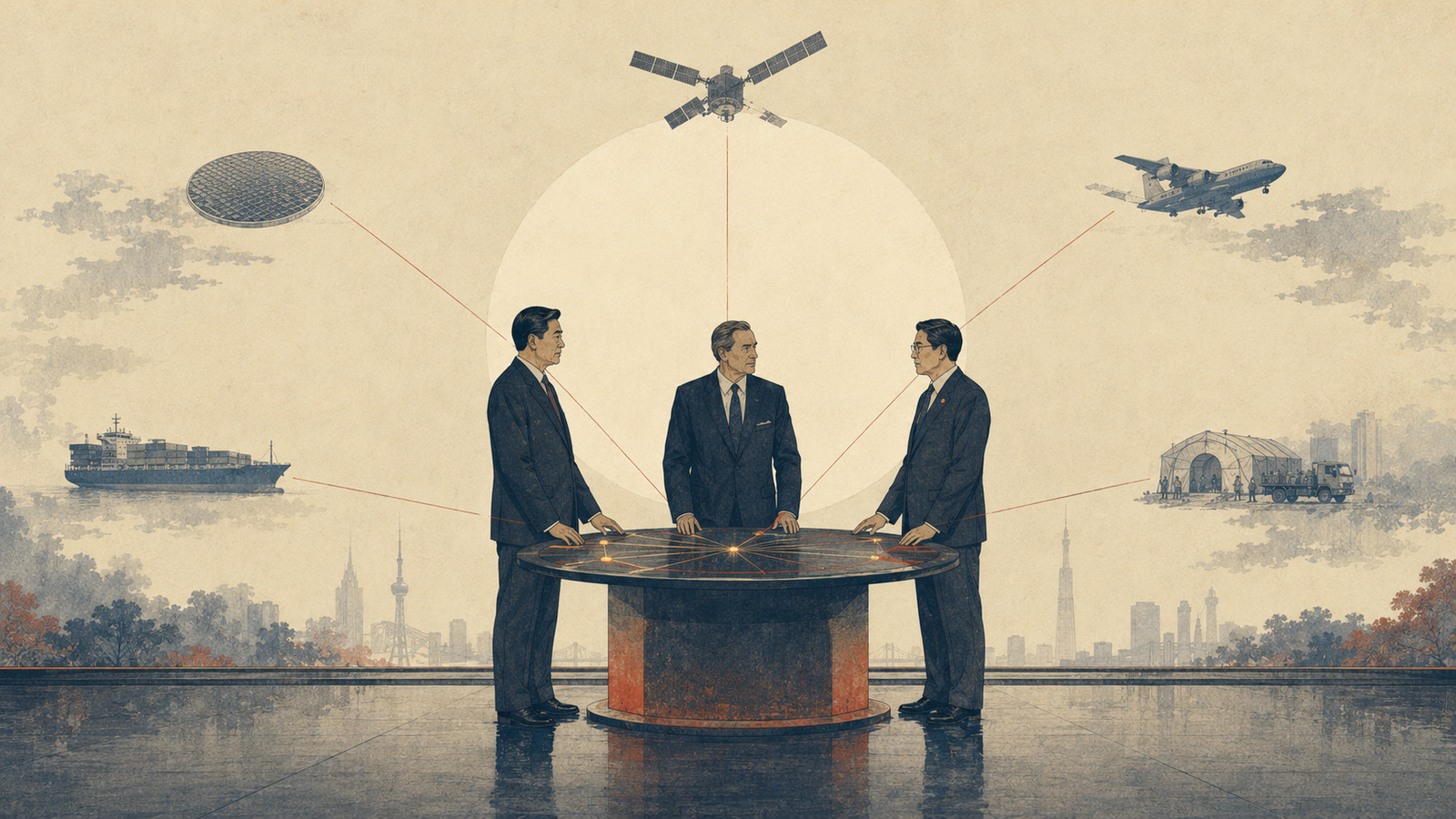
The meeting lasted only 35 minutes. Yet when the foreign ministers of Japan, the United States and South Korea sat down in Manila on July 22, their agenda stretched from ballistic missiles to semiconductors, cybercrime, disaster aircraft, artificial intelligence and nuclear energy. That breadth is the story. Security in Northeast Asia is no longer confined to ships, aircraft and troops. It now runs through laboratories, logistics databases, satellite links, factory inventories and the identities of remote software workers.
Japan’s Foreign Minister Toshimitsu Motegi, U.S. Secretary of State Marco Rubio and South Korean Foreign Minister Cho Hyun met on the sidelines of ASEAN-related meetings in the Philippine capital. It was their second trilateral foreign ministers’ meeting in July, following one in Ankara on July 7. They agreed to advance security cooperation, including joint exercises; expand economic-security work on a supply-chain early-warning system and cutting-edge technologies; coordinate against transnational crime; and launch a trilateral consultation on international disaster relief.
On North Korea, the ministers aligned behind complete denuclearization in accordance with United Nations Security Council resolutions, action against malicious cyber activity and disguised overseas IT workers, and resolution of Japan’s abductee issue. They also discussed Southeast Asia and opposed unilateral attempts to change the status quo by force or coercion. The language was diplomatic. The direction was not: the three governments are trying to build a network that can see crises earlier, move forces and relief faster, protect industrial chokepoints and survive political turnover.
From Communiqués to Machinery
The significance of Manila was not a new grand doctrine. It was the effort to turn three years of promises into working machinery. Joint exercises test whether forces can communicate in the same air and sea space. Real-time missile-warning links combine observations from different sensors and shorten the interval between detection and decision. A supply-chain warning system is meant to reveal trouble in critical minerals, batteries or semiconductor materials before a shortage closes assembly lines.
The new disaster-relief consultation is not a soft appendage to the military agenda. When an earthquake, typhoon or tsunami disables ports, communications and roads at once, governments must already know who can provide satellite images, strategic lift, ships, medical teams, water systems and emergency power. Japan brings deep disaster-response and engineering experience; the United States brings global transport and space capabilities; South Korea brings rapid-response capacity and advanced digital systems. Used well, that combination can become a regional public good beyond the three countries’ borders.
More joint security exercises; economic-security coordination through supply-chain early warning and advanced technology; a trilateral disaster-relief consultation; action against transnational crime; and closer work on North Korea’s nuclear, missile, cyber and illicit-revenue programs. The objective is to connect military, industrial, law-enforcement and humanitarian systems.
A Triangle Built From Two Alliances
This relationship was not designed as a triangle. After World War II, Washington built separate treaty alliances: the original U.S.-Japan Security Treaty was signed in 1951 and replaced by the 1960 Treaty of Mutual Cooperation and Security; the U.S.-South Korea Mutual Defense Treaty followed the Korean War in 1953. In the classic “hub-and-spokes” system, Washington was the hub and Tokyo and Seoul were separate spokes. Japan and South Korea never acquired a mutual-defense obligation to each other.
That distinction still matters. The 2023 Commitment to Consult says the three governments will consult expeditiously when regional threats affect their collective interests, share information, align messages and coordinate responses. It is a serious political commitment, but it is not an automatic collective-defense clause comparable to Article 5 of the North Atlantic Treaty. Calling the arrangement an “Asian NATO” is memorable and legally misleading.
The more accurate description is an attempt to make two alliances interoperable. Shared warning pictures, recurring exercises, regular meetings of leaders, foreign ministers, defense ministers and national security advisers, and crisis communication channels are being layered on top of the bilateral treaties. The goal is to ensure that a change of government does not force officials to rebuild elementary coordination from the beginning.
1965 and the History That Never Left
Japan and South Korea normalized diplomatic relations on June 22, 1965. They signed a basic treaty and agreements covering claims and economic cooperation, fisheries, the legal status of Korean residents in Japan, cultural property and dispute settlement. The United States had pressed its two allies for years to settle their differences. In Cold War strategic and economic terms, cooperation between neighboring anti-communist states appeared obvious.
But law could not close the memory of Japan’s colonial rule of Korea from 1910 to 1945. Disputes over former forced laborers and “comfort women,” textbooks, political statements and sovereignty over the islets called Takeshima in Japan and Dokdo in South Korea repeatedly returned to domestic politics. Tokyo has stressed that claims were legally settled in 1965; many in South Korea emphasize individual victims’ dignity and later court decisions. These positions are not merely diplomatic talking points. They emerge from different public memories of the 20th century.
The result is a partnership with a structural contradiction. Japan and South Korea have strong shared interests in maritime stability, trade, advanced manufacturing, tourism and managing demographic decline, but their security relationship can be damaged by a historical dispute seemingly far removed from radar screens. Durability therefore does not require forgetting history. It requires a firewall strong enough to keep missile warning and emergency relief working when historical politics becomes bitter again.
North Korea Made Cooperation Operational
North Korea’s nuclear and missile programs supplied the most powerful practical pressure for trilateralism. Geography gives the partners different views of the same launch. South Korean sensors sit close to launch areas; Japanese systems observe trajectories across the archipelago and nearby seas; the United States contributes space, maritime and terrestrial sensing together with broad command capabilities. Fusing observations can produce a more complete track than any country holds alone.
Japan and South Korea signed the General Security of Military Information Agreement, or GSOMIA, in 2016 to protect shared classified information. In August 2019, amid disputes over export controls and history, Seoul notified Tokyo that it would terminate the pact. The termination was suspended that November and the notification formally withdrawn in March 2023. The episode was a warning: strategic logic by itself could not insulate security cooperation from bilateral politics.
In December 2023, the three countries fully activated a system for sharing North Korean missile-warning data in real time and established a multiyear exercise plan. The critical difference was that a communiqué had become a functioning link. As Pyongyang turned to cyber theft and overseas IT workers who conceal their identities to earn revenue, the target set also expanded—from launchpads and warheads to cryptocurrency accounts, hiring systems and corporate networks.
Camp David Changed the Rhythm
On August 18, 2023, Prime Minister Fumio Kishida, President Joe Biden and President Yoon Suk Yeol gathered at Camp David for the first stand-alone summit among the three countries. The enduring result was less a single dramatic pledge than the embedding of cooperation in calendars and bureaucracies. They committed to regular meetings of leaders and senior security officials, real-time missile warning, a multiyear exercise plan, economic-security dialogue and rapid consultation during crises.
In June 2024, the first Freedom Edge exercise brought the three forces together for ballistic-missile defense, air defense, anti-submarine warfare, search and rescue, and maritime interdiction training. The following month, defense chiefs signed the Trilateral Security Cooperation Framework, institutionalizing policy consultations, information sharing, exercises and defense exchanges. In November, the leaders established a Trilateral Coordinating Secretariat. Staff-level officials were given a permanent spine to connect the summits.
The machinery continued to operate. A secretariat meeting in Tokyo on June 12, 2026 reviewed concrete cooperation and coordination on North Korea and economic security. In July, the foreign ministers met twice within 15 days. Frequency matters because personal trust among leaders may open a door but can disappear at an election. Scheduled meetings, responsible offices, shared procedures, budgets and exercise calendars give the partnership a life beyond political chemistry.
Semiconductors Are Modern Supply Lines
Technology moved to the center of the security agenda because weapons, hospitals, cars and communications networks depend on many of the same chips, batteries, satellites and cloud systems. Japan is formidable in semiconductor manufacturing equipment, specialty materials and precision components. South Korea has world-scale memory-chip and battery production. The United States dominates important parts of advanced design, software, cloud computing, research finance and the security architecture surrounding the market.
Those strengths are complementary, but the companies are also competitors for customers, subsidies and engineers. A trilateral supply-chain system therefore has to do more than declare solidarity. The early-warning concept developed after Camp David aims to share signs of export restrictions, natural disasters, transport disruption, price spikes or factory outages affecting critical minerals, rechargeable batteries and semiconductor inputs before the shock stops production.
To work, government alerts must connect with corporate procurement and inventory data. Officials must agree on what is confidential, which thresholds trigger a warning, who receives it and when alternate sourcing begins. The same discipline applies to artificial intelligence, quantum science, space systems, biotechnology and next-generation communications. Joint research can grow only if the partners build usable rules for intellectual property, research security, export controls, personal data and technical standards.
This is where economic security can collide with economic nationalism. A subsidy designed to bring a factory home may divert investment from an ally. An export control intended to deny technology to a rival may interrupt a partner’s production. Cooperation will be credible when the three capitals resolve those conflicts before companies are forced to absorb them.
Space, Cyber and the Invisible Front
Satellites do far more than detect the heat of missile launches. They track shipping, map flood damage after typhoons, monitor ports and undersea-cable approaches, and reconnect communities when terrestrial communications fail. If the three countries integrate space-domain awareness, Earth observation, satellite communications and cyber defense, the same architecture can strengthen deterrence and save lives.
Cyber operations demand an even wider coalition. Attribution and disruption can require intelligence agencies, police, banks, cryptocurrency exchanges, hiring departments and cloud providers to act together. North Korean IT-worker schemes illustrate the problem. If a worker uses a false identity to enter a company, generate revenue and reach sensitive data, the front line runs through ordinary recruitment and payment systems. Manila’s attention to transnational crime recognizes that a modern security threat may never wear a uniform.
Technology cooperation also creates vulnerability. The more data that allies connect, the more damaging a compromised credential, poorly secured contractor or insider can become. Shared networks need common security standards, compartmentation and rehearsed incident response—not only political trust.
Small Reactors and the Third-Country Test
The Ankara meeting on July 7 produced a Memorandum of Cooperation on deploying small modular reactors, or SMRs, in third countries. This was not just a power-plant sales initiative. A nuclear project binds together design, licensing, fuel, construction, operations, workforce training, export finance, physical security and nonproliferation for decades.
If Japan, the United States and South Korea can offer growing economies reliable low-carbon power, they can combine climate policy, energy security and industrial diplomacy. Their capabilities are potentially complementary: U.S. reactor concepts and finance, Japanese components and engineering, and South Korean construction and operating experience. But an announcement is far from a reactor. Cost overruns, radioactive waste, licensing, fuel assurance, local consent and nuclear security remain formidable tests.
The SMR agreement reveals the partnership’s outward ambition. It is no longer concerned only with defense of the Korean Peninsula and Japanese home islands. It wants to help shape the technologies, standards and financing choices of countries in Southeast Asia and beyond. Success will depend on whether the offer is transparent, affordable and safer than its competitors.
China and the Language of Regional Order
Official trilateral documents do not treat China as a simple enemy. China is a major trading partner for all three and an indispensable participant in climate policy, financial stability and any lasting settlement on the Korean Peninsula. Yet concerns about the East and South China Seas, the Taiwan Strait, military activity and economic coercion provide another strong force behind closer coordination.
The Manila formula—opposition to unilateral changes to the status quo by force or coercion—states a principle without naming a single adversary. It also exposes the strategic balance the three capitals must maintain. They want stronger deterrence without closing channels for crisis management. They want resilient supply chains without sliding into indiscriminate economic separation. Their threat perceptions overlap, but they are not identical, and their exposure to the Chinese market differs.
Four Fault Lines That Could Still Break the Pattern
| Fault line | The practical test |
|---|---|
| Japan-South Korea history | Can operational cooperation continue when a court ruling, memorial dispute or election inflames public opinion? |
| Industrial competition | Can competition over chip, battery and nuclear subsidies coexist with shared supply-chain strategy? |
| Different approaches to China | Can the partners preserve common principles and crisis controls while maintaining different economic relationships? |
| Institutional drift | Will more meetings yield measurable improvements in warning, exercises, joint projects and disaster response? |
There are other limits. Classification rules are different. Military command arrangements remain bilateral. Constitutional and legal constraints shape how each country can use force. Elections can reward leaders for challenging a neighbor. Private companies hold much of the data and technology the governments want to protect, but their incentives are commercial and global.
Success Will Be Measured in the First 24 Hours
The clearest measures of mature cooperation will not be the length of the next joint statement. They will be the speed with which all three countries see the same track after a North Korean missile launch; the number of days an early warning saves when a mine or chip plant closes; whether satellite imagery, aircraft and rescue teams reach an earthquake zone without duplication; and how quickly stolen cyber funds can be traced and frozen.
Manila will not leave an image as dramatic as Camp David. But the work of turning two alliances and one historically difficult bilateral relationship into a daily operating network advances through meetings like this one and the thousands of technical decisions that follow.
The triangle has not transcended history, and it is not a single alliance built to contain China. It is something more pragmatic: a system that tries to connect missile warning, maritime operations, semiconductor resilience, disaster relief, cyber defense and nuclear technology. Its task in 2026 is not to accumulate promises. It is to make them work before the next crisis begins.
Sources and references
The meeting record and historical chronology were checked primarily against official documents from the three governments. Future exercises and projects will require verification after implementation.
- Japan MOFA: Japan-U.S.-ROK Foreign Ministers’ Meeting, Manila, July 22, 2026
- Japan MOFA: Foreign Minister Motegi’s July 7, 2026 press conference in Ankara
- The Spirit of Camp David: Joint Statement, August 18, 2023
- Camp David: Commitment to Consult
- U.S. Defense Department: Real-time DPRK missile-warning data sharing
- U.S. Defense Department: Trilateral Security Cooperation Framework
- Japan MOFA: Trilateral Coordinating Secretariat meeting, June 12, 2026
- Japan MOFA Diplomatic Bluebook: Japan-ROK relations and GSOMIA
- U.S. Office of the Historian: The 1965 Japan-ROK treaty and related agreements