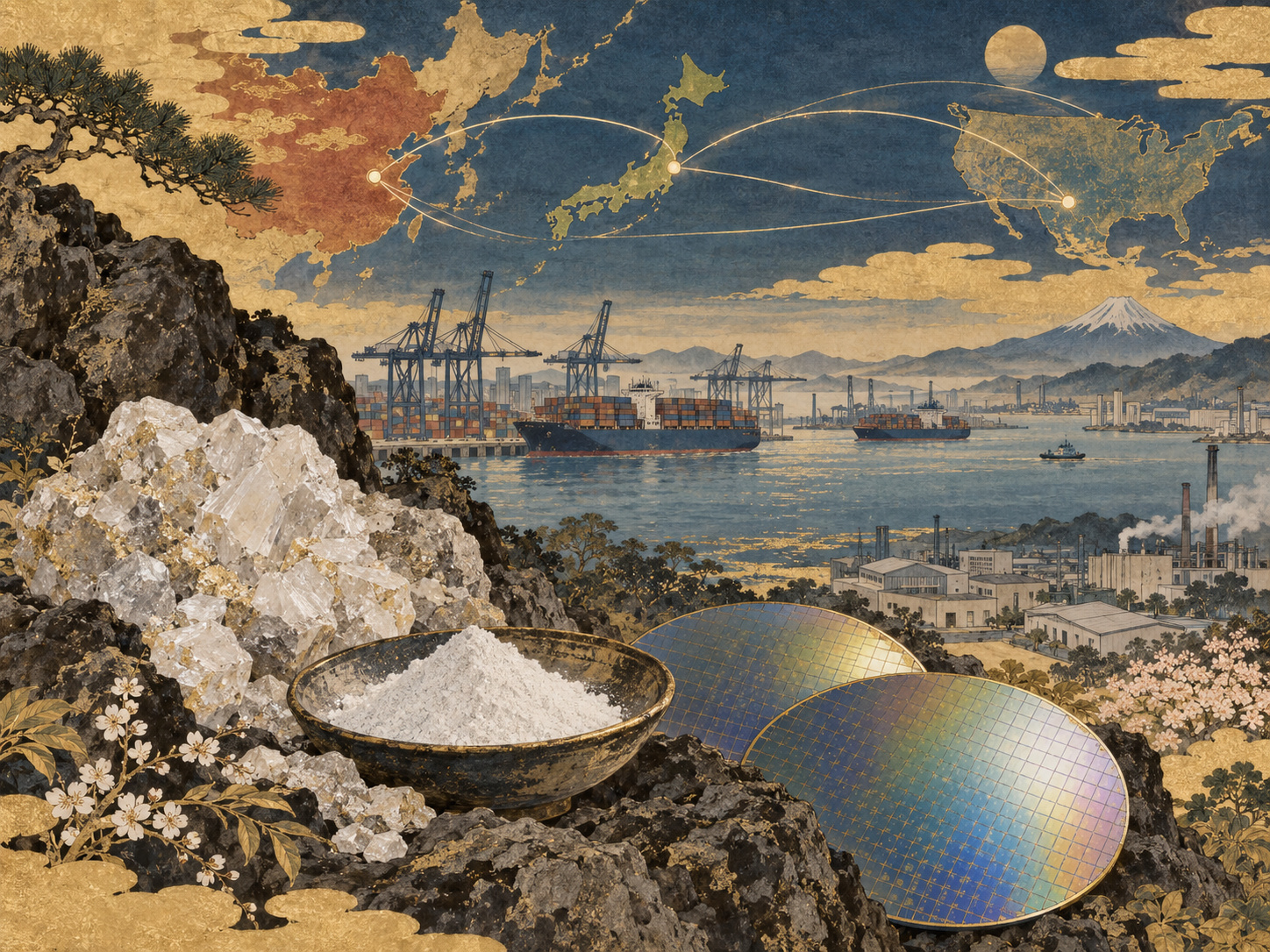
Semiconductor etch chambers, jet-engine turbine coatings, lasers and advanced ceramics have something in common that rarely appears in consumer-facing technology stories: yttrium. The element is used in relatively small volumes, but in applications where a missing coating powder or high-purity oxide can idle equipment worth vastly more than the material itself.
That mismatch between market size and industrial importance has turned yttrium into a test case for economic security. On April 4, 2025, China placed seven medium and heavy rare-earth categories under export control: samarium, gadolinium, terbium, dysprosium, lutetium, scandium and yttrium. The Chinese Ministry of Commerce and General Administration of Customs specifically listed yttrium metal, alloys, targets, yttrium oxide and yttrium compounds among the controlled items.
In semiconductors, yttrium protects the factory rather than becoming the chip
Yttrium’s semiconductor importance is easy to misunderstand. The critical role is not primarily that large quantities are embedded in finished chips. It is that yttrium-based materials help semiconductor manufacturing equipment survive the harsh plasma environment used to etch microscopic patterns.
A Japanese Ministry of Economy, Trade and Industry technical survey explains that halogen-based plasma inside etch tools can corrode or erode chamber components. The resulting particles can damage patterns on wafers and reduce both yield and equipment uptime. Yttrium oxide, or yttria, is widely used as a protective coating because of its plasma and corrosion resistance.
That distinction matters in a shortage. A manufacturer cannot necessarily swap in a chemically similar powder and resume production the next morning. Changing a coating can require material qualification, chamber testing, process tuning, contamination studies and customer acceptance. In advanced manufacturing, the existence of a substitute is not the same as having a qualified substitute.
A few kilograms can sit upstream of a multibillion-dollar aerospace system
Yttrium also matters in the hottest sections of aircraft engines. Yttria-stabilized zirconia and related materials are used in thermal-barrier coatings designed to protect turbine components at extreme temperatures. Reuters reported in September that aerospace suppliers in North America and Europe have been revisiting older rare-earth-free coating formulations as supply concerns grow.
The search includes ceramic systems developed decades ago. Better modern deposition and measurement technologies may improve those older materials, but aerospace qualification is deliberately slow. A coating used in a turbine cannot be changed casually. That leaves manufacturers exposed to a paradox: yttrium may represent a tiny fraction of the cost of an engine, yet a shortage can delay work on an engine worth millions of dollars.
China’s rule is a licensing system, not a blanket global ban
China’s April 2025 measure did not prohibit all exports of yttrium. Exporters must apply for licenses for covered items and declare controlled classifications to customs. China’s Ministry of Commerce said the controls were adopted to protect national security and interests and to meet non-proliferation obligations, describing controls on dual-use items as consistent with international practice.
The practical issue is that licensing speed and approval patterns determine whether factories actually receive material. Reuters, citing Chinese customs data, reported no U.S.-bound yttrium shipments in January, May or June 2026. In Japan, METI has publicly acknowledged that Chinese controls on rare earths and other critical minerals have caused delays in licensing and prolonged customs inspections that affect Japanese companies.
The political interpretation is contested. Chinese authorities give national-security and non-proliferation reasons for the controls. Reuters has reported that shipment patterns have shifted amid U.S.-China tariff disputes and periods of heightened Japan-China tension. This report distinguishes the formal legal rationale from observed trade disruptions rather than assigning a motive independently.
September 10: Washington and Tokyo put the obscure element on the table
According to Reuters, the September 10 meeting hosted by the U.S. Department of Energy was designed for candid discussion of current and emerging strategic bottlenecks, specifically in permanent magnets and yttrium. Japan’s Ministry of Economy, Trade and Industry participated along with government and corporate representatives.
The Department of Energy told Reuters it welcomed Japan’s partnership and encouraged companies in both countries to launch critical-minerals projects as part of broader efforts to diversify supply chains. But the department did not disclose the meeting’s decisions, and Japan has not published a result document that Japan.co.jp could locate.
What is public is the larger framework. Japan and the United States signed an Agreement on Strengthening Critical Minerals Supply Chains in March 2023. In March 2026, the two governments also announced an action plan on critical-mineral supply-chain resilience, including discussion of trade mechanisms such as price floors, identification of mining, processing and manufacturing projects for priority financial and policy support, and the sharing of geological information.
Japan has been here before
For Japan, the strategic risk in rare earths is not theoretical. In 2010, China sharply reduced rare-earth export quotas. During a diplomatic confrontation over disputed islands in the East China Sea, shipments from China to Japan also slowed sharply. Prices surged and Japanese manufacturers faced an abrupt reminder that efficient just-in-time supply chains can become fragile when one country dominates upstream production.
Japan responded along three tracks: investing in mines outside China, funding technologies that used less rare earth material or substituted other materials, and pursuing trade-policy remedies. METI says those efforts helped reduce China’s share of Japan’s total rare-earth imports from 85% in 2009 to 58% in 2020.
The most visible diversification project was Australia’s Lynas Rare Earths. In 2011, Sojitz and the Japan Organization for Metals and Energy Security, JOGMEC, financed Lynas through their joint vehicle Japan Australia Rare Earths, or JARE, with a package totaling $250 million. In 2023 they committed another A$200 million and secured an agreement for up to 65% of Lynas’s dysprosium and terbium output from Mt. Weld feedstock to be supplied to Japan.
2010: Export-quota cuts and disrupted Japan-bound trade trigger the rare-earth shock.
2011: Sojitz and JOGMEC back Lynas to build a non-Chinese supply source.
2023: The Japan-U.S. critical-minerals agreement takes effect; Japan increases support for Lynas.
April 2025: China places yttrium and six other rare-earth categories under export control.
February 2026: Japan successfully lifts rare-earth-rich mud from about 6,000 meters below the sea near Minamitorishima.
September 10, 2026: U.S. and Japanese officials and companies discuss yttrium and permanent-magnet bottlenecks.
Diversifying “rare earths” does not mean every element is diversified
Japan’s diversification strategy worked in important ways, but a headline number for all rare earths can conceal element-by-element vulnerabilities. Different ores contain different proportions of rare-earth elements. Separation requires specialized chemical processing. End users may demand very high purity, specific particle sizes or validated compounds.
The U.S. Geological Survey’s 2026 Mineral Commodity Summaries estimated that China exported about 1,600 metric tons of yttrium compounds and metal in 2025, measured in yttrium-oxide equivalent. Japan was the largest destination by quantity, followed by South Korea, the United States and Germany.
USGS also reported that average Y₂O₃ prices rose 42% in 2025 from 2024 and yttrium metal prices rose 22%. In a relatively small market, a modest absolute change in available tonnage can produce a large shift in price and inventory behavior.
Minamitorishima is strategically important, but it is not next quarter’s supply
Japan does have a potentially important domestic resource: rare-earth-rich mud around Minamitorishima in Japan’s exclusive economic zone. In February 2026, the deep-sea drilling vessel Chikyu successfully lifted rare-earth mud from approximately 6,000 meters below the surface in a government-backed technology demonstration.
METI called the achievement meaningful for economic security and marine development, but also stressed what remains: demonstrating the full chain from mining through separation and refining, and proving that the system is economically viable. Recovering mud from extreme depth is not the same as producing semiconductor-grade yttria reliably at commercial cost.
Minamitorishima should therefore be understood as a long-term strategic option, not a near-term replacement for current Chinese supply.
Stockpiles help, but qualification determines whether factories can run
Strategic stockpiles are an obvious response to mineral risk. Yet for yttrium, the relevant question is not only how many tonnes are stored. It is what form and specification are stored.
A semiconductor equipment supplier may need a high-purity oxide or a narrowly specified thermal-spray powder. An aerospace supplier may need material tied to a qualified coating system. A lighting or laser producer may need a different compound altogether. “Yttrium inventory” is therefore not automatically interchangeable inventory.
For companies, resilience increasingly means mapping the bill of materials at a much finer level: knowing days of inventory by grade, validating secondary suppliers before a crisis, designing recycling pathways, funding substitute qualification, and deciding which products should receive scarce inputs first.
Five questions that matter more than the headline supply number
- Where is the material separated and refined? A mine is not a supply chain without chemical separation capacity.
- What grade is required? Semiconductor, aerospace and optical uses have different purity and form requirements.
- How long does licensing take? Material may be legally exportable yet unavailable on the factory’s schedule.
- How long does substitute qualification take? A technically plausible replacement may require months or years of validation.
- What will Japan and the U.S. finance together? Mining alone will not solve shortages if separation, coating powders and recycling remain concentrated.
The next rare-earth crisis will not look exactly like 2010
The lesson of 2010 was that Japan could reduce dependence on a single country. The lesson of 2026 is that dependence cannot be measured with one national percentage. A supply chain may appear diversified in aggregate while remaining almost completely dependent on one source for a particular element, chemical form or process step.
Yttrium illustrates the modern version of critical-mineral risk. It is obscure, used in modest volumes and often invisible in the final product. Yet it protects semiconductor chambers from plasma erosion and turbine components from extreme heat. Its industrial value comes precisely from where it sits in the process.
The September 10 U.S.-Japan meeting elevated that hidden dependency into a policy issue. The real measure of success will not be the number of meetings. It will be how quickly Japan and the United States can create qualified alternatives across mining, separation, high-purity processing, recycling and end-use materials—and how they bridge the years before those alternatives reach scale.
Yttrium is element 39 on the periodic table. For Japan’s manufacturers in 2026, the more important number is the number of production lines that can keep running when one small material stops moving.
Sources & Reporting Notes
- China Ministry of Commerce / General Administration of Customs, Announcement No. 18 of 2025 — Controlled yttrium forms and licensing requirements.
- China Ministry of Commerce spokesperson statement — Beijing’s stated national-security and non-proliferation rationale.
- Reuters, Sept. 24, 2026 — Sept. 10 U.S.-Japan meeting, shipment disruptions and corporate impact.
- Japan Ministry of Economy, Trade and Industry, June 30, 2026 press conference — Licensing delays and prolonged customs inspections affecting Japanese companies.
- METI technical survey on electronics materials — Yttria protective coatings in semiconductor etch equipment.
- U.S. Geological Survey, Mineral Commodity Summaries 2026 — Yttrium production, prices and Chinese export destinations.
- METI, White Paper on International Economy and Trade 2025 — Japan’s post-2010 diversification and China import share.
- JOGMEC / Sojitz, additional investment in Lynas — Heavy rare-earth supply agreement for Japan.
- USTR, U.S.-Japan Critical Minerals Agreement — Bilateral framework signed March 28, 2023.
- METI, Japan-U.S. Action Plan for Critical Mineral Supply Chain Resilience — March 2026 policy framework.
- Cabinet Office of Japan, Minamitorishima rare-earth mud test — Recovery from roughly 6,000 meters depth.
- Reuters, Sept. 21, 2026 — Aerospace suppliers exploring older rare-earth-free thermal-barrier coatings.
This report was prepared for the October 2, 2026 edition using public information available through 11:06 AM JST on September 30, 2026. Japanese institutional names and policy terminology were checked primarily against METI, the Cabinet Office and JOGMEC. The September 10 U.S.-Japan meeting is reported from an invitation reviewed by Reuters; no specific outcome document has been identified. China’s stated legal rationale for the controls is presented separately from reported trade and diplomatic context.
Image rights: © 2026 Japan.co.jp. AI-assisted editorial illustration. For licensing, see the contact page.