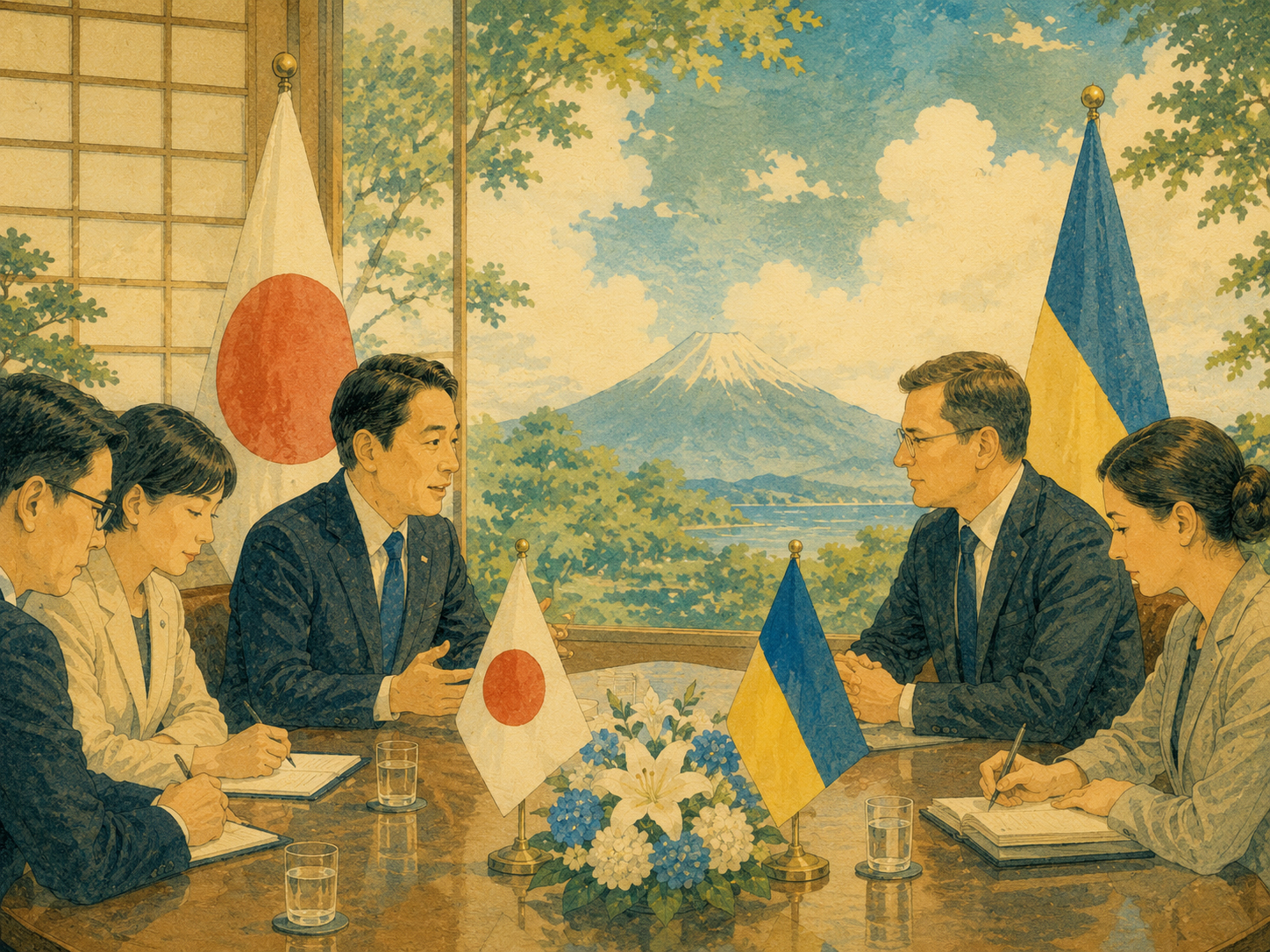
In Tokyo, the choreography was formal: a handshake, a meeting, a joint press announcement, and then a working dinner. On July 1, beginning at 6:15 p.m. and lasting roughly 115 minutes, Japanese Foreign Minister Toshimitsu Motegi met with Ukrainian Foreign Minister Andrii Sybiha, who was visiting Japan from June 30 to July 2. The official description sounds like a routine diplomatic schedule. It was not. For Japan, every meeting with Ukraine now touches the core question of its own security policy: whether the international order can still say no to a unilateral attempt to change the status quo by force.
At the meeting, the two ministers signed and exchanged notes on a grant aid project for a Human Resource Development Scholarship. Motegi expressed respect for the daily efforts of the Ukrainian people, including Minister Sybiha, to bring peace to their country, and reiterated that Japan’s consistent position of standing with Ukraine would not waver. He also stressed the principle that attempts to change the status quo by force should not be tolerated, and said Japan would continue support for Ukraine, sanctions against Russia, and public-private assistance for Ukraine’s recovery and reconstruction in coordination with the international community.
Sybiha’s visit had been announced by Japan’s Ministry of Foreign Affairs on June 26. MOFA said Motegi would hold a foreign ministers’ meeting and working dinner with Sybiha, exchanging views on bilateral relations and regional situations, and that the visit was expected to further strengthen Japan-Ukraine relations. It was Sybiha’s second visit to Japan as foreign minister, following his August 2025 visit. Motegi and Sybiha also met face to face in Canada in November 2025 and held a telephone conversation in February 2026.
Why a working dinner matters
“Working dinner” is one of those diplomatic phrases that rarely wins headlines. But in diplomacy, the table can matter as much as the conference room. Formal meetings are often scripted. Joint press statements preserve only language both sides can accept. Dinner allows a softer exchange: political constraints, battlefield assessments, reconstruction priorities, concerns about third countries, public fatigue, budget pressures, and the psychology of a long war.
Ukraine is geographically distant from Japan. But the principle exposed by Russia’s invasion is close to East Asia. Can borders be changed by force? Can a large power override the sovereignty of a smaller neighbor? How far can one war ripple through energy, grain, finance, sanctions, semiconductors, cyber operations, refugees, land mines, and reconstruction capital? Ukraine has become more than a European war. It is a test of the international system on which Japan depends.
The meeting in numbers
Japan’s support is not a great-power military model
Japan’s Ukraine policy is defined by the boundary between what Tokyo can and cannot do. Japan operates under constitutional and legal constraints. It is not a country that sends large quantities of offensive weapons to a front line in the way some NATO members can. But that does not make Japan a bystander. It has built a long-war support model through fiscal assistance, humanitarian aid, emergency recovery, reconstruction, mine action, energy support, medical assistance, education, scholarships, sanctions, and international financial coordination.
In June 2024, Prime Minister Fumio Kishida met President Volodymyr Zelenskyy on the sidelines of the G7 Puglia Summit and signed the Japan-Ukraine Support and Cooperation Accord. MOFA described the accord as clarifying areas of support and cooperation, including security and defense, humanitarian support, recovery and reconstruction, in accordance with Japan’s constitutional and legal requirements. Japan also emphasized that it was the first non-Atlantic country to sign such a document based on the G7 Joint Declaration of Support for Ukraine.
This is Japan’s distinctive lane: not the biggest battlefield supplier, but a builder of recovery capacity. Bridges, power, hospitals, schools, mine clearance, human resources, technology, and private-sector links. Some readers may wonder why reconstruction is being planned while the war continues. The answer is that modern reconstruction does not begin the day after a ceasefire. If the power grid is destroyed, winter becomes dangerous. If mines remain, fields cannot be farmed. If schools are gone, children lose years. If administrators are not trained, a postwar state cannot absorb help.
From the 2024 Tokyo conference to reconstruction diplomacy
In February 2024, Tokyo hosted the Japan-Ukraine Conference for Promotion of Economic Growth and Reconstruction. The Japanese and Ukrainian governments co-hosted it with Keidanren and JETRO, and more than 100 Ukrainian government and business representatives came to Japan. AP reported that the conference highlighted Japan’s non-military role in Ukraine: reconstruction, investment, technology, humanitarian support, and long-term partnership. The agenda ranged from demining and energy to transport, agriculture, digital systems and medicine.
The conference’s real message to Japanese companies was this: Ukraine is a battlefield, but it is also a future reconstruction market. The risk is obvious. War continues. Insurance is difficult. Governance matters. But the idea of treating reconstruction as the meeting point of national security and economic diplomacy is increasingly central to Japan’s role. It also echoes Japan’s own postwar history: a country rebuilt with external support now offering finance, systems and technical knowledge to another country fighting for survival.
In 2025, Tokyo hosted the Ukraine Mine Action Conference. MOFA says the conference brought together around 600 participants from 75 countries and international organizations, along with business leaders, NGOs, and mine-action operators. The theme was “Acceleration toward Reconstruction,” with discussions centered on people, technology, and the seamless transition from mine action to recovery and reconstruction. Mine clearance is not glamorous. But it is a gate to everything else. Homes cannot be rebuilt on mined land. Fields cannot be farmed. Roads cannot be repaired. Children cannot walk safely to school.
Why scholarships belong in a war story
The Human Resource Development Scholarship signed at the July 1 meeting may sound small compared with war, sanctions, missiles and power stations. It is not. Long-term reconstruction depends on people who know how to run public systems. Infrastructure can be purchased with money. Institutions require trained people. Ukraine will need administrators, legal specialists, energy planners, urban designers, doctors, teachers, digital-government architects, anti-corruption officials, local-government leaders and public managers.
This is an area where Japan has credibility. Since the Meiji era, Japan has studied foreign systems, adapted them, revised them and embedded them in domestic institutions. In the postwar period, it rebuilt cities, railways, ports, water systems, public health, schools and industrial policy. None of that can be simply exported to Ukraine. But Japan’s experience in connecting technical competence, bureaucracy, local administration and long-term development is a real asset.
A brief history of Japan-Ukraine relations
Japan recognized Ukraine’s independence in December 1991 and established diplomatic relations in 1992. During the Cold War, Ukraine was largely viewed in Tokyo through the lens of the Soviet Union. After independence, it gradually became visible as a state standing between Europe and the former Soviet space — a country whose fate had implications beyond its borders.
Russia’s 2014 seizure of Crimea and the war in eastern Ukraine changed Japan’s view. The issue was no longer only European stability. It was the principle of territorial integrity, sanctions coordination and G7 solidarity. The full-scale invasion in February 2022 made that logic unavoidable. Japan joined sanctions against Russia, expanded financial and humanitarian assistance, accepted displaced Ukrainians, and repeatedly framed the war as a challenge to the foundations of the international order.
In that history, the July 2026 foreign ministers’ meeting is a marker of continuity. Long wars create fatigue. Attention moves to the Middle East, elections, inflation, disasters, budgets and domestic politics. That is why two foreign ministers sitting down in Tokyo matters. It turns policy persistence into public signal.
The domestic meaning for Japan
Inside Japan, Ukraine support always carries a question: how far should Japan involve itself in a distant war? Japan has domestic needs of its own — energy prices, food prices, yen weakness, defense spending, population aging and disaster recovery. Yet the government continues to connect Ukraine to Japan’s own security because the logic of the war cannot be contained geographically.
Japan’s fear is that successful coercion becomes precedent. If the use of force pays off in Europe, that lesson may be tested elsewhere. So Ukraine policy is not only charity. It is deterrence by defense of principle. Do not reward aggression. Do not isolate the victim. Defend the rule of law. These ideas recur throughout Japan’s diplomatic language because they are not abstractions for Tokyo. They are the rules Japan needs in the Indo-Pacific.
What Ukraine wants from Japan
Ukraine does not ask Japan to become a country it is not. The more realistic expectation is that Japan will do what Japan can do well: mine-clearance technology, energy equipment, hospitals, schools, local government capacity, railways, ports, agriculture, digital government, disaster management, anti-corruption support, private investment, insurance and financial guarantees.
For Ukraine, Japan’s role complements the United States and Europe. Western partners carry much of the military and macro-financial burden. Japan can help shape the quality of reconstruction: resilient infrastructure, trained officials, Japanese companies, careful project management, and non-military security cooperation. For Japan, that is also a way to practice a broader form of statecraft: not only deterrence by weapons, but stability through recovery capacity.
Japan.co.jp view
The heart of this story is not that two foreign ministers had dinner. It is that Japan continues to move Ukraine support from emergency response into long-term state rebuilding. Joint statements, scholarships, sanctions, reconstruction, mine action and public-private partnerships are not separate policies. Together they say that Japan is not waiting for the war to end before thinking about the peace that must follow.
This is very Japanese diplomacy. It is quiet. It is procedural. It does not deliver instant drama. But it lasts. Rebuild bridges. Train people. Clear mines. Restore power. Connect companies. Strengthen institutions. When war is reported through explosions, Japan’s role may be heard in the quieter sound of recovery being prepared.
The July 1 meeting in Tokyo was one scene in that quieter diplomacy: a handshake, a joint announcement, a dinner. Behind it was something larger than Ukraine’s future alone. It was Japan’s investment in a world where law, not force, still defines order.
Reader guide
| Item | How to read it |
|---|---|
| What happened | On July 1, Foreign Minister Motegi met Ukraine’s Foreign Minister Sybiha for roughly 115 minutes, followed by a joint announcement and working dinner. |
| Concrete result | The ministers signed and exchanged notes on grant aid for a Human Resource Development Scholarship project. |
| Diplomatic meaning | Japan reaffirmed support for Ukraine, sanctions against Russia, and public-private recovery and reconstruction assistance. |
| Historical background | The meeting follows the 2024 Japan-Ukraine Support and Cooperation Accord, the Tokyo reconstruction conference, and Japan’s 2025 mine-action diplomacy. |
| Japan.co.jp view | Japan’s strongest Ukraine role is recovery, people, institutions, mine clearance, energy and private technology — quiet but consequential security diplomacy. |
Sources and references
This article is based on materials and reporting from Japan’s Ministry of Foreign Affairs, AP, Reuters and related public records. War conditions, aid amounts and diplomatic schedules may change as official information is updated.
- MOFA Japan: Japan-Ukraine Foreign Ministers' Meeting and Working Dinner.
- MOFA Japan: Visit to Japan of H.E. Mr. Andrii Sybiha.
- MOFA Japan: Japan-Ukraine Support and Cooperation Accord.
- MOFA Japan: Japan-Ukraine Conference for Promotion of Economic Growth and Reconstruction.
- MOFA Japan: Ukraine Mine Action Conference 2025.
- MOFA Japan: Response to the situation in Ukraine.
- AP: Japan vows support to Ukraine while hosting reconstruction conference.
- Reuters: Ukraine, Japan sign 10-year support agreement.