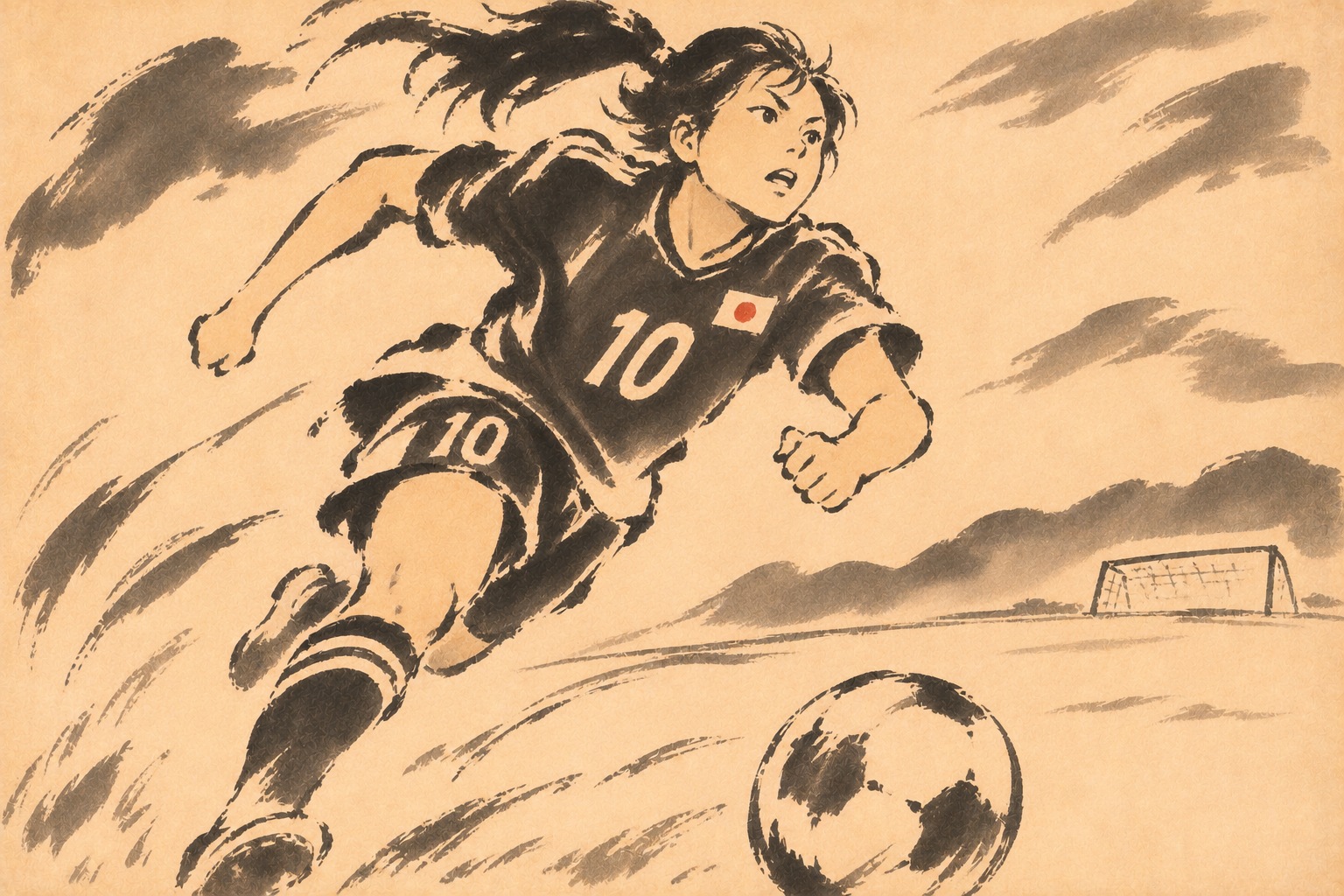
- Five minutes into stoppage time, Japan refused to leave
- A final spanning two calendar dates
- The hard route through Morocco
- What really happened in the semi-final
- The goal that ended a ten-year wait
- Players to watch, and why roles matter
- Nigeria is no supporting character
- The long shadow of Costa Rica 2014
- A development system with an unusual history
- The clubs and schools behind a national side
- The match itself still has questions to answer
- A result that matters beyond a trophy
Five minutes into stoppage time, Japan refused to leave
A World Cup campaign can turn on a single touch of the ball. For Japan’s U-17 women, that touch came in the fifth minute of second-half stoppage time against the two-time defending champions, DPR Korea. Trailing 1-0 in Rabat, the Japanese side kept pressing until an own goal brought them level. A lengthy video review followed; the equalizer stood. Japan then converted four penalties while goalkeeper Kou Kadowaki saved an attempt and another DPR Korea kick hit the post. The shootout ended 4-1. For the first time since 2016, Japan was going back to the final of the FIFA U-17 Women’s World Cup. A late rescue makes a memorable lead, but this is also a story about a decade of development, a network of schools and clubs, and the limits of what a single youth championship can tell us about a country’s footballing future.
A final spanning two calendar dates
Japan faces Nigeria in Rabat on Saturday, November 7 at 6:30 p.m. local time—3:30 a.m. on Sunday, November 8 in Japan. The venue is Pitch 3 of the Mohammed VI Football Complex. FIFA moved the final from its originally advertised stadium and confirmed the replacement on October 28. Japan’s official match page still lists the final as not yet played at the time of this report. This article is therefore a verified preview, not a claim about the championship result. Anyone preparing a November 8 homepage should check the JFA and FIFA scoreboards after full time, verify the scorers, and revise the headline and text if the report is to be presented as post-match coverage.
The hard route through Morocco
Japan competed in Group D against Zambia, France and Venezuela. The JFA records 2-0 victories over France and Venezuela, followed by a 3-1 defeat of Kenya in the round of 16. The quarter-final against Ghana was a different test: Japan won 1-0 through Nanami Kurita’s second-half goal. Then came a 1-1 semi-final draw against DPR Korea, followed by the penalty shootout victory. FIFA notes that Japan had conceded only two goals across the six matches preceding the final—one against Kenya and one against DPR Korea. A record like that is not an abstract defensive metric: it suggests a team capable of navigating contests in which one error could end its tournament. Yet the scores also show different demands, from open group matches to knockout ties settled on fine margins.
What really happened in the semi-final
DPR Korea went ahead in the 52nd minute through Ri Ui-gyong, according to FIFA. The own goal credited to Won Sol-gyong arrived in the 90th minute plus five. It is important to preserve that attribution: a Japanese player did not receive official credit for scoring the equalizer. In the shootout, Kadowaki saved Eh Chong-gum’s attempt, another DPR Korea player struck the post, and Asuka Tanaka converted Japan’s decisive kick. FIFA named Mashiro Yamaji Player of the Match. Coach Sadayoshi Shirai, in comments published by FIFA after the match, praised the collective determination of the starters, substitutes and staff. The remarks were carried by FIFA, not obtained in an independent JAPAN.co.jp interview. The lesson of the match was not a tactical miracle conjured from one kick; it was that Japan stayed close enough to make the late moment count.
The goal that ended a ten-year wait
Before the semi-final drama, Japan first had to get past the quarter-final stage that had halted its previous four U-17 World Cup campaigns. On November 1 in Morocco, Kurita scored against Ghana in the 54th minute after a deflected effort involving teammate Yuka Kishida. Japan won 1-0; Fuki Ito was named Player of the Match. That narrow victory restored Japan to the last four for the first time since 2016. The past is part of the stakes here. A generation of teenage players had watched Japanese sides depart at the quarter-final stage, even as the country maintained a reputation as one of the tournament’s leading nations. This team broke that pattern, not through an overwhelming scoreline, but through the sort of alertness in the penalty area that often determines close knockout matches.
Players to watch, and why roles matter
FIFA singled out Harura Matsushita before the tournament, identifying her as a defensive midfielder admired for reading play and interrupting attacks. The JFA roster lists Matsushita with JFA Academy Fukushima. Captain Honoka Yotsumoto is listed with Cerezo Osaka Yanmar Ladies; Mashiro Yamaji, the semi-final’s Player of the Match, also comes from the Fukushima academy. Kurita and Fuki Ito are registered with Nippon TV Tokyo Verdy Menina. These facts do not establish an inevitable starting lineup for the final. They do show the variety of pathways into Japan’s squad—and why a fair account should look beyond the decisive scorer. Defenders positioning the line, midfielders stopping transitions and substitutes maintaining intensity can shape a match just as strongly as a highlight-reel goal.
Nigeria is no supporting character
Nigeria’s story is every bit as dramatic. The team lost its first game 2-1 to Poland and then reeled off five consecutive victories to reach the final, beating Brazil 3-1 in its semi-final. Queen Joseph scored Nigeria’s opening goal in that match. Coach Akeem Busari has overseen an attack distributed across several players: FIFA counted eight different Nigerian scorers before the title match. The result is a compelling contest between a Japanese side that has conceded twice in six matches and a Nigerian team with varied scoring options and momentum after its opening setback. Nigeria is seeking its first U-17 women’s world title. FIFA also notes it could become the first champion in the competition’s history to lose its opening match. Neither storyline guarantees a particular result.
The long shadow of Costa Rica 2014
Japan has been here before. In Costa Rica in 2014, the Japanese team defeated Spain 2-0 to win its first U-17 women’s world title. Japan had also reached the 2010 final and returned again in 2016. The Morocco championship match will be Japan’s fourth final, a decade after the last one. According to FIFA, Japan and New Zealand are the only nations to have appeared in all ten editions. That consistency speaks to sustained participation in youth football, but today’s players should not be measured as replicas of the champions of twelve years ago. The global game has expanded, and national teams now emerge from varied combinations of academies, club youth programs and schools. History gives the occasion weight without deciding the outcome.
A development system with an unusual history
JFA Academy Fukushima is one of the most striking institutional strands in this squad. The academy opened in 2006 with a six-year program, placing the boys’ and girls’ sections in different Fukushima communities. After the 2011 earthquake and nuclear disaster, the girls’ program continued in Susono, Shizuoka Prefecture, rather than ending its work. The JFA announced that the girls would return to Fukushima in April 2024, bringing five existing school years back and welcoming a new intake. Several players registered for Morocco 2026 are listed as academy students. That does not prove the academy alone created a World Cup finalist: selecting promising young athletes and giving them structured support is one part of a much wider national ecosystem. But the continuity of the program, across relocation and return, gives this tournament a history beyond the field.
The clubs and schools behind a national side
The roster makes clear that Japanese girls’ football does not have a single development route. Players come from youth systems associated with Tokyo Verdy, INAC Kobe, Nojima Stella Kanagawa, Cerezo Osaka, Mynavi Sendai and JEF United, as well as school environments including Fujieda Junshin High School. These institutions operate in different regional and competitive circumstances. The national team brings those experiences together for a short tournament. A powerful performance at 17 can inspire younger players, but it does not by itself solve barriers to participation, coaching access, training time or the balance between education and elite competition. The practical question after Morocco will be whether more girls, in more communities, can see a sustainable place for themselves in football.
The match itself still has questions to answer
Japan’s organization against Nigeria’s diversified attack offers one possible lens on the final, but pre-match analysis should not be mistaken for knowledge of events that have yet to happen. Coaches can change the lineup, a penalty can shift momentum and a single moment can overturn even the strongest statistical trend. The official local and Japanese kickoff times differ because the game is played across time zones. The JFA lists DAZN as the streaming provider for Japan. Match-day readers should use the federation’s latest notice to confirm viewing details, while editors should use a verified final score rather than social posts or live rumors when updating the story.
A result that matters beyond a trophy
By reaching the final, Japan has already surpassed four successive quarter-final exits and produced another memorable chapter in a long youth football history. Victory would mean a second title after 2014; defeat would mean a fourth final appearance and another generation exposed to the highest level of international competition. At this stage, neither ending has occurred. What can be reported is the journey: Kurita’s breakthrough against Ghana, the late own goal against DPR Korea, Kadowaki’s intervention in the shootout and the chance to face a Nigerian team that has itself overcome a first-round loss. Behind those moments stand years of work in academies, clubs and schools. Whatever the score, that foundation deserves examination rather than a passing mention in a victory-or-defeat headline.
Sources and reporting method
The JFA’s Japanese match records and roster establish official names, clubs and Japanese-time scheduling; FIFA records supply match narrative, opponent background and tournament history. Attributed comments come from FIFA reporting, not our interviews.