- A disaster changed the landscape—and created an evolutionary experiment
- Thirty-eight percent hybrids: a surprising starting point
- Species identity is more complicated than whether animals can mate
- Freshwater survival and the urge to migrate
- Chromosomes reveal another layer of reproductive isolation
- Why a nine-year record matters to evolutionary biology
- A long history of sticklebacks—and of the species question
- What this study does not say about tsunami recovery
- After the genomic shift, the unanswered questions
A disaster changed the landscape—and created an evolutionary experiment
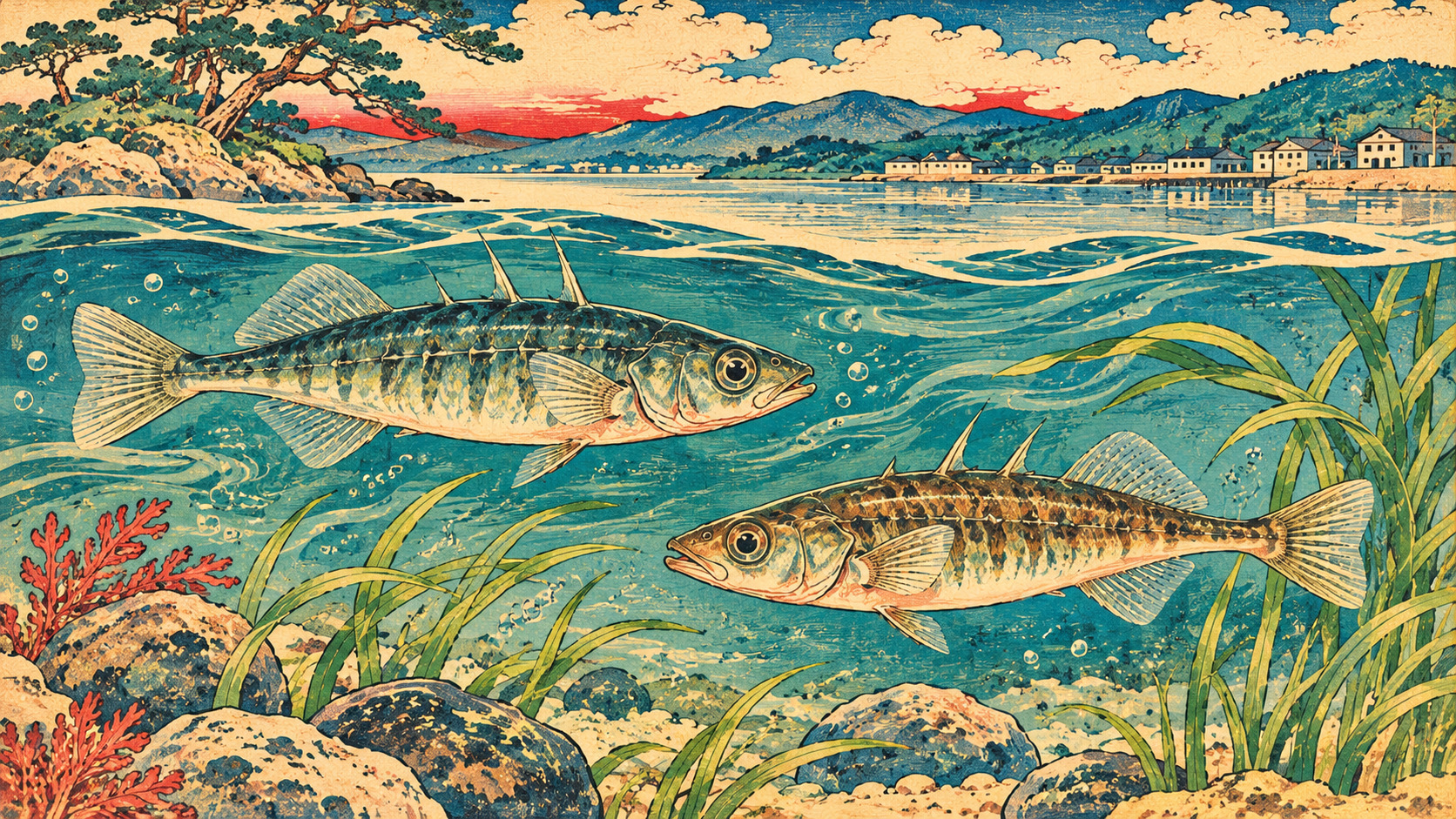
On March 11, 2011, the Great East Japan Earthquake and tsunami devastated coastal communities. In Ōtsuchi, Iwate Prefecture, flooding and land subsidence also transformed parts of the former town center into freshwater spring-fed ponds. These new habitats brought together two closely related fish with very different ecological habits.
One was the freshwater form of the threespine stickleback, Gasterosteus aculeatus. The other was Gasterosteus nipponicus, the Japan Sea stickleback, a marine and migratory species. Researchers discovered that the fish had hybridized in the newly formed water bodies. The event made it possible to follow how the descendants of two species changed over successive generations.
A study published in Nature Ecology & Evolution on September 25, 2026, drew on samples collected for nine years, from 2012 through 2020. Japanese institutions announced the findings on September 28; Science Japan covered them on November 19. This is a new explanation of a published scientific result, not a claim that the genetic change first happened this November.
Thirty-eight percent hybrids: a surprising starting point
In 2012, hybrids represented 38 percent of sampled individuals. The authors propose that tsunami waters carried marine sticklebacks into the flooded area while backwash moved freshwater fish down from upstream. The exact route taken by each individual cannot be reconstructed, but the newly shared habitat created an unusual opportunity for interbreeding.
That early mixture did not persist in the way a simple image of two populations merging might suggest. As researchers sampled subsequent generations, the proportion of genetic variants descended from the marine Japan Sea stickleback fell sharply. By 2020, the population was genetically almost entirely dominated by freshwater G. aculeatus ancestry.
The investigators compared the observed changes with computer simulations representing random genetic drift. Most tracked marine-derived alleles disappeared more quickly than drift alone would predict. That pattern pointed toward biological barriers to gene flow—including adaptation, habitat choice and reproductive incompatibilities—rather than chance as the whole explanation.
Species identity is more complicated than whether animals can mate
A common misunderstanding about speciation is that two species must never produce offspring together. Biology is less tidy. Hybridization can occur even between well-differentiated lineages, while the success of the resulting descendants depends on the ecological conditions they encounter and their ability to reproduce.
The freshwater and marine sticklebacks differ in their capacity to survive freshwater conditions, in migration toward the sea, and in mating and fertility traits. Some of those characteristics are shaped by genetic regions that can keep lineages distinct even after initial hybridization.
The study's 'restored species boundary' refers to the decline of much of the marine species' ancestry within this particular pond population. It does not mean all damaged coastal habitats were restored, that the tsunami benefited biodiversity, or that no marine-derived DNA survived anywhere.
Freshwater survival and the urge to migrate
Ecology gave the study's genetics a biological mechanism. The team found that G. nipponicus survived freshwater environments less well than G. aculeatus, with hybrids showing intermediate survival. Marine fish were also more inclined to move seaward, while hybrids again occupied an intermediate position.
Such differences can change which individuals remain in the pond and leave offspring. A fish that moves away or struggles to survive there may contribute fewer descendants to a population living in freshwater. Evolution in this setting is not a deliberate recovery plan; it is a shift in the frequency of inherited variants as ecological and reproductive conditions act across generations.
Researchers linked unusually rapid loss of marine ancestry to regions associated with freshwater adaptation, migration, mate choice and male hybrid sterility. Their results suggest that strong barriers at particular locations in the genome helped set the direction of change early in the process.
Chromosomes reveal another layer of reproductive isolation
Using genomic markers that distinguish the two species, the researchers analyzed how ancestry changed at 667 diagnostic loci. They found that rates of loss were not uniform. Some genome regions shed G. nipponicus-derived alleles especially quickly, while others retained remnants longer.
Of particular importance were ancestral and newly evolved X-chromosome regions associated with reproductive isolation. These sex-linked regions appeared to form strong barriers to the movement of genes from one species into the other's genomic background.
The findings also argue against an explanation based on only a handful of big-effect genes. Many smaller genetic incompatibilities scattered across the genome may have contributed to the rapid overall decline in introgressed marine ancestry. The exact contribution of each mechanism remains a subject for further testing.
Why a nine-year record matters to evolutionary biology
The most unusual feature of this investigation may be its timing. Scientists rarely witness the birth of a natural hybrid population and then return often enough to reconstruct what happens to its genome. A single sample can show that hybridization occurred; repeated samples reveal which ancestry persists and which disappears.
The team followed the Ōtsuchi population annually across a period corresponding to roughly ten generations, using genome sequencing approaches including RAD-seq. Because the generation time was about one year, the pace of change could be measured on a human research timescale rather than inferred solely from ancient genetic signatures.
Field evidence has limits. Immigration after the initial event cannot be categorically ruled out, and survival, migration and fertility interact in the wild. But continuous observation of a real population offers a rare test of hypotheses that would otherwise remain largely theoretical or depend on controlled laboratory crosses.
A long history of sticklebacks—and of the species question
Sticklebacks have been central to evolutionary genetics because different lineages have repeatedly adapted to distinct environments. Comparisons between marine and freshwater forms have helped scientists investigate how selection, development, body form and behavior can diverge while retaining recognizable evolutionary relationships.
The question extends back to Darwin: how do lineages remain distinct when organisms move and genes sometimes cross boundaries? Hybridization can erode differences, but ecological barriers and reproductive incompatibilities can also make that borrowing temporary. A newly created habitat makes the tension visible.
For this Japanese population, the researchers were able to follow ancestry changes rather than infer them from one contemporary snapshot. Yet the findings should not be stretched into a universal rule for every hybrid zone, fish species or natural disaster. Replication in other settings and mechanistic experiments remain essential.
What this study does not say about tsunami recovery
There is an ethical as well as scientific reason for precision here. The 2011 tsunami killed people and transformed Ōtsuchi's social and ecological landscape. Describing the disaster as an 'opportunity' for research should never be confused with calling it beneficial for the community.
The results concern genomic composition and reproductive isolation in one fish population that occupied a tsunami-created freshwater habitat. They do not measure a complete recovery of wetlands, fisheries, coastal food webs or the broader regional ecosystem. Even within the hybrid population, the decline of foreign ancestry is not synonymous with the disappearance of every trace of it.
The technical term 'purging' refers to the reduction of alleles introduced through hybridization. It is not a claim that anyone removed animals or deliberately engineered the population. Nor does it establish a simple hierarchy in which one species is inherently superior; ecological fit and reproductive processes are specific to the habitat.
After the genomic shift, the unanswered questions
The work provides evidence that major reproductive-isolation loci and smaller incompatibilities together can preserve species identity after substantial mixing. In the first generations, barriers associated with freshwater survival, migration and reproduction acted especially strongly; thereafter ancestry declined across much of the genome.
The next step is to identify causal pathways more precisely, test why particular sex-linked regions resist introgression and determine whether similar patterns appear in independent hybrid populations. Scientists must continue distinguishing direct measurements from the interpretations supported by models.
Nine years of fieldwork made a rare sequence visible: an environmental shock created contact, interbreeding followed, and much of one species' genomic contribution faded. What lasted was not an untouched landscape, but a clearer understanding of how boundaries between species can endure even when their genes briefly intermingle.
Sources, method and limitations
This independent report is based on the September 25 peer-reviewed paper, September 28 primary Japanese institutional announcements, and Science Japan’s November 19 coverage. We did not conduct fieldwork, independently reanalyze genome data, or interview the investigators. The genomic findings must not be confused with broader environmental recovery.