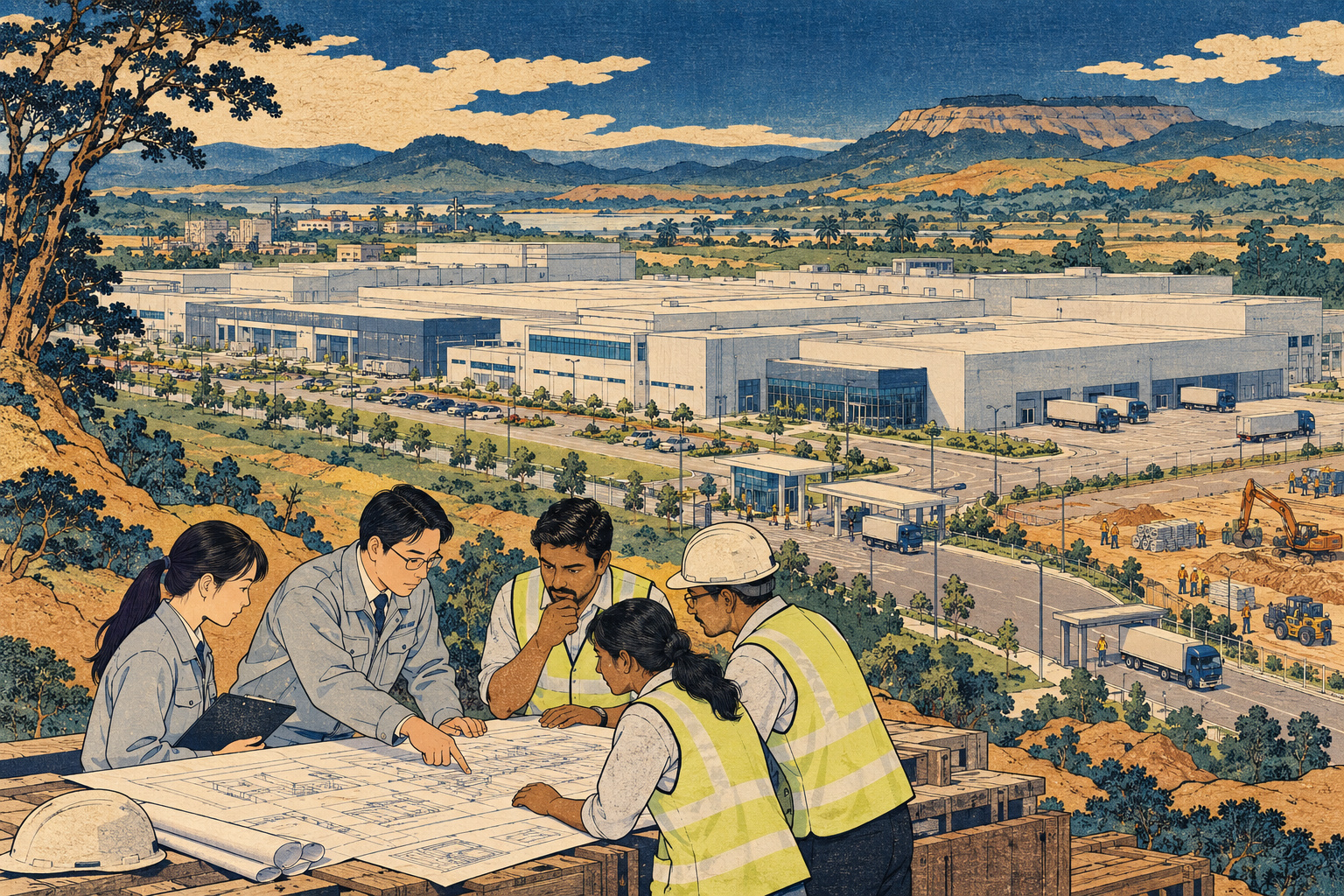
Toyota’s planned vehicle plant in Maharashtra will need more than an assembly line. It will need a supply network ready to deliver the right parts, at the required quality, from the start of production. Toyoda Gosei’s proposed factory in the same industrial area is one piece of that preparation—and a test of how efficiently a Japanese supplier can turn India’s automotive growth into durable earnings.
Announced on September 24, the project carries a company-stated investment of approximately ¥9.3 billion and a planned production start in the first half of 2029. It will operate as a branch of Toyoda Gosei South India in the Bidkin Industrial Area, making bumpers and instrument panels among other components. The company describes it as its eighth location in India.[1]
| Location | Bidkin Industrial Area, Maharashtra |
|---|---|
| Production start | First half of 2029, planned |
| Land / buildings | Approximately 78,400 m² / 29,200 m² |
| Employment | Approximately 570 people by 2030 |
Source: Toyoda Gosei. These are planned dimensions, timing and staffing.[1]
The customer’s timetable explains the location
Toyota’s May 11 announcement puts its new Toyota Kirloskar Motor plant in Bidkin on the same first-half-2029 timetable. Toyota plans initial capacity of 100,000 vehicles a year, approximately 2,800 employees and production of a new SUV, with stamping, welding, painting and assembly operations. It identifies India and surrounding markets as destinations for the plant’s output.[2]
That alignment gives the supplier project a specific commercial setting. The opportunity is not merely that India may sell more cars. A major customer has identified a production site and a launch window, giving suppliers a timetable around which to prepare tooling, trial parts and manufacturing processes. Capacity must become usable before it can become revenue.
Locating in the same industrial area could simplify transport and coordination. It also links the supplier’s ramp-up to the customer’s execution. If vehicle production starts later or grows more slowly than anticipated, a parts plant may carry staff and equipment costs before volumes reach the expected level. Toyota’s stated annual capacity is consequently useful context, not evidence of a guaranteed order for that many sets of Toyoda Gosei parts.
An India network built over successive customer programs
The expansion follows years of investment in both manufacturing and development. In 2018, Toyoda Gosei established a technical and sales office near Delhi, explaining that proximity to Maruti Suzuki India would speed up its work with the customer. Later that year, its Gujarat plant began production, supplying products including airbags to Suzuki Motor Gujarat.[4],[5]
In September 2024, the company began production in an expanded building at its Neemrana airbag operation. It also announced a separate factory project at Harohalli in southern India that month. These developments show a network evolving around customer requirements across several regions, rather than a first move into an unfamiliar country.[6],[7]
A local factory is only one layer of that network. Engineering staff who can resolve specification changes, suppliers who can provide consistent materials and technicians who can support equipment all influence how quickly a site responds. For other manufacturers considering India, this is the more instructive story: localization concerns organizational capability as well as where a building stands.
From rubber research to the parts occupants see and rely on
Toyoda Gosei traces its roots to a rubber research operation established within Toyoda Automatic Loom Works in 1934. It became the independent Nagoya Rubber company in 1949 and adopted the Toyoda Gosei name in 1973. Its product history expanded from rubber into large plastic components, instrument panels and airbags.[3]
That evolution helps explain why a project centered on interior and exterior parts matters. The supplier is investing in components whose dimensions, appearance and assembly characteristics have to work with the vehicle around them. Increasing output is therefore inseparable from reproducing quality. A factory can have ample theoretical capacity while still falling short of what the customer can accept.
Existing earnings give the investment a firmer foundation
For the year ended March 2026, Toyoda Gosei’s India segment reported revenue of ¥51.858 billion, up 22.4%, and operating profit of ¥5.767 billion, up 32.3%. Segment revenue includes intersegment sales. The company attributed the improvement to factors including higher customer production and cost reductions.[8]
Those results establish an existing business generating earnings; they do not establish the economics of the proposed plant. The figures cover the wider segment and its operating sites. A new facility must absorb preparation, training and commissioning costs before reaching steady production. Its return will depend on utilization, pricing, quality and cost performance rather than the growth rate of the existing network alone.
The company’s 2030 Business Plan identifies India among its priority regions and safety systems and interior/exterior products among its focus areas. It also emphasizes profit growth and capital efficiency. That makes the appropriate test of this project more demanding than whether another factory opens: does the additional capital produce a business able to earn through changing market conditions?[9]
A growing market still needs careful interpretation
The Society of Indian Automobile Manufacturers, or SIAM, reported approximately 4.64 million domestic passenger-vehicle sales for April 2025–March 2026, up 7.9%. These are industry domestic-sales figures, not consumer vehicle registrations. SIAM’s coverage excludes BMW, Mercedes-Benz, JLR and Volvo Auto for that annual total.[10]
Its August 2026 release reported passenger-vehicle sales growth of 36.5% from a year earlier, while noting that the comparison benefited from a lower base. A strong month supports the picture of demand momentum, but it is not a forecast for 2029. Suppliers making investments with long lead times need to consider what vehicles customers will build and what volumes can be sustained after the launch period.[11]
Automation is a question of cost and flexibility
The announced manufacturing approach combines large molding equipment and digital production management with collaborative robots and karakuri mechanisms. Karakuri uses simple mechanical arrangements such as levers and springs; Toyoda Gosei has described transferring low-investment automation developed in Thailand to other locations. A similar approach appeared in its earlier Harohalli plan.[1],[7],[9]
The underlying investment question is how much machinery each task requires. A sophisticated installation may raise output but also increase the cost of maintenance or modification. Simpler mechanisms can be useful where they meet the job’s requirements. The relevant measures are consistent quality, uptime, changeover performance and total operating cost—not the number of robots installed.
The staffing plan also requires care. Approximately 570 employees by 2030 is a future estimate, not a count of jobs already created. For the surrounding community, the value of the project would include training and sustained employment. For the company, building those skills is part of achieving a reliable production start. Recruitment and automation are therefore connected decisions rather than separate headlines.
The milestones that will turn a plan into a business
Construction progress will be visible, but it is not the only evidence that matters. Tooling readiness, trial production, customer acceptance and stable output after launch will determine whether the site can perform its intended role. These are practical milestones to follow, not outcomes already reported for Bidkin.
For purchasing teams and local suppliers, the project indicates where new capabilities may be needed. For investors, the question is whether capital committed ahead of demand can generate acceptable returns once production begins. For employees, it is whether the facility creates a lasting place to develop skills and work safely.
Toyoda Gosei’s plan is consequential because it connects an identifiable automaker expansion with a supplier network that already has a history and an earnings base in India. The next stage will require the less visible work behind every successful factory launch: making quality repeatable, preparing people and keeping costs aligned with actual customer demand.
