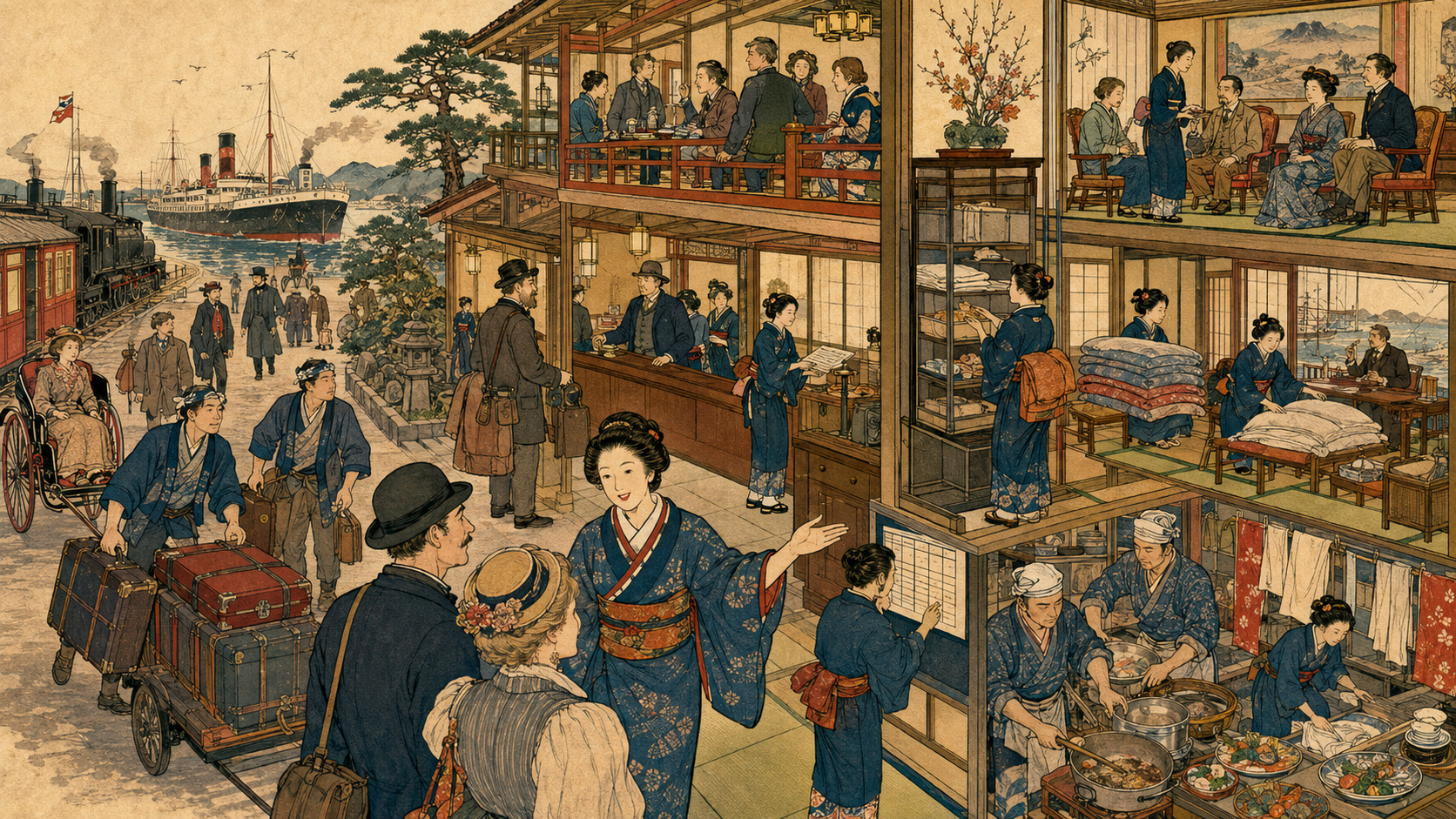
At three in the afternoon, guests collect in a hotel lobby. A clerk checks a reservation on one screen, changes the room assignment on another and waits for confirmation that cleaning has finished upstairs. In the kitchen, cooks match dinner orders with an allergy list. Then a phone rings. No replacement has been found for an absent worker. Rooms that could have been sold stay dark.
A room night is perishable. A hotel cannot save its vacant room from August 7 and sell it twice on August 8. A shift left uncovered tonight is revenue lost forever. That fact makes lodging unusually difficult to run: too little demand produces empty inventory, while a sudden surge can break the roster. The product is not the room alone. Reservation, arrival, cleaning, food, safety, complaint handling, local guidance and departure must be assembled by people, in sequence, every day.
Japan’s 2026 Tourism White Paper, released July 10, places unprecedented demand beside a supply system struggling to receive it. In 2025, inbound visitors reached 42.68 million, up 15.8%, and their spending reached ¥9.4549 trillion, up 16.4%. Both were records. Japanese domestic travel spending also set a record at ¥26.8 trillion, while all travel spending inside Japan totaled ¥37.6 trillion. Yet 72.2% of lodging properties answering a government survey said they faced a labor shortage.
A Demand Record Meets an Operating Limit
Foreign visitors generated 177.87 million guest nights in the preliminary numbers used by the white paper, 8.2% more than a year earlier and a record. Japanese guest nights fell 3.8% to 475.61 million. Inbound demand kept the national market high, but roughly seven in ten foreign guest nights remained in the three largest metropolitan regions. Areas outside them accounted for only about 30%. “Boom” is not a uniform condition spread across the map.
Occupancy also tells different stories by business type. Final 2025 figures put business hotels at 75.3% and city hotels at 74.1%, while ryokan inns averaged 38.2%. A city property can have customers but lack the people to open every room. A rural inn can suffer from weak weekdays, a short peak and the same recruiting shortage. Closed rooms and scarce workers can coexist.
The white paper follows the Fifth Tourism Nation Promotion Basic Plan, approved by the Cabinet in March 2026. Its special theme is the strength of destinations and the tourism industry: labor, lodging productivity, new technology and resilience. The policy question has moved beyond how many people Japan can attract. It is whether tourism can be good for residents, good for visitors and, crucially, good for the people who work in it.
Productivity Does Not Mean Running Faster
In fiscal 2024, lodging labor productivity was ¥5.87 million in value added per average worker, compared with ¥8.17 million across all industries. Lodging stood at 72% of the all industry benchmark. It had been only ¥4.28 million, or 60%, in 2019, then collapsed to ¥2.42 million, or 35%, in 2020. Revenue recovery and higher room prices helped it rebound, but the structural gap survived.
Because the measure divides value added by workers, it can rise when a hotel prices a valuable stay correctly, removes repeated data entry, smooths demand and moves employee time toward work a guest values. It does not automatically rise when a cleaner is assigned an impossible number of rooms. If understaffing forces the hotel to close rooms or cancel meals, both revenue and value added can fall even though fewer people are on the payroll.
Capital investment points to another gap. Tangible fixed investment per employee in fiscal 2024 was ¥1.24 million across all industries but ¥750,000 in lodging. Training was weak as well: 50.3% of lodging businesses conducted no off the job training, and 52.2% provided no planned workplace training. When a property is too busy to teach, it cannot redesign work. When margins are too thin to invest, the low margin process survives.
- Among properties with shortages, 79.3% could not staff peak periods adequately and increased the burden on current workers.
- 40.6% had to reduce part of their service.
- 21.5% abandoned desired expansion or higher occupancy.
- 50.4% incurred extra time or expense trying to recruit.
The Edo Inn: Hospitality Was Always a Labor Network
The story begins before the modern hotel. Along the five main highways of the Edo period, post stations contained honjin for elite travelers, wakihonjin, hatago inns and simpler lodging. They served official processions, pilgrims, merchants and people traveling to hot springs. A hatago supplied a bed and food, but the post town also transferred baggage, horses, workers and news to the next station. Lodging was a node in a regional transport and labor network.
Demand moved with weather, festivals, pilgrimage seasons and official travel. Food spoiled. Family members, resident workers, carriers and neighboring businesses absorbed the peaks. In contemporary management language, that resembled multiskilling and regional labor sharing. Yet the flexibility also rested on hierarchy, long hours and family labor. When hospitality is remembered only as a timeless virtue, the people who paid its hidden cost disappear.
Railways changed the travel map after the Meiji Restoration. Western style hotels appeared near treaty ports, stations and major destinations. Foreign guests required beds, Western meals, sanitation, language ability and predictable reservation standards. The personal service of the ryokan and the repeatable processes of the hotel competed, borrowed from each other and created a distinctive Japanese lodging industry.
In 1909, Hotels Began Solving Inventory Together
In 1909, 28 properties founded the organization that became the Japan Hotel Association. In 1920, it worked with the Japan Tourist Bureau to radio hotel room availability to foreign ships approaching port. In 1929, the association and the Railway Ministry advertised jointly in the United States.
The radio notice is an old story with a modern logic. Competitors pooled accurate inventory data and connected it with travelers before arrival. The technology moved from radio to telephone, fax, travel agency ledgers, computerized reservation systems, online travel agencies and property management systems. The operating problem stayed recognizable: sell the right room to the right guest at the right time without double booking it.
The 1948 Hotel Business Act built a public health and licensing framework for the postwar industry. The 1949 law promoting hotels for international tourism encouraged facilities able to receive foreign visitors. Japan needed foreign currency during reconstruction, and hotels were both an export business and a public face of the country.
1964 and the Mass Production of a Night Away
The Tokyo Olympics and the Tokaido Shinkansen changed hotel demand and the meaning of distance in 1964. The Japan Hotel Association records it as the first hotel boom and helped manage Olympic catering. A second, larger scale hotel boom followed in 1969, then a third centered on high rise hotels in 1971.
Higher incomes, railways, expressways, group tours, company outings and school travel created a vast market for hot spring ryokan. The one night, two meal model, with a banquet dinner, room guidance, futon preparation and breakfast, worked well when a travel agency delivered a predictable group. Kitchens and service could prepare at scale. Young regional workers and live-in employment absorbed busy periods.
The success left buildings and routines designed for another demand pattern: banquet halls, several elaborate dishes, split shifts and tightly separated job categories. As individual travel grew, arrival times, diets, booking sources and desired activities fragmented. Modern personalization was layered on top of the old mass model. Each stay required more coordination even when its price did not rise.
After the Bubble, Price Comparison Changed the Bargain
Resort construction in the late 1980s created large lodging and leisure projects across Japan. After the asset bubble burst, debt, aging buildings and the decline of group travel weighed on many properties. Internet booking spread from the late 1990s and 2000s. It gave a small inn national reach, but it also put competing room prices on a single screen.
Commissions, inventory across several platforms, last minute pricing and review management became new forms of work. Limited service hotels spread in cities, using standard operations and fewer food and banquet functions to deliver a lower price. Traditional ryokan faced pressure to move toward distinctive value or simpler service. Properties in the middle could be trapped between the labor cost of elaborate hospitality and a commodity room rate.
In 2003, the government set a goal of ten million visitors by 2010 and began the Visit Japan Campaign. The Tourism Nation Promotion Basic Law was enacted in 2006 and took effect in 2007. The Japan Tourism Agency opened in October 2008. Tourism moved from the administrative margins of leisure policy toward the center of regional economics and national growth strategy. Inbound visitors passed ten million for the first time in 2013 and reached 31.88 million in 2019.
In 2020, the Chain of Skill Broke
COVID-19 produced the sharpest demand collapse the modern lodging industry had experienced. Total guest nights fell 44.3% in 2020 to 331.65 million. Foreign guest nights fell 82.4% to 20.35 million. Occupancy dropped to 34.3% overall and 25.0% at ryokan. Inbound arrivals fell 87.1% to 4.116 million.
Hotels closed, reduced service, loaned employees to other businesses or watched them leave. The skill stored in lodging is not merely knowledge of a reservation screen. It is reading a guest’s uncertainty, sequencing dozens of meals, hearing that a machine sounds wrong and changing travel advice before bad weather stops a train. When experienced people depart, their judgment does not reappear the morning that customers return.
Border controls eased in 2022. A weak yen and the global travel recovery brought demand back faster than the labor system. People who had found work in industries with steadier hours needed a reason to return. If pay, night work, split shifts, limited days off and seasonal instability were unchanged, “tourism has recovered” was not a persuasive job offer. The pandemic did not invent the labor shortage. It exposed and accelerated an older employment bargain.
The Meaning of a ¥1.33 Million Pay Gap
Average annual pay in 2025 was ¥4.13 million in lodging and ¥5.46 million across all industries, a gap of ¥1.33 million. Nonregular workers were 54.7% of lodging employment, compared with 36.5% across all industries. Annual days off in lodging and food service were also below the all industry average. Regional living costs may differ from Tokyo, but compensation must still be judged against nights, weekends and the skills the work demands.
Part time work is not inherently poor work. It helps an industry respond to seasonal demand and can suit students, parents and older workers. The problem comes when central functions depend on a revolving group of low paid workers while overloaded permanent staff repeatedly train them. Quality becomes fragile and a career path never forms. Multiskilling without allowances, evaluation and training is just several jobs placed on one person.
The white paper found labor shortages at 66.0% of small properties with annual sales under ¥100 million, 77.1% of medium properties from ¥100 million to under ¥1 billion, and 69.9% of large properties. A medium property can retain the complexity of restaurants, banquets and several departments without the recruiting brand or investment capacity of a national company. Different scales require different remedies.
- Among properties with higher profits, 81.2% cited room price increases and 49.5% cited more inbound guests.
- Among those with lower profits, 78.0% cited material costs and 70.7% cited labor costs.
- 42.3% said service reductions caused by labor shortages contributed to lower profit.
- Higher prices are necessary, but the turning point is whether the proceeds return to wages, time off, training and equipment.
Digital Transformation Is Not a Tablet in the Lobby
The Tourism Agency defines tourism digital transformation broadly: seamless reservation and payment, integrated operations through property management systems, use of customer and regional data, shared regional sales, and technical standards that let systems connect. Replacing a paper guest card with a tablet achieves little if staff must type the same details again into booking, cleaning and accounting systems.
Self check-in, room cleaning management, service robots, translation, demand forecasts and generative AI can remove repetition and late night clerical work. Yet in the survey, properties most often reported results from foreign talent at 30.2%, improved labor conditions at 25.2%, and short shift or event staff at 22.3%. Individual digital measures generally sat near one in ten; generative AI was 4.2%. “Nothing in particular” was 29.4% overall and 47.5% among small properties.
Those results do not prove technology has failed. They show that equipment alone is not transformation. A property must fund adoption, connect old systems, organize its data, train employees and change the underlying process. In some places, shared regional booking, cleaning, delivery and recruitment infrastructure may work better than asking every family inn to buy and maintain its own stack.
An Aichi Inn Earned More by Opening Less
Hotel Suehiro in Gamagori, Aichi Prefecture, is the white paper’s most striking reversal of conventional wisdom. The inn studied its finances and occupancy by day, then established a fixed closure from Tuesday through Thursday. It renovated rooms, revised menus to create more value and trained employees to perform several functions. People who acquired additional duties received allowances and recognition in evaluation.
Revenue fell to roughly two thirds because the inn operated fewer days, but its profit margin rose 15%. Closed days saved fuel and created time for repair. Schedules became predictable and the hotel stabilized hiring of younger people. It succeeded by becoming deliberately smaller: concentrating labor, equipment and guest experience on the days that could produce value.
A three day closure is not a universal formula. A hot spring inn and an urban business hotel have different demand and costs. The transferable lesson is that Suehiro used data rather than custom to choose its operating design, and returned part of the efficiency gain to work quality and compensation.
Atami, Nara and Kurokawa: Experiments Beyond One Hotel
Atami in Shizuoka Prefecture used generative AI to analyze social and large scale data from Taiwan, Thailand and the United States, examine questions brought to the tourism desk and translate posts. According to the white paper, the main analysis workload fell to about one fifteenth of its former level, while analysis of inquiry trends fell to about one quarter. Staff could move from compiling information to deciding what the destination should say and do.
The Nara Visitors Bureau tested regional employee sharing with Hokkaido and Fukui, whose busy periods differ. In November 2024, two beverage service workers from a Hokkaido hotel worked at a Nara hotel. The receiving property protected occupancy while the employees exchanged skills. Housing, travel cost, employer responsibility, matching and a lasting revenue model remain unresolved, but the idea treats seasonality as a relationship between regions rather than the surplus or shortage of one company.
The Kurokawa Onsen Ryokan Cooperative in Minamioguni, Kumamoto, uses proceeds including those from its hot spring hopping pass to support joint induction, training, awards, open company events and a Kurokawa academy. The district develops people for the destination, not only for one inn. Its Kurokawa-juku leadership program produced 63 graduates over six cohorts. It is a shared human resources department that small properties could not build alone.
Foreign Talent Must Be More Than a Patch
Foreign talent was the measure most often judged effective in the labor shortage survey. In an industry serving multilingual travelers, an overseas employee contributes more than one additional pair of hands. Language, culture and knowledge of foreign sales channels can shape the product itself.
But people will not stay if housing, residency procedures, Japanese instruction, night shifts and promotion are ignored, or if management sees them only as cheaper labor. Japan’s Specified Skilled Worker route has widened entry into lodging; the industry also needs visible exits and next steps. Can a front desk worker progress into reservations, revenue management, food, facilities, destination management or leadership? For workers of any nationality, skill must connect to pay and authority.
Better conditions are a cost, but so is a closed floor. Recruitment advertising, agency labor, overtime, repeated training, damaged reviews and unsold rooms rarely appear on one line of the wage table. Management should measure higher pay as an investment in rooms that remain sellable and service that remains trustworthy.
More Value Is Not Simply More Luxury
If Japan pursues the government’s 2030 goals of 60 million inbound visitors and ¥15 trillion in spending through volume alone, crowding, transport gaps, waste, housing conflict and worker exhaustion will grow. Value per visitor and per night must rise, and demand must spread across regions, weekdays and seasons.
Higher value is not just marble in a lobby. It can be an experience that encourages a longer stay; proper payment to local farmers and craftspeople; guidance toward quieter hours; accessible rooms; thoughtful options for families and long stays; direct booking that reduces commissions; and a price that covers the work. A guest who does not want dinner should not be forced into a costly package. A guest who wants it should receive food worth its labor.
Japan raised the international tourist tax from ¥1,000 to ¥3,000 on July 1, 2026. The related fiscal 2026 budget increased from ¥49 billion to ¥130 billion, with spending for smoother travel and crowding measures, promotion, and regional cultural, natural and food content. A larger tax creates a stronger obligation to show that visitors, residents and workers experience the improvement.
Eight Measures for an Industry That Works
| Question | Measure | Why it matters |
|---|---|---|
| Workforce | Vacancy, turnover and three year retention | Hires alone do not show whether skill accumulates |
| Conditions | Real hourly pay, days off, night and multiskill allowances | Annual pay must be read with hours and difficult shifts |
| Productivity | Value added per worker, sellable rooms and overtime | Exposes “efficiency” achieved only by removing people |
| Investment | Capital per worker and connected system use | Success is the disappearance of repeat entry, not the purchase |
| Training | Learning hours, certified skills and internal promotion | Prevents multiskilling from becoming unpaid work expansion |
| Price | Room rate, direct booking and regional purchasing | Shows whether higher prices reach wages and local income |
| Distribution | Regional share and weekday or off season occupancy | Reduces crowding and extreme peaks better than a visitor total |
| Community | Resident sentiment, transport, waste and housing effects | Visitors alone cannot define tourism success |
From Highway Inns to AI: A Labor Timeline
Edo period Post towns, hatago and hot springs connect travelers, baggage, information and regional labor.
Meiji era Railways and treaty ports foster Western style hotels and standards for beds, meals, sanitation and reservations.
1909 Twenty-eight hotels form the association that becomes the Japan Hotel Association.
1920 Hotels radio room availability to approaching foreign ships, an early shared inventory system.
1948–49 The Hotel Business Act and international tourism hotel law establish postwar health, licensing and visitor frameworks.
1964 Tokyo Olympics and Tokaido Shinkansen. The first hotel boom grows beside group tours and large ryokan.
1969–71 Large scale and high rise hotel booms follow.
2003 The Visit Japan Campaign makes ten million inbound visitors a national target.
2007–08 The Tourism Nation Promotion Basic Law takes effect and the Japan Tourism Agency opens.
2019 Japan welcomes 31.88 million inbound visitors before the pandemic.
2020 Guest nights fall 44.3%; closures and departures break the chain of skills.
2025 Visitors reach 42.68 million and spending ¥9.45 trillion, while labor capacity remains tight.
2026 The fifth tourism plan and white paper put good work, productivity, technology and regional distribution at the center.
Before Japan Welcomes 60 Million
For more than a century, Japan has become progressively better at connecting demand with the country. Hotels radioed available rooms to ships; travel agencies filled banquet halls; online platforms placed a family inn on a global screen; social media made an unknown town visible overnight. The present shortage is no longer customers. It is the management capacity to convert expectations into a valuable stay without destroying the lives of the people doing the work.
There is no single hotel business. Large groups possess capital and data but can struggle to change a vast organization. A family ryokan can adapt quickly but lacks purchasing and recruiting scale. Medium properties carry complicated services without the resources of a national chain. A uniform subsidy for robots cannot solve all three. Shared purchasing, regional systems, employee housing, transport, training, succession and labor exchange must be combined.
The white paper’s heaviest figure may not be 72.2% or ¥5.87 million. It may be the 47.5% of small properties that reported no particularly effective response to their labor shortage. Tools have not reached them, they cannot use the tools, or tonight’s roster leaves no time to redesign tomorrow.
The Edo post town ran lodging as a regional network. Hotels joined forces in 1909 and shared room information by 1920. The 1964 industry reorganized itself for an Olympic surge. History shows that Japanese lodging is not an unchanging tradition. It has repeatedly redesigned work around a changing form of travel.
The next redesign begins by refusing to treat omotenashi as an infinite supply of personal sacrifice. Enter reservation data once. Close on a day that cannot cover its costs. Raise the room price. Return the gain to wages and predictable rest. Train people across a destination and exchange them with regions that peak at a different time. Promote foreign workers into management. Give compilation to AI and return human attention to a worried traveler.
To light the dark floor at three in the afternoon, a hotel does not merely need to find one more person at the edge of the wage market. It needs a design in which that person can still be there next year, learning, resting and teaching the next hire. Japan’s next tourism record should not be measured by arrivals alone. It should be measured by the value left with all three parties after checkout: traveler, community and worker.
Reporting Notes and Principal Sources
Public information was checked through August 7, 2026, 9:02 a.m. JST. The 2026 Tourism White Paper is the statutory annual report required by Article 8 of the Tourism Nation Promotion Basic Law. Preliminary and final lodging totals, survey years and fiscal years differ across sources. Productivity is a value added measure; alone it does not express quality, health, safety or satisfaction.
- Japan Tourism Agency: Release of the 2026 Tourism White Paper
- Japan Tourism Agency: 2026 Tourism White Paper Overview
- Japan Tourism Agency: 2026 Tourism White Paper, Part I
- Japan Tourism Agency: 2025 Annual Lodging Statistics, Final
- Japan Tourism Agency: 2020 Annual Lodging Statistics
- Japan Tourism Agency: 2020 Inbound Visitor Total
- Japan Tourism Agency: Fifth Tourism Nation Promotion Basic Plan
- Japan Tourism Agency: Tourism Nation Promotion Basic Law
- Japan Tourism Agency: Organization and Role
- Japan Tourism Agency: Tourism Digital Transformation
- Japan Tourism Agency: Hotel IT Introduction Casebook
- Japan Tourism Agency: Lodging Productivity
- Japan Hotel Association: Association History
- e-Gov Law Search: Hotel Business Act