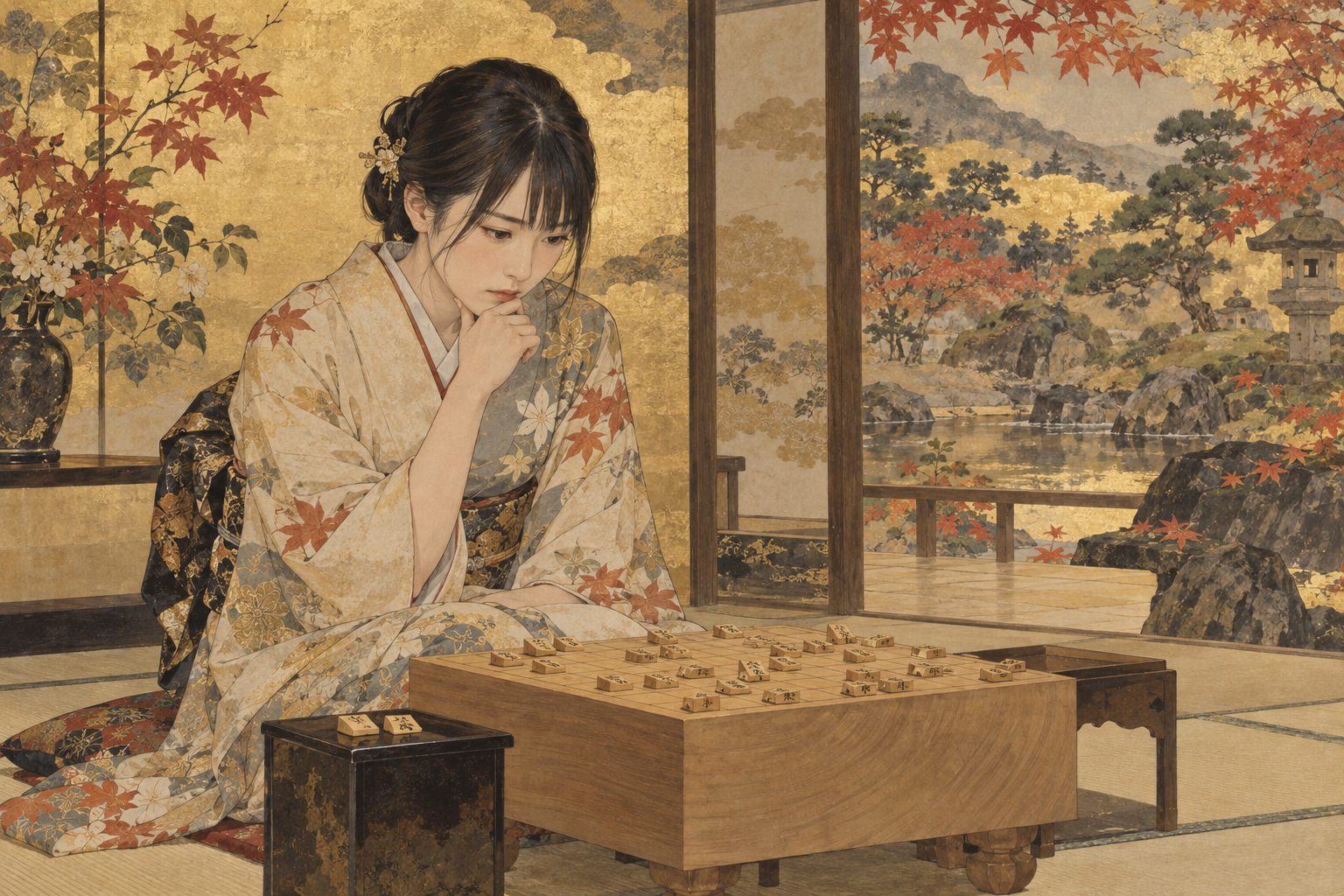
A victory, and a decision no previous woman has faced
On October 10, Tomoka Nishiyama defended the Hakurei title in Kanazawa, winning Game 5 of a best-of-seven series against Kana Fukuma. The final score, four games to one, gave Nishiyama her fifth Hakurei championship and eligibility to enter a professional shogi classification that no woman has yet joined.
The distinction matters. She has not automatically changed her status. The rule gives her a choice, and when reporters asked whether she would exercise it, she declined to give an immediate answer. This is a story about an outstanding player who has earned a new option—not about a career decision that has already been made.
Why there are two kinds of professional player
For readers outside Japan, the words can be confusing: Nishiyama is already a professional shogi player. She competes and holds titles as a joryu kishi, under the women’s professional structure. Yet the Japan Shogi Association separately administers the kishi system, which awards professional dan ranks beginning at fourth dan and is formally open to players of any gender.
The difference is not merely linguistic. The two pathways have different qualifying processes, tournament structures and career rules. Calling Nishiyama the “first woman professional” without qualification would erase generations of women who have played professionally. The milestone would be the first female kishi within the association’s other professional classification.
The game that opened the door
The deciding match took place at Hotel Nikko Kanazawa. According to the official Hakurei match blog, play began at 9 a.m. Nishiyama, playing second, adopted a third-file rook formation. The endgame developed into a tense exchange of attacks, with the official commentary describing finely balanced positions and consequential thinking time.
The result came after 118 moves at 5:30 p.m. Fukuma used the full four-hour allotment; Nishiyama’s recorded time was three hours and 23 minutes. These details are documented. Claims about precisely what Nishiyama felt at particular moments, or an unreported decisive insight, would be invention.
A career built against the old gate
Born in 1995 in Osakasayama, Osaka Prefecture, Nishiyama entered the Japan Shogi Association’s Shoreikai apprentice system in 2010 at age 14. She reached the intensely competitive third-dan league, where contenders vie for promotion to fourth-dan professional status, but left the system in 2021 without securing that promotion.
That long apprenticeship complicates any simple fairy tale about a rule suddenly rewarding an outsider. Nishiyama knows the traditional path through direct experience. Her later achievements in the women’s circuit were built alongside years of study and competition at the highest levels accessible to her.
She took the examination route, too
An established alternative route to becoming a kishi is a transfer examination for qualifying candidates. Nishiyama attempted that five-game test between September 2024 and January 2025, winning twice and losing three times. Three victories would have been sufficient.
The 2025 Hakurei rule is different. Instead of requiring success against a specified set of fourth-dan examiners, it recognizes sustained success in a separate elite women’s competition. Supporters and critics can reasonably disagree on how performances across those systems should be compared; the existence of that policy debate does not diminish the accuracy of her five-title achievement.
How the Hakurei tournament became a new gateway
The Hakurei competition began in 2021 and includes a structured women’s ranking league. Its creation enlarged the competitive platform for women’s shogi, adding an extended ranking pathway as well as a major championship. Nishiyama’s five Hakurei titles have now triggered both eligibility for the honorary Queen Hakurei distinction and a separate career qualification.
In June 2025, the association approved the new rule allowing five Hakurei titles to qualify a woman to join the main kishi ranks. Contemporary reports described debate around the measure. This is a rare case in which the rules of a professional sport have changed while a living champion was approaching the exact threshold.
Fukuma is part of this history, not a supporting character
Kana Fukuma, Nishiyama’s challenger, was herself a four-title women’s champion going into the Kanazawa match. Their rivalry is one of the pillars of contemporary elite women’s shogi. The fifth game belonged to a title series in which both competitors had prepared to win, regardless of the institutional consequences that awaited Nishiyama.
Reporting the match solely as a woman approaching a male-dominated institution risks overlooking the high competitive standards already established inside women’s shogi. The new rule must be understood alongside that long-developed ecosystem, rather than implying that meaningful excellence began only when a different professional status became possible.
What happens in the next two weeks
Contemporary accounts say Nishiyama has two weeks to declare whether she will exercise the new eligibility. After the match she indicated that she could not answer immediately and wanted to consider the matter carefully. At the October 12 research cutoff, the sources reviewed did not establish that a final decision had been announced.
If she proceeds, she would be the first woman to enter the kishi classification. If she declines, she remains the player who earned that right and defended her title. The newsroom should check an official association statement immediately before publishing and never convert speculation about her intentions into a reported fact.
The stakes are bigger than a headline
A first can transform public understanding of what is possible. It can also place an exceptional burden on the person carrying the symbolism. Nishiyama’s choice may involve competitive schedules, professional obligations and personal priorities; no reliable source available for this story discloses her private evaluation of those tradeoffs.
It would be irresponsible to claim that acceptance guarantees higher earnings, easier tournament access or a particular ranking trajectory. Those issues depend on applicable regulations and individual circumstances. The respectful question is not why she has failed to decide quickly, but what institutions owe an athlete who has reached an unprecedented decision point.
A much older game, still changing its rules
Shogi’s reputation rests on tradition, but its modern competitive life has constantly adapted: newspaper-sponsored championships, televised competition, internet broadcasts and computer analysis have transformed how games are followed and studied. Women’s leagues and titles also developed institutionally rather than springing fully formed from the game’s distant past.
The 2025 rule is part of that evolution. An association can honor the rigor of its qualifying standards while asking whether its pathways accurately recognize achievement. The question is not whether tradition matters, but how a living tradition responds when players produce results earlier generations of officials did not anticipate.
What genuine progress would look like
Nishiyama’s achievement will be visible to girls learning shogi in homes, schools and clubs. Whether it changes recruitment, coaching opportunities and retention is a separate question that will require statistics and sustained reporting. One celebrated player cannot, by herself, prove that the pipeline for future generations has become equitable.
What can be said today is precise and powerful: a champion completed the required sporting achievement, the new rule supplied an unprecedented eligibility, and the next move belongs to her. Her 118-move victory is settled history. Her answer is not.
Sources and verification
- 日本将棋連盟:西山朋佳 女流棋士データベース
- 日本将棋連盟:第6期白玲戦第5局案内
- 白玲戦公式中継ブログ:西山白玲が防衛(2026年10月10日)
- 白玲戦公式中継ブログ:勝負所の解説
- 日本将棋連盟:棋士編入試験規定(既存の別ルート)
- 日本将棋連盟:プロ棋戦の規定と女流の称号
- 日本将棋連盟:女流棋士の新引退制度(2026年)
- 時事通信:資格獲得と本人の判断保留(日本語)
- 共同通信:2025年規定と2週間以内の判断
- 時事通信:英語による制度説明
Source cutoff: October 12, 2026, JST. No confirmed decision to exercise the eligibility was found as of this review.