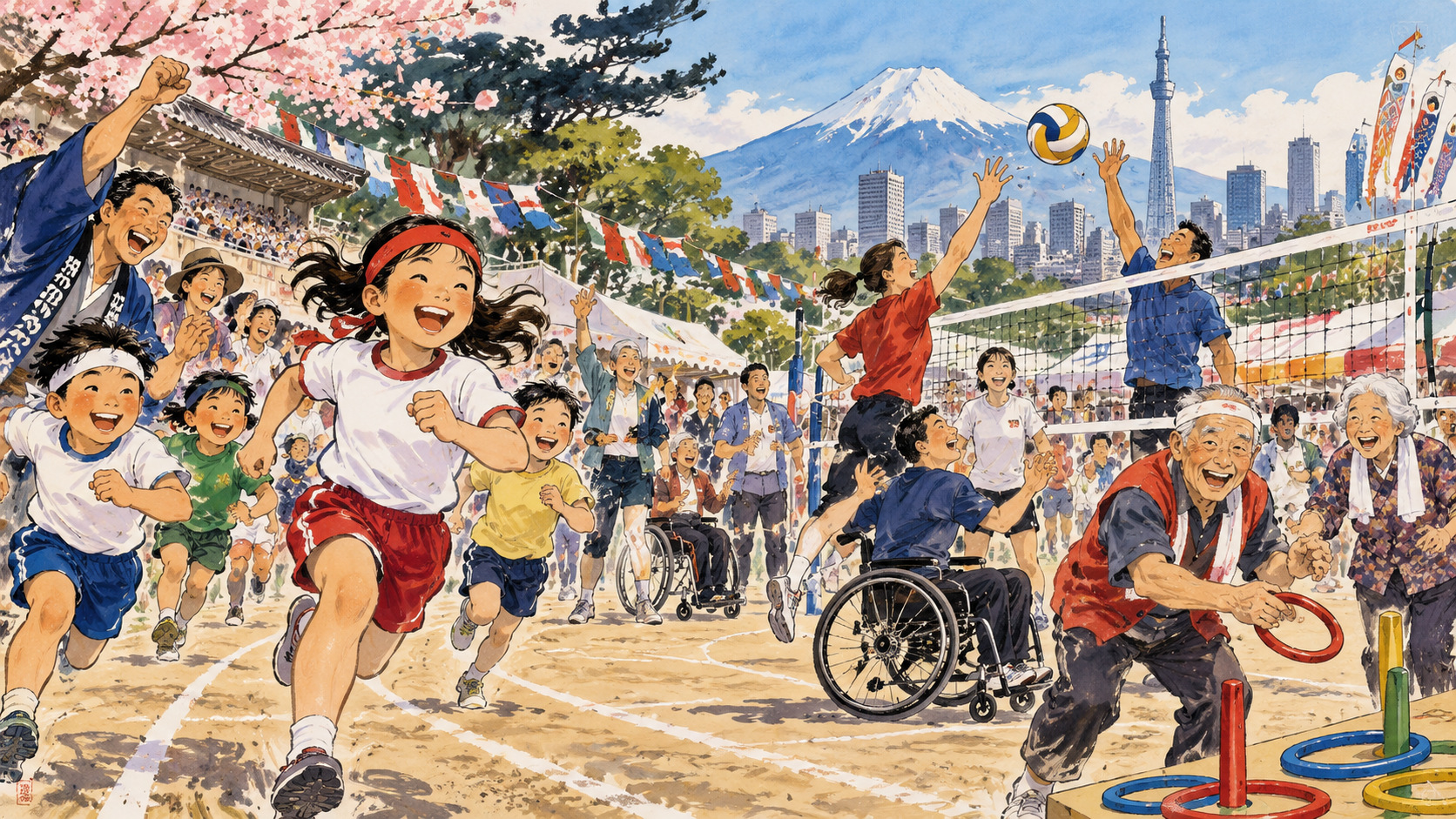
A few steps from Sendagaya Station, Tokyo Metropolitan Gymnasium is preparing to become something less intimidating than an Olympic venue. On Monday, October 12, families, first-time participants, older residents and people curious about adaptive sport are being invited to try activities rather than simply watch champions. The one-day festival offers a practical test of a question that has followed Tokyo since its Olympics: what does a sports legacy look like when the cameras have gone?
Sports Festa 2026 at Tokyo Metropolitan Gymnasium is scheduled for 10 a.m. to 5 p.m., with free admission. The Tokyo Sports Culture Foundation, the public-interest organization behind the event, calls it part of the fifth-anniversary legacy programming for Tokyo 2020, which ultimately took place in 2021. The event was still ahead when this October 10 edition was prepared. [1][2]
The date that gave Sports Day its meaning
October 10 is the anniversary of the opening of the 1964 Tokyo Olympic Games. Japan’s holiday was originally called Health and Sports Day and observed on October 10. The date moved to the second Monday of October in 2000, and the holiday was renamed Sports Day in 2020. Cabinet Office guidance emphasizes enjoyment of sport, respect for others and a healthy, energetic society. In 2026 the legal holiday falls on Monday, October 12—not Saturday the 10th. [6][7]
That evolution matters. Where the first Olympic Tokyo signified reconstruction and an international coming-of-age, the newer concept of sporting legacy asks whether a global event translates into everyday opportunity. A fully booked competition venue can be impressive without being welcoming to a child who has never played volleyball or a retiree wondering how to start exercising again.
Champions are part of the invitation
The organizing foundation names Jun Mizutani, a table-tennis gold medalist at Tokyo 2020, and Yukinobu Ike, a wheelchair-rugby gold medalist from Paris 2024, among the featured guests. An athlete talk segment is scheduled for 1:00–1:30 p.m. Their appearances put Olympic and Paralympic experiences in the same public conversation. [1][4]
There is an important difference between a promised program and an observed outcome. Organizers have advertised talks and demonstrations; that does not establish that every visitor will meet an athlete or that every activity will have unlimited admission. The final schedule and any session-specific entry arrangements should be checked before travel.
A menu designed for first attempts
The published program includes volleyball experiences, open table tennis, billiard-and-football hybrid billicker, boxing fitness, games with oversized blocks, bucket-based table tennis, e-Ninja activities, fitness testing and senior health-and-fitness consultations. This unusually broad range is an editorially interesting feature: it treats sport as movement and discovery, not exclusively as the pursuit of a podium. [1]
A first successful encounter with a new game can be more important to long-term participation than attending a professional match. Yet that possibility should not be overstated. The published schedule provides no demonstrated evidence that a one-day festival will increase sustained exercise, prevent disease or reduce inequality in access to sport. Those outcomes need follow-up data.
A volleyball manga as an access point
A special collaboration with the volleyball manga and anime Haikyu!! adds photo spots, character greetings and a stamp rally. The connection is not arbitrary: Tokyo Metropolitan Gymnasium is among the places associated with the series. A visitor who arrives for a fictional sports story may discover the real game alongside it. [1][4]
The commercial success of Japanese sports entertainment creates powerful cultural routes into participation. A character can make a volleyball court familiar long before a child joins a team. Whether this particular partnership changes behavior is unknown; its relevance lies in connecting a public sports facility with an audience that might otherwise pass it by.
Four public venues, not just one
The foundation also lists commemorative Sports Day programming at Komazawa Olympic Park General Sports Ground, Tokyo Budokan and Tokyo Aquatics Centre. The four-venue structure broadens the geographic footprint, though activities and access arrangements differ. Visitors should not assume the Gymnasium’s free experiences are identical at the other sites. [1]
The Gymnasium additionally plans to open its training room, swimming pool and track facilities without charge. The published access window is 9:00 a.m.–8:45 p.m., except for the 25-meter pool, currently scheduled from 3:00 p.m. to 8:45 p.m. These hours are distinct from the festival’s 10 a.m.–5 p.m. program. Specific entry restrictions and changes should be checked with the facility. [3][8]
What the Olympic legacy test really requires
Tokyo knows how to stage sport on the world’s largest scale. Its 1964 Games and the delayed Tokyo 2020 Olympics left buildings, memories and international exposure. But a legacy cannot be measured solely by the survival of a venue. It depends on who can use it, whether facilities are accessible, how much participation costs and whether ordinary residents can develop a habit of coming back.
For a parent, the decisive variable may be transport and a child-friendly opening time. For a person with a disability, it may be equipment, trained staff and clear accessibility information. For an older resident, a safe introduction matters more than a spectacular demonstration. A free event does not settle those challenges, but it can lower the barrier of first entry.
Practical information for visitors
Tokyo Metropolitan Gymnasium is at 1-17-1 Sendagaya, Shibuya-ku, close to JR Sendagaya Station and the A4 exit of the National Stadium station on the Toei Oedo Line. Organizers request indoor athletic shoes because street footwear is not permitted inside. The event website warns that staff and media may take photographs or video for records and publicity. [2][3]
The event office lists telephone 03-5428-3327 during weekday business hours. Activity availability, reservations, capacities or timetables may change. Neither attendance nor the actual delivery of the October 12 program can be reported as a completed fact in an article dated October 10.
From hosting sport to owning it
The lasting image from this festival may not be a star athlete on a stage. It may be a child discovering table tennis, an older participant being welcomed into a gym or a family deciding to return the following weekend. Olympic cities earn their reputations in spectacular moments; their sporting futures are built in ordinary ones.
If Tokyo can make public sport feel genuinely available to people who do not already see themselves as athletes, the legacy of the Games becomes more than a commemorative slogan. It becomes a city in which participating is as natural as watching.
Sources and references
Verified as of October 8, 2026 (JST). Actual attendance, guest participation, program changes and longer-term outcomes were not independently established before the event.