Tohoku University Builds a Robotic Metals Lab Designed for AI-Guided Discovery
A robot now carries bulk steel samples from heat treatment to X-ray analysis to mechanical testing, building the physical infrastructure needed for AI to choose the next experiment.
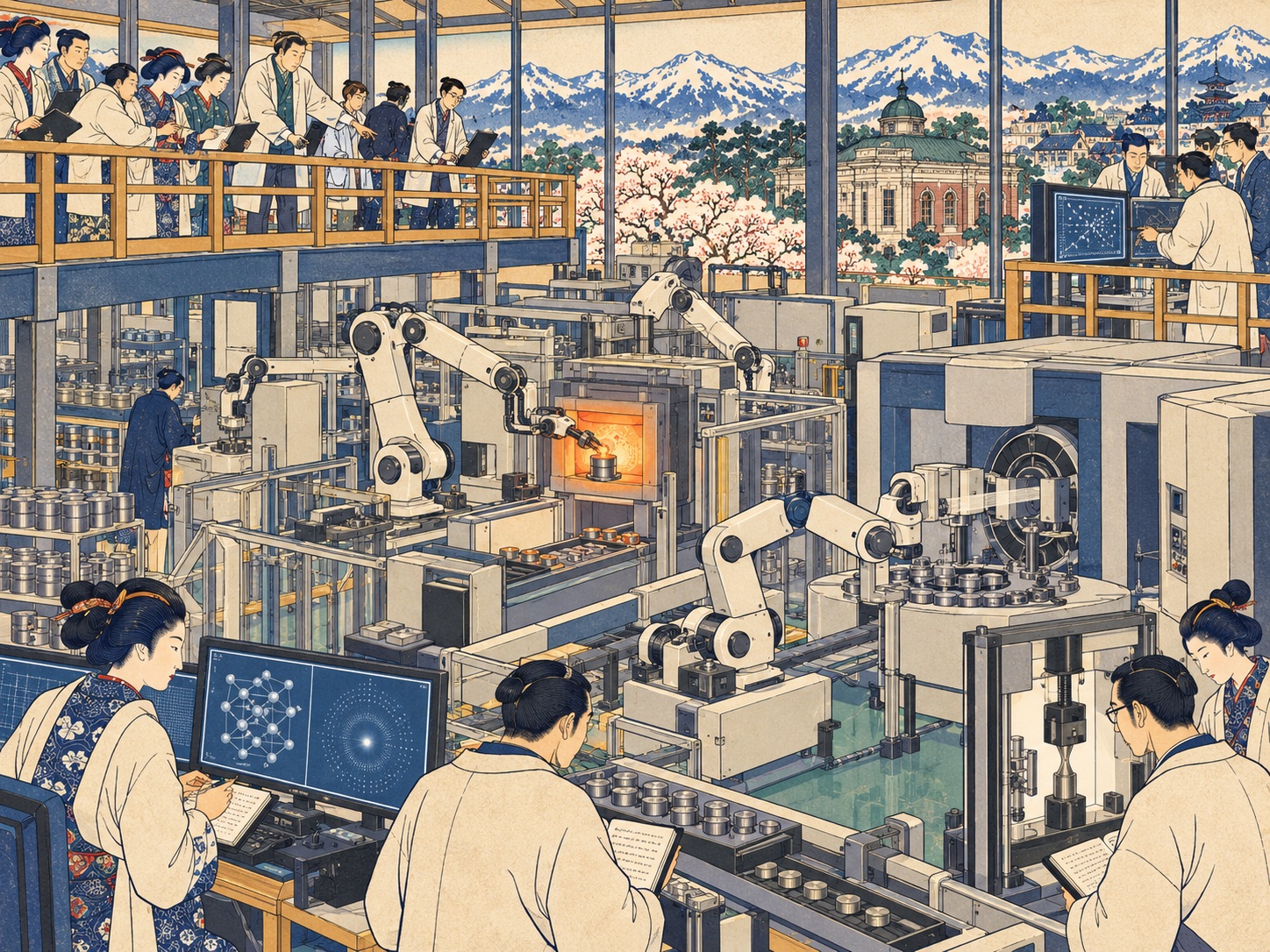
SENDAI. Much of materials science is still held together by human hands. A researcher loads a metal specimen into a furnace, removes it after heat treatment, carries it to an X-ray diffractometer, records a measurement, transfers it to a mechanical tester and then begins the process again with a slightly different condition.
Researchers at Tohoku University’s Institute for Materials Research have now connected those steps into one robotic workflow. Their system integrates an induction heating furnace, X-ray diffraction, or XRD, and miniature impact testing with a robot arm, allowing bulk structural-metal samples to move automatically from processing to structural analysis to mechanical evaluation.
The research was led by Assistant Professor Yulin Xie, Academic Researcher Sayaka Sekida and Professor Goro Miyamoto of Tohoku University, with Tadashi Furuhara, now at the National Institute for Materials Science, NIMS; NIMS group leader Ryo Tamura; and Masaya Inakawa, then representative director of LaboRobo and now CAIO of Tsubame Lab. The paper was posted online September 18 in Science and Technology of Advanced Materials: Methods; Tohoku University announced the work on October 2.
In structural metals, composition is only the beginning
Finding a useful alloy is not simply a matter of choosing the right percentages of iron, chromium, molybdenum or other elements. Two pieces of steel with the same chemical composition can behave very differently after different heat treatments because heating and cooling alter their microstructure.
Temperature, holding time, heating rate and cooling rate already create a large experimental space. Add a second tempering step and order becomes another variable. Add a third and the combinations expand again. Materials scientists therefore face a basic constraint: humans can experimentally explore only a tiny fraction of all technically plausible processing conditions.
Automation has moved faster in areas that manipulate liquids, powders or thin films, where samples can be standardized and transferred relatively easily. Bulk metals are harder. They are rigid, sometimes heavy, require high-temperature processing and must move among large pieces of equipment designed for different purposes. The challenge is not merely to bolt a robot arm onto a laboratory bench; the entire physical workflow has to be engineered.
Connecting the furnace, the diffractometer and the fracture test
The Tohoku system begins with a custom induction-heating furnace. According to the paper, the furnace has vacuum capability and mass-flow control for an argon-plus-2% hydrogen atmosphere that helps prevent oxidation, as well as helium gas cooling. It can heat at up to 500 kelvin per second to 1,500°C and cool at roughly 200 kelvin per second at maximum helium flow.
After treatment, a robot transfers the specimen to the XRD instrument. X-ray diffraction provides information about crystal structure and phases without destroying the sample. The specimen then moves to a miniature impact-testing machine, where the system measures mechanical response through destructive testing.
The researchers designed dedicated feeders and robot tooling because conventional laboratory equipment was not created to hand samples cleanly to one another. Software control ties the instruments together, making the workflow repeatable rather than a series of isolated automated steps.
The paper reports that the characterization sequence—XRD plus mechanical testing—can be completed within 800 seconds for one specimen. Tohoku University says the integrated sequence is more than 10 times faster than a comparable human-operated workflow. The deeper advantage is consistency: a robot can repeat the same handling and measurement sequence continuously while capturing process data in a standardized way.
| Component | Role | Why it matters |
|---|---|---|
| Induction furnace | Heat treatment | Automated atmosphere, heating and cooling control |
| X-ray diffraction | Structural analysis | Measures how processing changes crystal structure |
| Miniature impact tester | Mechanical evaluation | Connects structure to actual strength response |
| Robot arm | Sample transfer | Moves bulk specimens across otherwise separate instruments |
| NIMO software | Optimization/orchestration | Provides the bridge toward future closed-loop AI experimentation |
A steel test case showed the process-structure-property chain
To demonstrate the platform, the researchers used JIS SCM435H, a chromium-molybdenum low-alloy steel whose mechanical properties are strongly influenced by heat treatment. They tested one-step and two-step tempering conditions and compared structural signals with mechanical performance.
For one-step tempered samples, the paper reports a positive correlation between the full width at half maximum of the ferritic 211 XRD peak and bending strength. The bending strengths measured through the automated system were also linearly proportional to hardness values obtained manually.
That result matters because the scientific target is not automation for its own sake. Materials design depends on linking process—how a material was made—to structure—what happened inside it—and finally to property—how it performs. The robotic platform captures all three in one workflow.
The two-step tempering demonstration was deliberately limited. Only four two-step conditions were explored, so the study does not claim to have found an optimum. What it did show was that sequence-dependent processing can produce behavior that does not simply follow the relationship established by one-step tempering. That is exactly the kind of multidimensional space where an autonomous search system may eventually be valuable.
NIMO is the bridge from automation to autonomy
The project also uses NIMO, the autonomous-experimentation software developed at NIMS and descended from the NIMS Orchestration System, or NIMS-OS, announced in 2023.
The distinction is important. Automation means a machine can execute a predefined sequence. Autonomous experimentation adds another loop: software analyzes the result, decides which condition should be tested next, sends that condition back to the equipment and repeats the cycle.
NIMO was built to connect materials-search algorithms with automated equipment rather than require every laboratory to develop a custom AI-control stack from scratch. NIMS has since used it in autonomous searches involving electrolyte materials and composition-gradient thin films, among other applications.
In the Tohoku work, NIMO was already used to optimize PID parameters for furnace control. PID control is a standard feedback method used to keep temperature or other physical variables close to a target. This is a meaningful demonstration of closed-loop optimization, but it is not the same as an AI independently discovering a new alloy or optimal heat-treatment recipe. The paper explicitly presents autonomous exploration of heat-treatment conditions as the next stage.
The self-driving laboratory is becoming a real research infrastructure
Across materials science, the idea is often described as a “self-driving laboratory.” The concept combines robotics, standardized data capture, machine learning and optimization so that an experimental campaign becomes a feedback loop rather than a manually curated series of trials.
NIMS released NIMS-OS in 2023 specifically to coordinate AI with automated experiments. In 2025, a NIMS team integrated Bayesian optimization with autonomous evaluation of composition-gradient magnetic thin films. The software selected the next region of composition space to test, incorporated the measurement and iterated.
Tohoku University has been building parallel pieces of the same ecosystem. In 2025, researchers created an AI-generated “materials map” combining literature-derived experimental information with first-principles computational data to help identify structurally similar candidate materials. In 2026, another Tohoku-led effort involving dozens of researchers proposed a roadmap for closed-loop discovery of hydrogen-storage materials, linking reliable data, physics-aware models, AI design and automated experimentation.
The recurring idea is that AI becomes more scientifically useful when it can act on the physical world. A prediction alone may identify a candidate. A closed loop can test that candidate, learn from failure and decide what to do next.
A long history of instrument automation, now joined at the workflow level
Materials research has been progressively mechanized for more than a century. X-ray diffraction turned crystal structure into something that could be measured systematically. Modern heat-treatment furnaces added precise programmed temperature profiles. Digital mechanical testers and microscopes made results easier to collect and compare.
Yet laboratories have often remained collections of instrument “islands.” The furnace has its control system. The diffractometer has another. The mechanical tester has a third. A researcher becomes the integration layer, physically moving samples and mentally connecting one dataset with the next.
The new Tohoku platform is significant because it attacks that integration problem. Its novelty is less about inventing a new furnace or a new XRD method than about making otherwise separate instruments operate as one scientific process.
The analogy with manufacturing is useful. Factories did not become dramatically more productive merely by automating individual machines. The larger gains came when transfer, inspection, scheduling and process control were integrated into a line. Materials laboratories may now be entering a similar phase.
A student-born automation effort helped solve the physical details
Co-author Masaya Inakawa’s route into laboratory automation illustrates the practical problem. Tohoku University has described how, as a student working in a chemistry laboratory, he became frustrated by time consumed by repetitive tasks such as glassware handling, chemical registration and data organization. He began writing software to automate administrative tasks and then moved into small robotic arms.
That effort became LaboRobo, a Sendai-based company focused on custom laboratory automation. Its relevance here is not merely entrepreneurial. Real laboratory automation lives or dies on details: how a sample is gripped, how it is aligned, how a furnace door is accessed, how the robot confirms that a specimen has been released, and how the system recovers from an error.
The research paper notes that special tools, including an automated sample feeder, had to be designed for the bulk-metal workflow. Those physical interfaces are part of why bulk structural materials have lagged behind liquid-handling chemistry in autonomous experimentation.
Why industry should care
Structural metals sit underneath automobiles, aircraft, industrial machinery, buildings and energy infrastructure. Commercializing a new alloy is typically less about finding one attractive data point than about mapping how processing affects performance and then proving that the result can be reproduced.
A laboratory workflow that runs more than 10 times faster does not automatically make the entire product-development cycle 10 times shorter. Certification, fatigue testing, manufacturing scale-up, joining, corrosion testing and cost analysis remain major tasks. But faster, more standardized exploration changes which experiments become economically possible.
It also changes the data asset. AI systems are only as useful as the experimental data fed into them. Automated workflows can record furnace programs, timestamps, atmospheres, measurement settings and test results in machine-readable form. That consistency can be as important as raw speed because it gives later models a cleaner basis for inference.
Autonomous does not mean researcher-free
The phrase “autonomous laboratory” can suggest a future in which scientists are removed from experimentation. The current technology is much narrower. An AI can choose among conditions that researchers have defined and optimize metrics that researchers have specified. It cannot independently decide which societal problem deserves attention or whether an anomalous measurement is a breakthrough, a contaminated sample or a failed sensor.
Automation also depends on standardization. The current system is designed around samples of a fixed 40 × 4 × 1.5 mm geometry. Applying the workflow to a brittle alloy, a different specimen geometry or a material that oxidizes or deforms unusually during heating could require new grippers, fixtures, test protocols and safety controls.
That is why the authors describe the system as a foundation for autonomous exploration rather than a completed autonomous discovery machine.
The next experiment could be chosen by the machine
The next scientific step is clear: let the optimization system choose the next heat-treatment condition itself. After one experiment, the XRD and mechanical measurements would update the model. The model would then select a temperature, duration or multistep sequence expected either to improve performance or to produce the most informative new data. The robot would run that experiment and return the result.
The goal need not be a single “strongest steel.” Real structural materials involve trade-offs among strength, ductility, toughness, processability, thermal stability and cost. Autonomous methods become most valuable when they can efficiently search those conflicting objectives.
What Tohoku University has built is therefore less spectacular than the phrase “AI discovers a new material”—and arguably more consequential as infrastructure. A robot can now carry a metal sample from furnace to diffractometer to mechanical test while the system records a coherent trail from processing to structure to performance.
Once that loop is reliable, AI has somewhere to act.
Sources
- Tohoku University, October 2, 2026 research announcement
- Institute for Materials Research, Tohoku University, publication details
- Yulin Xie et al., “Development of an automated evaluation system for the process-structure-property relationship of structural metallic materials towards autonomous exploration”
- NIMS, Development of NIMS-OS, July 20, 2023
- NIMS, autonomous AI exploration of composition-gradient thin films, November 20, 2025
- Tohoku University, AI-powered materials map, 2025
- Tohoku University IMR, roadmap for AI and automated experimentation in materials research, August 25, 2026
- Tohoku University, profile of LaboRobo and Masaya Inakawa