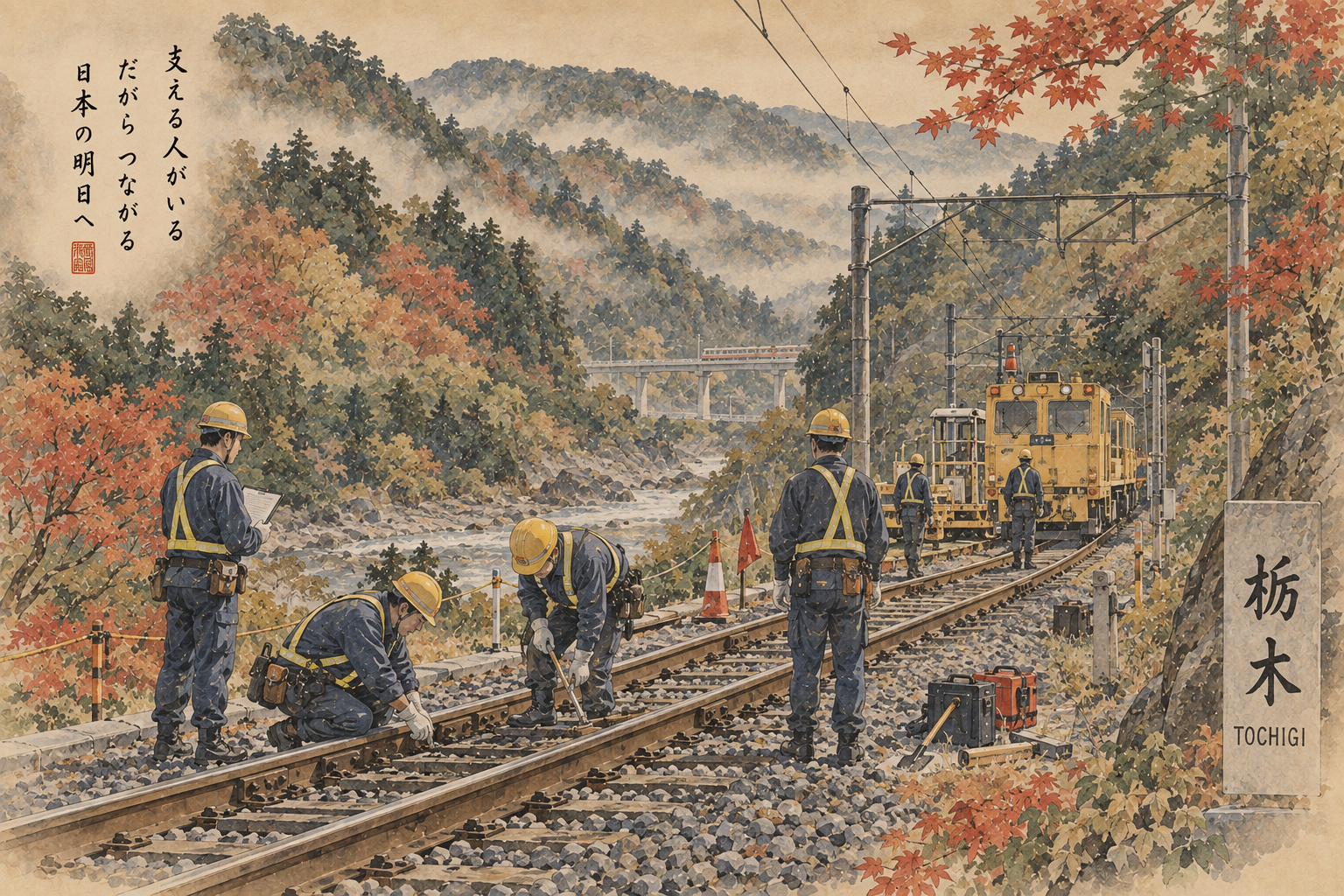
At about 10:46 a.m. on August 20, four male workers applying herbicide inside Shin-Kanuma Station on the Tobu Nikko Line in Kanuma, Tochigi Prefecture, were struck by the limited express Spacia X No. 2 heading toward Asakusa. All four died. Roughly 50 passengers were aboard; no passenger or crew member was reported injured. Tobu Railway’s first release listed the cause simply as under investigation.[1]
Six weeks later, an interim report submitted by Tobu Railway to the Kanto District Transport Bureau describes failures that began well before the train entered the station. The planned pre-work discussion did not establish where workers would evacuate. The formally designated work supervisor, inexperienced in directing this kind of moving vegetation-control job, effectively handed command to a more experienced superior from Tobu Construction who was off duty that day. Some workers had not received the safety-management instruction required by the rules.[2][3]
The first question was why an “all clear” was given
In the first days after the accident, attention centered on the lookout chain. Japan.co.jp’s August 24 report noted that multiple train lookouts were present but that a signal indicating workers had cleared the track may have been given while four remained inside the danger zone. At the time, it was not known who had verified what or where communication failed, and there was not enough evidence to reduce the accident to a simple “communication error.”[4]
The interim report moves the timeline backward. The workers did not merely fail to react correctly to an approaching train. The most basic safety question—where they were supposed to go when a train approached—had not been settled before they entered the section where the collision occurred.
The evacuation point was supposed to be decided at the morning briefing
According to TBS reporting based on the interim report, the vegetation-control crew planned to move from Shin-Kanuma along one track toward Tokyo, turn around near the first crossing and return toward the station on the other track while working. The evacuation location for that return section was supposed to be confirmed during a pre-work meeting. The meeting did not take place, and no evacuation location was fixed. About five minutes before the accident, workers entered the track below the station platform.[2]
For people working on an operating railway, an approaching train is not an unforeseeable emergency. It is the ordinary hazard around which the job must be designed. Lookouts, warning methods, designated clearances and evacuation points exist precisely because trains continue to run.
The person formally responsible and the person actually directing the work were not the same
The designated work supervisor was an employee of Tobu Construction, a Tobu Railway subsidiary. The interim findings say this was his first time directing vegetation work while moving along the track, and he was relatively unfamiliar with the crew. He therefore relied on a more experienced superior from the same company who had come to the site despite being off duty. The designated supervisor concentrated on duties including taking record photographs while the superior effectively directed the field work.[2][5]
The superior had experience and broader responsibility for the series of vegetation jobs. But he was not the formally designated work supervisor for that day. The result was a gap between the person named in the safety structure and the person issuing operational instructions.
That distinction is not bureaucratic trivia. In a high-risk system, titles define who receives lookout information, who authorizes entry, who verifies evacuation and who can halt the operation. Experience can improve judgment, but informal command can blur responsibility for required checks.
Some workers reportedly questioned the instruction but stayed silent
After the crew reached the end of the platform, the experienced superior instructed workers to enter the track area below it and joined them there. The collision occurred about five minutes later; the superior was among the four killed.[2]
The interim reporting includes another disturbing detail. Some workers reportedly felt the interval before the next train was too short and had doubts about entering. They nevertheless followed the instruction because they believed speaking up could bring anger or conflict—phrased in reports as concerns that “if I voiced an opinion, I would be scolded” or that saying something unnecessary would cause trouble.[5]
If that finding is upheld, the accident raises a question beyond written procedures: whether workers believed they had practical authority to challenge an unsafe instruction. In railways, construction, aviation and other high-hazard industries, the ability of a junior worker to say “stop” can become the final defense when formal controls fail.
Why did the lookout warning save some workers but not four others?
According to the interim account, the train driver saw the four men shortly before impact positioned close to the platform. The driver had also observed a signal from a train lookout indicating safety and proceeded according to the applicable rule, the report says.[2]
Two other workers near the lookout heard a buzzer and verbal warning and climbed onto the platform. The formally designated supervisor, who had entered the track at the rear of the group, reportedly did not hear the call but looked up, saw the train approaching and also got onto the platform. Four others did not escape.[2]
Why the warning produced different outcomes remains an important unresolved question: distance, line of sight, noise, lookout positioning, timing, the sequence of signals and exactly who had confirmed whose location all require final investigation.
Some workers had not received the required safety instruction
FNN reported that Tobu Railway’s interim findings identified workers who had not been given the safety-management instruction required by company rules.[3]
The interim report does not establish, at least in the material publicly reported so far, how strongly that lapse contributed to the fatalities. But work on active railway infrastructure depends on common understanding: what each signal means, where the safe location is, what the lookout does, who the supervisor is and what to do when any worker believes conditions have become unsafe.
The more companies represented on a job site, the less safe it is to assume that everyone shares the same unwritten habits. Training and pre-work confirmation are the mechanism for creating one operational language.
Contractors are normal in railway maintenance. Fragmented responsibility is not supposed to be
The vegetation work was performed through a contracting structure rather than entirely by direct Tobu Railway employees, involving Tobu Construction and other participating companies. That is not unusual. Modern railway operators routinely use specialist contractors for track, civil engineering, vegetation, electrical and security work.
Contracting itself does not establish a cause of this accident. Specialists can bring skills and efficiency that an operator does not maintain entirely in-house. The safety question is whether responsibilities cross company boundaries as clearly as the work does.
Who trains each person? Who briefs subcontractors when conditions change? Who has command at the worksite? Who controls the lookouts? Who can call off a job? A contractor chain becomes dangerous only when those connections are assumed rather than verified.
The government’s warning used the phrase “underlying factors”
On the day of the accident, the Kanto District Transport Bureau issued a formal warning to Tobu Railway’s chief safety officer. It called the deaths of four workers “extremely regrettable” and instructed the company to investigate not only the immediate cause but the underlying factors, take measures to prevent recurrence and report them promptly in writing.[6]
That wording matters. Accident prevention cannot end with identifying the person who made the last incorrect decision. Investigators must ask whether training was adequate, whether an inexperienced supervisor was properly supported, what authority an off-duty superior had on site, whether lookout positions and communications were appropriate, whether the work plan left enough time around trains and whether people could challenge unsafe directions without social penalty.
The old railway-maintenance problem: protect the line while trains keep moving
A railway is infrastructure that must be maintained precisely because it is heavily used. Rails, switches, signaling equipment, overhead systems, drainage, embankments and vegetation all require recurring work. Yet the asset being maintained is also the space through which trains continue to move.
Many high-risk jobs can be shifted to overnight possessions when tracks are closed. Not every task can be performed only at night, however, and work between trains remains part of railway maintenance. Under those conditions, safety cannot depend on “there should be no train.” It has to assume that a train will come.
That is why railways build layers: a work supervisor, train lookouts, advance warnings, fixed evacuation areas, agreed signals and limits on when work can begin. The Shin-Kanuma interim findings are a reminder that multiple defenses can exist in a rulebook and still fail if the operational links between them disappear.
Labor shortages are a wider industry problem—but not an established cause here
Japan’s construction and infrastructure-maintenance sectors are confronting an aging workforce and recruitment pressure, accelerating investment in automation, remote inspection, image analysis, drones and sensors. Railways are also trying to reduce the amount of time people must spend physically inside operating track areas.
It would be wrong, however, to claim that labor shortages caused the Shin-Kanuma accident. Tobu’s interim report does not make that finding.
The broader question is more careful: in a workforce where experienced personnel may be scarce, how should companies qualify first-time supervisors, transfer specialist knowledge, manage contractors and reserve scarce veterans for tasks that cannot be automated? The accident does not answer that question, but it makes the consequences of weak field organization impossible to ignore.
The paradox of the experienced person
There is an uncomfortable irony in the interim findings. The designated supervisor recognized that he lacked experience and relied on a veteran. At first glance, seeking help from the more experienced person sounds prudent.
But safety systems cannot depend on a veteran informally replacing the formal structure. When authority shifts without the corresponding checklist, documentation and accountability shifting with it, required checks can fall between roles.
A mature safety system is designed so that a first-time supervisor is supported by process, not rescued by improvisation—and so that even an expert cannot bypass a step that protects workers.
A workplace where people cannot object loses its final defense
The reported statements from workers who had doubts but kept quiet must be treated carefully until the investigations are complete. They nevertheless raise a classic safety-culture issue.
In a high-risk workplace, disagreement about safety cannot be treated as insubordination. If someone believes five minutes is not enough and can say so without fear, that objection can catch a danger missed by the formal plan. If workers believe questioning a superior will cause anger or conflict, a written “stop work if unsafe” rule may have little practical value.
What investigators still need to establish
Tobu Railway says it will establish a third-party committee to examine causes and recurrence prevention further. The Japan Transport Safety Board is conducting its independent investigation, while police continue their inquiry.[2]
Among the remaining questions are what information led the lookout to signal safety; how radio, buzzer and voice warnings propagated; whether work timing provided adequate margin; how the physical geometry below the platform affected evacuation; exactly which workers missed which required training; and whether any organizational incentives discouraged stopping the work.
The quality of the eventual response will depend on whether corrective action moves beyond “be more careful” toward systems that change behavior: explicit command authority, mandatory pre-work verification, auditable training records, redundant lookout controls and real stop-work authority for anyone who perceives danger.
Four deaths should not be reduced to one mistake
After a major accident, there is pressure to find one simple explanation: a lookout error, a supervisor error, a worker error. The Shin-Kanuma interim report describes something more troubling.
An evacuation location was not fixed. Formal and practical command diverged. Required education was missing for some workers. People who felt uncomfortable did not speak up. The warning system did not get four people to safety.
The Japan Transport Safety Board may ultimately determine that some factors mattered more than others. Until then, the responsible conclusion is not that one person caused the disaster. It is that a railway system designed to survive individual mistakes appears to have lost several layers of protection at once.
Sources
- Tobu Railway, initial accident release, Aug. 20, 2026
- TBS News Dig, reporting on Tobu Railway’s interim report, Oct. 1, 2026
- FNN Prime Online, required safety instruction not given to some workers, Sept. 30, 2026
- Japan.co.jp, initial investigation report, Aug. 24, 2026
- FNN Prime Online, command structure and worker concerns, Oct. 1, 2026
- Kanto District Transport Bureau, warning to Tobu Railway, Aug. 20, 2026