- A shopping center that can tell you where you are
- The right to choose a destination, not merely follow a route
- How a pavement tile acquires an audio layer
- Before the smartphone: an invention on an Okayama road
- An eight-year development path through Kanazawa
- The remarkable number that is not an impact measure
- Why the Kinshicho installation is commercially interesting
- Digital layers cannot replace safe physical routes
- Who maintains the map when the shops change?
- The measure that matters: moving freely
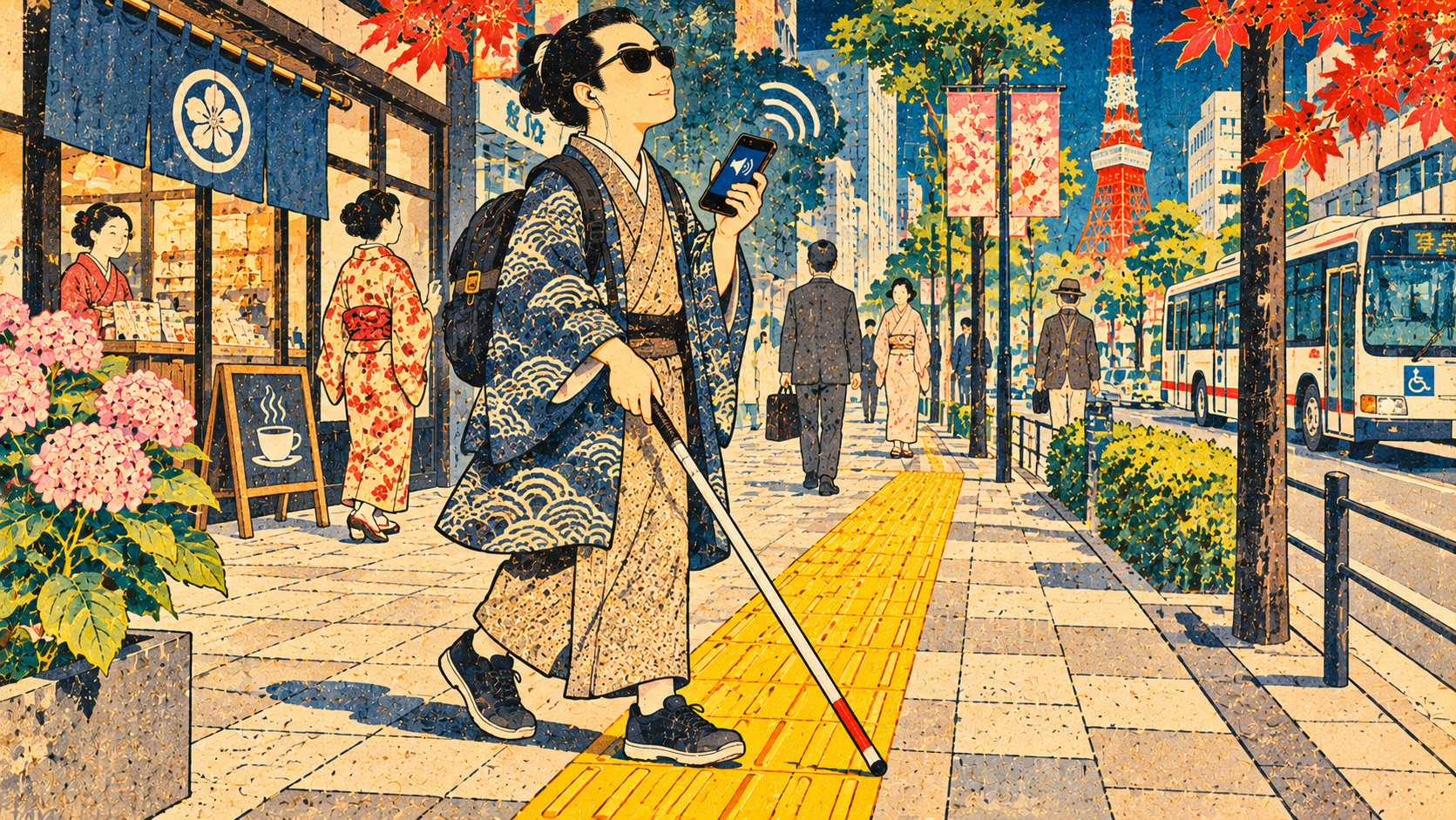
A shopping center that can tell you where you are
For a person navigating a busy shopping center without reliable sight, reaching the entrance may be only the beginning. Which floor holds the restaurants? Where is the shop that prompted the journey? Which way leads back to the station? The raised lines and dots embedded in Japanese floors can help with orientation and danger, but they do not automatically disclose the surrounding businesses. A research team is trying to close that information gap by making individual tactile blocks readable by smartphone.
At Rakutenchi Building in Tokyo’s Kinshicho district, an installation completed at the end of July 2026 links an underground access level, the ground floor and a second-floor restaurant area. Kanazawa Institute of Technology announced the completed installation on August 5, with a demonstration scheduled for August 8. This November 5 article is a reported examination of that earlier development, not a claim that the system was newly installed this week.
The right to choose a destination, not merely follow a route
The motivation described by the institute is as important as its engineering. People who lost useful vision told the project team that independent shopping had become difficult; some no longer knew where shops were located and had stopped visiting commercial facilities. Tokyo Rakutenchi, the company behind the building, installed the guidance system in response to such concerns. Those accounts are reported by the university; JAPAN.co.jp did not independently interview the visitors.
The ambition is more than moving someone safely from one point to another. A person ought to be able to decide which destination they want, learn what a building contains and change plans without surrendering control to a companion. Voice guidance can support that independence—but only if it is reliable, understandable and easy to find when it is needed.
How a pavement tile acquires an audio layer
The system is called code-encoded tactile paving, or kōdoka tenji burokk(u) in Japanese. Its physical basis is familiar: raised tactile surfaces. Researchers add distinguishable marks, described as circles and right triangles, to create a code that a dedicated smartphone application can read. Once recognized, the code connects a location with spoken information about nearby facilities and directions. It does not mean a block literally contains a loudspeaker.
The application, Walk & Mobile, was presented as free for both iPhone and Android users at the time of the August announcement. In the Kinshicho building, the physical guidance line connects pedestrian approaches from the Tokyo Metro Hanzomon Line and JR Kinshicho area to different levels and shop entrances. The markers are placed at points where detailed information matters. Real-world performance depends not only on the code but on where people can safely pause and use their phones.
Before the smartphone: an invention on an Okayama road
Tactile paving is one of Japan’s great accessibility inventions. Seiichi Miyake conceived the concept in 1965, according to the Okayama Prefecture government, and the first blocks were laid near the Haraoshima intersection in Okayama on March 18, 1967, close to a school for students with visual disabilities. Their function was not to spell out written Braille in concrete. It was to make directions and warnings perceptible underfoot and through a white cane.
Over subsequent decades, the technique spread through railway stations, sidewalks and public buildings. Japanese Industrial Standard JIS T 9251 standardized tactile dimensions and arrangements. There are important differences between linear guidance tiles and dotted warning tiles, and high visual contrast matters for people with residual sight. The modern idea of adding digital information should be understood as a further layer on a successful physical system, not a reason to discard that system.
An eight-year development path through Kanazawa
The Kanazawa Institute of Technology says research on the coding method began in October 2018. A prototype was tested in January 2019 in Kanazawa Station’s east-side underground plaza. The team then installed or tested blocks around the 21st Century Museum of Contemporary Art, the National Crafts Museum, central streets and major road routes in Kanazawa. Public workshops and hands-on demonstrations followed in 2023.
The work involves the laboratory of Professor Kunio Matsui at Kanazawa Institute of Technology and W&M Systems LLC. The Japan Inclusive Creators Association, a nonprofit organization, has supported dissemination. The 2026 announcement describes deployments in the Kanazawa area and several Tokyo-region sites before the full Rakutenchi installation. This makes the Tokyo shopping center a new scale of operating environment, not the first time anyone has encountered the technology.
The remarkable number that is not an impact measure
The developers describe a system of 25 coded positions, each capable of two states, and four possible viewing orientations. Multiplication gives 134,217,728 potential combinations. That is a statement about theoretical coding capacity. It is not a count of functioning sites, of reliably recognized tiles, or of people helped. Those different quantities should never be conflated.
A floor may be dusty, wet or worn; lighting and camera angles vary; and smartphone cameras must be handled by people with different levels of vision, dexterity and technological familiarity. What counts as excellent engineering performance in a controlled demonstration may be only one ingredient of a successful walking experience. The question is not how much information fits in a code, but how effortlessly meaningful information can be retrieved.
Why the Kinshicho installation is commercially interesting
Japan has long built tactile paths into transport facilities. Shopping centers present additional complexity: stores open and close, floor plans change and people make spontaneous decisions. Rakutenchi’s deployment covers several floors and connects station approaches to places where customers actually choose a business. This is a concrete step toward treating accessible information as part of everyday commerce, not merely a compliance feature at the entrance.
The project was described as a first-of-its-kind permanent commercial-building deployment spanning this kind of route. That is the institute’s characterization, not an independently audited national inventory. The broader lesson is that private property managers cannot simply wait for municipal streets to be improved; building operations, tenant information and individual autonomy are part of the accessibility system too.
Digital layers cannot replace safe physical routes
The Japanese transport ministry’s accessibility guidance emphasizes continuous, comprehensible guidance lines, appropriate placement of warning blocks, adequate contrast and surfaces that remain stable and slip-resistant. It is critical that any addition preserve the tactile features used by people who never open an app. A person with a flat battery or no smartphone must still be able to follow the physical guidance safely.
There are also practical questions about whether users can stand still at a code without obstructing pedestrian flows, whether a noisy concourse overwhelms audio instructions and what happens when an elevator or entrance is unexpectedly closed. A technology that helps users make more independent decisions should be judged by those decisions and by safety—not by promotional imagery alone.
Who maintains the map when the shops change?
What happens after installation may determine whether the project succeeds. A restaurant can close, a corridor can be renovated and a temporary barrier can appear overnight. A tile may still be machine-readable while its associated information is stale. That makes maintenance responsibility, update schedules, funding, accuracy audits and reporting of broken routes central issues for property managers and software providers.
Privacy is another question worth asking. An app that reads place-specific codes could in principle generate usage records, but the available public documents do not establish what personal data, if any, this particular implementation retains. It would be wrong to allege surveillance without evidence. A transparent privacy policy, accessible consent practices and meaningful choices for users would nevertheless strengthen public trust.
The measure that matters: moving freely
The publicity milestones are clear: an invention in Okayama in 1967, a coding project launched in Kanazawa in 2018, years of experiments and a permanent three-level commercial installation completed in 2026. The evidence that remains less visible is the comparative experience of users over time. How often can a first-time visitor independently reach a chosen shop? How quickly is guidance restored when a route changes? What proportion of users can operate the app comfortably?
The Rakutenchi system should be taken seriously without being oversold. It offers a plausible way to give a familiar Japanese accessibility device a new informational role. Its real public value will emerge through sustained testing with people with different visual abilities, publication of meaningful outcomes and dependable maintenance. The ultimate accomplishment would not be talking pavement. It would be a city in which more people can choose where to go.
Sources and reporting method
Desk-based research using original university, municipal and transport-ministry sources. The dates distinguish the July installation, August announcement and this November analysis. No site visit or original interviews were conducted.
- Kanazawa Institute of Technology: Rakutenchi installation (Aug. 5, 2026)
- KIT Kunio Matsui Laboratory: Kinshicho installation
- KIT: 2023 demonstration and development timeline
- KIT: 2023 citizen workshop and deployment
- Okayama Prefecture: history of tactile paving
- Okayama City: 2026 Tactile Paving Day notice
- MLIT: tactile paving design guidance
- Kanazawa City open data: encoded tactile-block locations
- MLIT Chubu Transport Bureau: tactile blocks and standards
- Diet record: 2025 discussion of tactile paving and hazards