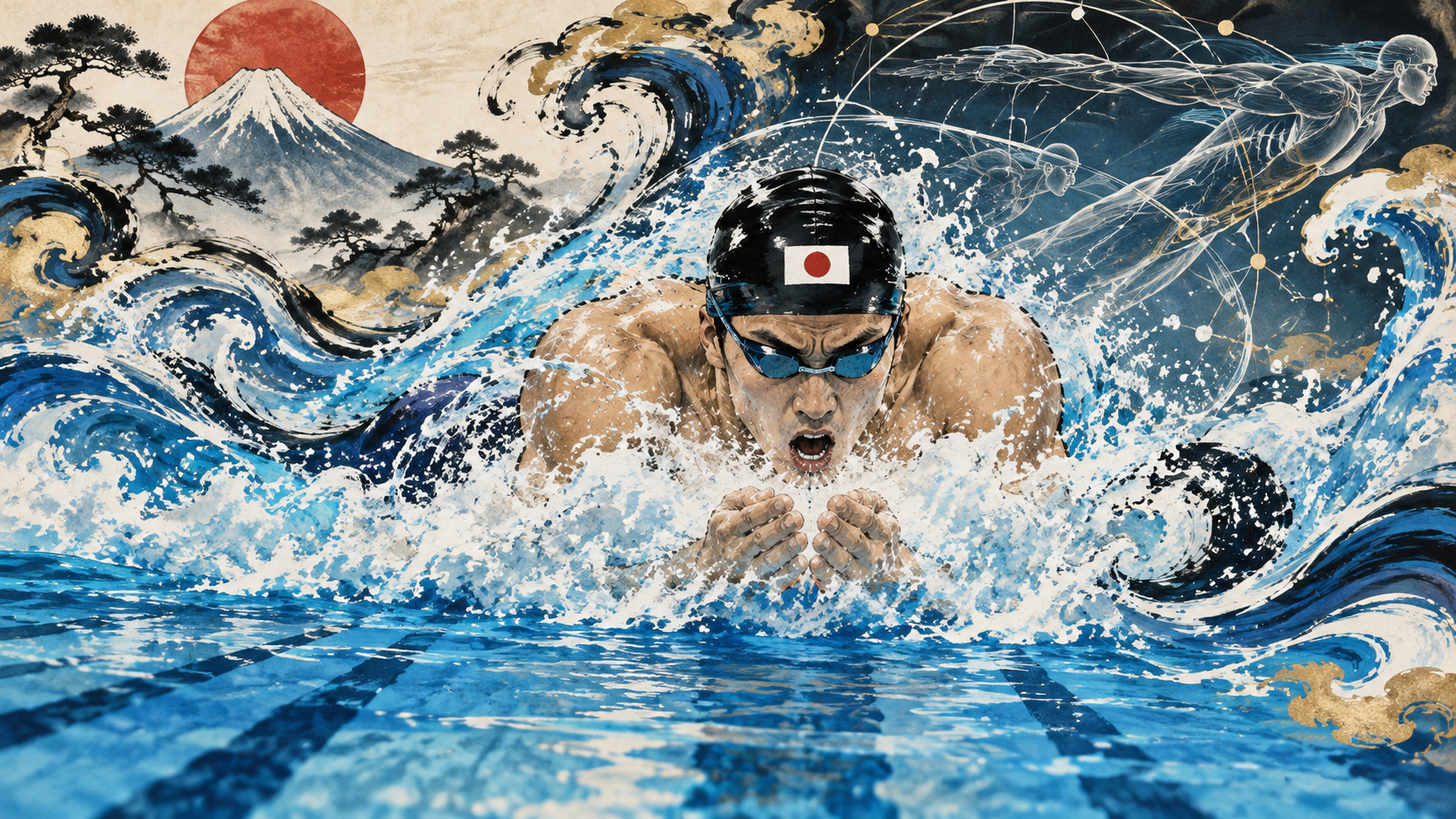
A world record is an outcome, not an explanation. On September 24, Shin Ohashi, a 17-year-old swimmer representing Japan, won the Asian Games 200-metre breaststroke in 2:04.83 at the Tokyo Aquatics Centre. He broke Qin Haiyang’s 2023 mark of 2:05.48 by 0.65 seconds and became the first man beneath 2:05 in the event. He also won the 100-metre breaststroke. Those results are established. The exact combination of training, mechanics and preparation that produced them is not yet publicly documented. [1][4]
The distinction is essential in the age of sports science. An extraordinary swim invites accounts of revolutionary kick mechanics or secret analytical systems. But scientific research rarely supports a tidy single-cause explanation. Breaststroke poses an unusually difficult coordination problem: the swimmer must generate force with the arms and legs, keep resistance controlled while recovering the limbs, and manage that trade-off as fatigue mounts.
Four lengths, a revealing finish
Japan Aquatics reported Ohashi’s cumulative splits as 28.27 seconds at 50 metres, 59.89 at 100, and 1:32.40 at 150. The four individual lengths therefore took 28.27, 31.62, 32.51 and 32.43 seconds. His final length was 0.08 seconds quicker than his third. A finish of that quality does not prove any particular physiological adaptation, but it does establish that his pace did not simply unravel in the closing lap. [1]
The national federation’s race account observed an apparently smooth rhythm and increasing tempo in the final stretch. It is a useful eyewitness description, not a released frame-by-frame biomechanical study. There is no public stroke-count dataset in the report, nor quantified hand force, foot orientation or muscle activation during the final. The difference between observation and measurement matters.
The peculiar mathematics of breaststroke
Freestyle has a comparatively continuous sequence of propulsive movements. Breaststroke contains sharper transitions between arm propulsion, leg propulsion, limb recovery and glide. During those transitions a swimmer may lose speed, then regain it. A 2022 systematic review of elite breaststroke science identifies stroke rate, distance per stroke, timing, glide duration and within-cycle velocity variation as important dimensions of performance. [6]
An aggressive stroke rate is not automatically a winning stroke. Too much time gliding can sacrifice momentum; recovering the legs too widely can increase frontal area and drag; poorly coordinated propulsion can waste force. The task is to find the useful timing for a particular swimmer and race distance. It is why a coach’s stopwatch alone can identify improvement without explaining it.
Fighting the water without fighting the stroke
The central physical contest is between thrust and drag. The swimmer accelerates when the net forward force is positive and decelerates when resisting forces dominate. Researchers distinguish passive drag, measured or inferred in streamlined gliding, from active drag during full swimming. Active drag is more difficult to measure reliably, particularly when body shape and limb motion change continuously. [7][9]
That uncertainty should temper sweeping claims. The literature supports the importance of reducing unnecessary frontal area and aligning the phases of the stroke, but it does not provide one universally optimal glide duration or kick for every athlete. The best solution shifts with anthropometry, speed, fatigue and race strategy.
What Japanese biomechanics researchers are asking
A research paper involving scientists from the University of Tsukuba and other Japanese institutions examined the relation between three-dimensional lower-limb movements and propulsive force from the feet during breaststroke kicking. It exemplifies a shift from generic advice to measuring where and when the leg contributes useful force. [8]
It does not, however, document Ohashi’s technique. Research on other swimmers cannot be retroactively presented as the discovery behind his record. To test such a claim, investigators would need consented measurements from Ohashi, comparable training-phase data and a rigorous account of what actually changed.
The swimming school behind a teenage champion
The Japanese Olympic Committee identifies Ohashi’s birthday as March 5, 2009, his school as Shijonawate Gakuen High School and his swimming club as Hirakata Swimming School. His emergence reflects a Japanese talent pipeline that extends beyond national-team camps into school and club sport. In March 2026, the young breaststroker collected three national championship victories, a sign that his international breakthrough was preceded by exceptional domestic performances. [2][11]
The details of his weekly mileage, gym programming, nutrition, sleep, recovery monitoring and injury history have not been established by the primary material reviewed for this article. It would be irresponsible to turn a teenager’s achievement into a supposedly replicable workout plan. Long-term athlete development requires more than aggressive volume and faster split targets.
A Japanese lineage from Busan to Tokyo
In 2002, Kosuke Kitajima broke a 200-metre breaststroke world record at the Busan Asian Games. He went on to win both breaststroke events at the 2004 Athens and 2008 Beijing Olympics. Ohashi’s September achievement arrives nearly a quarter-century after that Asian Games milestone, inviting comparison across generations without assuming that their techniques, training or competitive environments were identical. [12]
The previous modern benchmark came from Qin Haiyang, who set 2:05.48 at the 2023 World Aquatics Championships in Fukuoka. Taking 0.65 seconds off a record at this level is a striking margin. But sporting history is not a story of national exceptionalism alone: progress comes through competition among swimmers and coaches across countries, as training methods, facilities and technical understanding circulate.
The promise and limits of performance technology
Underwater video, stroke segmentation, velocity tracking, pressure sensors and physiological testing can give a coach a more detailed picture of the race than an aggregate time. Yet these technologies involve trade-offs: instrument placement can change movement, imaging creates measurement error, and a sophisticated numerical model may still fail to capture what a tired athlete does under competition pressure. Reviews of swimming biomechanics recommend integrating multiple signals rather than leaning on a single metric. [9]
Japan now has a swimmer whose best-known result is also a useful question for science. Could the quality of his final 50 metres be maintained across competitions? Are his stroke frequency and distance per stroke stable under pressure? How do turns, underwater phases and respiratory timing contribute? None can be answered confidently from the final time alone.
What 2:04.83 can—and cannot—tell us
Ohashi’s achievement demands celebration, especially amid hopes for the 2028 Los Angeles Olympics. It also deserves restraint. Public race splits show extraordinary sustained performance. Reviewed science explains why breaststroke demands coordinated propulsion and control of drag. Neither reveals a single secret that produced the result.
The next useful reporting task is therefore not to invent a laboratory breakthrough. It is to speak with Ohashi and his coaches, seek time-series race analysis and ask how improvements were measured over months while protecting the wellbeing of a young athlete. Great results are the beginning of investigation, not the end of it.
Sources and verification
- 日本水泳連盟/Japan Aquatics、アジア大会200m平泳ぎレース報告(2026年9月24日)
- 日本オリンピック委員会、大橋信・選手プロフィール
- 愛知・名古屋アジア競技大会組織委員会、世界新記録(9月25日)
- World Aquatics、2026 Asian Games record review
- Olympic Council of Asia, Shin Ohashi world record report
- Nicol et al., elite breaststroke biomechanics systematic review (2022)
- Systematic review of breaststroke energy cost and coordination (2024)
- Japanese researchers, breaststroke leg kinematics and foot propulsion (2025/2026)
- Swimming biomechanics: from pool to laboratory and back
- World Aquatics video of Shin Ohashi’s Asian Games 200m breaststroke
- 日本水泳連盟・2026年日本選手権資料
- 日本オリンピック委員会・大橋信の世界新記録と北島康介の2002年大会
Source review cutoff: October 8, 2026 (JST). Ohashi’s underlying stroke measurements and private training, nutrition and recovery records were not independently available.