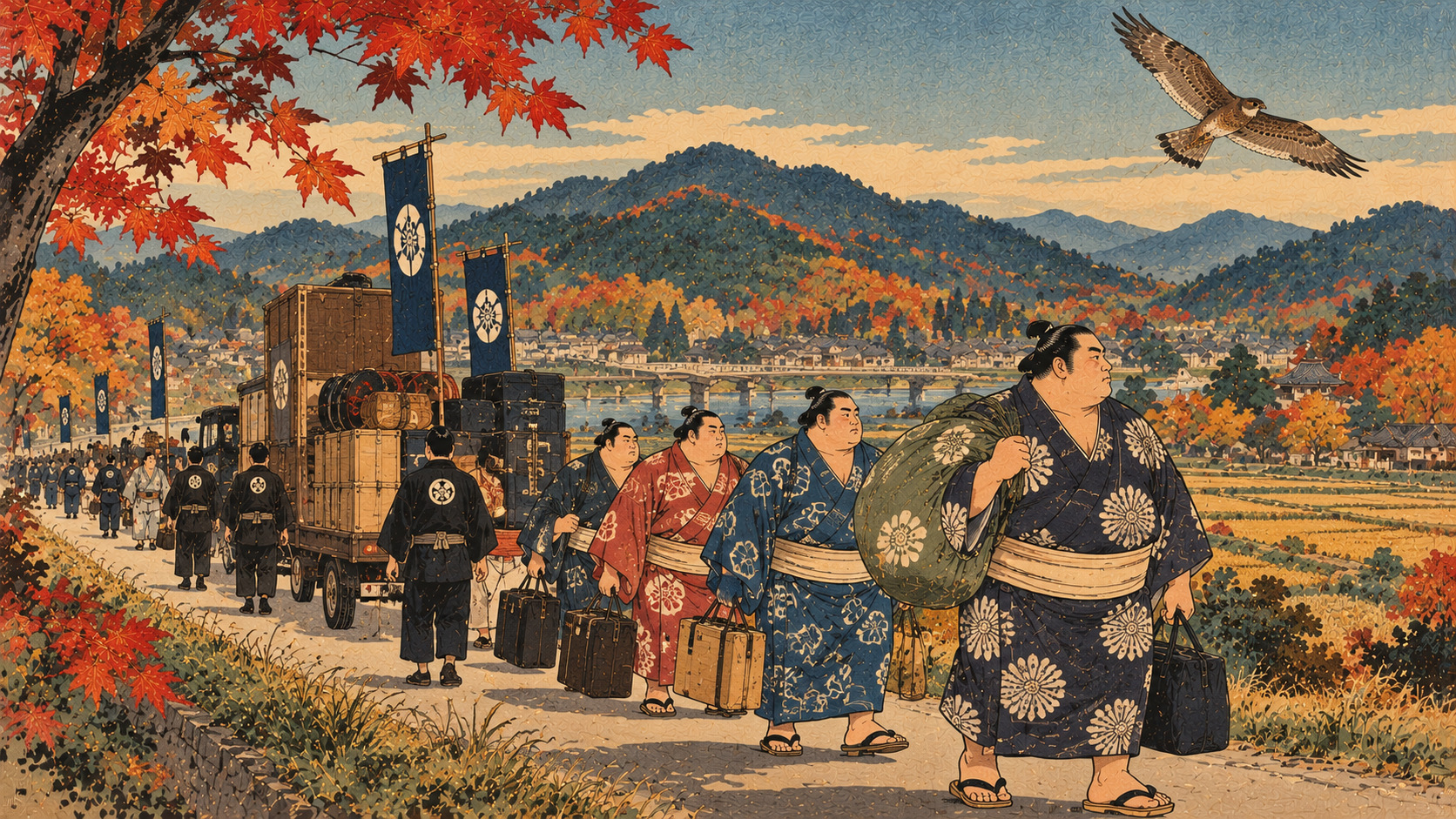
A wrestler finishes practice, adjusts his belt and returns to the edge of the ring. A drummer or a singer may take over. By midafternoon, the ceremonial closing bow is over and the touring party is preparing to leave. What looks like a single day's entertainment to a spectator is one stop in a complicated moving operation.
Japan's six annual grand tournaments dominate televised sumo. But between them, the Japan Sumo Association stages regional tours, jungyō, that bring wrestlers, training, bouts and performing traditions to cities and towns far from Tokyo's Ryōgoku Kokugikan. The October 2026 itinerary illustrates how tightly the schedule can be packed: Okayama city on October 21, Wake on October 22, Kasaoka on October 23, Hiroshima on October 24 and Ube on October 25.
Regional sumo is not merely competition transplanted to a gym. It is a moving collaboration among wrestlers, specialized staff, local promoters and host communities.
Five towns, five venues, one traveling institution
October's sequence across western Japan is revealing. The organization that appears in an Okayama gym one day moves to a different venue the next. Each local audience sees a festival of training and wrestling. The people on tour see a succession of unloading, preparation, performance, packing and travel.
The Japan Sumo Association describes a typical program in which training and lower-division action occupy the morning. Demonstrations and traditional entertainment take place between bouts, the top-division entrance ceremony comes at about 1 p.m., senior bouts begin around 1:30 p.m., and a ceremonial bow ends the day around 2:30 p.m. Wrestlers typically board buses for the next destination at approximately 3 p.m. Actual arrangements differ by venue, and this standard timetable is not confirmation of what happened at any specific October 2026 stop.
The local promoter who makes the day possible
One of the most consequential figures may never step onto the ring. The kanjinmoto, or contracted local promoter, organizes the event locally. An association manual states explicitly that the organizer of a regional tour engagement is the promoter who signs a hosting agreement with the association, rather than the association itself, and that the promoter bears responsibility for the event.
That matters because a temporary sumo venue is an event-production project. Tickets, seating, movement of spectators, safety measures, contractors and venue readiness all require coordination. Exactly which logistical costs are allocated to the promoter and which to the association depends on arrangements not established by the publicly available general guidance. There is no sound basis for assigning a single profit margin or hosting cost to every town.
Wake's October 22 engagement has its own anniversary context; Kasaoka's October 23 stop and Hiroshima's October 24 stop have separate promoters and venues. The itinerant show is standardized enough to be recognizable and local enough to require fresh organization every day.
Practice as public education
Grand tournaments reward results. Regional tours let people see the process that produces them. A spectator may watch practice drills, observe the movement and balance of larger wrestlers from close range, and see how a more experienced wrestler helps a junior train. These moments can make the sport comprehensible in ways a fast televised bout cannot.
This is not to say that regional bouts constitute a separate championship. The association has experimented with competitions on tour in the past: its own historical materials record a tour victory-award system introduced in spring 1999 and abandoned in spring 2000. The modern purpose is broader than maintaining an independent league table.
Why the comedy matters
The sumo world contains an unlikely form of physical comedy. Shokkiri uses two wrestlers to demonstrate prohibited maneuvers and unusual techniques in deliberately comic fashion. The association traces the custom to the Edo period. It teaches the rules while giving spectators permission to laugh.
Then there is sumō jinku, a style of traditional song performed by wrestlers wearing ornate ceremonial aprons, or keshō-mawashi. The association also lists demonstrations of tower-drumming, hairstyling and, where arranged, a yokozuna's rope-tying. Such programs show that sumo's living heritage is sustained not just by celebrated wrestlers but by callers (yobidashi), referees (gyōji), hairdressers (tokoyama) and others whose expertise keeps the institution functioning.
Individual demonstrations vary. A general list of possible activities should not be mistaken for a guaranteed program at every 2026 venue.
From independent stable tours to an association-wide circuit
The infrastructure of touring sumo has evolved. According to a Japan Sumo Association history explainer, before 1957 some tours were mounted by individual stables, groups of stables or touring associations. Today's circuit is organized association-wide; the association characterizes it as traveling with more than 300 people.
That history complicates the romantic idea of an unchanging caravan. Modern buses, contracted venues and centralized scheduling coexist with artistic forms that reach back generations. The technology of movement changes, while the prospect of seeing elite wrestlers close to home remains a powerful attraction.
What happens to the host town?
A major sporting visit may benefit hotels, food businesses, transport operators and vendors. It may also give families a rare direct encounter with a national cultural institution. The association's tour department explicitly identifies spreading sumo and encouraging young people as part of its mission, and official photo archives document occasions when wrestlers interacted with children and fans.
But the economic claims deserve discipline. The existence of an event does not prove its net financial benefit. Establishing that would require attendance figures, local and out-of-town spending, promoter costs and any public subsidies. These figures are not consistently available in the association's general tour calendar, so this article does not offer an invented estimate of the circuit's economic return.
The moment after the last bout
Perhaps the best way to understand a regional tour is to picture the last minutes after the public spectacle ends. Fans leave with photographs, autographs or memories. Specialized staff dismantle the temporary arrangements, wrestlers prepare for travel, and a new host town is waiting.
In a country often described through Tokyo institutions, sumo's touring life tells a parallel story: the sport travels to its audience. It depends on small gyms as well as great arenas, local initiative as well as national prestige, and voices, jokes and training routines as well as the dramatic final bout.
The Wake stop on October 22 offers one close-up of that world. The larger story is how Japan keeps the world of sumo moving between towns, year after year.
Sources & research method
Based on association documentation and historical records; individual event finances and impacts are not independently verified.