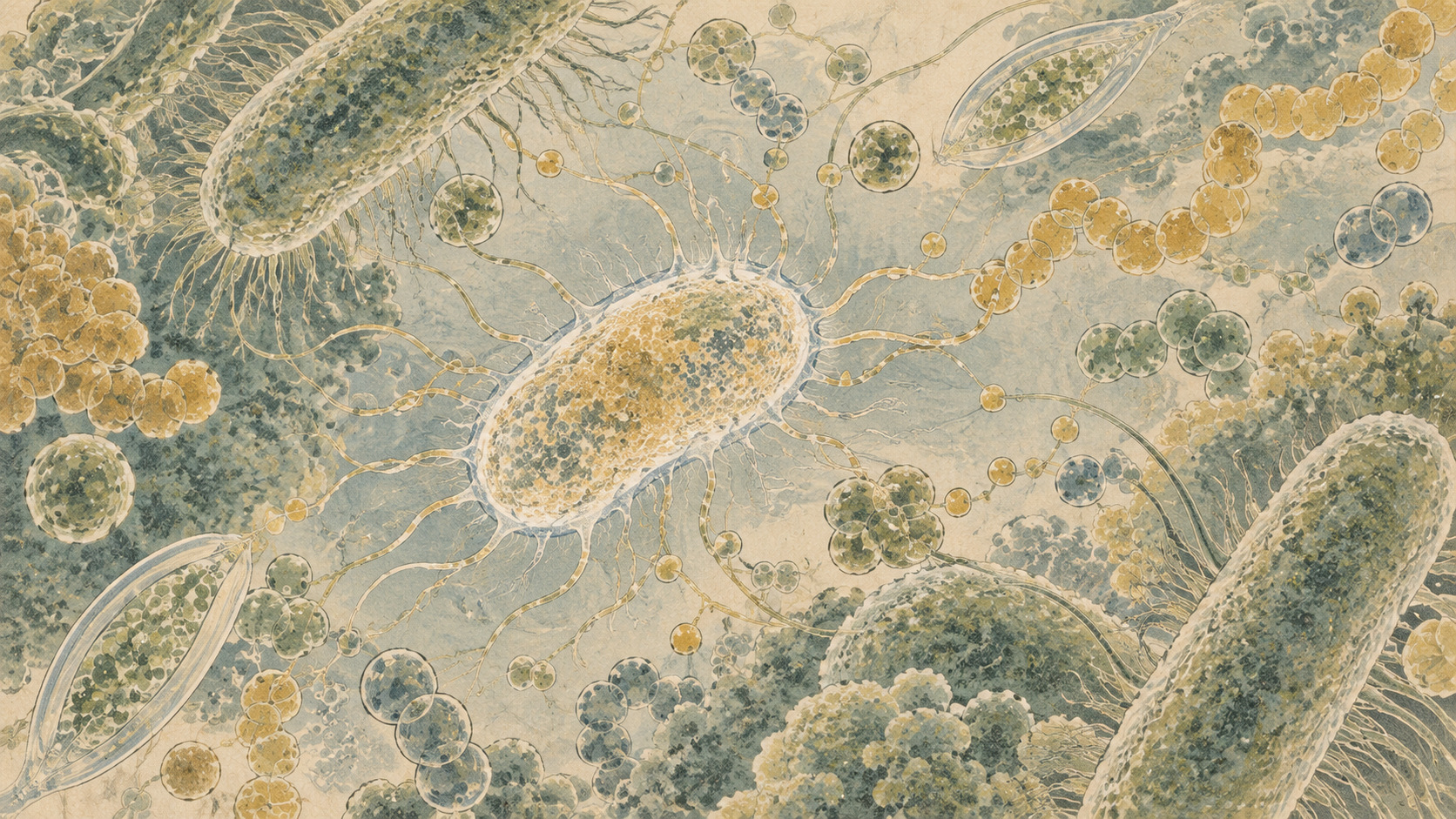
A cell that seems to have given up the business of living
Imagine a company that has outsourced nearly every operation except keeping its records and making copies of those records. In an ocean-associated microbial community, Japanese researchers have found the biological equivalent: an archaeon that appears to lack nearly all familiar biochemical routes for making nutrients and capturing energy, yet retains core systems for replicating and expressing its genetic instructions.
The organism bears the provisional name Candidatus Sukunaarchaeum mirabile. Its circular genome contains approximately 238,000 base pairs of DNA, less than half the size of the smallest previously characterized archaeal genome, according to the research team. The October 13 announcement from Kyoto University has revived a fundamental question: what must a cell do for itself, and what can it obtain from another organism?
Crucially, the finding does not mean this microbe can survive without food or energy. The working explanation is nearly the opposite. It appears so reliant on outside supplies that it has lost much of the machinery usually needed to manufacture them. That distinction is the difference between an extraordinary biological discovery and a misleading miracle headline.
The clue was hidden in a dinoflagellate community
The project began with genome analysis of microbes associated with a marine dinoflagellate, Citharistes regius. Such single-celled eukaryotes can harbor complicated miniature communities of bacteria and other organisms. The researchers were examining those relationships when a compact, unusual circular DNA sequence emerged.
Using complementary sequencing and assembly techniques, they reconstructed a 238-kilobase genome unlike known archaeal sequences. The reconstruction incorporated multiple lines of genomic evidence, including genes involved in reading and translating genetic information. Its small size was not simply assumed from a short fragment.
But a genome is not a complete field biography. The team has not established by direct observation exactly where this archaeon lives relative to the dinoflagellate and associated microbes, nor which partner supplies which metabolites. It is safer to describe a newly revealed lineage in a dinoflagellate-associated microbial community than to claim a particular host has already been proven.
What the genome can—and cannot—tell us
Cells generally need chemical pathways to obtain building blocks, maintain their structure and use energy. Sukunaarchaeum has lost nearly all recognizable genes for those familiar tasks. Yet its genome preserves much of the machinery for DNA replication, transcription of DNA into RNA, and translation of RNA into proteins.
An earlier analysis predicted roughly 189 open reading frames, alongside ribosomal RNA and transfer RNA genes. These measurements offer a portrait of extreme specialization. They do not prove that every unknown gene has been assigned a function, or that no unfamiliar route for metabolism exists. Genome annotation works by comparing sequences with experimentally understood biological machinery, and a deeply divergent lineage may carry surprises.
The central interpretation is strong metabolic dependence. To establish its full physiology, however, researchers will need much more than sequence information: localization, imaging, metabolic experiments and perhaps methods for maintaining the organism with its partners. Those challenges explain why the finding is both striking and incomplete.
A name drawn from Japanese mythology
The name Sukunaarchaeum alludes to Sukuna-bikona, a diminutive deity in Japanese mythology. Mirabile means something marvelous or remarkable. The combination gives this microscopic oddity a memorable name without substituting folklore for its evolutionary classification.
The prefix Candidatus matters. It signals provisional taxonomic treatment for a microorganism that has not been fully characterized in culture. NCBI records the organism under that provisional name, while genome-based nomenclature has its own evolving conventions. Readers should not infer that a living isolate has been grown in a laboratory or that all issues of formal naming have been resolved.
Additional related sequences in marine environmental datasets indicate Sukunaarchaeum may be part of a wider, previously overlooked lineage. The story may therefore extend well beyond one unusual organism: a whole corner of microbial evolution could have escaped routine surveys.
Why archaea transformed biology
For much of modern microbiology, the microscopic world was approached largely through what could be seen and cultured. In the late 1970s, Carl Woese and colleagues used ribosomal RNA comparisons to show that archaea represented a lineage profoundly distinct from ordinary bacteria. This rearranged the framework for understanding the history of cellular life.
Archaea are now recognized as an enormously varied collection of microorganisms, including inhabitants of extreme environments and ordinary oceans and sediments. Their relationship to the emergence of complex eukaryotic cells is central to modern evolutionary inquiry.
Recent advances in single-cell sequencing, metagenomics and computational reconstruction have made it possible to study organisms that scientists cannot yet cultivate. Sukunaarchaeum is a product of that revolution: its genome came into view through deep analysis of a complex sample, not because an organism was isolated and grown in a dish.
From symbionts to mitochondria to viruses
Evolution can reward division of labor. A microbe receiving reliable nourishment or energy-related resources from another organism may, over many generations, lose genes that are no longer essential within that partnership. At the far end of such relationships lie mitochondria and chloroplasts, cellular structures with ancient symbiotic origins that lost or transferred many ancestral genes as they became organelles.
Viruses occupy a different position. Most depend on cellular hosts to translate their genetic material into proteins, lacking the full protein-making machinery of cells. Sukunaarchaeum retains core cellular information-processing functions despite its severe metabolic simplification. This creates a useful comparison about biological autonomy—but it is not evidence that archaea and viruses are merging into an evolutionary intermediate.
Researchers are asking where the practical boundary of cellular independence lies. The answer may not be a universal gene count: it depends on environmental conditions, partnership stability and what outside support a cell can reliably obtain.
A discovery that has a longer timeline than this week
The researchers shared an early version of their findings on bioRxiv in May 2025. A peer-reviewed version appeared in Current Biology in 2026, titled “A hidden archaeal lineage with an ultra-reduced genome retaining only its replicative core.” The University of Tsukuba publicized the work on October 10, and Kyoto University issued its research announcement on October 13.
This chronology matters. October 13 was not the day scientists first identified the microbe. It was a moment of renewed public attention following publication and Japanese institutional announcements. A report prepared for October 15 must not sell the research as a discovery made that morning.
The collaboration includes researchers from Tsukuba, Kyoto, the University of Tokyo, Yamagata University, JAMSTEC and international colleagues. It illustrates how identifying a nearly invisible life form often depends on contributions from sequencing specialists, evolutionary biologists, marine researchers and bioinformatics experts rather than a single laboratory.
The next discovery may be its partner
The most consequential questions remain unresolved. Which organism supplies the compounds Sukunaarchaeum apparently cannot synthesize? Is the archaeon inside another cell, attached to one, or dependent on interactions within a larger community? What does its cell actually look like, and how does it reproduce? None can be answered conclusively from genome content alone.
Microscopy, targeted localization, single-cell analyses and measurements of exchanged molecules could eventually test the hypotheses generated by the sequencing work. Researchers may also find related genomes in different seas, revealing whether extreme gene loss is confined to one ecological niche or is more widespread.
There is no immediate evidence here of a medicine, industrial bioprocess or engineered minimal cell ready for use. Its significance is foundational. The organism suggests that some cells become extraordinarily simple not by doing more with less in isolation, but by living within intricate systems of dependence. The smallest genetic library may exist because the rest of the biological work has moved next door.
Sources and supporting documentation
- 京都大学:スクナ古細菌の発見(2026年10月13日)
- 筑波大学:研究成果発表(2026年10月10日)
- Harada et al., Current Biology (2026), peer-reviewed paper
- Harada et al., bioRxiv preprint (2025)
- NCBI Taxonomy: Candidatus Sukunaarchaeum mirabile
- NCBI/INSDC genome accession AP040136.1
- SeqCode Registry: nomenclatural status
Research verified through October 13, 2026. The original preprint, peer-reviewed paper and institutional announcement dates are distinguished.