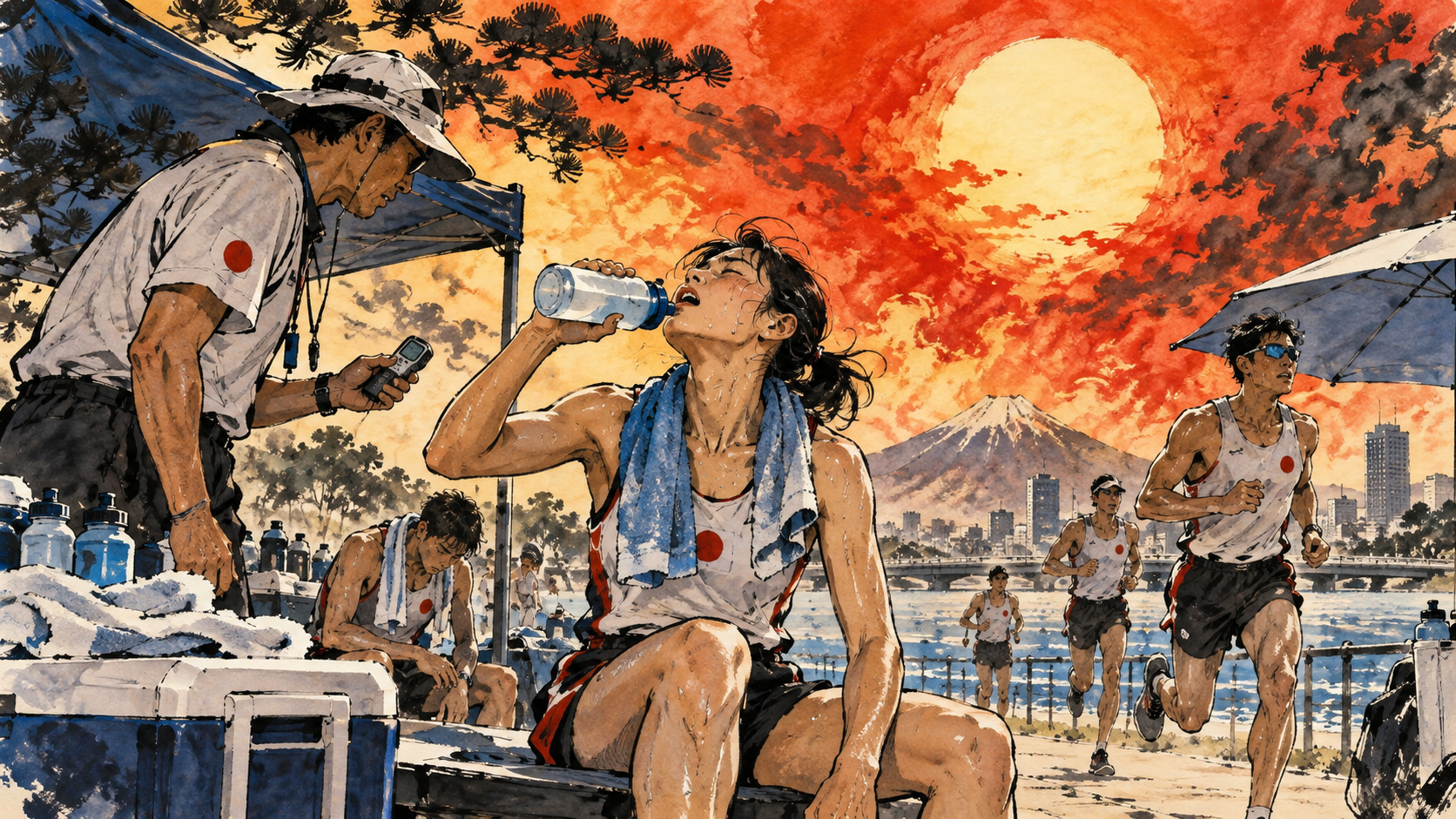
The most consequential decision at a summer sporting event may happen before the starting whistle. Will the race start on time? Should training move to the evening? Is there a shaded recovery area and an emergency plan if someone collapses? In Japan, where record heat has altered the conditions of outdoor life, those questions increasingly define responsible sport. The solution is not a single electrolyte drink or gadget; it is an operating system built around measurement, preparation and the authority to stop play.
The Japan Sport Association, known as JSPO, adopted a formal heat-response policy in June 2024. For events it organizes, sports activities are to be cancelled in principle when the wet-bulb globe temperature, or WBGT, reaches 31. It particularly cautions against children exercising under those conditions. The rule is an organizational policy and sports guideline, not a universal statutory ban applicable to every Japanese competition. That distinction matters for clubs, schools and event operators deciding whose standard governs their event. [1]
The weather number that matters is not the thermometer alone
WBGT incorporates influences that a simple air-temperature reading cannot communicate: humidity, radiant heat and the surrounding thermal environment. Japan’s Ministry of the Environment publishes exercise guidance that treats WBGT 31 or higher as a default cancellation threshold, 28–under 31 as a category in which strenuous exercise should cease, and 25–under 28 as requiring proactive breaks. These WBGT thresholds are not identical to ambient air temperatures, despite both sometimes being displayed with Celsius-style notation. [2]
That difference is consequential on a sunlit synthetic pitch, beside a concrete stadium, or at a school ground where shaded refuge is scarce. Forecast maps are useful for preparation, but an organizer also needs readings reflecting actual conditions at the venue. Equipment placement, wind, the time of day and what athletes are wearing all affect the operational decision. A single temperature value must never displace an assessment of the sport and the people exposed.
A warming baseline for Japanese sport
Japan’s Meteorological Agency reported that summer 2025 was the warmest in its instrumental series dating to 1898, with a nationwide June–August average 2.36°C above the reference average. The agency also recorded a temperature of 41.8°C in Isesaki, Gunma Prefecture. Those observations establish the scale of the heat problem; they do not, on their own, prove the cause of an individual athlete’s illness. [5][6]
The burden is unequally distributed. Wealthy professional teams can invest in medical staff, recovery rooms and sophisticated monitoring. Municipal fields, school teams and volunteer-led clubs may have little budget for ice, shade, transport or rescheduling. Officials and spectators may spend longer periods in the sun than the athletes. Heat safety is therefore an issue of access to sport, not merely the pursuit of elite performance.
How exercise turns into dangerous body heat
Muscular work produces substantial metabolic heat. To regulate temperature, the body sends blood toward the skin and loses heat through sweat evaporation. Humidity can reduce the effectiveness of evaporation; intense sunlight and still air can worsen the balance. Dehydration adds cardiovascular strain and may impair endurance. The International Olympic Committee’s consensus recommendations regard the environment, the athlete’s preparation and the event’s medical response as parts of one system. [7]
Exertional heat stroke is a medical emergency, not a more severe form of ordinary tiredness. Confusion, collapse or other serious neurological symptoms during heat exposure warrant emergency response, immediate cessation of exertion and rapid whole-body cooling while obtaining medical assistance. Organizers need equipment, trained responders and a practiced chain of responsibility before the event begins. Waiting to see whether drinking water resolves the problem can cost precious time. [4][8]
Acclimation is preparation, not a test of toughness
Heat acclimation uses repeated, carefully managed exposure to increase an athlete’s tolerance of hot conditions. Physiological adjustments may include changes in sweating and circulation. The IOC’s consensus document generally favors approximately two weeks of structured acclimation before a hot competition, while recognizing that shorter periods can offer benefits. This is not an endorsement of pushing unprepared children or exhausted athletes through dangerous heat. [7]
JSPO also emphasizes the special risk of a sudden transition to hot weather, such as an early-season training camp or a sharp rise after cooler conditions. Training should begin with a lighter workload and increase gradually, with attention to illness, individual susceptibility and recovery. Importantly, an acclimated athlete is not exempt from cancellation rules or the need for emergency readiness. [3]
Why there is no universal water prescription
Sweat loss varies by body size, activity, clothing, humidity and individual physiology. Japan’s sports guidance recommends avoiding losses above roughly 2% of body mass during exercise and accounting for salts lost through sweat. The IOC urges individualized hydration plans tested in training and cautions against excessive drinking. An identical bottle quota for every competitor is not a scientifically grounded answer. [3][7]
Hydration planning starts before the game. Sleep, recent illness, previous training load and access to fluids during competition matter. Event regulations must allow athletes to drink and recover. Endurance events, intermittent team sports and indoor competitions demand different approaches, and athletes with health concerns need individualized professional advice.
Cooling is infrastructure
Ice, shaded recovery space, drinking water, air movement, appropriate clothing and accessible medical teams serve different functions. The IOC calls on event operators to monitor conditions, communicate risks, provide cooling resources and build safeguards into the competition schedule. Emergency cooling arrangements are especially important because heat stroke treatment cannot wait for a distant ambulance alone. [7]
The logistics carry a price. Moving a match to early morning may affect transport, broadcast slots and staffing. Evening play may require lighting. Air-conditioned gyms consume energy, and keeping cooling equipment ready demands storage and trained personnel. Those are real costs, but ignoring them transfers risk to athletes, families and volunteers. The economic question is not whether safety costs money; it is how governing bodies budget for it openly.
The lesson of Tokyo’s rescheduled Olympic races
Japan’s Tokyo Olympics, held in 2021 after a pandemic postponement, provided a vivid demonstration of the conflicts between the spectacle of a host city and safe competition conditions. The marathons and race walks were moved to Sapporo amid concern over heat. The episode showed that modifying a venue, calendar or start time is itself a sports-safety intervention—not a failure to stage a successful event.
The challenge is translating that flexibility to youth sport. An organizers’ rulebook should identify who can postpone or cancel events, what measurements trigger review, how participants are informed and how medical emergencies are handled. An event that is called off for safety should not stigmatize children or penalize responsible coaches for lacking determination.
What wearables can and cannot tell us
Portable WBGT monitors, weather applications and athlete sensors can make risk more visible. But readings can be inaccurate or unrepresentative, and physiological monitoring raises issues of consent, privacy and interpretation. A dashboard cannot decide who holds the authority to stop competition. Earlier IOC scientific work called for better sport-specific exposure measurements and evidence-based thresholds rather than treating one instrument as a universal safety guarantee. [9]
The next advance may be organizational rather than technological: a person assigned to measure, another authorized to make the safety call, a trained medical group ready to cool an athlete, and a competition culture prepared to prioritize those decisions over the schedule.
What Sports Day should mean in a hotter Japan
Japan observes Sports Day on Monday, October 12, 2026; this edition appears on October 10, the historical date associated with the opening of the 1964 Tokyo Olympics. It is an appropriate occasion to reconsider what athletic commitment means. No coach can promise to abolish heat illness, and no scientific guideline can anticipate every individual emergency.
But sport can choose evidence over bravado. It can measure the conditions, prepare athletes without forcing dangerous exposure, build breaks and cooling into its venues, and sometimes have the discipline to stop. Protecting the next season of participation may ultimately be more important than completing today’s fixture at any cost.
Sources and verification
- 日本スポーツ協会「スポーツ活動中の暑熱対策に関するJSPO対応方針」(2024年6月3日)
- 環境省「暑さ指数とは?」—熱中症予防運動指針
- 日本スポーツ協会「熱中症予防5ヶ条」
- 日本スポーツ協会「熱中症を防ごう」—ガイドブック・救急処置
- 気象庁「2025年の夏の記録的高温について」(2025年9月1日)
- 気象庁「気候変動監視レポート」
- IOC consensus statement on recommendations and regulations for sport events in the heat, British Journal of Sports Medicine (2023)
- IOC consensus statement, PubMed record
- IOC consensus statement on thermoregulatory and altitude challenges for high-level athletes (2012)
- 環境省「熱中症予防情報サイト」—暑さ指数の実況・予測と警戒アラート
- 日本スポーツ協会「熱中症予防フォーラム」—暑熱順化と水分補給
Source review: October 8, 2026 (JST). This article does not independently establish WBGT measurements, injury statistics, facility budgets or actual compliance for any particular school, club or sporting event.