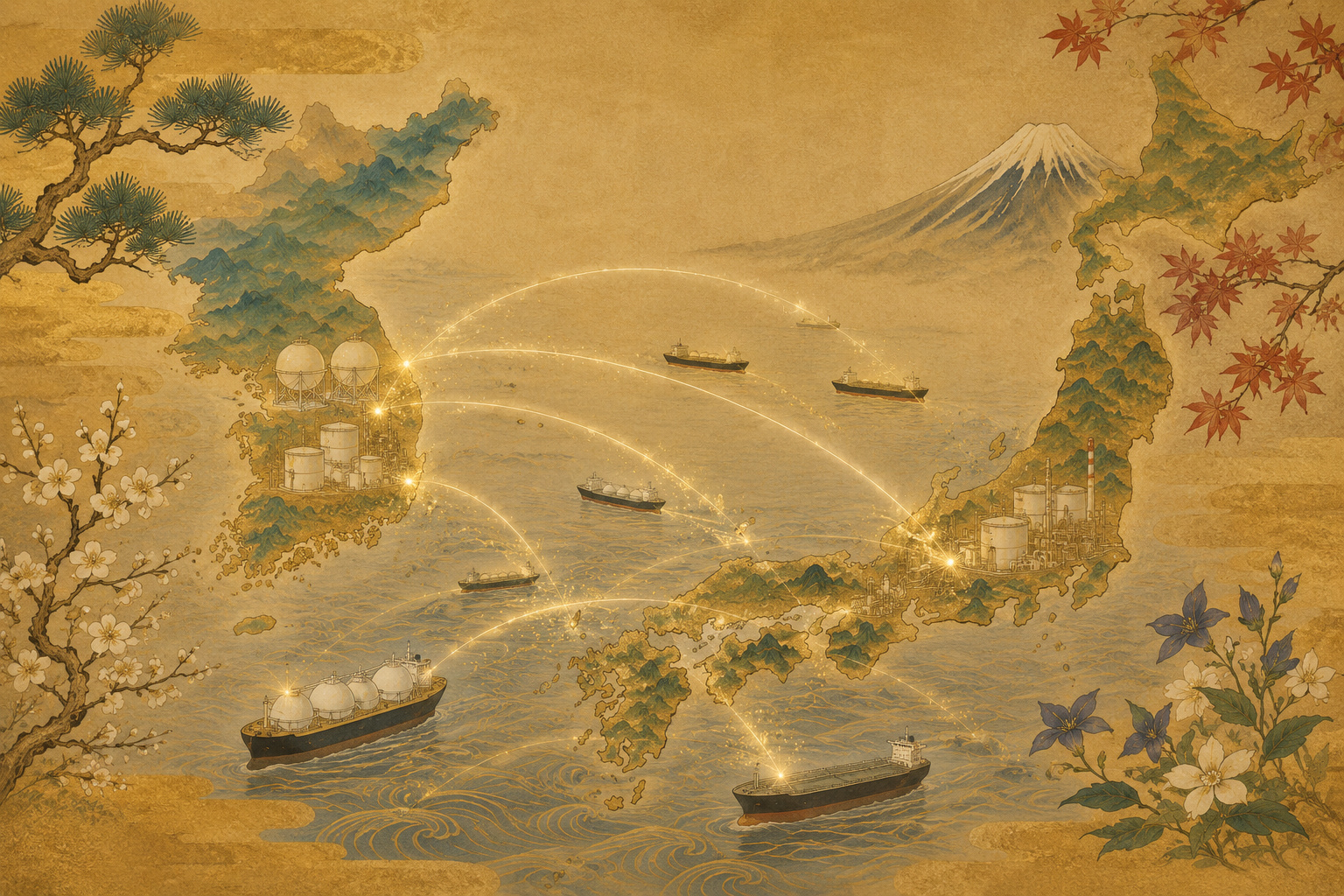
Japan and South Korea are neighbors with a shared strategic weakness: both are major industrial economies that import most of the fuel feeding their refineries, gas systems and power sectors. On September 2, officials met in Tokyo for the first implementation council of the Japan–Korea Supply Chain Partnership Arrangement, or SCPA. Among critical minerals, carbon-border rules and supply-chain due diligence, they agreed to keep deepening cooperation on emergency supplies of LNG, crude oil and petroleum products.
The September meeting was implementation, not a sudden new pact
South Korea’s Ministry of Trade, Industry and Resources said the first SCPA implementation council was held in Tokyo on September 2. The two sides discussed diversification and stabilization of critical-mineral supply chains, bilateral and multilateral cooperation, and continued cooperation on stable LNG, crude-oil and petroleum-product supply during emergencies.
They also exchanged information on carbon-emissions rules and supply-chain due-diligence requirements, including the European Union’s Carbon Border Adjustment Mechanism. That makes the SCPA wider than an energy-sharing arrangement. It is an economic-security channel designed to deal with disruption, critical resources and the regulatory conditions attached to those resources.
The SCPA itself was signed on March 14. METI’s fact sheet organizes it around three Rs: Readiness, Restoration and Resilience. Participants are to share policy and operational expertise, notify each other when signs of a disruption emerge, and allow either side to request an emergency meeting. Unless there is a valid reason otherwise, that meeting is to be held within five days.
The framework also lists facilitation of business transactions, encouragement to seek alternative supply sources and efforts to minimize unnecessary trade restrictions. It is a mechanism for opening doors quickly—not a legal order to hand over national stocks.
The practical energy relationship began at company level
Long before the September council, Japan’s JERA and Korea Gas Corporation had begun building a working LNG relationship. In April 2023 they signed an MOU covering possible LNG swaps, trading, ship optimization and exchanges of market views.
In October 2024, the Japanese and Korean governments announced a trial LNG procurement-cooperation program built around companies including JERA and KOGAS. The objective was to test joint procurement, cargo swaps and related mechanisms rather than wait for a real shortage to discover whether the idea worked.
In 2025, it did work at least once. The two companies completed LNG cargo swaps based on their procurement and inventory positions. In a joint government release, METI and its Korean counterpart said the transactions helped stabilize inventories and support energy security for both sides.
That record is what gives the current diplomacy practical weight. LNG cooperation is not only a promise to “consider helping” in a future crisis; the logistics and contractual concept have already been exercised with actual cargoes.
March 2026 turned one-off cargo flexibility into a standing relationship
On March 14, at an Indo-Pacific energy-security forum in Tokyo, JERA and KOGAS signed a new agreement on optimizing LNG operations. JERA said the framework covers discussion of supply-demand trends and proposals for mutual flexibility in incoming LNG vessels, shipping and terminal operations.
KOGAS described the arrangement as a structure for more stable and efficient LNG supply management, including regular meetings to discuss supply coordination and joint crisis response.
On the same day, Japan’s Economy, Trade and Industry Minister Akazawa Ryosei and South Korean Trade, Industry and Resources Minister Kim Jung-kwan signed the SCPA. The alignment is deliberate: the governments provide a crisis-response framework while the companies hold the contracts, terminals, ships and inventories that can actually be rearranged.
The May summit broadened the agenda from LNG to oil and refined products
On May 19, Prime Minister Sanae Takaichi met President Lee Jae Myung in Andong, South Korea. Their governments then issued a joint release on energy security and supply-chain resilience.
For crude oil and petroleum products, METI and MOTIR said they would encourage public-private dialogue focused on swaps and mutual supply, including supply of relevant products during a crisis and restraint from unnecessary export restrictions. They also identified cooperation in crude procurement and transportation, including engagement with producing countries.
For LNG, the two governments described Japan and South Korea as the world’s second- and third-largest LNG importers and said they would deepen operational cooperation, including stronger mutual-supply flexibility, using the JERA–KOGAS relationship as a foundation.
Japan also proposed a broader regional concept, the Partnership on Wide Energy and Resources Resilience in Asia—POWERR Asia—to explore cooperation with other Asian economies, including in stockpiling and energy-resource supply resilience.
Why the two countries fit together: the same vulnerability, different assets
Japan’s energy self-sufficiency rate was 15.3% in FY2023. More than four-fifths of its primary energy supply still came from imported fossil energy. Oil is especially concentrated: 2025 government data put Middle East dependence at 94.0% and dependence on crude passing through the Strait of Hormuz at 93.0%.
LNG is more diversified. Australia, Malaysia, Russia, the United States, Indonesia and others are important suppliers, with the Middle East accounting for 10.8% of Japanese LNG imports in 2025. But Japan has no international gas pipeline, so overseas natural gas arrives by ship.
Korea has a similar structural dependence. The IEA says Korea has no international gas pipeline and imports essentially all natural gas as LNG. Its crude oil also arrives by tanker. But Korea has a major refining system—around 3.5 million barrels per day of capacity in the IEA’s structural review—and significant ability to export petroleum products.
Cooperation becomes valuable not because one country is an energy producer and the other a buyer. Both are buyers. The opportunity comes from differences in contract timing, terminal positions, refinery output, product inventories and seasonal demand.
An LNG swap does not necessarily mean moving Korean gas to Japan
A cargo swap can be contractual and logistical rather than a simple bilateral shipment. Suppose a cargo contracted by a Japanese buyer is scheduled to arrive later at one location, while a Korean buyer has a cargo arriving earlier somewhere else. By exchanging destinations or delivery rights, the companies can meet short-term demand without necessarily buying another expensive spot cargo or sending ships on longer routes.
That is why the JERA–KOGAS agreements mention supply-demand views, shipping optimization and terminal operations together with swaps. Energy security is about the timing and location of molecules, not only the annual volume contracted.
The same logic can extend to crude and refined products. If Japan experiences a jet-fuel shortage while Korean refineries have exportable product, a product swap or supply arrangement may be faster than waiting for crude to arrive and be refined domestically. If a Korean refinery faces a feedstock mismatch, contractual flexibility or a compatible crude cargo controlled by a Japanese buyer could be useful.
Public agreements put these mechanisms on the table. They do not yet publish specific products, grades, quantities or formulas for pricing.
Large stockpiles do not solve every shortage
Japan has one of the world’s deepest oil-stock systems, combining government stocks, mandatory industry stocks and producer-country joint stocks. In spring 2026, official Japanese figures were around 240 days on the domestic calculation basis.
But a national reserve measured in “days” can hide local and product-specific constraints. Much of an emergency reserve is crude. A disruption may instead be a shortage of gasoline, kerosene, diesel or jet fuel. A refinery outage, port closure, cyberattack or earthquake can prevent crude from becoming the product needed in the region where it is needed.
Korea’s refining capacity and product-export system therefore matter. The value of bilateral cooperation is not simply adding two national stockpile totals. It is creating more combinations of crude, refinery capacity, product inventories, terminals and tankers.
Gas security is even more dependent on cargo timing
The IEA’s review of Korea’s gas-security framework shows why. KOGAS is required to hold mandatory gas inventory equal to seven days of average sales plus a 30-day preventive reserve. Korea has no underground gas storage and stores gas as LNG in above-ground terminal tanks.
LNG is less straightforward to stockpile indefinitely than oil. It must be kept cryogenic and tank capacity is finite. A gas emergency is therefore managed through a combination of inventories, additional procurement, demand reduction and fuel switching.
That makes cargo flexibility itself a strategic reserve of sorts. A buyer with several contractual supply sources, terminal options and a partner able to swap arrival windows has more resilience than one relying only on the volume already sitting in tanks.
What the public Japan–Korea framework covers
| Area | Already agreed or demonstrated | Not yet publicly guaranteed |
|---|---|---|
| LNG | JERA–KOGAS MOUs, 2025 cargo swap, 2026 regular operational cooperation | Guaranteed emergency volume, price, priority or automatic trigger |
| Crude oil | Swaps/mutual supply and procurement/transport cooperation placed on the agenda | Mandatory strategic-stock release or fixed grades/volumes |
| Petroleum products | Mutual supply and restraint from unnecessary export restrictions during crises | Product-specific commitments for gasoline, diesel, jet fuel, etc. |
| Supply-chain crisis | SCPA emergency meetings, alternative-source support, transaction facilitation | Legal obligation to accept the other side’s request |
| Regional resilience | POWERR Asia proposed as a wider Asian cooperation concept | Membership, permanent funding, fixed stock volumes or operating body |
The Hormuz shock turns diplomacy into logistics
The 2026 Middle East crisis makes the arrangement more than bureaucratic architecture. Japan’s crude system remains overwhelmingly exposed to the Strait of Hormuz, while South Korea also relies heavily on imported crude from the Middle East. A major disruption can therefore hit both economies at once.
That exposes the limitation of mutual aid: two importers cannot create fuel that does not exist. If both face the same global shortage, neither has unlimited surplus to send the other.
The value is in reducing mismatches—one country needing a specific product sooner, a cargo being better positioned for another terminal, refinery output being available on one side, or an emergency purchase being coordinated rather than duplicated. Cooperation can reduce panic buying and logistics inefficiency even when it does not increase global supply.
That is also why the May release included cooperation with producer countries and the wider POWERR Asia proposal. Bilateral coordination can strengthen the two buyers’ ability to seek additional supply from outside the pair.
Energy has become a practical lane in a politically complicated relationship
Japan–South Korea relations have repeatedly been strained by history, security disputes and trade policy. Yet the renewed dialogue of recent years has increasingly focused on economic-security areas where a disruption would hurt both sides at the same time: semiconductors, critical minerals, supply chains and energy.
LNG was a relatively practical place to begin. JERA and KOGAS are commercial counterparts and competitors, but different inventory and delivery schedules can make a swap mutually beneficial. The successful 2025 cargo exchange gave the relationship a measurable outcome.
The March 2026 SCPA broadened that experience into supply-chain crisis management. The May summit expanded the energy agenda to crude and refined products. The September implementation council created a recurring mechanism for turning those commitments into specific work.
Carbon rules belong in the same conversation
The September 2 meeting also covered CBAM and supply-chain due-diligence regulation. That may seem separate from emergency fuel supply, but modern energy security has a regulatory dimension.
The carbon intensity of electricity and industrial inputs affects the competitiveness of steel, chemicals, autos and other exports. Due-diligence rules can determine whether minerals and energy inputs meet environmental or human-rights requirements. Japan and South Korea have similar export-oriented industrial structures and can face similar compliance costs in Europe and other markets.
A supply source that is available but fails future regulatory tests may not be resilient in an economic sense. That is why SCPA places disruption response, critical minerals and carbon-related trade rules under the same umbrella.
April 2023: JERA and KOGAS sign an LNG-business cooperation MOU covering swaps, trading and shipping optimization.
October 2024: The governments launch trial LNG procurement cooperation.
2025: JERA and KOGAS complete actual LNG cargo swaps based on procurement and inventory conditions.
March 14, 2026: JERA–KOGAS sign an LNG operational-cooperation agreement; Japan and Korea sign the SCPA.
May 19, 2026: Takaichi–Lee summit in Andong broadens cooperation to crude oil, petroleum products, LNG and regional resilience.
September 2, 2026: First SCPA implementation council meets in Tokyo.
In the next crisis, the real metric will be time
Energy emergencies are won or lost on logistics schedules. Redirecting an LNG vessel can require contract changes and terminal compatibility. Crude grades have to match refinery configurations. Petroleum products have specifications, seasonal requirements and storage constraints.
The SCPA’s emergency-meeting rule is useful because it shortens the diplomatic path. But to shorten the physical path, both sides need the commercial contacts, inventory information, port capacity and contractual flexibility mapped in advance.
The 2025 LNG swap was a rehearsal for exactly that kind of coordination. The next test is whether oil and refined products can reach the same level of practical readiness.
Japan and Korea are not becoming one strategic reserve
The clearest way to understand the framework is not as pooled sovereignty over national fuel stocks. Each country keeps control of its own government reserves, commercial inventories and private contracts. What changes is the menu of options available when something goes wrong.
Political relations can fluctuate. Tanker schedules, winter gas demand and refinery outages do not wait for politics to improve. If each country can treat the other’s market and infrastructure as an additional emergency option, resilience improves.
But the lack of automatic commitments is real. Domestic political pressure will be strongest precisely when fuel is scarce. If both countries are short at the same time, the willingness to export product or redirect a cargo will be tested.
That is why the September 2 meeting matters despite its bureaucratic appearance. Energy security rarely turns on a dramatic summit sentence. It turns on whether, when the disruption arrives, officials and companies already know whom to call, which cargo can move, which refinery has room and which port can receive it.
Sources & Reporting Notes
- Republic of Korea Ministry of Trade, Industry and Resources, first SCPA implementation council — Primary September 2, 2026 release on the Tokyo meeting, energy supply, critical minerals and CBAM/supply-chain due diligence.
- METI–MOTIR Joint Press Release on Energy Security and Supply Chain Resilience — May 19 commitments on crude and product swaps/mutual supply, procurement and transportation cooperation, LNG operations and regional resilience.
- METI, March 2026 Japan–Korea ministerial and SCPA — March 14 ministerial meeting, signing of the Supply Chain Partnership Arrangement and unveiling of the JERA–KOGAS LNG agreement.
- METI, Japan–Korea Supply Chain Partnership Arrangement fact sheet — Readiness, Restoration and Resilience framework, emergency meeting mechanism and cooperation tools.
- Ministry of Foreign Affairs of Japan, Japan–ROK Summit — Official May 19 summit record involving Prime Minister Sanae Takaichi and President Lee Jae Myung.
- JERA, MOU with KOGAS to enhance LNG operation — Supply-demand coordination, LNG shipping/terminal optimization and cargo-swap framework.
- KOGAS, LNG supply cooperation agreement with JERA — Korean-side primary release describing regular consultations and prior cargo-swap cooperation.
- JERA, 2023 MOU with KOGAS — Earlier cooperation on LNG swaps, trading, shipping optimization and market information.
- METI–MOTIE, further development of Korea–Japan LNG procurement cooperation — Official 2025 statement that JERA and KOGAS carried out cargo swaps based on procurement and inventory conditions.
- METI–MOTIE, Trial LNG Procurement Cooperation — 2024 government framework for testing joint procurement and cargo swaps.
- Agency for Natural Resources and Energy, Japan fossil-fuel import structure — 2025 Japanese crude-oil Middle East dependence of 94.0%, Hormuz dependence of 93.0%, and LNG Middle East dependence of 10.8%.
- Agency for Natural Resources and Energy, Japan oil-stock statistics — Official national, industry and producer-country joint stockholding data.
- IEA, Korea Natural Gas Security Policy — Korea imports gas as LNG, has no international gas pipeline, and uses KOGAS reserves and emergency measures.
- IEA, Korea Oil Security Policy — Korea’s strategic and commercial oil stocks and large refining/product-export system.
- Reuters, “South Korea, Japan discuss cooperation on emergency energy supply” — International reporting on the September 2 implementation meeting.
This article was checked against public material available by 2:24 AM JST on September 3, 2026. Japanese official names, ministerial titles and terms such as SCPA, POWERR Asia and CBAM were verified primarily against Japan’s Ministry of Foreign Affairs, METI, the Agency for Natural Resources and Energy and JERA. The September 2 implementation-meeting details rely on the Republic of Korea Ministry of Trade, Industry and Resources primary release. The framework is not described as an automatic reserve-release or guaranteed-supply treaty because the public documents do not specify mandatory volumes, prices or activation thresholds. Japanese oil-stock levels vary by reporting date, so the article uses the approximate spring-2026 level rather than presenting one daily estimate as timeless.
Image rights: © 2026 Japan.co.jp. AI-assisted editorial illustration. Reproduction or reuse without permission is prohibited. For licensing, see the contact page.