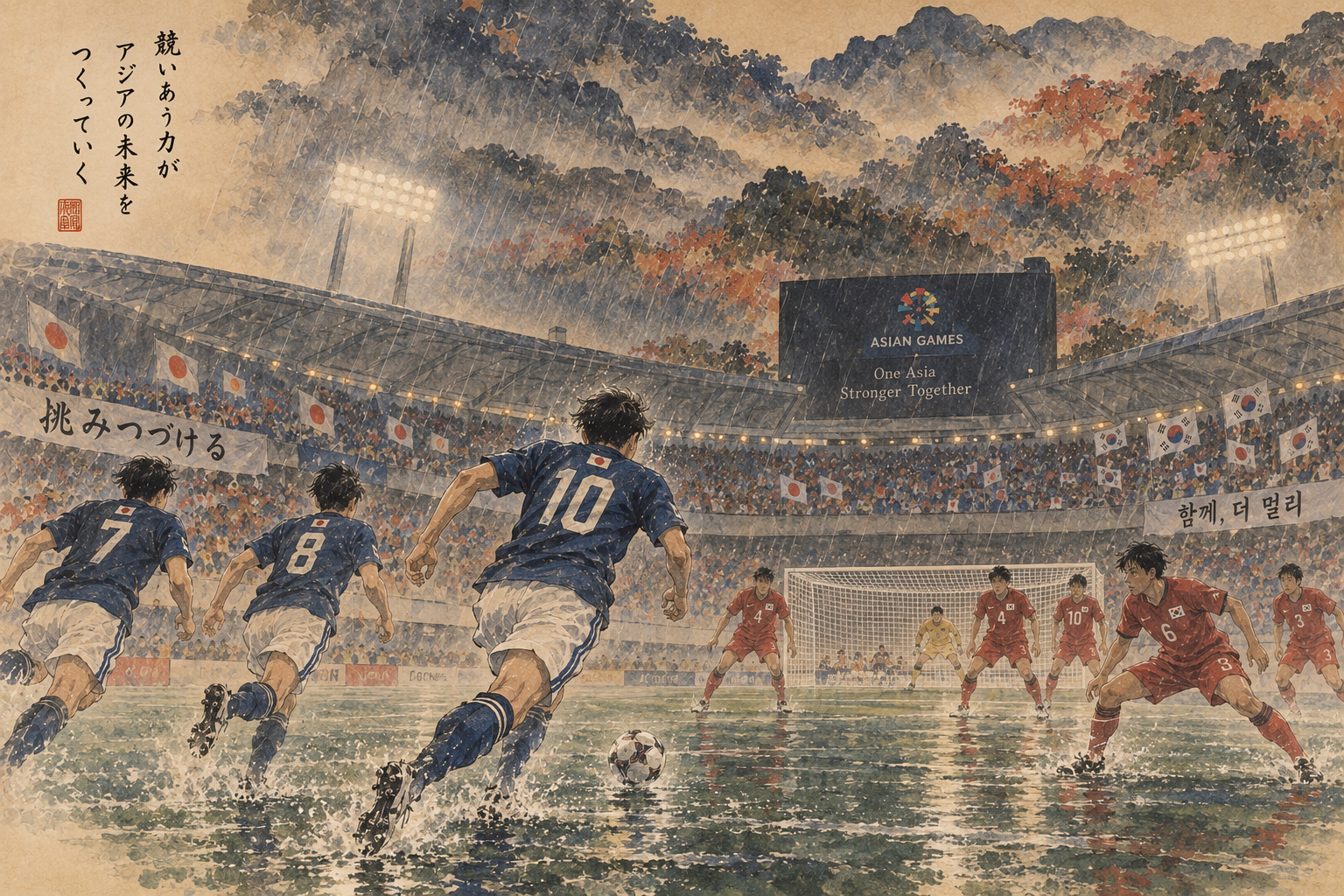
Japan was two minutes from elimination. On September 30 at Nagai Stadium in Osaka, the host nation trailed Uzbekistan 1–0 in the Asian Games men’s football semifinal after conceding to Sardorbek Bakhromov in the eighth minute.
Then Sena Ishibashi struck in the 88th. The match went through extra time without another goal. The shootout stretched deep into both teams’ lists before Uzbekistan’s Kuvonchbek Khushvaktov hit the crossbar and Japan emerged 9–8 on penalties. Go Oiwa’s side had survived long enough to earn the match it had spent the entire tournament trying to reach: an October 3 final against South Korea at Toyota Stadium.[1]
Tonight at 7:30 p.m. in Toyota
The Japan Football Association lists the men’s final for 7:30 p.m. Japan time on Saturday, October 3 at Toyota Stadium in Aichi Prefecture. South Korea earned its place with a 2–1 comeback over China: Wang Yudong put China ahead in the 22nd minute, Lee Young-jun equalized 11 minutes later and Bae Jun-ho headed the winner in the 82nd.[2][3]
As of publication, the final has not yet been played. This is a match preview, not a result story.
The same final for the third Games in a row
Japan and South Korea are becoming unusually familiar opponents at the last step of the Asian Games.
In the 2018 Jakarta-Palembang final, Hajime Moriyasu’s U-21 Japan held South Korea scoreless through 90 minutes before conceding twice early in extra time. Lee Seung-woo scored in the 93rd minute and Hwang Hee-chan in the 101st. Ayase Ueda replied in the 115th, but Japan lost 2–1. South Korea’s squad included future European stars such as Son Heung-min and Kim Min-jae.[4]
At Hangzhou in 2023, Japan struck first after only two minutes through Kotaro Uchino. South Korea answered through Jeong Woo-yeong and Cho Young-wook and again won 2–1. Korea completed a third consecutive Asian Games title; Japan took a second straight silver medal.[5]
Now the final returns for a third successive edition. South Korea is seeking an unprecedented fourth consecutive title. Japan is trying to end two cycles at once: the run of final defeats to Korea and a 16-year wait for men’s Asian Games gold.
Why Japan deliberately brought a U-21 team
The Asian Games men’s football competition is fundamentally an under-23 event, with up to three over-age players permitted. Japan chose to compete as a U-21 national team instead. JFA’s 23-player squad includes overseas-based defenders Rion Ichihara and Keita Kosugi, midfielder Nelson Ishiwatari and forward Uche Brian Seo Nwadike, along with university players and young J.League regulars. Oiwa is the head coach.[6]
JFA has explicitly tied this group to the 2028 Los Angeles Olympics. The Asian Games matter as a title in their own right, but the federation also views the tournament as a development stage for a generation expected to peak two years from now.[7]
That gives Japan two clocks in the final: the immediate one, measured in 90 minutes, and the longer one, measured toward Los Angeles 2028.
Sena Ishibashi and the value of the 88th minute
Ishibashi, a Shonan Bellmare forward wearing No. 20 for this tournament, had already been part of Oiwa’s attacking rotation during the group stage. Against Uzbekistan, his importance was defined by timing rather than volume. He scored when Japan had almost run out of tournament.[8]
The equalizer also changed the psychological shape of the match. Uzbekistan had protected an early lead for 80 minutes. Japan suddenly had extra time. When the match reached penalties, the pressure reversed from chasing a goal to surviving one kick at a time.
A 9–8 shootout is not merely a dramatic scoreline. It means both teams continued converting long after the usual first five penalties, pushing the contest into a phase where defenders, substitutes and deeper-order takers can become decisive. Japan did not win because the shootout was comfortable; it won because it outlasted the discomfort.
South Korea is chasing Asian Games history
South Korea won men’s gold at Incheon in 2014, Jakarta in 2018 and Hangzhou in 2023. Victory in Toyota would make it four consecutive Asian Games titles. Before the 2026 tournament, AFC records credited South Korea with six men’s gold medals in total.[9]
The semifinal against China showed why the defending champions remain difficult to remove. They fell behind, equalized quickly and found the winner late through Bae Jun-ho, the Stoke City midfielder arriving at the back post in the 82nd minute.[3]
South Korean players also compete within a domestic system in which Asian Games gold can affect eligibility for special treatment under mandatory military-service rules. That is a documented institutional stake, but it should not be reduced to an assumption about any individual player’s motive. On the field, the more relevant fact is that this team is playing to extend a tournament dynasty.
Japan has won the men’s tournament only once
Japan’s single Asian Games men’s football gold came at Guangzhou in 2010. A team featuring Kensuke Nagai, Kota Mizunuma and Hotaru Yamaguchi won all seven matches, conceded only once in the tournament and beat the United Arab Emirates 1–0 in the final.[7]
JFA notes that since the men’s tournament adopted age restrictions in 2002, Japan has one title and three runner-up finishes. The recent pattern is clear: Japan reaches the final often enough to belong there, but has not converted those appearances into gold since 2010.[7]
Why the Asian Games is not simply another senior international
Men’s Asian Games football has used age restrictions since 2002, in a format broadly similar to Olympic men’s football. That makes it different from the AFC Asian Cup, which is contested by full senior national teams.
The tournament functions partly as a high-pressure development environment. Japan’s 2018 team included players such as Ueda, Ko Itakura and Daizen Maeda, all of whom later became senior internationals and World Cup players. The final can therefore matter both as a medal match and as an early glimpse of future senior-team players.[4]
Oiwa has been here before
Go Oiwa also coached Japan in the 2023 final. His side scored after two minutes but eventually surrendered control and lost 2–1. JFA’s later review of that tournament praised the development of the young squad but acknowledged the final as a missed chance for gold.[5]
Three years later, he arrives in the same fixture with an even younger group. One tactical question will be whether Japan can play through South Korea’s pressure rather than spend long stretches defending after turnovers.
A second issue is recovery. Japan played 120 minutes plus a long shootout in Osaka on Wednesday. South Korea completed its semifinal against China in 90 minutes. With only a few days before the final, those extra 30 minutes may matter late in the match.
Home advantage comes with home pressure
Japan returns to Toyota Stadium, where it played its group-stage fixtures. The team beat Thailand 3–0 there on September 23, with goals from Yotaro Nakajima, Keita Kosugi and Hisatsugu Ishii.[8]
Familiarity with the stadium, climate, travel and crowd can help a young team. Hosting also creates expectation. A final at home carries a different emotional burden from a neutral-site tournament abroad, particularly after Japan’s silver medals in 2018 and 2023.
A rivalry that does not need political inflation
Japan–South Korea sporting contests are often framed through the two countries’ broader historical relationship. That history exists, but it is not necessary to turn a U-21 football final into a proxy political confrontation.
The sporting context is already substantial. Japan seeks its first men’s gold since 2010. South Korea seeks a fourth straight title. Oiwa’s group is being developed toward Los Angeles 2028. Korea has beaten Japan in the last two Asian Games finals.
Those facts explain the stakes without assigning national grievances to a generation of young players.
Three things to watch
First, recovery. Japan’s semifinal required 120 minutes and a 9–8 shootout; Korea’s required 90 minutes. If the final remains level into its last half-hour, the accumulated load may become visible.
Second, response to the first goal. Both semifinalists trailed and recovered. Japan waited until the 88th minute; Korea answered China within 11 minutes. Neither team arrives believing an early deficit ends the match.
Third, Japan’s ability to play forward under pressure. In the 2023 final, Japan scored early but could not repeatedly escape Korean pressure. A young side built for 2028 will learn more from controlling stretches of the final than from surviving entirely in its own half.
The 90 minutes earned by two remaining minutes
Japan’s Asian Games campaign nearly ended in Osaka. Without Ishibashi’s 88th-minute intervention, there would be no third straight Japan–Korea final and no chance at a first men’s gold in 16 years.
Tournament football rarely rewards only the team that looks strongest from beginning to end. Champions survive bad periods, find goals late and carry themselves through matches that stop behaving according to plan.
Japan survived one of those matches against Uzbekistan. Tonight at Toyota Stadium, there is no next round to survive toward. There is only the opponent that has stood between Japan and gold in each of the previous two Asian Games.
Sources
- AFP-Jiji / The Japan Times, Japan vs. Uzbekistan semifinal report (Oct. 1, 2026)
- Japan Football Association, 2026 Asian Games men’s final schedule
- Reuters, South Korea vs. China semifinal report (Sept. 30, 2026)
- JFA, 2018 Asian Games final: Korea Republic 2–1 Japan
- JFA, 2023 Asian Games final: Korea Republic 2–1 Japan
- JFA, Japan U-21 Asian Games squad
- JFA, 2026 Asian Games tournament preview and Japan men’s history
- JFA, Japan 3–0 Thailand, Toyota Stadium
- AFC, South Korea’s third consecutive title in 2023