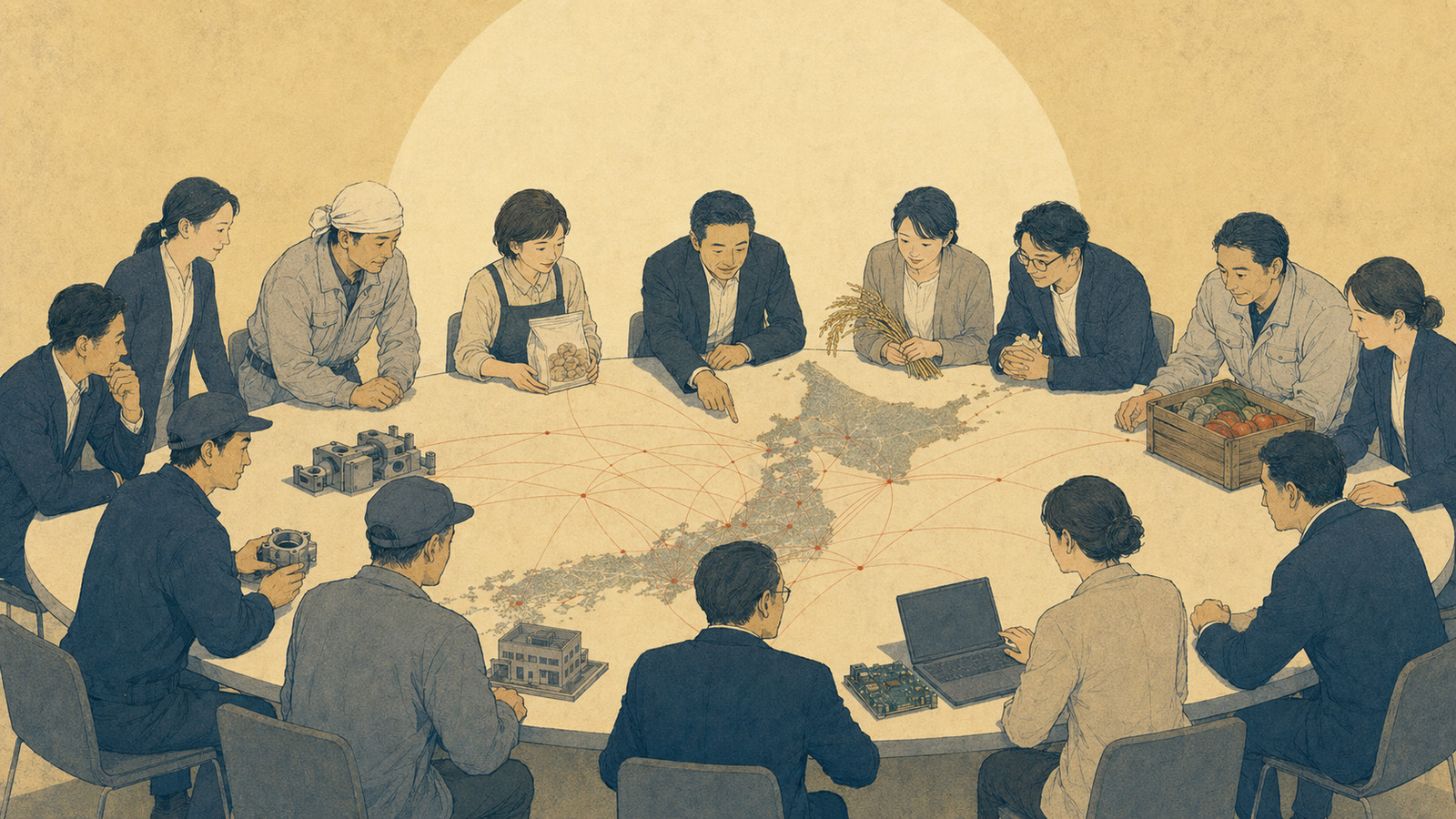
A business card once traveled as far as the local bank officer carrying it. In August, the same act of introduction will stretch from Hokkaido through Tohoku to the factories, stores and offices of greater Tokyo: more than 2,000 companies have registered for a month-long business-matching program assembled by 21 regional financial institutions.
The sixth EnmusuBA, organized by Tokyo-based financial-technology company Kokopelli, is scheduled to run online from August 3 through August 31, 2026. Two in-person sessions will supplement the digital program: August 20 at the Minato City Industrial Promotion Center in Tokyo and August 28 at the Sendai City SME Revitalization Center. Participation in the event is free.
The record registration count, measured on July 22, is significant. It is not the result. The meetings have not yet happened, “2,000” counts entrants rather than completed negotiations, and the organizer has not said that every registrant is legally an SME. The program is built as an SME-support event and draws on Big Advance member companies, but the precise language matters: a large top of the funnel does not prove a contract at the bottom.
That distinction does not diminish the experiment. It makes it more interesting. EnmusuBA is an attempt to transform one of regional finance’s oldest assets—knowledge of who makes what, who can be trusted and who needs a buyer—into a searchable, cross-regional network. Its real subject is not an online fair. It is the changing job description of a Japanese banker.
What EnmusuBA Actually Does
This is not a virtual exhibition hall in which companies wander anonymously from booth to booth. It is a pre-matched process. Participants publish concrete needs, search the platform and request a conversation. A meeting is scheduled only when the other company accepts. The two sides then arrange a time during the event period, generally using Zoom or another online tool. At the physical venues, accepted partners can meet across a real table.
The themes reveal how broad the word “matching” has become. One track covers sales expansion in food, manufacturing, sustainability and overseas markets. Another seeks cooperation in components, machining, assembly, construction, infrastructure, transport and logistics. A third connects providers of AI, information technology and workflow tools with businesses seeking productivity gains.
According to Kokopelli’s July 23 release, buyers and companies seeking collaboration may participate even if they are not Big Advance members, while companies joining as sellers must be members. The event landing page, however, contains a more restrictive participation box saying non-members need to register for Big Advance. The organizer should reconcile those instructions before applications close. The service’s standard public price is ¥3,300 a month including tax, separate from the event’s announced free admission.
- Banks: Aomori Michinoku, Ashikaga, Bank of Iwate, Kita-Nippon, The 77 Bank, Shonai, Joyo, Sendai, Toho, Towa, Tochigi and Higashi-Nippon.
- Shinkin banks: Kawasaki, Seibu, Tama, Chiba, Tokyo Higashi, Hanno, Hiratsuka, Mito and Yokohama.
Calling all 21 “regional banks” is convenient but imprecise. Shinkin banks are cooperative financial institutions whose membership is composed mainly of local residents and SMEs; mutual support and a defined service area are part of their institutional identity. The mix matters. It joins shareholder-owned banks with cooperative lenders whose branches often sit closest to microbusinesses.
From 1,650 Entries to 1,000 Meetings
The fifth EnmusuBA, held in February 2026 with a focus on Kansai, attracted about 1,650 entrants and produced more than 1,000 meetings during one month, Kokopelli says. Some negotiations have already become contracts, although the company has not published their number or value. Across ordinary platform activity and special events, Big Advance reports roughly 240,000 cumulative meeting requests.
Those figures show scale, but they describe different stages. One company can send several requests. A request can be declined. A mutually accepted meeting can end without a quotation. A contract can be too small to change the seller’s economics. And a first order can fail to become a repeat customer. The danger of any matching marketplace is celebrating motion instead of value.
| Stage | What should be counted | What the public currently knows |
|---|---|---|
| Entry | Unique companies eligible to participate | More than 2,000 for the sixth event |
| Intent | Needs posted and requests sent by unique companies | Platform-wide cumulative requests are about 240,000 |
| Acceptance | Requests accepted by the proposed partner | Not yet reported for the sixth event |
| Meeting | Conversations actually held, adjusted for cancellations | More than 1,000 at the fifth event |
| Commercial result | Quotes, pilots, orders, contract value and repeat business | Some fifth-event deals; no aggregate value disclosed |
| Regional value | Sales, jobs, productivity, succession or resilience created | No common long-term measure published |
The fair test will therefore come after August. How many entrants secured at least one meeting? How many meetings crossed prefectural or regional lines? What share reached a quotation within three months, a paid order within six and repeat business within a year? Those measures would turn a publicity number into evidence about economic development.
The Bank as a Map of the Town
Regional finance has always carried information that a balance sheet cannot hold. A branch manager knows that a metal shop’s delivery is dependable, that a food producer’s packaging is weak, that a trucking company has spare capacity on the return journey, or that an owner approaching retirement would listen to a successor. Economists call much of this “soft information.” It accumulates through repeated contact and is difficult to transmit in a credit score.
Japan’s postwar main-bank system made the relationship especially durable. Companies often concentrated borrowing, payments and advice with one primary bank. For large industrial groups, that structure could coordinate finance and corporate rescue. For a small regional company, it meant that a bank officer was sometimes the only outside professional who saw the business every year.
That intimacy can support patient credit, but it has never been automatically benign. A company may become dependent on one institution. A bank may hesitate to recognize failure or prefer collateral over a difficult judgment about the enterprise. Local knowledge can harden into local closure: the same networks that create trust can keep unfamiliar suppliers outside.
Business matching tries to open the map. The banker still contributes verification and context, but the searchable network allows a buyer in Tokyo to discover a producer in Aomori, or a Sendai manufacturer to find a specialist processor in Kanagawa. The task moves from “Can this customer repay?” to “Whom should this customer meet?”
A Financial Network Built Since Meiji
The story begins well before the modern regional bank. The revised National Bank Act of 1876 triggered the formation of locally rooted national banks; 153 were operating by the end of 1879. The Bank of Japan was established in 1882 partly to bring order and national integration to financial markets that remained divided by region.
Branches, telegraph lines and central-bank settlement gradually reduced the distance between local money markets. Yet local banks remained tied to merchants, landlords and industries in their home districts. During the late 1930s and the war, state-directed consolidation drastically reduced their number and pushed much of the country toward a “one prefecture, one bank” structure, though the pattern was never absolute.
After 1945, regional banks financed reconstruction and the high-growth economy. They collected household savings and lent to local manufacturers, wholesalers, builders and retailers. The system’s strength was continuity: a bank could judge a company through a cycle. Its weakness emerged after the asset bubble burst. Non-performing loans, falling land prices and the financial crisis of the 1990s exposed the cost of delayed recognition and overreliance on collateral.
In March 2003, the Financial Services Agency issued its Action Program for strengthening relationship banking. It asked regional institutions to understand businesses through close, long-term communication while resolving the bad-loan problem. A regulatory chronology published by the agency identifies April 2004 as the point at which business matching, M&A support and management consultation were explicitly placed among the expanded activities banks could perform.
That date is an important hinge. The bank’s introduction stopped being merely an informal favor by a well-connected officer and became a recognized component of corporate support. Over the following two decades, banks created consulting units, M&A desks, succession services, regional trading companies and personnel-matching programs. The loan remained central, but it was no longer a sufficient definition of regional finance.
2018: The Introduction Becomes Software
Kokopelli and Yokohama Shinkin Bank launched Yokohama Big Advance on April 19, 2018. Their proposition was deliberately hybrid: combine face-to-face knowledge held by a regional institution with technology able to cross its geographic boundary. Within a year, nine financial institutions had adopted the model.
The platform expanded beyond matching. It added simple website creation, subsidy information, business chat, employee benefits, invoice and attendance functions and direct communication with the participating financial institution. For a small firm without a dedicated IT department, the bundle offered a low-cost digital front office. For a bank, it created more frequent signals about a customer’s needs.
COVID-19 supplied a brutal demonstration of the model’s usefulness. Kokopelli reported about 10,000 cumulative meeting requests in September 2020. By November 2022 the count exceeded 100,000, while participating institutions had grown from 42 to 83. In April 2023, the first EnmusuBA brought roughly 500 companies into a concentrated three-day online event. The sixth edition’s 2,000 registrations are four times that inaugural turnout, although its month-long and hybrid design is not directly comparable.
Digitalization did not abolish the relationship manager. It changed the division of labor. Software can index a request for precision parts, shelf-stable food or a carbon-accounting tool; a human can ask whether the need is serious, whether the timing is realistic and whether an introduction is wise. The platform provides reach. The institution lends credibility and follow-through.
Why 2026 Is a Decisive Moment
Japan has approximately 3.36 million SMEs. They account for 99.7 percent of companies and about 70 percent of employment. Their collective weight is enormous, but many have little capacity for dedicated sales development, procurement research or digital transformation. A brilliant machining company may be nearly invisible outside its tier of a supply chain; a rural food maker can master fermentation and still lack a buyer with national shelves.
The operating environment has become harsher. The SME Agency describes persistent cost increases, labor shortages, higher interest rates and the need to raise productivity and prices. Its 2025 White Paper placed the average age of business owners at 60.7 in 2024. The 2026 White Paper warns that, under one projection, SME employment in 2040 could fall to the mid-80-percent range of its 2018 level.
These pressures interact. A company without sales growth cannot lift wages. A company that cannot hire may need automation or an outside production partner. A capable owner without a successor may need a buyer, management talent or an alliance rather than another short-term loan. Matching is therefore not a peripheral marketing service. It can sit at the junction of revenue, productivity, succession and resilience.
The regional institutions face their own version of the problem. The Bank of Japan’s April 2026 Financial System Report counts 61 members of the Regional Banks Association and 35 second-tier regional banks, alongside 247 shinkin banks holding BOJ current accounts. Population decline narrows traditional loan growth, while compliance, cyber security and specialized personnel raise fixed costs. Rising interest rates may improve lending margins, but they do not recreate regional population.
The FSA’s December 2025 Regional Financial Capability Enhancement Plan answers by casting these institutions as hubs. Their strength, the agency says, is deep understanding based on business evaluation. From that base they are expected to deliver both finance and non-financial support: growth capital, turnaround work, succession and M&A, management talent, DX and connections to players beyond the region. EnmusuBA is a private platform operating inside that policy direction.
Hokkaido, Tohoku and Kanto Are Complementary
The event’s geography is not arbitrary. Hokkaido and Tohoku contain formidable food, agriculture, forestry, fisheries, materials and manufacturing capabilities, but their producers often face long transport distances and thin local markets. Kanto contains dense purchasing power, corporate headquarters, distribution systems and specialist service providers. Connecting the regions can create sales, but it can also reorganize supply chains.
A Tokyo buyer may want distinctive regional foods. A Tohoku factory may need an alternate processor after a disaster or equipment failure. A transport company may seek freight for an empty return route. A construction company may need a certified subcontractor; a rural manufacturer may need a cyber-security provider. A platform becomes useful when it translates those broad wishes into a specification another company can answer.
The earthquake and tsunami of 2011, repeated floods, the pandemic and global supply disruptions have all shown the cost of depending on one route or supplier. Cross-regional matching can be part of business continuity: not simply the cheapest transaction, but a second relationship that exists before the first one breaks.
Trust Is the Product—and the Risk
A participating financial institution’s name lowers the psychological barrier to answering a stranger. But an introduction is not a guarantee. Companies must still check ownership, financial capacity, quality systems, labor conditions, intellectual-property protections, sanctions and export requirements. The platform should state clearly what the bank has verified and what remains the parties’ responsibility.
Conflicts also require daylight. A financial institution may earn fees from a platform membership, an advisory service, payments or a later financing transaction. That does not make the introduction improper, but the customer should know who pays whom. A seller should not feel that buying a digital subscription is necessary to preserve credit access. A buyer should know whether search results are neutral, sponsored or shaped by a bank officer.
Data are another form of collateral. A posted need can reveal a capacity shortage, failed supplier, technology gap, overseas plan or succession concern. Access controls, retention limits and incident response matter. AI can help draft requests or recommend partners, but it can also reproduce the network’s existing bias toward companies with polished profiles and abundant data. Human review is essential where a recommendation carries the halo of a bank.
- Is this an introduction, a recommendation or a verified qualification?
- What information will the other company, bank and platform operator see?
- Are any referral, subscription or success fees attached?
- Who owns drawings, samples and data shared during the meeting?
- What happens if an order is late, defective or never paid?
- Will the relationship still make sense after freight, certification and staff time?
From Matchmaker to Market Builder
The best outcome is not 2,000 isolated conversations. It is a network that learns. If several food producers need cold-chain capacity, institutions can identify an infrastructure gap. If manufacturers repeatedly request the same test process, a bank can help finance a shared facility. If buyers reject regional products for packaging or certification rather than quality, advisers can target the actual constraint.
That requires aggregated evidence that protects company confidentiality. Organizers should publish a post-event scorecard at three, six and twelve months: meetings held, unique firms with at least one match, cross-region share, quotations, pilots, orders, repeat transactions, transaction-value bands, jobs or investment supported, no-show rate and reasons for failure. Results should be separated by sector, buyer or seller role and company size so that one active group does not conceal another’s exclusion.
The institutions should also preserve the human work after the video call. Small firms often need help turning interest into a specification, price, sample, contract, financing plan or logistics arrangement. A platform that creates leads but leaves owners alone at the hardest stage risks becoming another inbox. A bank officer who follows the match through production and payment converts software reach into relationship finance.
The Meaning of Two Thousand
On August 3, the impressive number will return to zero in the only count that ultimately matters: no meeting has happened until two companies decide to spend time on each other. Then the network will begin again, request by request.
If the event ends with a thousand video calls and little follow-up, it will have been a busy month. If a Hokkaido producer earns a repeat Kanto buyer, a Tohoku factory finds a second source for a critical part, or a shinkin customer hires the DX partner that releases scarce labor, the effect will be larger than the contract. The company becomes more resilient, and the institution becomes relevant for a reason beyond credit.
That is the historical promise inside EnmusuBA. The local bank once knew the town. The modern regional institution must know how the town connects to the country—and how to make a trustworthy introduction across the distance.
Sources and methodology
The 2,000-company registration figure, previous-event results and cumulative platform requests are organizer disclosures, not independently audited outcome data. Japan.co.jp checked the event structure against the official landing page and placed it in historical and policy context using government, central-bank and industry sources.
- Kokopelli: July 23, 2026 registration announcement and event outline
- Sixth EnmusuBA official event page: institutions, process, venues and eligibility
- Big Advance service site: functions, pricing and operating model
- Kokopelli and Yokohama Shinkin: launch of Yokohama Big Advance in April 2018
- Kokopelli: first anniversary and expansion to nine financial institutions
- Kokopelli: platform growth from 10,000 to more than 100,000 requests, 2020–22
- Kokopelli: first EnmusuBA event and 2018–23 platform history
- Financial Services Agency: 2003 Action Program for relationship banking
- Financial Services Agency: April 2004 recognition of business matching among expanded bank activities
- Financial Services Agency survey: SMEs’ expected support from regional institutions
- Financial Services Agency: 2025 report on strengthening regional financial capabilities
- Financial Services Agency: Regional Financial Capability Enhancement Plan
- Financial Services Agency: July 2026 progress report on financial intermediation
- Bank of Japan Currency Museum: national banks and the founding of the BOJ
- Bank of Japan: wartime bank consolidation
- Bank of Japan: April 2026 Financial System Report
- Shinkin Central Bank: structure and role of cooperative shinkin banks
- METI: 2025 SME White Papers and the 70% employment share
- SME Support Japan: 3.36 million SMEs, 99.7% of companies and 70% of employment
- SME Agency: 2024 average business-owner age of 60.7
- SME Agency: 2026 White Paper summary and projected labor constraints
- Japan Finance Corporation: business-matching examples and regional-institution partnerships