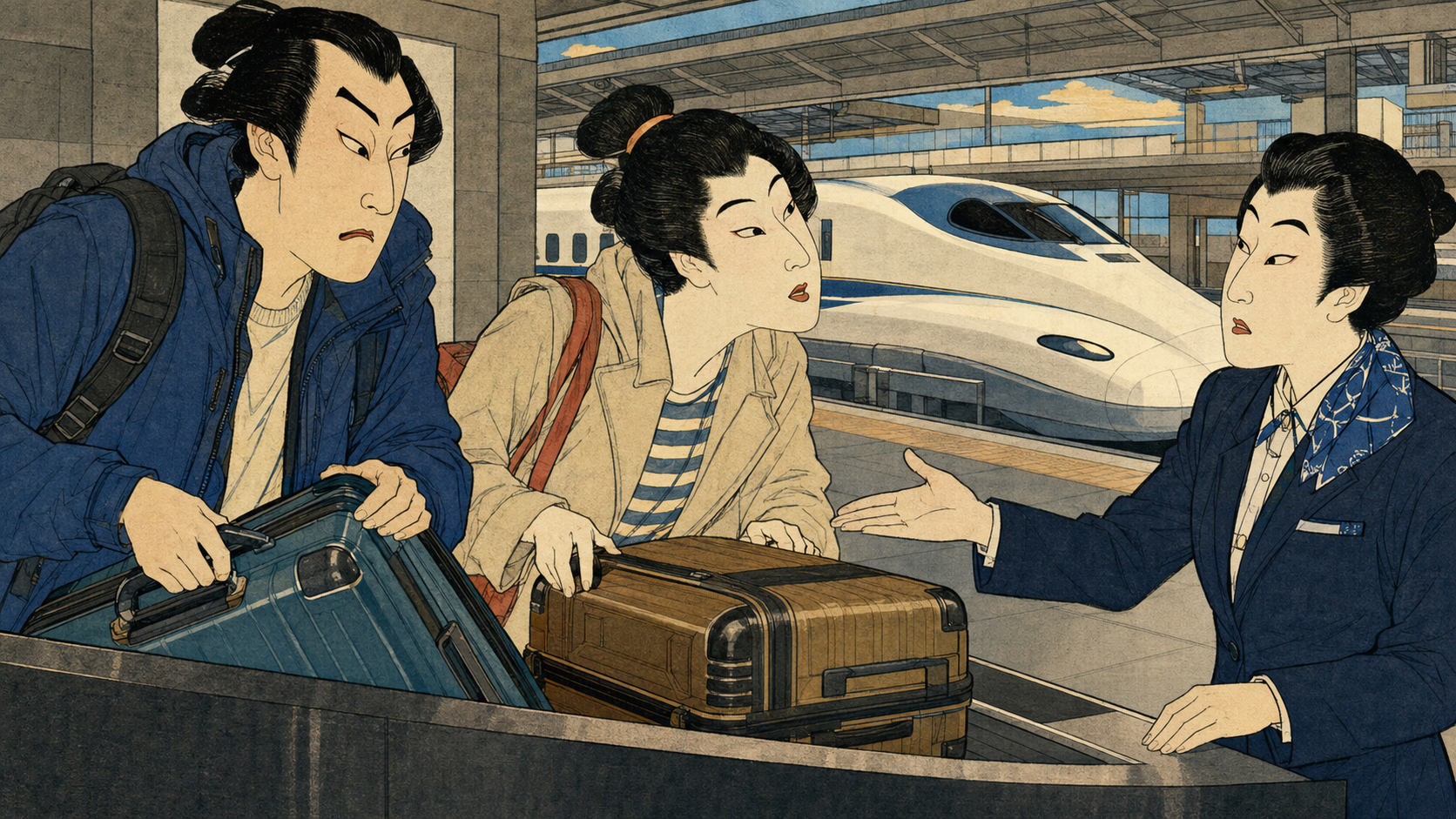
The morning sound of Tokyo Station is partly the sound of wheels, but not the steel wheels beneath trains. Suitcase casters tap across stone from Yaesu to Marunouchi, stop abruptly at the ticket gates, turn toward elevators and rattle over platform joints. A case is lifted at stairs, guarded at the owner’s feet and studied beneath an overhead rack that may or may not accept it. Japan has made the movement of people by rail astonishingly smooth. The box belonging to the person has remained a problem for the person’s arms.
JR East’s new service, beginning August 1, alters that assumption in a small but fundamental way. A customer makes a web reservation by 9:30 a.m., then places one bag or case in a designated Multi-Ecube locker at Tokyo or Sendai Station by 10:30. The luggage travels between the cities through the Hakobyun Quick train-freight network and is delivered to a participating hotel later that day.
The first corridor links Tokyo with Sendai. More than 500 hotels in greater Tokyo and about 30 around Sendai Station and the Akiu Onsen resort area are covered. Prices are ¥3,500 for an S compartment, ¥3,600 for M and ¥3,700 for L—about $21.36 to $22.58 at the exchange rate carried in this edition. A staffed station counter remains available without an advance reservation, subject to operating conditions and capacity.
It sounds like a better locker. It is more consequential than that. The door is the visible edge of a chain involving identification, collection, station handling, a train, arrival sorting, road delivery and a hotel desk. The passenger no longer needs to travel with the suitcase, or even on the same service that carries it. People and property are deliberately separated, each sent through the network most suitable for it.
A locker that sends rather than stores
A conventional coin locker rents a location for a few hours or days. The customer must return to the same bank of doors and retrieve the item. With this service, closing the door changes the locker from storage into a freight acceptance point. A reservation number or QR code connects identity, payment, compartment and destination. Staff collect the bag, move it through the station, hand it into the railway operation and pass it to last-mile delivery at the destination.
This is not airline-style checked baggage tied one-to-one to the passenger’s seat reservation. JR East has not promised that a customer and case will ride the same train. The useful idea is the opposite: separate the two flows. The person should be free to visit a museum, eat lunch, change trains or take a later departure; the object can follow a controlled logistics schedule.
Multi-Ecube provides the interface. Introduced in October 2023, the system combines four functions—reservation, deposit, collection and shipment—in one cabinet linked to a web platform. JR East Smart Logistics reached 1,000 units on May 28, 2026. Its web membership has passed 250,000, while more than 430 locations support receipt or shipment and process over 25,000 such transactions a month. Tokyo–Sendai luggage is not an isolated travel perk. It is the next use for a distributed logistics terminal network built inside everyday pedestrian space.
How it works—and where the promise ends
- Reserve: By 9:30 a.m. on the day of use, select an eligible Multi-Ecube, compartment size and destination hotel through the website and pay.
- Deposit: By 10:30, enter the reservation number or scan the QR code at the assigned locker. Put one bag or case in the compartment and close it.
- Transport: Staff collect and transfer the item into Hakobyun Quick for the Tokyo–Sendai trunk journey, then into delivery at the destination.
- Receive: Collect it later that day at the hotel desk. Guest name, stay date and hotel details must correspond to a valid booking.
The appearance of a locker suggests anytime access, but same-day transport depends on a strict morning cut-off. Collection, loading, the intercity train and hotel rounds must fit into one operating day. A case placed in ordinary storage at 10:31 does not acquire the same-day promise merely because it is inside the same machine. Availability also depends on compartments, train capacity, railway operation and last-mile conditions.
The destination must participate. This is not delivery to any written address. An unstaffed vacation rental, a friend’s home or a reservation whose guest details cannot be confirmed may not work. Carrier terms also restrict valuables, dangerous goods, fragile articles, perishables and other unsuitable contents. “Large luggage” is not infinitely large luggage: typical Multi-Ecube L compartments are only about 34–36 centimeters wide, 58–66 deep and 84–87 high. Shape matters as much as the marketing letter.
Same day also does not mean before the passenger. Arrival depends on every handoff. Passports, cash, keys, medicine, an evening change of clothes, infant supplies and anything whose delay would be serious should remain with the traveler. Hands-free travel is a way to choose what not to carry, not an argument for placing the entire trip inside a locked cabinet.
Railways once considered baggage their business
The system appears futuristic because the smartphone and QR code are visible. Its underlying idea is old. When rail dominated Japanese intercity travel, stations accepted both people and property. A passenger could check baggage, while a non-traveler could consign a small parcel. Tags and claim checks controlled the handoff, and baggage cars—sometimes attached to passenger trains, sometimes running as dedicated services—moved the goods through a nationwide station network.
Porters known by their red caps carried trunks through major stations. Railway workers pushed carts along platforms and loaded combined passenger-baggage cars. The colloquial word chikki, derived from “check,” became familiar enough to mean checked rail baggage. The traveler entered a coach unencumbered; the railway took responsibility for the box.
In that sense, separating passenger and luggage is not the invention. The novelty is replacing a staffed baggage window, paper tag and claim stub with a web reservation, electronic lock, machine-readable identifier and hotel database.
Roads and trucks weakened the old model. A station-to-station system made customers perform both the first and last mile, while a truck could collect at one door and deliver to another. Japanese National Railways carried roughly 70 million small parcels in 1975 but only about 12 million a decade later. Its national baggage operation ended at the close of October 1986, on the eve of JNR’s breakup and privatization.
1964: sixty locker doors in Shinjuku
Automation had entered the station before railway baggage disappeared. Alpha Locker System dates Japan’s first coin lockers to December 15, 1964, when 60 doors were installed underground near Shinjuku Station’s west-side entrance. There had been queues at the staffed baggage counter. In the year of the Tokyo Olympics and the opening of the Tokaido Shinkansen, a traveler could for the first time buy a small, temporary private space without speaking to an attendant.
The locker separated person and bag, but only in space. It did not move the bag. Twelve years later, a black cat began to change that division of labor.
Yamato launched Takkyubin on January 20, 1976, promising collection by telephone, simple packing and next-day household delivery. Only 11 pieces were handled on its first day. The service reached its fiftieth anniversary in 2026 as a national habit: golf clubs, skis, refrigerated food, airport luggage, gifts and ordinary parcels travel through a dense door-to-door network.
The station lost its position as the obvious gateway for small freight. Homes, convenience stores, hotels and carrier offices became acceptance points. For travelers, forwarding a large suitcase to the next hotel a day early became one of Japan’s most practical solutions. Yet conventional parcel delivery often assumes an overnight interval. A traveler using clothes in Tokyo this morning and needing them in Sendai tonight has no day to spare. Same-day Shinkansen delivery fills that missing interval.
Shinkansen freight is no pandemic side business
JR East began trials in 2017 using spaces such as onboard-sales preparation rooms on Tohoku Shinkansen trains. Fresh vegetables, fish, fruit, confectionery, medical goods, precision equipment and electronic parts could reach metropolitan buyers at railway speed and with timetable discipline. The group named its train logistics service Hakobyun in 2021 and widened experiments during the pandemic-era collapse in passenger demand.
In 2025, JR East moved from trials toward a business spanning a single parcel, hundreds of boxes and the use of entire cars. It set a goal of ¥10 billion in annual group revenue. On March 23, 2026, a seven-car E3 train with seats removed and level floors began operating between Morioka and Tokyo as Japan’s first Shinkansen formation dedicated to freight. It can carry as much as 17.4 metric tons, or roughly 1,000 boxes. A train once built for the Yamagata Shinkansen’s passenger service returned as a baggage vehicle in a new industrial age.
That does not mean a tourist’s suitcase is guaranteed to ride the dedicated E3 formation. The August product uses Hakobyun Quick, the network through which an individual can take one urgent item to a station counter. Quick links Tokyo with Shin-Hakodate-Hokuto, Shin-Aomori, Morioka, Sendai, Niigata, Nagano and Kanazawa. At most stations, counter acceptance can be as late as 30 minutes before the relevant train; Shin-Hakodate-Hokuto and Kanazawa require 60 minutes.
The August innovation is therefore less about a new train than a new connection. Multi-Ecube turns an unattended cabinet into the front end of a service that previously required a counter. A modest piece of station furniture becomes an API in steel.
Tourism has outgrown the old baggage assumptions
Scale is part of the pressure. The Japan National Tourism Organization counted a record 42,683,600 international arrivals in 2025. Another 21,084,800 arrived in the first half of 2026. The issue is not merely that more people are traveling. Low-cost aviation, longer multi-city itineraries, family trips and shopping have made large four-wheel cases a permanent feature of the station landscape.
A Shinkansen does not have an aircraft-style hold into which every large case disappears. On the Tokaido, Sanyo and Kyushu corridors, the operators introduced advance reservations for “oversized baggage” on May 20, 2020. A bag whose three dimensions total more than 160 centimeters and no more than 250 requires a seat with a designated baggage area. The reservation itself costs no extra, but bringing such a bag without one triggers a ¥1,000 fee; anything over 250 centimeters cannot be brought aboard.
Those specific rules should not be carelessly transplanted to the Tohoku Shinkansen, the route in this story. Their importance here is historical and operational: they show how suitcase growth forced Japan’s busiest high-speed corridor to allocate scarce cabin space formally rather than leave the area behind the last row to a race among passengers.
A case too heavy for the overhead rack narrows an aisle or deck, becomes a hazard if it falls and slows boarding around platform doors. Elevators become pinch points. For a parent holding a child’s hand, an older visitor with a cane, someone using a wheelchair or a traveler recovering from injury, the case is more than an annoyance. It can decide whether a journey is feasible.
“Hands-Free Travel” became national policy in 2015
Japan’s transport ministry adopted a common Hands-Free Travel logo in 2015 for qualified counters at airports, stations and commercial facilities that store luggage or send it to airports, stations and hotels. The stated purpose was not only comfort. The government wanted international visitors to travel farther into regional Japan and spend more once freed from large bags.
There is a real economic mechanism behind the slogan. A traveler who must first reach the hotel with a suitcase follows the shortest path. A traveler whose bag is already moving can stop at a museum, market, temple or hot spring. JR East’s phrase “the value of time” describes lighter shoulders, but it also means converting check-in hours into regional circulation and spending.
That goal has a public dimension. Fewer cases can improve platform flow and accessibility for everyone, including residents who never buy delivery. If operators can demonstrate measurable reductions in crowding and dwell-time friction, governments and hotels may eventually have reason to help subsidize a service that currently falls entirely on the user.
Six ways to move one suitcase
| Choice | Best for | Main limit or price |
|---|---|---|
| Carry it aboard | Small or medium bags, immediate need, lowest cost | Passenger remains responsible; some routes require an oversized-baggage-area reservation |
| Ordinary station locker | A day trip that returns to the same station | The bag does not move; lockers fill and daily fees or opening hours apply |
| Conventional takkyubin | A planned itinerary with a day or more of lead time | Broad coverage and often cheaper, but many routes are next-day or later |
| Multi-Ecube same-day | A morning Tokyo–Sendai journey with the bag needed at a participating hotel that night | Reserve by 9:30, deposit by 10:30; ¥3,500–¥3,700, one item per compartment |
| Hakobyun Quick counter | Urgent station-to-station freight, no locker booking or an item unsuitable for the locker | Counter hours, route, capacity and receiving arrangements apply |
| Same-day Delivery WEST | Same-day movement among Kyoto/Osaka and Hiroshima/Hakata | Counter-based; ¥11,000–¥12,000 per bag, up to 200 cm and under 30 kg |
These choices divide time as much as they compete on price. If tomorrow is sufficient, ordinary parcel delivery wins. If the traveler will return in a few hours, a locker is simplest. If the contents must remain constantly available, carry the bag. The new product sells a narrower commodity: the same evening without the same carriage.
At ¥3,500, it costs far more than storage. Yet the relevant comparison may include the fare and time spent returning for a case, a taxi to the hotel in Sendai, or the attraction abandoned because the luggage could not be taken inside. For one traveler, the trade may be attractive. Four pieces for a family exceed ¥14,000. “Hands free” is not automatically affordable, and convenience infrastructure can create a new divide between travelers who can buy time and those who must carry it.
The environmental claim needs measurement
Rail freight has a broad environmental advantage at long distance and high volume. JR Freight says its container operations emit about one-eleventh the carbon dioxide per unit transported of commercial trucks. Loading unused space on a train already scheduled to run can be efficient, and the transport ministry has highlighted Hakobyun as a response to driver shortages and freight constraints.
But that one-eleventh figure cannot simply be printed on the tag of a tourist suitcase. Collection and hotel delivery still use people and road vehicles. A dedicated train, space on a passenger service, load factor, the distance between lockers and hotels, and the density of delivery rounds all change the result. A credible sustainable-tourism program should eventually publish measured emissions per bag, failed-delivery rates and the number of truck kilometers avoided.
Crowding claims require the same discipline. If cases disappear from coaches but converge on a few locker banks before 10:30, and workers sort them in constrained station backrooms, inconvenience has moved rather than vanished. Good design must count the labor of collection staff, railway handlers, drivers and hotel clerks—the people rendered invisible by the clean interface.
Westward, airportward, homeward
Other operators are moving in the same direction. In June, JR West, Sagawa Express and partners launched Same-day Delivery WEST, linking Kyoto, Osaka and Shin-Osaka with Hiroshima and Hakata using Shinkansen plus road delivery. Depending on the origin, customers can deposit bags from noon to 2 p.m. and collect at a destination station by 7 p.m. or eligible hotel by 9 p.m. The price—¥11,000 to ¥12,000 per bag—is high, but it makes some of Japan’s longest urban tourist corridors a same-day baggage product.
JR East plans to install Multi-Ecube at Narita Airport around autumn 2026 and send luggage from the airport to Tokyo-area hotels. It will also test station-to-airport separation, allowing a passenger to leave a bag in a station locker and retrieve it at an airport. The long-term concept points toward off-airport check-in. A separate fiscal-2026 trial with NTT Data will use digitized passport information to let inbound travelers reserve same-day transport before the trip.
If the architecture matures, home, airport, station, locker and hotel become nodes on one baggage graph. The traveler will no longer ask where to store the suitcase, but where it should appear next. A station locker becomes a shared urban logistics interface rather than a metal amenity owned for one railway purpose.
That convenience creates responsibility. Connecting passport identity, hotel booking and travel movement raises the cost of a data breach. Misrouting, theft, cancellation, train disruption and compensation become harder when several companies handle one case. A locked door protects the physical item only at the first node. Plain multilingual terms, visible compensation limits, delay notifications and short data-retention rules must become part of the design rather than text buried after payment.
Invisible hands make a journey feel light
“Hands-free travel” sounds as though the luggage disappears. In reality, the moment it leaves the traveler’s sight is when work begins. Someone opens the service side of the locker, pushes the cart, checks the tag, loads the train, unloads the train, sorts the hotel route, drives the final kilometers and matches the name at reception. An unattended acceptance point is not an unattended transport system.
That is precisely where the design has value. Automation does not have to erase people; it can make their work available without forcing the traveler to reach a counter during a narrow opening window. The coin locker of 1964 shortened the baggage-counter queue. Takkyubin in 1976 moved the parcel gateway from station to doorstep. Multi-Ecube in 2026 joins the doorstep logic of parcel delivery to the speed and timetable of the Shinkansen.
Suitcase wheels will not fall silent in Tokyo Station on August 1. The price, morning cut-off and limited hotel network mean the first users will be a fraction of the crowd. But large changes in travel begin as unfamiliar paths used by a few. Carrying the case is no longer an unquestioned condition of riding the railway. It is becoming one option.
Four decades after JNR’s baggage cars disappeared, passengers and property are traveling the same rails again. This time, they need not share a carriage—or even a departure. The traveler looks through the window. The case is handled as a separate job. The distance between them becomes freedom.
Sources and references
This article distinguishes announced launch terms from later expansion plans and trials. Customers should confirm the latest booking terms for eligible luggage, exact lockers, delivery timing, disruption handling and compensation.
- JR East: Creating richer travel time with JRE Hands-Free Travel, July 14, 2026
- Impress Watch: JR East’s station-locker-to-hotel same-day delivery
- JR East: Turning multifunction lockers and stations into logistics hubs
- JR East and JR East Smart Logistics: Multi-Ecube reaches 1,000 units
- JR East Smart Logistics: Multi-Ecube dimensions and FAQ
- JR East: Commercializing Hakobyun and developing a freight-only Shinkansen vehicle
- JR East: Japan’s first freight-only Shinkansen, operations from March 23, 2026
- Japan Ministry of Land, Infrastructure, Transport and Tourism, White Paper 2025: Hakobyun
- Alpha Locker System: Japan’s first coin lockers, December 15, 1964
- Yamato Transport: Takkyubin’s fiftieth anniversary
- Japan transport ministry: Adoption of the Hands-Free Travel logo in 2015
- JNTO: 42,683,600 international arrivals in 2025
- JNTO: June and first-half 2026 visitor arrivals
- JR Central: Shinkansen luggage and oversized-baggage rules
- JR West: Same-day Delivery WEST
- JR Freight: Environmental characteristics of rail-container transport
- Hiroshi Wada, Further History of JNR Baggage Trains: decline and 1986 closure of the national rail-parcel operation