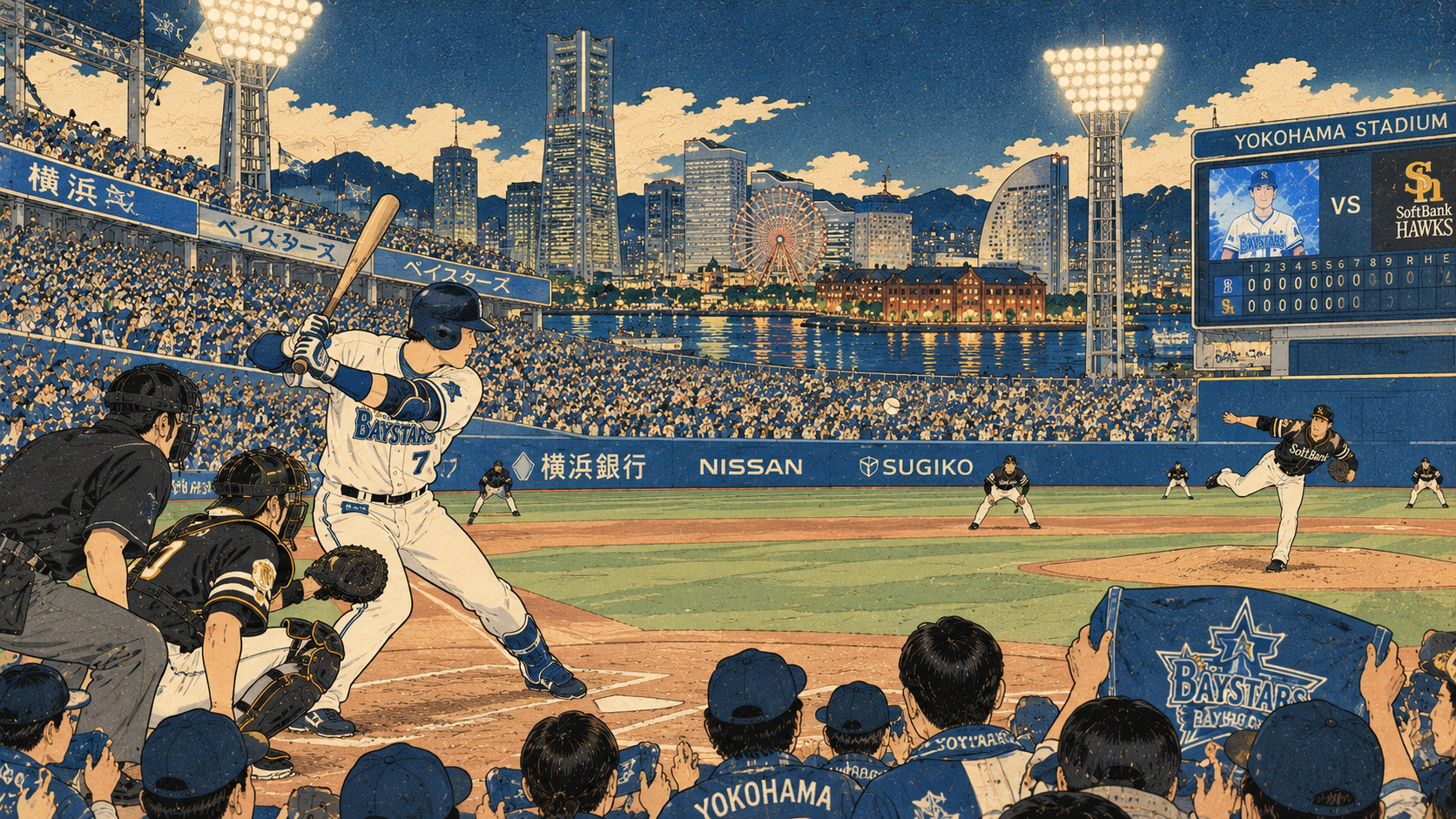
In 2024, DeNA lost its first two games to SoftBank, then won four straight. An opener can matter without deciding a series.
One swing broke a tie—and one double won the game
On a Yokohama night that stretched into an 11th inning, the opening contest of the 2026 Japan Series became a test of patience. The Fukuoka SoftBank Hawks emerged with a 3–1 victory over the Yokohama DeNA BayStars on October 24. The decisive hit was an RBI double to left by Yudai Shoji in the 11th, followed by a sacrifice fly from Tatsuru Yanagimachi. Earlier, DeNA captain Shugo Maki had tied the game with an eighth-inning home run. The official record offers a clear story of how a close game turned. Game 2 is scheduled for October 25, so this report is an analysis of Game 1, not an invented account of two completed games.
How a scoreless contest changed
Neither team scored through six innings. SoftBank assembled a seventh-inning opportunity when Taisei Makihara singled and Yudai Yamamoto doubled, putting runners at second and third. Shoji brought home the opening run on a groundout. DeNA responded in the eighth, when Maki homered to make it 1–1. The sequence is a useful reminder that a baseball game can be shaped by productive outs as much as by spectacular hits. DeNA had created a way back into the contest, but it still needed another run; SoftBank had lost its lead without losing its composure.
Shoji’s most consequential night
The decisive sequence began in the top of the 11th when Yuki Yanagita doubled. After changes on the bases and in the pitching matchup, Shoji came to the plate with one out and runners on first and second. His double to left produced a 2–1 lead; Yanagimachi added an insurance run on a sacrifice fly. Shoji had also generated the first run in the seventh. There is no need to invent a postgame quotation or award to explain why his name matters: the official play-by-play places him at both of the game’s decisive scoring moments.
A contest decided beyond the starters
DeNA starter Yutaro Ishida and SoftBank starter Naoyuki Uwasawa kept the contest tight before relief staffs were called on. The official decision credited Roberto Osuna with the win, Masaki Iwata with the loss and Kazuki Sugiyama with the save. Pitcher wins and losses are scoring conventions, not complete judgments of performance. But those decisions accurately mark the point at which a scoreless first half had become an endurance exercise for two bullpens. Evaluating tactical choices requires the full situation, including matchups and availability, not retrospective certainty about what a manager should have done.
What the box score does—and does not—show
SoftBank finished with three runs on 11 hits and no errors; DeNA scored once on nine hits with no errors. Both teams reached the 11th without committing an official fielding error. Hits alone cannot explain every lost scoring chance, and no short summary can reconstruct every decision that produced one run rather than three. The run distribution is nonetheless revealing: scoreless through six, a SoftBank run in the seventh, a DeNA equalizer in the eighth, and two decisive runs in the 11th. The game was a late, narrow separation rather than a wire-to-wire rout.
The rematch carries a remarkable precedent
The teams have recent championship history. SoftBank defeated DeNA four games to two in the 2017 Japan Series. Seven years later, in 2024, SoftBank won the opening two games in Yokohama only for DeNA to win four straight and secure its first Japan Series title in 26 years, its third overall. That comeback is one reason October 24 should not be treated as a verdict on the 2026 championship. It is historical context, however, not proof that the same momentum shift will repeat. Personnel, tactics and circumstances change from season to season.
Why 2024 still matters to baseball readers
The 2024 result is particularly instructive because the early scoreline appeared to favor SoftBank. Its victories in Games 1 and 2 were followed by DeNA wins in Games 3 through 6. The sequence illustrates the limits of reading championship probabilities out of one weekend. DeNA’s 2024 performance also underscored how the postseason offers a different measure of success from a long regular season. It would be poor analysis to assume that the 2026 participants are simply reenacting 2024, but it would be equally misleading to ignore a major chapter in their shared history.
Two cities, two baseball cultures
The BayStars play in a waterfront metropolis shaped by trade, migration and the geography of Yokohama Bay. The Hawks represent a powerful baseball institution rooted in Fukuoka and supported well beyond the city. Corporate ownership names appear prominently in Japanese professional baseball, yet the teams’ significance is inseparable from local fans, ballparks and the repeated rituals of a season. An interleague championship sends those two civic cultures onto the same stage. For an international audience, it offers a window into a league where local identity and national sporting ambition coexist.
The format makes every decision matter
The Japan Series is a best-of-seven championship: the first club to earn four victories wins. The official 2026 schedule places Games 1 and 2 in Yokohama on October 24 and 25. October 26 is a travel day. Games 3 to 5 are scheduled for October 27–29 at Mizuho PayPay Dome Fukuoka, with Games 6 and 7, if necessary, back in Yokohama on October 31 and November 1. Through a possible seventh game, contests are declared tied after 12 innings; the special rules change should the series extend beyond that. The possibility of a draw complicates bullpen use and short-series strategy.
What to watch when play resumes
For DeNA, the obvious question is how more of its baserunners can be turned into runs. For SoftBank, the challenge is to preserve the advantage without asking too much of the same late-inning relievers. Starting-pitcher availability and lineup changes should be judged from official Game 2 announcements, not assumed from Game 1. An opening win creates a one-game series lead, nothing more. At the reporting cutoff, the second game had not yet taken place; the October 26 edition must be refreshed with its verified result if it is to present an opening-weekend recap.
Resisting the temptation to invent a hero’s speech
Sport naturally produces dramatic narratives. Shoji’s hit was decisive; Maki’s home run rescued DeNA from a regulation defeat; several pitchers carried the contest deep into the night. Those facts are enough to make a compelling account. This report does not attribute emotions or conversations to athletes who have not been interviewed, and it does not present invented crowd remarks as eyewitness reporting. Readers should be able to distinguish documented plays from analysis. The quality of sports journalism depends as much on that discipline as on knowing the game.
The championship moves from Yokohama toward Fukuoka
One result is secure: SoftBank took Game 1, 3–1, in 11 innings. After a second scheduled contest in Yokohama, the series is set to shift south to Fukuoka. The Hawks won this matchup in 2017; the BayStars answered with their unforgettable 2024 comeback. The history sharpens the anticipation but does not settle 2026. Baseball’s next result must be played, scored and verified before it can become part of this story.
Sources and verification
Reporting cutoff: after Game 1 on October 24, 2026, before Game 2. Game 2 outcome must be independently checked and incorporated before publishing an October 26 opening-weekend recap. No interviews or eyewitness quotes were invented.