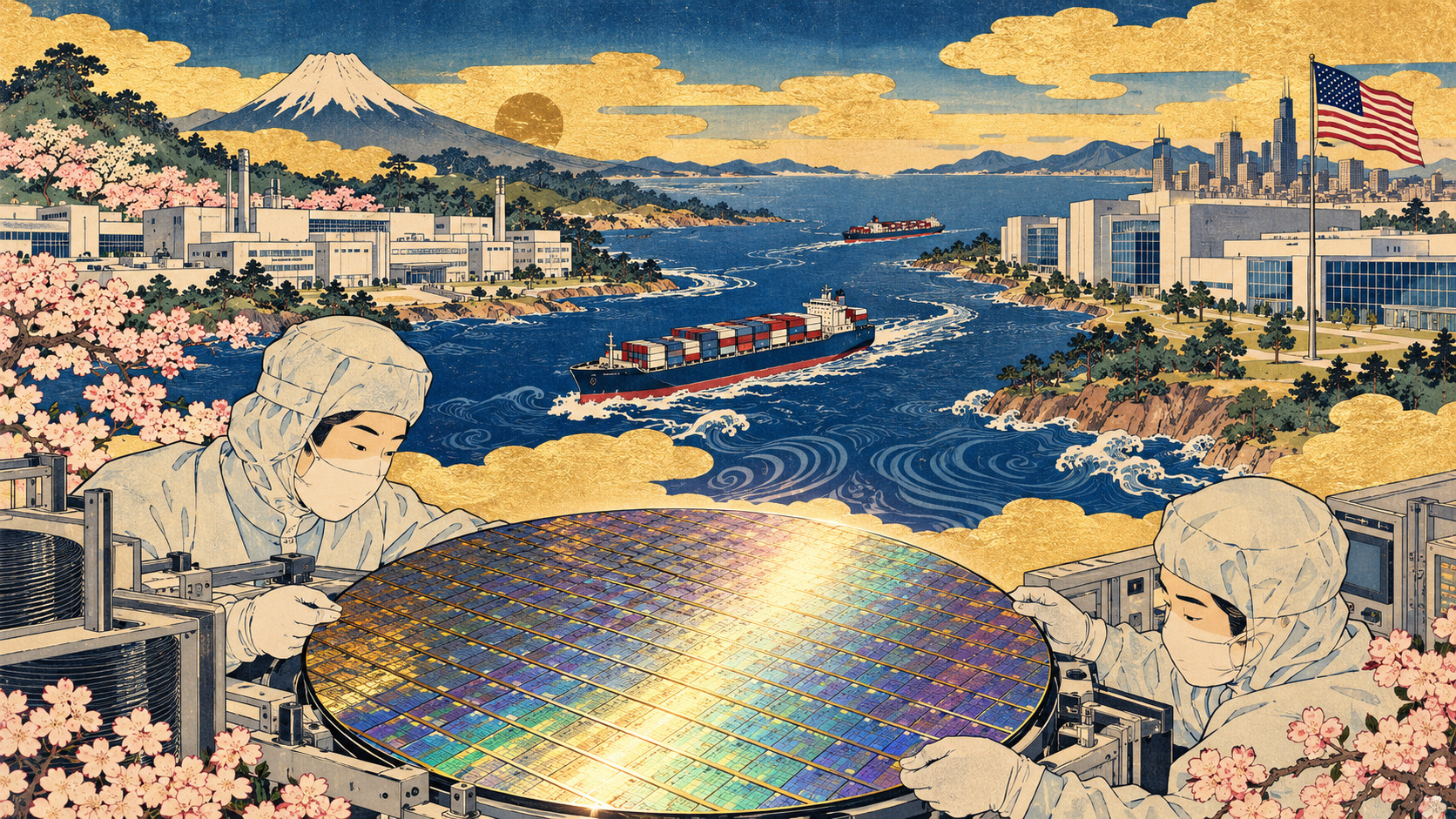
Where a factory is built is only the beginning of the question of who benefits.
The factory at the center of a contradiction
Japan is spending heavily to rebuild an industry it once dominated. In Hokkaido, Rapidus is attempting to establish advanced logic-chip manufacturing. In Kumamoto, a Taiwan-led foundry venture is building production capacity on Japanese soil. Yet on October 14 GlobalFoundries announced that it would operate two planned semiconductor plants in Malta, New York, under an American-Japanese initiative backed by up to $21 billion of Japanese investment.
That juxtaposition looks startling. Why should a country trying to restore its semiconductor manufacturing capability finance factories across the Pacific? The answer involves trade negotiations, different kinds of chips, the economics of manufacturing and a question governments rarely answer clearly: what exactly counts as a return on industrial policy?
What was actually announced
GlobalFoundries says Japan will provide investment while the company supplies its technology and operating expertise. The facilities are planned for its existing Malta campus and are intended to make foundational semiconductors for automotive, industrial and connectivity markets. The $21 billion figure is a ceiling for an initiative, not evidence that the entire sum has already been disbursed or spent.
Reporting on the transaction describes roughly $10 billion for an initial plant and additional prospective investment for another facility. A 2029 production target has been reported for the first plant. Neither groundbreaking schedules nor projected output should be mistaken for commissioned production. Capital structure, risk allocation and enforceable supply commitments remain central questions for investigators and investors.
The tariff bargain behind the investment
The immediate political context is the 2025 tariff and investment settlement between Tokyo and Washington. Japan's Ministry of Economy, Trade and Industry describes a memorandum concerning $550 billion in strategic investment. That number is an overall framework, not an account of cash already transferred to American factories. Japanese official explanations also describe a process of bilateral consultation and project selection.
The distinction matters. The arrangement grew out of tariff pressure, which means its value to Japan cannot be judged solely by the financial yield of a chip factory. Officials may view reduced trade friction and a more stable security relationship as part of the bargain. Critics, by contrast, can reasonably ask why public financial capacity is being directed overseas while domestic manufacturers seek support. Those are competing public-policy perspectives, not mutually exclusive facts.
A brief history of Japan’s semiconductor paradox
Japanese companies became formidable memory-chip manufacturers in the 1980s. Their rise gave way to decades of restructuring as South Korean competitors expanded in memory, Taiwan developed contract manufacturing and semiconductor design separated from fabrication. American-Japanese trade tensions were part of that story, but they are not a complete explanation for it.
Japan retained major strengths in equipment, materials, precision components and industrial know-how. Consequently, a fab located in New York can still buy equipment from Japanese suppliers and create commercial opportunities in Japan. But a sale of manufacturing equipment abroad is not equivalent to developing a new domestic workforce experienced in running an advanced fab. One is an export transaction; the other is long-term industrial capability.
Rapidus is pursuing a different technological wager
Japan's Rapidus is working toward advanced logic-chip production in Chitose, Hokkaido. A June 2026 METI committee document reports approval of ¥631.5 billion in additional support for front-end and back-end technology development and records a ¥150 billion equity investment executed through Japan's Information-technology Promotion Agency on June 5. Those figures concern a domestic technology and production program, not the planned New York factories.
Comparing those sums to $21 billion without context would be misleading. The processes, intended customers, production technologies, project stages and public financing instruments differ. Rapidus faces the demanding challenge of qualifying a sophisticated process, securing paying customers and making manufacturing economically sustainable. GlobalFoundries is an established operator emphasizing different, foundational technologies.
Kumamoto shows a third path
The Japan Advanced Semiconductor Manufacturing venture led by Taiwan's TSMC, with participation from Japanese companies, illustrates a hybrid approach: foreign know-how and ownership combined with manufacturing on Japanese soil. Its industrial impact goes beyond chip output. Land, utilities, housing, training and transportation all become part of the cost and opportunity of a semiconductor cluster.
There is no single formula for national resilience. A wholly Japanese-owned company operating at home, an internationally owned factory on Japanese soil and a Japanese-financed fab abroad all distribute risk and benefits differently. Policymakers should say which capability each project is intended to secure.
Not every strategically important chip is leading-edge
Semiconductor discussion often gravitates to the smallest process nodes and the largest AI processors. Yet power-management, automotive-control, radio-frequency and industrial chips are vital too. The pandemic-era shortages showed how disruption in relatively mature processes could halt automotive assembly lines and disrupt manufacturing more broadly.
GlobalFoundries markets specialized and foundational technologies. Expanding those capabilities in the United States could diversify sourcing for Japanese companies that buy them. But a new geographic source is not a contractual supply guarantee. Priority during a shortage, access under future export controls, prices and approved product qualifications matter at least as much as a plant's address.
The American subsidy story predates this deal
GlobalFoundries was already part of Washington's semiconductor revival. In November 2024 the U.S. Commerce Department announced up to $1.5 billion in direct CHIPS Act funding for multiple projects in New York and Vermont, supporting a much broader investment plan over more than a decade. That earlier program must not be conflated with the October 2026 Japanese-backed initiative.
When governments layer subsidies, equity stakes, loans and guaranteed purchases, it becomes easy to double-count promised investment. Any useful assessment needs a project-by-project ledger, distinguishing previously committed support from genuinely incremental spending.
What America stands to gain
The immediate visible benefits of building in New York include construction contracts, engineering work, a wider base of American manufacturing and potential resilience for U.S. customers. GlobalFoundries expects business from operating the plants and providing its technology. The company's announcement emphasizes the national-security and supply-chain benefits for the United States.
These advantages are not surprising: the facilities are on American soil. The critical question is whether Japan receives meaningful benefits in proportion to its financing and whether the deal would otherwise have been politically unavoidable as part of the tariff negotiations.
What Japan might gain—and what remains uncertain
Possible Japanese returns include investment income, equipment and materials orders, access to trusted production capacity, diversified sourcing and a more predictable relationship with a vital trading and security partner. None should automatically be reported as a realized benefit. For supply resilience, the hard evidence would be supply agreements specifying volumes, products, priority, delivery terms and contingencies.
For financial returns, readers need to know who owns assets, how revenue is distributed, which party bears cost overruns and what happens if demand disappoints. The project announcements do not, by themselves, settle all those questions. Japan.co.jp has not independently obtained the underlying contracts or interviewed the negotiating parties.
The AI boom adds opportunity and volatility
AI data centers are driving investment throughout the semiconductor ecosystem, from processors to optical connections and power electronics. But enthusiasm can conceal mismatches between expensive new capacity and customer requirements. A plant is not profitable because policymakers describe its chips as strategic. Production yield, utilization, qualification, depreciation and long-term purchasing commitments determine whether it earns its keep.
The strongest industrial strategy does not require choosing between home and abroad in every case. It does require admitting opportunity costs. Capital directed to U.S. manufacturing cannot simultaneously fund every Japanese fab, university program or research pilot unless further financing is available.
Five questions the public should be able to answer
First, what precise Japanese financial commitments are binding today, and what remains optional? Second, who owns the facilities and receives profits? Third, do Japanese buyers obtain enforceable supply rights? Fourth, how does the project interact with earlier American CHIPS Act support? Fifth, which milestones demonstrate commercial rather than merely ceremonial progress?
The answers may vindicate the investment as shrewd alliance-based industrial policy. They may instead reveal an expensive concession made to preserve tariff terms. Or the result could be mixed: commercial opportunities for some Japanese suppliers alongside limited gains in domestic manufacturing depth. Responsible reporting must leave those outcomes open.
The test arrives after the announcement
Japan's semiconductor revival will not be judged by the size of an announced dollar figure or the number of shovels at a groundbreaking. It will be judged by factories that work, customers that buy, workers who acquire skills, and supply systems that remain functional when international politics turns difficult.
For now, the New York plan illuminates a genuine strategic dilemma rather than resolving it. Japan wants national manufacturing strength, yet it also depends on a durable industrial alliance with the United States. The next chapters will be written in contracts, wafer yields and shipments—not simply in summit communiqués.
Sources and further reading
The maximum announced investment is not spending already completed. Exact contractual rights, ownership and final financing terms have not been independently verified.