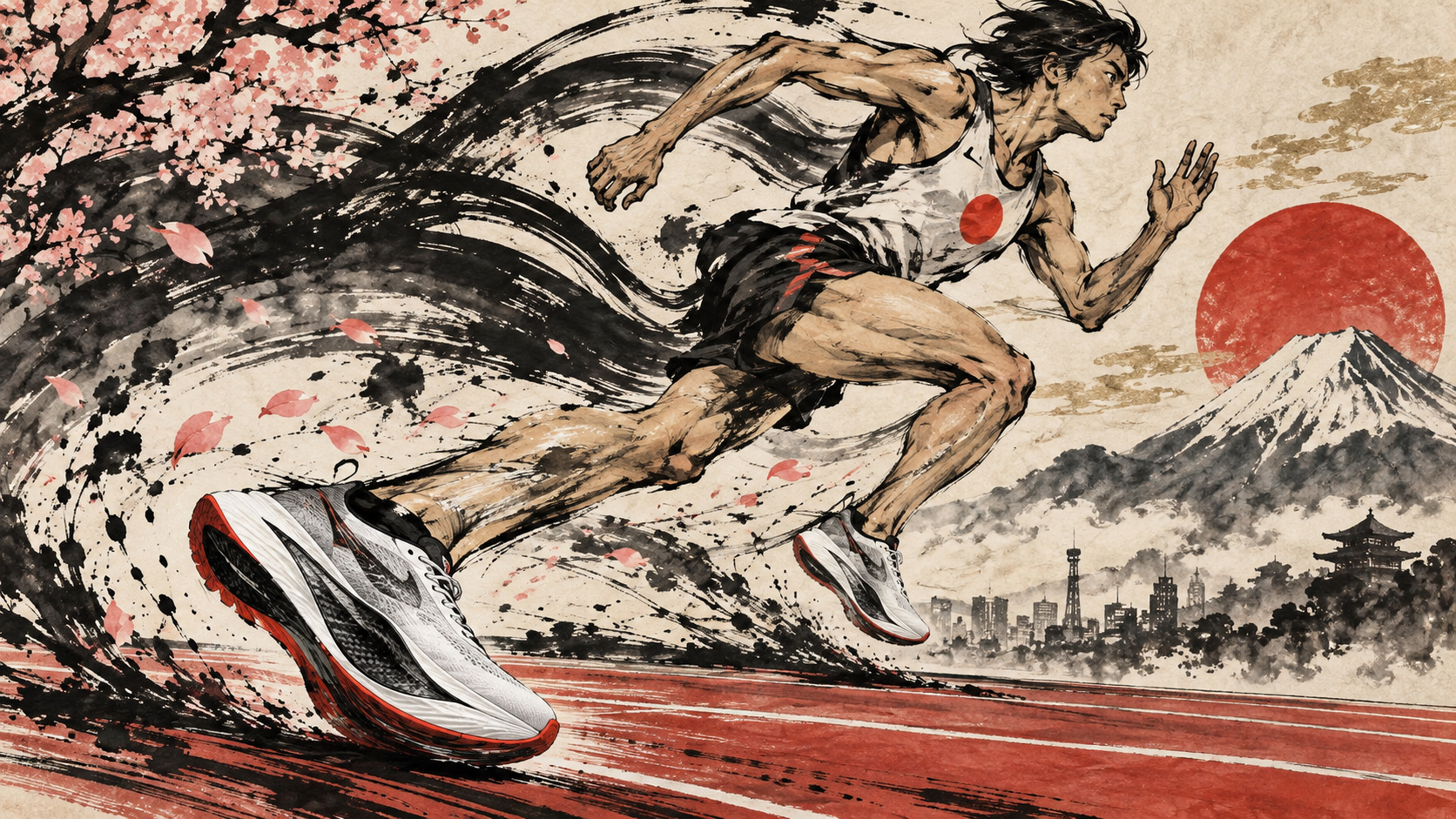
A racing shoe can look like a simple object: foam, rubber, fabric and a dark carbon plate buried under the runner’s foot. Yet the technology inside today’s fastest road shoes is now the subject of serious laboratory research and industrial competition. Japan’s ASICS and Mizuno offer contrasting answers to the same question: how can a shoe lower the energy needed to hold a given pace without compromising the control a runner needs when fatigue sets in?
The evidence points away from a marketing-friendly myth. A carbon plate is not an independent engine. Reviews of advanced footwear technology find meaningful improvements in running economy in some conditions, but benefits reflect the interaction of resilient foam, shoe geometry, bending stiffness and the individual athlete. A 2025 systematic review reported an average 2.7% improvement in running economy while finding that running speed and training status influenced outcomes. That is not a promise of a 2.7% faster race. [6]
From postwar Kobe to the research laboratory
ASICS traces its origin to Kihachiro Onitsuka’s postwar shoemaking business in Kobe in 1949. The modern ASICS company emerged in 1977 from the merger of three businesses, and its entry into dedicated running footwear dates to the late 1970s. The company’s history reflects a progression from observing athletes and improving traction toward specialized testing, materials engineering and differentiated product design. [4]
That long history matters because the current shoes cannot be reduced to a fashionable plate. The composition and resilience of the midsole, the placement of stiff components, the toe rocker, upper fit and shoe mass all affect the way a runner loads and unloads the foot. Researchers examine oxygen cost at controlled speeds as well as kinematics, joint work and force distribution. None of those measures, by itself, perfectly predicts finishing time.
ASICS designs for different running patterns
In May 2025 ASICS announced the METASPEED RAY, METASPEED SKY TOKYO and METASPEED EDGE TOKYO. The company introduced its FF LEAP foam and configured plate placement differently in the SKY and EDGE models. SKY aims at runners who tend to increase stride length; EDGE targets those who adjust cadence while extending their stride. The design premise is that one solution need not suit every runner. [1]
ASICS says FF LEAP is approximately 15% lighter, 13.7% more resilient and 30% more cushioned than its earlier FF TURBO PLUS material under its comparisons. It also reports approximately 18.8% and 21.4% higher energy return for SKY TOKYO and EDGE TOKYO, respectively, compared with their preceding models. These are manufacturer-reported material or product comparisons—not independent evidence that a runner’s speed improves by those percentages. [1]
The company positions a flatter carbon plate in SKY and a more inclined configuration in EDGE. Together with foam placement, the geometry is meant to change how the shoe compresses and responds at different stages of the stride. However, the industry’s stride-versus-cadence categories should not be mistaken for a universally validated fitting diagnosis. Ground contact, speed, fatigue, comfort and individual adaptation complicate selection. [2]
Mizuno enters with a different geometry
Mizuno’s HYPERWARP PURE, released in July 2026 according to its Japanese product listing, combines MIZUNO ENERZY XP foam with a three-dimensional, full-length carbon SMOOTH SPEED PLATE. Its listed mass is approximately 137 grams for one shoe in size 27.0 cm. The company emphasizes a light, responsive design for runners moving at a high cadence. [3]
A headline shoe weight may be alluring, but specifications need comparable sizes and testing procedures. Less mass does not automatically settle the trade-offs among stability, comfort, performance at different paces and durability. The meaningful comparison for readers would be an independently controlled test using multiple runners, matched protocols and clearly disclosed uncertainty.
What the carbon plate actually does
A plate increases longitudinal bending stiffness and affects the bending of the shoe and toe joints. Resilient foam compresses at contact and returns part of the stored energy, while rocker geometry changes the transition from landing to toe-off. A 2026 meta-analysis comparing plated and non-plated shoes reported statistically significant reductions in several measures of metabolic demand, but emphasized that isolating the plate’s contribution from the full footwear system remains difficult. [7]
Another 2026 meta-analysis found no consistent differences for several measures of joint power and leg stiffness. That matters: the intuitive account of a carbon sheet simply springing an athlete forward is an incomplete explanation of the biomechanics. Researchers still disagree on the relative contributions of the different components and on how responses vary by runner. [10]
Why running economy is not finishing time
Running economy describes the metabolic or oxygen cost of sustaining a specified speed. It does not directly measure how much faster an athlete will race with an unfamiliar shoe. A 2026 review described 2–4% improvements in running economy under some conditions and suggested that these may translate into a smaller, roughly 1–2% performance benefit. Even that mapping is conditional, not a personal prediction. [8]
A separate systematic review of 14 studies reported improvements in the neighborhood of 2.6–4.2% in some carbon-plated, resilient-foam configurations, while underscoring substantial heterogeneity. Testing speed, training level, shoe model and comparison baseline all matter. A scientifically credible company claim should state the comparator, protocol, sample and statistical variability. [9]
A faster shoe is not necessarily a safer shoe
Footwear that changes the mechanics of loading may alter stress across joints and tissues. The long-term injury implications of racing repeatedly in advanced designs are not settled. A thick sole does not, by itself, guarantee injury prevention. Coaches and runners should treat transition and individual fit as considerations distinct from short-term economy testing. [8]
Where the competition goes next
For Japanese manufacturers, the next competitive advantages may come from repeatable testing, greater consistency of foam production, durability, lower mass without sacrificing stability, and evidence-backed design for runners outside the elite field. Those are harder claims to market than a spectacular podium finish, but they matter to professionals evaluating technology companies and to the much larger population running for recreation.
On the eve of Japan’s Sports Day holiday, the country’s shoemaking history offers a useful lesson. The most enduring innovation is not a component that looks revolutionary in a cutaway photograph. It is a disciplined cycle of observing athletes, proposing a design, measuring the effects and admitting what remains uncertain. That is how a fast product can become credible engineering.
Sources and references
- アシックス「METASPEED RAY・SKY TOKYO・EDGE TOKYO」発表(2025年5月2日)
- アシックス「METASPEED TOKYO Series」技術解説
- ミズノ「HYPERWARP PURE」公式製品仕様
- アシックス「アシックスの歴史」
- アシックス「会社概要」
- Stephenほか、Journal of Sport and Health Science、シューズ剛性・反発性のメタ解析(2025)
- Metabolic effects of carbon-plated running shoes: systematic review and meta-analysis (2026)
- Mechanisms, Economy, and Performance of Advanced Footwear Technology in Endurance Running (2026)
- Emerging sports footwear technologies: systematic review (2026)
- Carbon plates in running shoes biomechanics: systematic review (2026)
Verification note: manufacturer laboratory claims are not treated as independent race-time improvements. Model-specific superiority across all runners, long-term injury prevention, sales volumes and contract values have not been independently established.