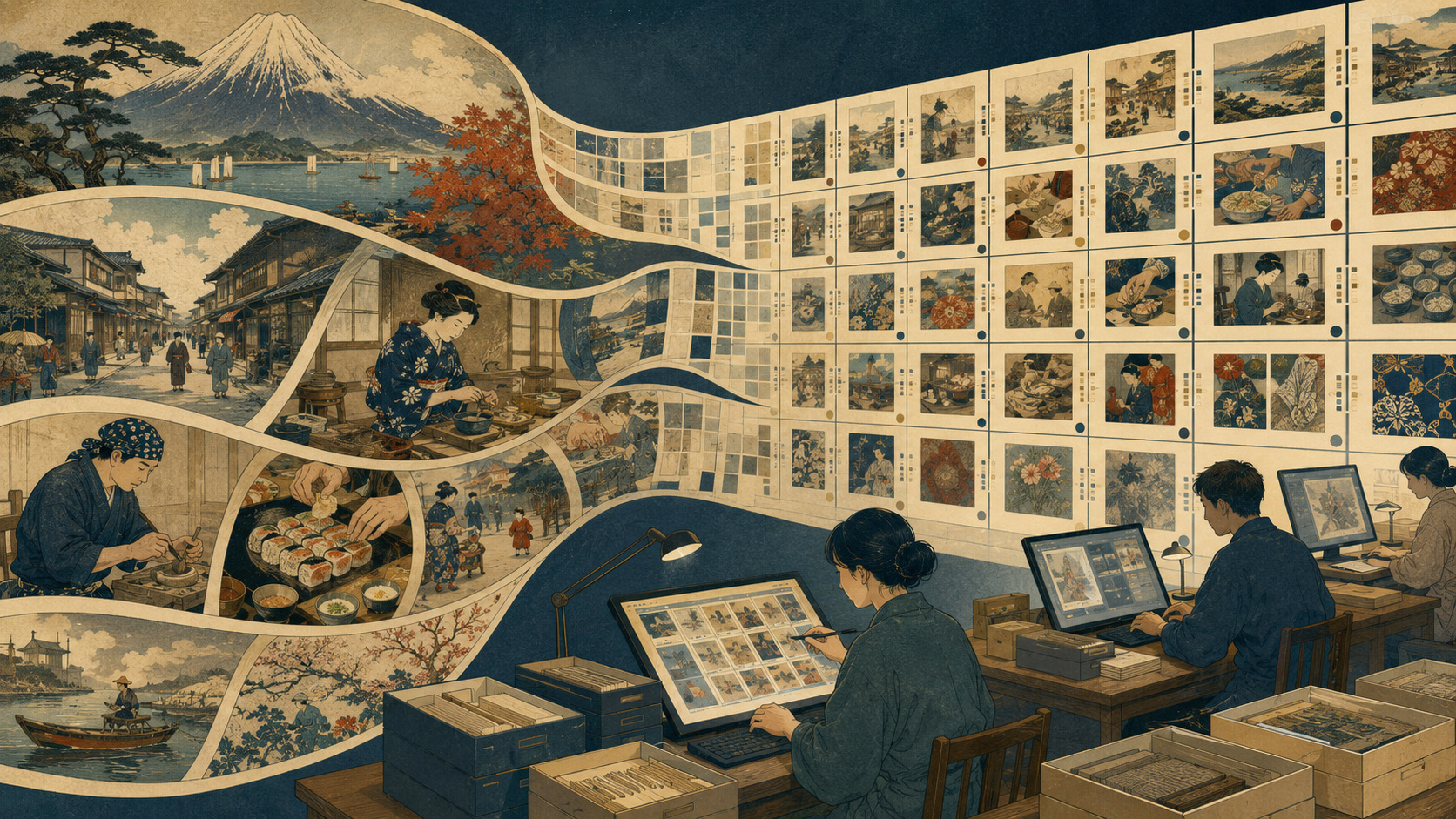
For most of the twentieth century, the valuable thing inside a picture archive was not merely the picture.
It was the paper trail. Who made the image? Who appeared in it? Could it be used in an advertisement, a textbook or a news report? Did a model sign a release? Did the photographer permit cropping? Was a building, artwork, logo or performance visible? Which territory, medium and period did the license cover? The archive earned trust by keeping those questions attached to the file.
Generative AI broke that familiar unit of trade. A developer may not want to publish a single photograph. It may want to copy millions of images into a model, extract patterns from them and distribute the resulting weights. One licensed use becomes a chain of uses: collection, storage, transformation, training, evaluation, publication and perhaps generation. The old caption card must become a machine-readable provenance system.
That is the significance of Visual Bank’s August 13 announcement. Its subsidiary amana images, which says it has managed licensed visual material since 1984, is opening part of its Qlean Dataset catalog to academic researchers through Hugging Face. The launch includes speech, video and text, but its Japanese image collections make the change easiest to see: faces with and without accessories, hands and nails, license plates, streets, stations and other ordinary views of life in Japan.
The offering is important precisely because it is less sweeping than the headline word “free” can suggest. It is not a public-domain image dump. It is not an open license. It does not let anyone mirror the files or train a commercial service. It is a gated bargain: qualified academic users get research rights without paying a fee; the provider keeps control over admission, reuse and commercial licensing.
“Free” describes the price—not the freedom
The Academic Research License permits eligible faculty, staff, students and independent researchers to inspect and evaluate the data, run noncommercial benchmarks, and train, fine-tune or evaluate AI and machine-learning models for scholarly research. Researchers may cite the material in papers and conference presentations. They may also publish trained models for noncommercial academic purposes.
That is meaningful access. High-quality image collections can cost more than a laboratory can afford, and collecting comparable material from scratch requires cameras, locations, participants, consent forms, annotation and secure storage. Removing the license fee lowers a real barrier.
But the license draws hard boundaries. An organization earning revenue from AI or ML products and services may not use the academic grant to train models—even if the work occurs inside a research division. Production use in commercial products or services is excluded. Redistribution, mirroring, resale and sublicensing of the source data are barred. Commercial use requires a separate paid agreement.
Access is also not anonymous. A Hugging Face account holder must supply a name, affiliation, academic status, intended use and email address. Requests are reviewed rather than automatically approved; the dataset pages describe a decision within three business days. Users must credit “Data provided by: Visual Bank / Qlean Dataset (amana images Inc.).” The Japanese license text governs, while the English version is a reference translation, and disputes are assigned to Japanese law and the Tokyo District Court as the exclusive court of first instance.
| Term | What it means here | What it does not mean |
|---|---|---|
| Free of charge | No dataset license fee for an approved academic use. | Anyone may download for any purpose. |
| Gated | Identity and intended use are submitted for review. | The data is secret or unavailable for research. |
| Academic | Noncommercial scholarship, evaluation and publication are permitted. | A company research group can automatically use it. |
| Rights-cleared | The provider represents that relevant rights have been managed for licensed AI use. | A regulator certified every file or an independent auditor published every contract. |
Inside the first image collections
The public dataset cards are unusually concrete compared with a generic promise of “Japanese data.” One collection describes 22,800 face images from 200 Japanese subjects of varied ages and genders, photographed from different angles and with accessories present or absent. The files total roughly 13 gigabytes and include both portrait-oriented and high-resolution camera images.
A license-plate collection describes roughly 4,000 vehicles photographed from three angles. Its table lists 12,025 JPEG and PNG files totaling about 14.8 gigabytes. Another set contains 200 multiview images of the hands and nails of 50 Japanese women. These are not enormous by foundation-model standards. Their value lies in defined capture conditions, subjects and intended tasks.
The larger academic catalog ranges beyond those three cards: Japanese people in full-body and multi-person scenes; faces with and without full makeup; station exteriors; commercial facilities and streetscapes; buildings and vehicles; walking and workplace actions; self-presentation videos for graduate recruitment; and many forms of Japanese speech. The launch announcement highlighted facial images of 200 people and videos of 72 students describing their strengths on camera.
Each collection can support a different research question. Accessories can test whether face detection fails when glasses, hats or masks occlude landmarks. Multiview plates can evaluate recognition under angle and distance. Hand photographs can test segmentation, keypoint estimation or nail analysis. Streets and stations can challenge scene understanding with signs, road markings, architecture and infrastructure found in Japan.
- How many distinct people or objects are represented—not merely how many files?
- Were subjects photographed repeatedly, making train/test leakage possible?
- Which ages, regions, skin tones, devices, angles and environments are included?
- Which labels exist, who created them, and how was disagreement resolved?
- What may be published: metrics, sample images, embeddings, model weights or none of these?
- What happens if a participant withdraws or a rights problem is discovered?
Rights clearance is a chain, not a magic stamp
Copyright is only the first link. A photographer may own the copyright in a picture, while a person depicted in it has privacy, portrait or publicity interests. A client may control a commission by contract. A museum can impose conditions on photography. Logos, packaging, posters and artworks inside the frame can carry separate rights. Location rules and confidential information may matter even when copyright does not.
AI adds another layer. Permission to reproduce a stock photo in a magazine does not automatically grant permission to use it for model training. Permission to train does not necessarily authorize a user to redistribute source files, publish memorized samples, sell model access or generate lookalike people. A serious license must map permissions to stages of the technical pipeline.
Visual Bank says rights management is the foundation of Qlean Dataset and that amana images has long received material legitimately from broadcasters, publishers and other rights holders. Elsewhere the company says it maintains practices aligned with Japanese regulations as well as GDPR and CCPA expectations. Those statements make a stronger provenance claim than a dataset assembled simply by crawling whatever image URLs a search engine can find.
They are still provider claims. The public cards do not reveal every contract, participant information sheet, compensation term, consent scope or withdrawal process. Nor should “rights-cleared” be confused with “risk-free.” A properly licensed face dataset can still enable a biased classifier. A lawful model can still memorize a person. A contractual permission can be broader than participants expected.
The right question is therefore not whether the stamp exists. It is what the chain contains, who checked it, which uses it covers, how long it lasts, and what remedy applies when a link fails.
How a stock-photo archive became AI infrastructure
amana images places its origin in 1984, when commercial photography traveled through transparencies, printed catalogs, telephone requests and physical delivery. A picture agency’s competitive advantage was selection and retrieval, but also reliability: the client needed an image at deadline and needed to know what it could lawfully do with it.
Digitization changed the container without eliminating the work. Film became a file; a cabinet became a database; keywords replaced the printed index. Rights, captions, creator identities and usage restrictions became metadata. The archive could search faster, deliver globally and count licenses, but its central trust function remained.
Visual Bank now describes more than 500 million “rights-cleared assets,” 16,000 data partners and at least six modalities across its group as of March 2026. Those are company-reported portfolio statistics, not counts independently audited for this article. Their significance is the organizational model: long-standing relationships with data holders can reach material that never sat openly on the web.
That changes what an archive can be. Instead of retrieving one photograph for one publication, it can assemble a reproducible corpus with known capture conditions; negotiate training permission; structure labels; and deliver images, sound, video, 3D and text as aligned data. The licensing desk becomes a provenance operation. The catalog becomes an input layer for machine learning.
1984 · amana images traces the beginning of its licensed-asset business to this year.
2009 · ImageNet’s paper shows the power of millions of web images organized by a semantic hierarchy.
2014 · COCO emphasizes complex, everyday scenes with dense human annotations.
2018 · Japan introduces flexible copyright limitations including Article 30-4 for certain non-enjoyment uses.
2021 · “Datasheets for Datasets” formalizes documentation questions about motivation, composition and maintenance.
2022 · LAION-5B publishes metadata for 5.85 billion image-text pairs collected at web scale.
2025 · Qlean Dataset begins its Academia Support Program.
2026 · Visual Bank moves gated academic datasets onto Hugging Face.
From curated benchmarks to the scraped web
The history of modern computer vision is also a history of changing dataset scale. ImageNet’s 2009 paper described 3.2 million images organized across 5,247 WordNet categories at that stage of the project. The project helped make large, standardized benchmarks central to progress in image classification.
Yet ImageNet’s own download terms underline a persistent divide: the project says it does not own the copyright in the images, provides access for noncommercial research and education, makes no guarantee that use will not infringe another right, and places responsibility on the user. The labels are curated; the underlying images remain tied to outside sources.
Microsoft COCO, introduced in 2014, shifted attention from centered objects to crowded everyday scenes. Its paper described 328,000 images and 2.5 million labeled instances across 91 object types. Human annotators outlined and captioned what they saw. Better annotations enabled richer tasks, but annotation labor did not itself clear every underlying image right.
Generative AI then pushed scale into another order. LAION-5B’s 2022 paper described 5.85 billion image-text pairs filtered with CLIP from Common Crawl-derived links. That approach made research at enormous scale possible, but it also inherited the web’s duplicates, errors, stereotypes, personal data and uncertain permissions. A URL plus an automated similarity score is not a model release.
Qlean takes the opposite wager: smaller, deliberately sourced collections can be more useful when the question requires consent, cultural specificity, traceable capture or commercial-grade provenance. It will not replace web-scale pretraining by itself. It can provide cleaner evaluation sets, supervised fine-tuning material, safety tests and domain-specific experiments in which knowing the origin matters more than having another billion loose pairs.
The missing-Japan problem is more than a language count
Visual Bank counted 3,942 Hugging Face datasets tagged Japanese and 85,069 tagged English in July 2026. The company’s release rounded that imbalance to roughly 3,000 versus 85,000 and described Japanese as about 0.3 percent of the platform total. These figures are tag counts, not measurements of size, quality or exclusivity: a dataset can carry multiple language tags, a very large corpus counts once, and most datasets may have no comparable tag.
Common Crawl provides another lens. Its official 2025 language-coverage table placed Japanese at 5.2018 percent of a sampled crawl. That is not trivial. Japanese is one of the largest languages in the crawl. But the open web is not a representative sample of Japan. Pages are selected by linking and crawling systems; paywalled, private, ephemeral, spoken and locally held material is absent or thin.
Image scarcity is harder to express as a percentage. A model may recognize “station” while missing the ticket gates, platform markings, uniforms, signs and accessibility features of Japanese stations. It may label a shopping street correctly but misunderstand vertical signage, bicycles, shutters, arcades or curb geometry. It may detect a face while performing unevenly across local age distributions, cosmetics, masks or camera conventions.
This is why “Japanese” should not become a single checkbox. Hokkaido and Okinawa are not interchangeable. Urban Tokyo does not represent a depopulating mountain town. A studio portrait is not a commuter train. Dataset diversity must exist within Japan—across region, class, age, disability, occupation, skin tone, weather and era—not merely between Japanese and English labels.
Scarcity is therefore partly about volume, but also about control over categories. If the available images are dominated by tourism sites, advertising poses and globally familiar icons, a model learns a polished postcard rather than a country.
Culture lives in mundane details
The most valuable Japan-specific data may be the least spectacular. License plates, station entrances, hands, nails, uniforms, storefronts and job-interview videos rarely appear in a “great images of Japan” collection. They are exactly the objects through which a system meets daily life.
A recruitment self-presentation video contains more than Japanese words. It contains conventions of framing, greeting, register, posture and self-description. An emotional conversation contains timing, backchannels, hesitation and social distance. A streetscape contains the visual grammar of roads and warnings. A face photographed with and without accessories can reveal whether a model mistakes a removable object for identity.
Those details matter for evaluation as much as training. A globally trained vision-language model may look capable on an English benchmark and fail when a Japanese prompt changes the social meaning of an image. Visual Bank separately supplied Qlean images to the National Institute of Informatics-led “msts-japanese” safety project. In a small preliminary test—40 images, two prompts and three vision-language models—the researchers reported harmful-response rates rising two to three times when prompts switched to Japanese. The sample is too small for a universal conclusion, but it demonstrates a testing question that translated English images alone would miss.
The NII dataset has its own AnswerCarefully terms and should not be confused with the new Academic Research License. Its relevance is conceptual: safety, bias and usefulness must be tested in the language and social context in which a system will operate.
Faces and license plates make privacy impossible to ignore
A landscape can raise copyright questions. A face can raise questions about a life. Images of identifiable people can reveal age, appearance, health clues, religion, location or association. Vehicle plates can connect a machine-readable identifier to time and place. Even when a dataset was collected with consent, technical reuse can create risks participants never encountered in an ordinary advertisement.
Japan’s Act on the Protection of Personal Information governs the handling of personal information by businesses, while sectoral rules, contracts and civil claims may add duties. Whether a particular image or identifier is personal data depends on context and linkage. Blurring a plate can reduce a risk but can also defeat the research purpose. Pseudonymizing a subject ID does not make a recognizable face anonymous.
Machine learning adds memorization and inference. A model can overfit repeated portraits, reproduce training images, enable membership inference or encode sensitive correlations. Publishing weights may disclose less than publishing raw images, but it is not automatically harmless. The Qlean license permits noncommercial academic model publication; responsible researchers still need to test what those models retain and what misuse they enable.
Consent must therefore be specific enough to be meaningful. Did participants understand AI training? Were biometric or generative uses contemplated? May models be published? Can data be transferred abroad? Is there a withdrawal route after training, and what happens to existing weights? Were children or vulnerable people involved? What compensation and contact process exist?
Those are not accusations that the Qlean collections lack consent. They are the questions that transform “rights-cleared” from marketing language into evidence a research ethics committee can evaluate.
Japan’s Article 30-4 is not a universal permission slip
Japan revised its Copyright Act in 2018 to create flexible limitations for certain uses that are not aimed at enjoying the thoughts or feelings expressed in a work. Article 30-4 is commonly discussed in relation to information analysis and machine learning. It permits exploitation to the extent considered necessary in qualifying circumstances, unless the use unreasonably prejudices the interests of the copyright owner.
That language is broader than a narrow, research-only exception. It is not a declaration that every work on the internet may be copied for every AI project. The purpose of the use, the degree of exploitation and harm to the market or rights holder matter. The Agency for Cultural Affairs’ March 2024 “General Understanding on AI and Copyright in Japan” explains how existing law may apply, while emphasizing that case law has not accumulated enough to settle every question.
Copyright is also not the whole legal field. Article 30-4 does not erase privacy, personal-information rules, portrait and publicity interests, confidentiality, contracts, computer-access restrictions or laws in other countries. Nor does an exception covering model development necessarily determine whether a generated output infringes a particular work.
A license remains useful even where a statutory exception might apply. It defines access, permitted research, confidentiality, redistribution, attribution, model publication, governing law and remedies. It can provide data that was never publicly accessible. It can also preserve a relationship with contributors rather than treating legal uncertainty as the sourcing strategy.
- Input: Was copying the material into a training system permitted by law or license?
- Data handling: Were privacy, personal-information, contract and security duties met?
- Model: May weights, embeddings or checkpoints be released, transferred or commercialized?
- Output: Does a generated result reproduce protected expression, reveal a person or create another actionable harm?
Why the gate can improve a dataset—and weaken it
Hugging Face’s gated-dataset system lets a publisher show a public dataset card while requiring logged-in users to request the underlying files. The publisher receives basic applicant information and can approve access automatically or manually. Downloads use authenticated credentials, giving the provider a record and a point at which to present terms.
For sensitive or licensed images, that friction has benefits. It discourages casual bulk copying, screens out clearly commercial uses, allows incident notices to reach users and gives the provider a route to revoke future access. It also preserves a commercial market while subsidizing scholarship.
The tradeoff is reproducibility. A paper whose reviewers cannot access the data is harder to audit. Manual decisions can be inconsistent or slow. Independent scholars, researchers at poorly resourced institutions and people outside conventional affiliation systems may face more uncertainty. A ban on redistribution prevents a university from preserving a mirror if the original disappears.
Versioning becomes critical. If files or labels change after a study, readers must know exactly which snapshot produced the result. A persistent dataset identifier, checksums, a changelog and a withdrawal record can preserve scientific traceability without making the images public. Access statistics and reasons for denial can reveal whether the gate works equitably.
Gating is therefore governance, not proof of quality. A poorly documented collection does not become representative because users filled in a form. A strong gate should be paired with a strong card.
What researchers can now test
The most immediate uses are controlled benchmarks and fine-tuning. A face-accessory dataset can measure error rates by accessory, angle, age group and subject. A plate dataset can test detection under perspective while separating vehicle identity between training and test sets. A street collection can evaluate visual question answering on Japanese signs and infrastructure. Defined subjects make failure analysis possible in a way that an anonymous web scrape often does not.
Researchers can also study domain adaptation: how much Japan-specific material is needed to improve a globally pretrained model, and whether that improvement reduces performance elsewhere. They can compare supervised fine-tuning with retrieval, synthetic augmentation or multilingual prompting. They can measure whether adding local images changes stereotypes, hallucination, calibration and harmful responses.
Because the license allows publication of noncommercial academic models, laboratories can release checkpoints and invite replication—subject to privacy, memorization and license safeguards. Because commercial evaluation is allowed only for assessing fit under the stated conditions, companies can inspect whether a separate paid license is justified without quietly converting the academic path into production.
The broader program matters in a field increasingly concentrated in industry. Stanford’s 2025 AI Index found that 90.2 percent of the notable models it tracked for 2024 originated in industry, while academia remained a leading source of highly cited research. Compute is one barrier; proprietary data is another. Free academic access does not equalize either one, but it gives university teams a material they could not otherwise lawfully assemble.
The most valuable result may not be a higher benchmark score. It may be a careful negative finding: a model that improves on one Japanese scene type but harms another, a consent framework that proves hard to operationalize, or a dataset whose repeated subjects inflate performance. Rights-cleared data makes rigorous criticism more—not less—important.
What a trustworthy Japanese dataset still needs to show
Modern dataset documentation owes much to “Datasheets for Datasets,” proposed by Timnit Gebru and co-authors and published in 2021. The idea is deliberately mundane: dataset creators should answer a standard set of questions about why a collection exists, what it contains, how it was gathered, how it was processed, what uses are appropriate, how it is distributed and how it will be maintained.
Qlean’s public cards provide useful counts, formats, broad composition and license terms. The next level would disclose collection dates and regions; participant recruitment and compensation; demographic distributions where ethical and relevant; device and lighting conditions; annotation instructions and quality controls; known gaps; duplicate and leakage tests; consent scope; withdrawal and deletion handling; and version history.
For image data involving people, a model-release risk assessment should accompany the data card. Researchers need guidance on face recognition, biometric inference, generation, re-identification, memorization tests and publication of sample outputs. For streets and plates, cards should explain masking, location metadata and treatment of bystanders. An independent rights or ethics audit—publishing methods and aggregate findings without exposing private contracts—would make the “rights-cleared” claim more verifiable.
The provider also needs a durable incident process. If a rights holder challenges an image, users should receive a notice, a file identifier and guidance on checkpoints already trained. If a participant withdraws, the record should say what can and cannot be undone. If a dataset disappears, papers should retain a citation and checksum. Trust is maintenance over time, not a one-day launch state.
- A version number, release date, checksums and permanent citation.
- Distinct-subject counts and split rules that prevent leakage.
- Collection geography, period, devices and environmental conditions.
- Recruitment, consent, compensation and withdrawal procedures in aggregate.
- Annotation instructions, reviewer agreement and known label uncertainty.
- Bias, privacy, memorization and misuse tests for released models.
- A correction, takedown and researcher-notification policy.
- Independent audit methodology for the rights-clearance process.
The new Qlean access program does not resolve the global argument over AI training data. It offers a practical alternative inside it. An archive that once answered “May this photograph appear on this page?” is learning to answer “May these images shape this model, under these conditions, for this research?”
That answer is narrower than open access, more conditional than a press-release headline and more valuable because of those limits. If the permissions are robust and the documentation grows with the collection, Japan’s old licensing craft could become part of a new scientific commons—not a commons without rules, but one whose rules can be inspected, tested and improved.
Reporting notes and principal sources
Company-supplied counts and rights claims are identified as such. The license summary is explanatory, not legal advice; applicants should read the controlling Japanese text. Dataset availability and the Qlean organization page were checked through August 16, 2026 at 6:00 AM JST.
- Visual Bank, August 13, 2026: Qlean Dataset academic release and license summary
- Qlean Dataset: English announcement page
- Hugging Face: verified Qlean Dataset organization and public catalog
- Qlean: Japanese face images with and without accessories
- Qlean: Japanese license-plate image dataset
- Qlean: Japanese women’s hands and nails image dataset
- Qlean Dataset: Academia Support Program and catalog
- Qlean Dataset: company history, portfolio statistics and data practices
- Visual Bank: Qlean images in the NII-led msts-japanese safety dataset
- Agency for Cultural Affairs: AI and copyright materials and 2024 General Understanding
- Japanese Law Translation: Copyright Act, including Article 30-4
- Personal Information Protection Commission: APPI general guidelines
- METI and MIC: AI Guidelines for Business, Version 1.0
- Deng et al., 2009: ImageNet paper
- ImageNet: image access and copyright terms
- Lin et al., 2014: Microsoft COCO paper
- Schuhmann et al., 2022: LAION-5B paper
- Gebru et al., 2021: Datasheets for Datasets
- Hugging Face documentation: gated datasets
- Stanford HAI: 2025 AI Index, research and development