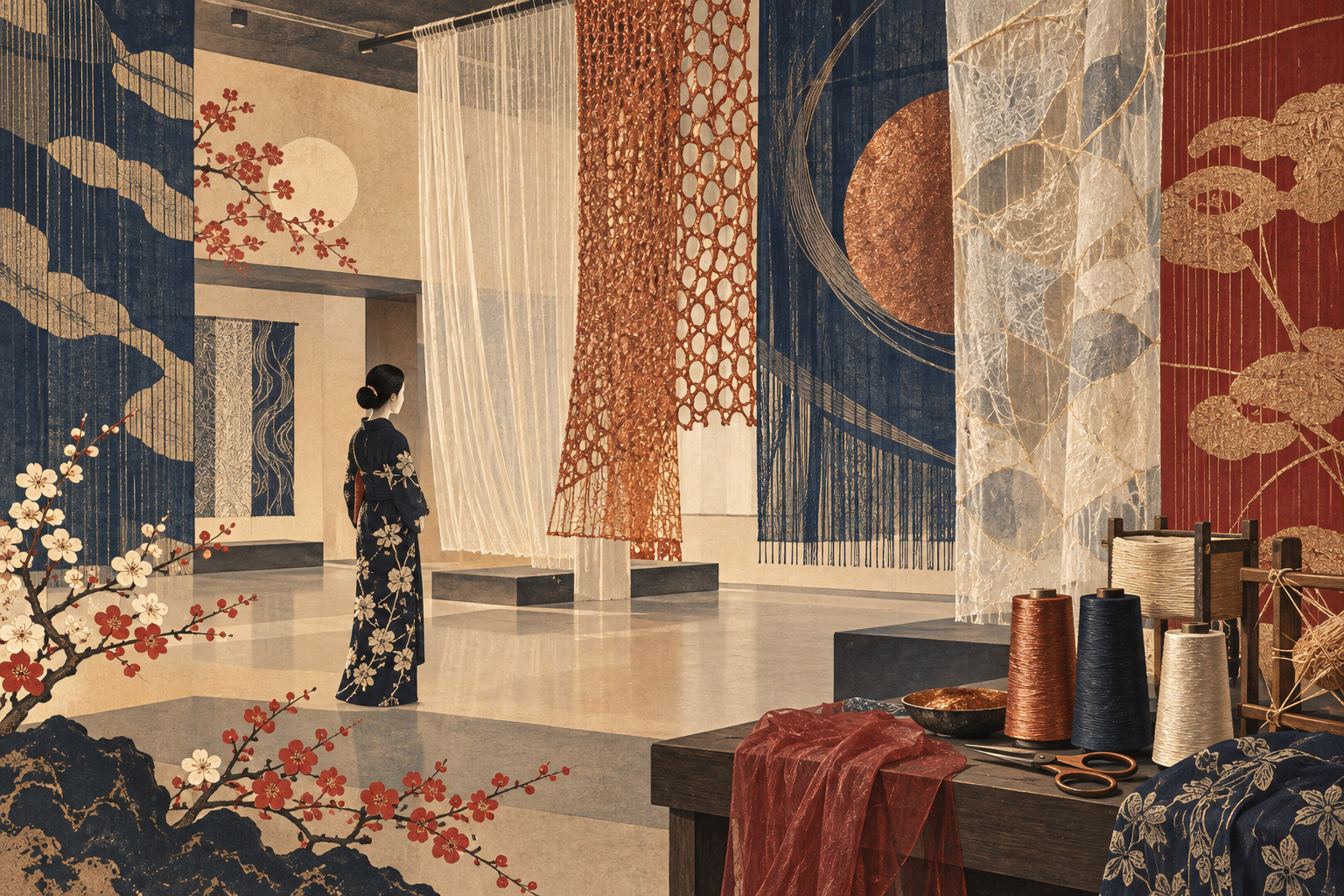
A fabric can look metallic and remain supple. Silk can invite attention for its irregularity rather than its smoothness. The work of Reiko Sudō and NUNO begins to change how we judge a textile before we know how it was made. At the Los Angeles County Museum of Art, Textile Alchemy: The Art of Reiko Sudō & NUNO offers a route from that first surprise to the people and processes behind it.[1][2][5]
Listed for September 20, 2026, through March 7, 2027, in the Resnick Pavilion, the exhibition brings together more than 100 textiles with drawings, raw materials, tools and prototypes. The museum presents the survey as an examination of experimentation and collaboration with workshops across Japan.[1]
A Tokyo studio with a regional foundation
NUNO’s own history begins in 1984, when the company was established and its main shop opened in Tokyo’s Roppongi district. A textile research centre followed in Kiryu in 1994. The chronology records participation in the Museum of Modern Art’s 1998 exhibition Structure and Surface: Contemporary Japanese Textiles, and the launch of the print-focused NUNO WORKS in 2002.[3]
These milestones connect retail, research, production and museum display. The cloth moves between them, carrying different expectations: it must interest a customer, respond to the conditions of manufacture and reward close examination. NUNO describes its practice as developing new combinations of materials and techniques with Japan’s regional weaving and dyeing industries.[3]
Seen that way, the workshop is part of the design process. An idea becomes specific when someone tests how a yarn behaves, how a surface changes under treatment or how a proposed structure can be produced. Knowledge acquired through repeated making helps determine which experiments are possible.
When a textile helps shape the museum
LACMA’s announcement traces NUNO’s metallic fabrics to coatings adapted from automotive manufacturing. Sudō’s custom chrome-sputtered curtains for the museum’s David Geffen Galleries extend that experimentation into architecture, reducing visible-light transmission while retaining outward views. The retrospective itself is in the separate Resnick Pavilion.[2]
A curtain makes a useful counterpoint to a textile on display. It affects how the surrounding room is experienced: what can be seen through it, how light enters and how a boundary feels. The material is doing work even when visitors are looking at something else.
For the viewer, the contrast between appearance and behaviour becomes a way into the design. Does a metallic surface suggest a stiffness that the fabric does not possess? How does its appearance change as it folds or catches light? Such questions give the surface a physical dimension beyond its colour or pattern.
Kibiso: a different measure of silk
One especially revealing example comes from Tsuruoka in Yamagata Prefecture. The producer of the kibiso brand explains that the material is the first silk extruded as a silkworm starts forming its cocoon. Thick and stiff, it was seldom used as material for conventional raw-silk production. The project reconsidered those difficult qualities as a starting point for new products.[5]
Its published credits make the collaboration visible. They identify Sudō’s role in textile-design supervision and separately name three companies responsible for textile production. The credits describe a network of contributions rather than a designer working alone.[6]
The significance is in the change of criteria. If every piece of silk is judged against an ideal of fine, smooth uniformity, an irregular material starts at a disadvantage. A different use can make its texture worth exploring. Design then involves finding a relationship between a material’s character and a purpose that gives that character value.
This is a useful way to think about reuse without making it sound effortless. Recognising a neglected resource is one step; making it workable, desirable and repeatable requires further labour. The people who understand the material’s behaviour are essential to that transition.
Nor does reuse, by itself, settle every environmental question. Processing, durability, maintenance and eventual disposal all matter when assessing a textile’s impact. The case is compelling because it makes a particular resource visible and opens those questions, rather than supplying a universal answer.
A Japanese precedent: giving a dyeing tradition new work
Earlier exhibitions provide context for Sudō’s approach. For its 2024 NUNO exhibition, Art Tower Mito described a collaboration with local practitioners reviving Mito Kuro, a black-dyeing technique associated with the former Mito domain. The project involved special carp streamers, with the participating local dye works identified in the museum’s Japanese announcement.[4]
This is a documented example from Mito, not a claim that those streamers appear in the LACMA installation. It shows how a regional technique can enter a fresh commission. A familiar process acquires a different form, scale or setting, inviting its makers to apply their expertise to a new problem.
Preservation can involve records, collections and demonstrations. Continuing production adds another dimension: skills are exercised while something new is being made. A workshop’s judgement about materials or finishing remains active when there is a reason to use it.
That is a plausible mechanism for sustaining knowledge, not proof of a wider economic recovery. Whether a region gains lasting work, attracts successors or can maintain equipment requires evidence over time. A museum exhibition can draw attention to that system; it cannot stand in for an assessment of its financial health.
Read the credits as closely as the pattern
Visitors can begin with what catches the eye, then read the names attached to the work. Who developed the design? Who wove, dyed or finished it? Which stage required a different specialist? Those questions help restore the production network to an object that can otherwise appear complete and self-contained.
Drawings and prototypes are valuable for the same reason. They can bring attention to a decision before it became an apparently natural feature of the finished cloth. An unusual surface represents choices about materials and treatment. Its final appearance can conceal the number of trials needed to reach it.
Before helping establish NUNO, Sudō worked as a research assistant in the textile studio of Musashino Art University’s industrial, interior and craft design department, according to her Japanese biography published by MUJI House.[7] Research, production and the experience of using a material are closely related concerns in textile design. Keeping all three in view gives the exhibition more depth than an account of visual invention alone.
From the collection back to daily life
LACMA’s exhibition plan includes a recreation of the original 1984 NUNO shop, functioning as a retail space. It places goods intended for use within an exhibition concerned with their creation.[2]
That arrangement raises an interesting distinction. A museum preserves an object so that it can be studied over time. A person buying a scarf or furnishing fabric expects it to enter daily routines. Neither encounter exhausts what the textile can mean.
NUNO’s account of its philosophy emphasises communication through the senses and connections between people. Fabric reaches us through sight, touch and sound, often without requiring much conscious attention.[3] Imagining how a textile might hang at a window or move around a body brings use back into the act of looking. Weight, drape and care become part of the discussion alongside composition.
Planning a visit
The exhibition is in LACMA’s Resnick Pavilion at 5905 Wilshire Boulevard, Los Angeles. Its stated run ends March 7, 2027. All exhibition dates and opening hours refer to Los Angeles local time.[1][8]
Regular museum hours are 11 a.m.–6 p.m. on Monday, Tuesday and Thursday; 11 a.m.–8 p.m. on Friday; and 10 a.m.–7 p.m. on Saturday and Sunday. The museum is closed on Wednesday. LACMA recommends arranging timed-entry tickets in advance because walk-up availability is not assured. Check its official visitor information for prices and date-specific changes.[8]
The lasting invitation of this exhibition is to look at ordinary cloth with greater curiosity. An unexpected texture can lead to a question about a process; that process can lead to a workshop, a place and a body of knowledge. The fabric becomes more interesting as the people who made it come into view.
Sources and methodology
Exhibition details follow LACMA’s announcements. Japanese primary sources establish Sudō’s name reading, NUNO’s history, material terminology and maker credits. The Mito project is historical context, not an asserted LACMA exhibit. This is a researched feature, not an eyewitness review or original interview; discussion of viewing and regional significance is editorial analysis.
- LACMA: Textile Alchemy exhibition overview, dates and venue
- LACMA: August 10 announcement and linked Exhibition Advisory, including curtains, material experiments and shop design
- NUNO: official Japanese description, philosophy and chronology
- Art Tower Mito: 2024 NUNO exhibition, Mito Kuro collaboration and production credit
- Tsuruoka Silk: kibiso material and brand background
- Tsuruoka Silk: design supervision, producers and project credits
- MUJI House: Sudō conversation and Japanese biography, including verified name reading
- LACMA: visitor information, regular hours and timed-entry tickets