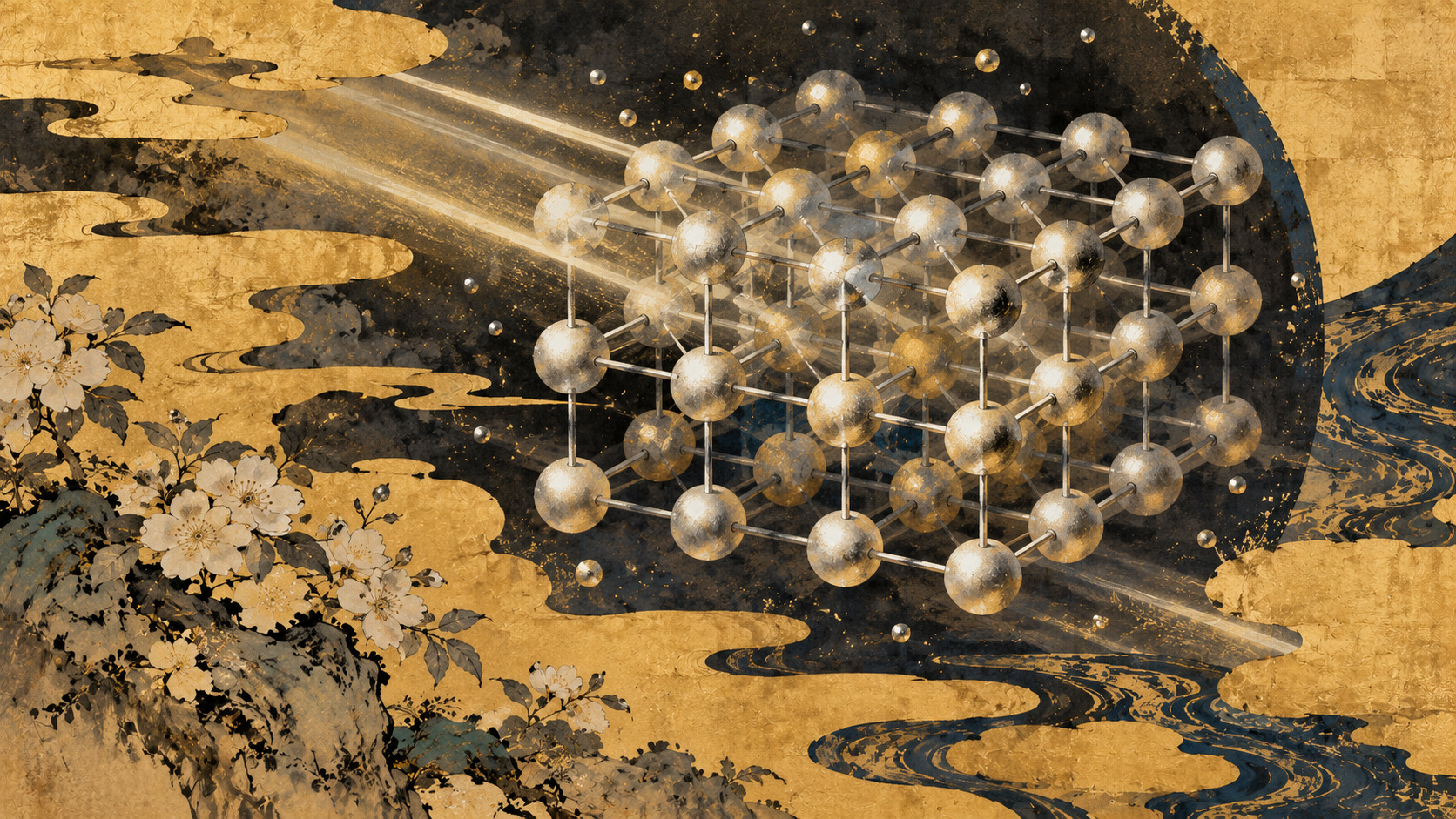
The breakthrough is not a commercial new silver. It is the ability to catch an unusual atomic structure forming—and changing—in real time.
Silver broke an old rule—briefly
We associate silver with a familiar metal: bright, conductive and readily shaped into jewelry, contacts or electronic components. But its properties begin at a much smaller scale, in the arrangement of atoms. Researchers at Hokkaido and Tottori universities have watched silver take an arrangement that elemental solids are almost never seen to adopt: a simple-cubic crystal lattice.
The work, announced October 21, 2026 and published that day in the American Chemical Society journal Nano Letters, is not a declaration that a new bulk form of silver is ready to manufacture. It is a demonstration that a fleeting, highly reactive atomic arrangement can be created and observed while it forms. That distinction turns a striking microscopy result into a broader question about how scientists discover materials.
A cube that is simple to draw but difficult to make
In ordinary metallic silver, atoms occupy the corners and centers of the faces of a repeating cube, a face-centered-cubic (fcc) structure. It is a densely packed, energetically favorable arrangement shared by other familiar metals.
A simple-cubic (sc) structure is more spare: in the idealized unit cell, atoms occupy the corners, with no extra atoms at the face centers. Textbooks illustrate it routinely, but elemental solids rarely choose it. The paper describes polonium as the only element previously confirmed in a simple-cubic structure, giving context to the researchers’ description of silver as the second such elemental case in roughly six decades. The qualification matters: it refers to this particular structural classification, not the discovery of the world’s second unusual crystal.
The microscope did more than look
The starting material was silver iodide, AgI, not a piece of pure silver. Inside a high-resolution transmission electron microscope, the team fired an electron beam at it. Beam-induced radiolytic decomposition released silver and enabled nanoscale crystals to form. The instrument recorded atomic arrangements as the reaction unfolded.
This route is far removed from casting a molten metal. At temperatures far below silver’s melting point, and under strongly nonequilibrium conditions, the product did not necessarily settle immediately into the ordinary fcc structure. In some cases it adopted the elusive sc lattice. The method makes the work distinctive: instead of inferring an unstable phase from a sample examined afterward, researchers directly observed its formation and subsequent transformation.
The precursor’s crystal phase held the key
The new arrangement did not arise indiscriminately from all forms of silver iodide. The journal abstract states that it formed selectively from metastable gamma-AgI. This dependence on the precursor polymorph suggests that a material’s starting organization and its reaction pathway can determine what emerges—even when the final composition is simply silver.
Molecular-dynamics simulations and first-principles calculations helped the team interpret the result. They did not establish isolated bulk simple-cubic silver as a new thermodynamic ground state. Rather, the evidence points toward a combination of nanoscale surface or interface effects and kinetic trapping under the irradiation-driven reaction. The details will be important for other laboratories seeking to reproduce or extend the experiment.
An unusual phase with an inconvenient personality
The resulting simple-cubic silver was exceptionally reactive relative to ordinary fcc silver. Continuous TEM imaging revealed progressive oxidation to silver oxide even under high vacuum, conditions in which conventional fcc silver remained comparatively stable. The crystal’s instability is part of what makes its observation notable.
Reactivity can be useful in chemistry, but it is not synonymous with better performance. A potential catalyst, sensor or functional coating needs not only interesting activity but also predictable lifetime, manufacturability, control of unwanted reactions and reproducibility. None of those industrial properties has been demonstrated here. The finding should not be described as a new commercial metal or a proven advance in semiconductor fabrication.
A century of learning to see crystals
In the early twentieth century, X-ray diffraction gave scientists a way to reconstruct periodic atomic structure from how crystals scatter radiation. It transformed mineralogy, metallurgy and chemistry, though the diffraction pattern was not a direct photograph of atoms. Electron microscopy and related techniques later made it possible to examine increasingly small structural features and, under suitable conditions, resolve atomic columns.
A parallel shift occurred in how materials were made. Rapid cooling, thin-film growth, irradiation and other processes showed that a substance does not always have to reach its most stable equilibrium structure. Metastable phases can appear along specific pathways. The silver study brings observation and synthesis unusually close together: the beam that enables imaging also triggers the chemical route that produces the crystal.
The Japanese collaboration behind the result
The researchers named in the joint announcement are Masaya Sakakibara, Tomoya Yamazaki and Yuki Kimura at Hokkaido University’s Institute of Low Temperature Science; Hiroki Nada of Tottori University; and Yuji Kunisada of Hokkaido University’s research community in energy and materials. Their paper lists Sakakibara, Nada, Kunisada, Yamazaki and Kimura as coauthors. The Japan Science and Technology Agency supported the work through its ACT-X strategic basic research program.
That combination of in situ microscopy and modeling is central. Images establish what appeared during a particular experiment; theory tests possible mechanisms and energy landscapes. Neither automatically ensures the same product will survive when the electron beam is switched off or when a manufacturer attempts to make it at scale. Independent replication would strengthen confidence in the broader method.
What the result could mean—and cannot yet mean
Scientists seek new material structures because atomic geometry influences reactivity, conductivity, magnetism and other behavior. As devices shrink, surfaces and interfaces become disproportionately important. The idea that transient conditions can stabilize an otherwise inaccessible lattice could open promising directions for fundamental research.
But broad claims about faster AI processors, better batteries or imminent commercial applications would get ahead of the data. This experiment concerns electron-beam-generated nanoscale silver under microscope conditions. There is no published demonstration here of continuous industrial manufacturing, durable bulk samples, a scalable device, or an economically viable process. Even the unusual reactivity that fascinates chemists might become a disadvantage outside carefully controlled environments.
The next experiment matters more than the hype
The achievement is not that scientists have rewritten the periodic table. They have widened the range of atomic structures that can be directly examined in an elemental metal. The emerging challenge is to identify exactly which starting phases, interfaces and kinetic conditions generate such arrangements, how long they persist, and whether their properties can be controlled usefully.
A rare crystal appearing inside a microscope is a beginning, not an endpoint. The most exciting sequel may be a method that lets researchers look for other materials in configurations that ordinary synthesis would never leave intact long enough to study.
Sources and methodology
Based on primary Japanese research releases and the published paper. No independent interviews were conducted; commercial outcomes remain unproven.