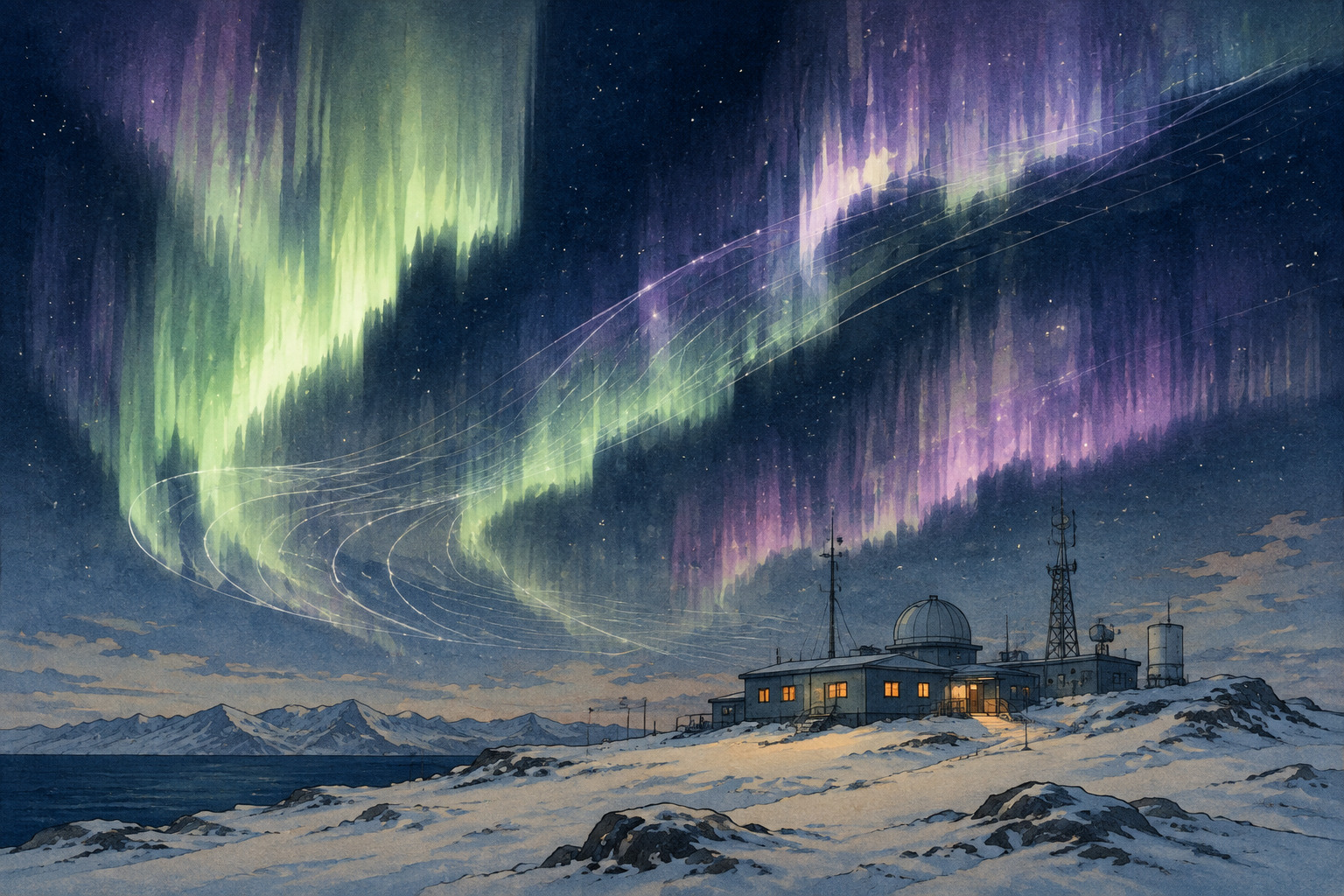
A satellite crossing the upper magnetosphere and a camera beneath the Scandinavian night were looking at different parts of the same event. Japan’s Arase spacecraft recorded naturally occurring electromagnetic waves far above Earth. On the ground, an all-sky imager watched a field of green auroral patches brighten and dim. The hard part was finding enough occasions when the two views were magnetically connected.
A Japanese research team searched seven observing seasons spanning 2017 to 2024 and isolated 60 such conjunctions, totaling about 30 hours. By comparing the wave properties at Arase with the form of the aurora near the satellite’s mapped magnetic footprint, the researchers found a strong division. When chorus waves appeared to have traveled to high magnetic latitude inside a plasma duct, patchy pulsating aurora occupied most of the corresponding ground-observation time.
The effect was also organized by time. Duct-like high-latitude propagation became more frequent from magnetic midnight toward morning, peaking near 7 magnetic local time. The result offers a physical explanation for the long-observed preference of pulsating auroras for the post-midnight sky.
The study was led by Yuri Ito, a third-year doctoral student in the Polar Science program at the Graduate Institute for Advanced Studies, SOKENDAI, and a project researcher at Japan’s National Institute of Polar Research. Its authors include researchers from SOKENDAI, NIPR, Nagoya University, the University of Electro-Communications, Kanazawa University, Tohoku University, Kyoto University, Kyushu Institute of Technology and the Institute of Space and Astronautical Science at JAXA. The paper appeared July 2 in the Journal of Geophysical Research: Space Physics.
“Morning” means a place in the magnetosphere
The headline needs a correction before the physics begins. Morning does not mean that the aurora appeared after civil sunrise or in a bright daytime sky. It refers to the morning sector of magnetic local time, a coordinate that describes a location around Earth’s magnetic environment as if it were a clock. The relevant events occurred after magnetic midnight and before magnetic noon, during periods dark enough for the northern cameras to classify the aurora.
The distinction matters because the result concerns the changing state of the magnetosphere as it rotates from the nightside toward dawn. In the study, the occurrence rate of high-latitude chorus with duct-like characteristics rose from midnight and reached about 0.70 near 7 magnetic local time. Cases without high-latitude chorus reached about 0.34 near 1 magnetic local time and then declined toward morning.
It is therefore not sunlight that favors the aurora. The statistics indicate that the plasma structure capable of guiding waves is more likely to be present in a particular magnetic-time sector. The process that creates that structure remains an open question.
A plasma duct works like a waveguide
Chorus waves are whistler-mode electromagnetic plasma waves generated near the magnetic equator. When their measured signals are converted to audio, their rising and falling tones can resemble birdsong, earning them the outreach nickname “space chirps.” Their scientific importance comes from how they interact with charged particles.
As chorus travels away from the magnetic equator, it often turns increasingly oblique to Earth’s magnetic field and weakens before reaching high latitudes. A plasma duct changes that route. It is an elongated region in which electron density is higher or lower than in the surrounding plasma. The resulting contrast in refractive index can confine a wave and guide it along magnetic-field lines, much as an optical fiber or engineered waveguide confines light or radio energy.
Guided chorus can remain nearly parallel to the field and travel farther poleward. Along that longer path it can resonate with more energetic electrons, changing their pitch angle—the angle between their motion and the magnetic field. Some electrons are scattered into the atmospheric loss cone and stream downward. Collisions with oxygen and nitrogen at roughly 90 to 100 kilometers altitude produce light.
The proposed geometry also explains the shape. A tube-like region in the equatorial magnetosphere maps along a bundle of magnetic-field lines toward the atmosphere. Electron precipitation in that bundle can appear below as a patch tens of kilometers across. As the chorus intensity varies, the patch brightens and dims on timescales of seconds to tens of seconds.
1 · Source Chorus waves form near the magnetic equatorial plane.
2 · Guide An electron-density duct confines the waves along magnetic-field lines.
3 · Resonance High-latitude chorus changes the direction of energetic electrons.
4 · Precipitation Scattered electrons descend into the upper atmosphere.
5 · Light Collisions with atmospheric atoms and molecules create a blinking auroral patch.
Six cameras supplied shape; Arase supplied wave physics
The ground network covered Tromsø and Skibotn in Norway, Kilpisjärvi and Sodankylä in Finland, and Kiruna and Tjautjas in Sweden. Monochromatic all-sky imagers recorded the 557.7-nanometer green emission from atomic oxygen once per second. The team separated diffuse aurora, pulsating aurora without distinct patches and patchy pulsating aurora, along with other or unclassifiable scenes.
Arase—officially Japan’s Exploration of energization and Radiation in Geospace satellite, or ERG—has studied radiation-belt particles and plasma waves since regular operations began in March 2017. For this analysis, its Plasma Wave Experiment supplied electric- and magnetic-field spectra and estimates related to plasma density, while its Magnetic Field Experiment measured the local field.
A conjunction required more than observations on the same night. The researchers traced the field line through Arase to an assumed altitude of 100 kilometers and required that footprint to fall inside a camera’s field of view. Arase also had to be above 10 degrees absolute magnetic latitude, and the aurora had to remain identifiable. Cloud, white-night conditions and ambiguous forms reduced the available sample.
One instrument limitation affected the classifications. A magnetic sensor in the Plasma Wave Experiment degraded, so direct wave-normal-angle estimates were unavailable after October 2018. The team instead combined the ratio of magnetic to electric wave power with high-resolution burst spectra and other wave properties. That is a reasonable observational workaround, but it means the propagation categories after that date are inferred rather than all being based on the same direct angle measurement.
The clearest guided-wave class had the clearest patches
| Class | What Arase detected | Analyzed time | Auroral association |
|---|---|---|---|
| Case 1a | High-latitude chorus in electric and magnetic components; predominantly electromagnetic and nearly field-aligned, consistent with ducted propagation. | About 16 h 53 min | Patchy pulsating aurora during 93% of the observed time. |
| Case 1b | High-latitude wave mainly in the electric component; more oblique or quasi-electrostatic, making non-ducted propagation more likely. | About 4 h 10 min | Diffuse and non-patchy pulsating forms during a combined 73% of the time. |
| Case 2 | No high-latitude chorus detected, consistent with waves failing to travel poleward through a duct. | About 8 h 42 min | Diffuse and non-patchy forms during a combined 86%; patchy forms during 17%. |
More than one auroral type could occur in the same camera image, so the percentages are not mutually exclusive and can total more than 100. Across all Case 1 intervals—about 21 hours—patchy aurora appeared during 80% of the time. Narrowing the comparison to Case 1a, where the wave evidence was most consistent with ducted, nearly field-aligned propagation, raised the patchy share to 93%.
Case 1b and Case 2 were dominated by diffuse or non-patchy forms. This separation between morphology on the ground and wave behavior in space is the study’s central result. It turns a physical scenario proposed from an earlier individual event into a pattern tested across multiple seasons.
Association is strong, but the sample has boundaries
The data support a model in which a duct guides chorus poleward and helps create patchy pulsating aurora. They do not establish that every patchy pulsating aurora requires a duct, or that a duct always produces an observable patch. The 60 conjunctions were selected from times when a single satellite’s magnetic footprint crossed a usable ground-camera view under classifiable sky conditions.
Case 1b also deserves restraint. A magnetic component below the instrument’s noise level can make an electromagnetic wave appear more electrostatic than it is. Conversely, an observed high-latitude wave does not by itself provide a three-dimensional map of the density structure that carried it.
For the four events with a direct density signature, the authors estimated equatorial duct scales ranging from several hundred kilometers to roughly 2,000 kilometers. Ground patches were tens of kilometers across after magnetic mapping. Those sizes are model-dependent estimates, not photographs of a tube suspended in space.
The observational result is nonetheless difficult to obtain. A low-inclination, highly elliptical spacecraft samples one location at a time, while an auroral patch can move, change shape and coexist with other emissions. Connecting 60 intervals through a common classification gives researchers a way to test whether the waveguide scenario recurs, rather than relying on a visually compelling single event.
The atmospheric consequence was not measured here
High-latitude chorus can interact with electrons ranging from hundreds of kiloelectronvolts to several megaelectronvolts. The most energetic can penetrate below the usual auroral altitude. Earlier research has connected such precipitation with chemical changes in the mesosphere and upper stratosphere, including possible effects on ozone.
This study did not measure ozone loss. It classified waves and auroral forms. Atmospheric chemistry is part of the reason energetic-electron precipitation matters, but it should not be reported as an environmental effect demonstrated by these 60 conjunctions.
The same boundary applies to space-weather forecasting. Better knowledge of when ducts form could eventually improve models of radiation-belt electron loss and help identify where highly energetic electrons are likely to precipitate. The present analysis does not itself deliver an operational forecast or quantify an improvement in prediction accuracy.
The next target is the birth of the duct
The statistics reveal when duct-like propagation and patchy pulsating aurora occur together. They do not yet explain what creates the elongated density enhancement or depletion, how long it survives, or why it becomes more common toward magnetic morning. Answering those questions requires measurements at several points, not another pass by one spacecraft alone.
The team points to EISCAT_3D, a next-generation phased-array incoherent-scatter radar network in northern Scandinavia, as one path forward. Three-dimensional ionospheric measurements can be combined with satellite observations to connect lower-altitude density structure with wave propagation farther out. Kanazawa University’s release also identifies the microsatellite IMPACT, now under development, as a future source of information about when and where ducts form.
The visible aurora is the final signal in a much longer chain: a wave born near the magnetic equator, a density channel in near-Earth space, an energetic electron diverted toward the atmosphere and an oxygen atom emitting green light. Seven seasons of linked observations have given that chain a statistical shape and a clock. The next experiment must catch its hidden waveguide being assembled.
- National Institute of Polar Research — Plasma ducts and the magnetic-morning preference of pulsating auroras, August 28, 2026
- University of Electro-Communications — Joint research announcement
- Kanazawa University — Joint press release (PDF)
- Tohoku University Graduate School of Science and Faculty of Science — Research announcement
- Ito et al. — Statistical Study on Pulsating Auroras and High-Latitude Propagation of Chorus Waves, JGR: Space Physics
- JAXA Institute of Space and Astronautical Science — Arase (ERG) mission profile
- JAXA Institute of Space and Astronautical Science — Arase begins regular operations
- National Institute of Polar Research — 2024 ground, satellite and radar conjunction study
- Nagoya University ERG Science Center — Audio rendering of space plasma waves