As of May 1, 2026, Japan’s public elementary and junior-high schools had 31,878 gymnasium and martial-arts buildings within the survey, of which 10,099 had cooling: 31.7%. Among the 29,213 buildings designated for shelter use, 9,683 were cooled: 33.1%. “Two-thirds without air conditioning” refers specifically to the 19,530 designated-shelter buildings—66.9% of that national shelter inventory.
The room where a disaster becomes daily life
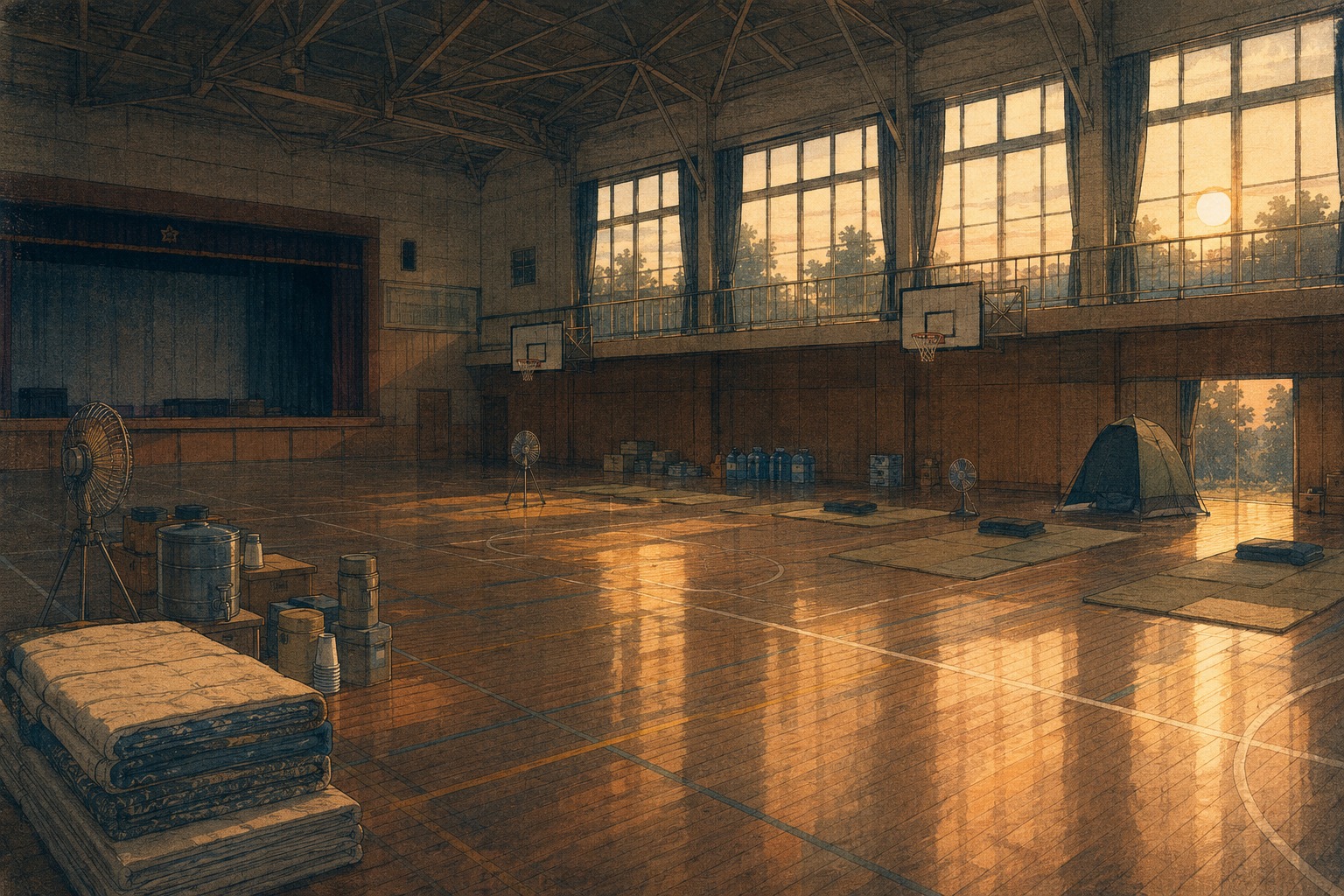
On a school morning, the polished floor is marked for basketball and volleyball. Shoes squeak. A whistle cuts through the air. On graduation day, folding chairs face a stage. But after a major earthquake, the same white lines disappear beneath blankets, cardboard beds, medicine boxes, charging cables and the private possessions of families who no longer have a safe home.
That transformation explains why a percentage about school facilities is really a measure of national resilience. The gymnasium is often the largest unobstructed public room in a neighborhood. It sits on land residents already know, beside toilets, water connections, kitchens, classrooms and open grounds. It is publicly managed and designed to hold crowds. Those qualities make it the default answer when a municipality must move hundreds of people indoors quickly.
They also make its weaknesses collective. A room built for vigorous activity lasting an hour can be profoundly unsuitable for older people, infants, pregnant women, patients and people with disabilities who must remain there day and night. High ceilings create a huge volume of air to cool. Metal roofs and large windows absorb summer radiation. Many older buildings have thin insulation and air leakage. The architectural features that make a gym flexible can make it thermally unforgiving.
The new arithmetic: rapid progress, enormous exposure
The Education Ministry’s July 30 release contains two national rates that should not be confused. Across all surveyed public elementary and junior-high gym and martial-arts buildings, 10,099 of 31,878 had cooling, an installation rate of 31.7%. Restrict the count to the buildings designated as evacuation shelters and the rate improves only slightly, to 9,683 of 29,213, or 33.1%.
The designation therefore adds just 1.4 percentage points to the likelihood that a gym is cooled. In other words, being formally assigned a life-safety role has not yet guaranteed a commensurate level of thermal protection.
There is real momentum. The overall elementary and junior-high gym rate climbed from 22.7% in May 2025 to 31.7% in May 2026, while the designated-shelter rate rose from 23.7% to 33.1%. Nine points in one year is the largest annual advance in the ministry’s trend line. But percentages can hide the human scale. Subtract the 9,683 cooled shelter buildings from the 29,213 designated total and 19,530 remain without cooling—enough facilities to make the problem visible in almost every part of the country.
The survey also counts equipment with a cooling function, including spot coolers. It establishes whether equipment exists, not whether every system can cool a fully occupied gym during a prolonged blackout, whether it is adequately maintained, or whether the municipality can afford to operate it throughout a long emergency. Installation is the beginning of readiness, not its final proof.
How the school gym became Japan’s civic refuge
Japanese schools have long performed more than an educational function. Their central locations, public ownership and large grounds have made them natural meeting places in emergencies. The 1995 Great Hanshin-Awaji Earthquake made the arrangement unmistakable to a national audience. Schools across Kobe and surrounding cities became crowded shelters, often while educators were simultaneously trying to account for children and restore classes.
The Great East Japan Earthquake of 2011 deepened the lesson. Large numbers of survivors spent extended periods in shelters, and official reviews found serious problems in health protection and living conditions. Water, food, toilets, privacy and warmth were often inadequate. The boundary between a place of immediate escape and a place fit for sustained living had not been defined clearly enough.
In 2013, the Disaster Countermeasures Basic Act was amended to formalize designated evacuation shelters and standards for the living environment. National guidance followed in 2013 and became more operational in 2016 through shelter-management, welfare-shelter and toilet guidelines. The legal vocabulary improved because experience had shown that keeping people alive through the first impact was not the same as protecting their health through the days afterward.
The 2016 Kumamoto earthquakes exposed the dual-use problem again: schools were needed both as shelters and as places that had to resume education. The 2024 Noto Peninsula earthquake added a winter warning. Gymnasiums with little permanent heating became intensely cold, and a government review urged municipalities to match heating and cooling methods to each shelter, secure power, and plan for ventilation and dry air. Summer and winter are opposite engineering problems with the same conclusion: an empty hall is not automatically a habitable refuge.
By 2019, the ministry reported that approximately 95% of public elementary and junior-high school sites had been designated as shelters. Japan had created an extraordinary nationwide network of neighborhood refuge points. It had not yet equipped that network to provide a safe indoor climate.
2018: the heat wave that cooled the classrooms—but not the gyms
The modern air-conditioning story changed in July 2018. During a record heat wave, a six-year-old first-grade boy in Toyota, Aichi Prefecture, died of heatstroke after returning from a school outing. The tragedy made the absence of cooling in classrooms impossible to treat as a question of comfort or tradition. The government’s supplementary budget set aside ¥81.7 billion to help install air conditioning in public elementary and junior-high classrooms.
The response worked with unusual speed. In September 2018, cooling reached 58.0% of ordinary classrooms but only 1.4% of gyms. By September 2019, the classroom rate was 77.1%; by 2020 it was 92.8%; by 2024 it was 99.1%. The latest May 2026 survey puts ordinary classrooms at 99.6%.
Gyms improved, but from a much lower base and without the same emergency acceleration. Their national rate moved from 1.2% in 2017 to 1.4% in 2018, 2.6% in 2019, 5.3% in 2020, 11.9% in 2022, 18.9% in 2024, 22.7% in 2025 and 31.7% in 2026.
| Survey date | Ordinary classrooms cooled | Elementary and junior-high gyms cooled | What the figures show |
|---|---|---|---|
| September 2018 | 58.0% | 1.4% | The heat crisis was recognized, but policy concentrated first on the rooms children occupied longest. |
| September 2020 | 92.8% | 5.3% | The classroom campaign neared completion while gym installation remained exceptional. |
| September 2022 | 95.7% | 11.9% | Attention began moving toward special rooms and disaster functions. |
| September 2024 | 99.1% | 18.9% | Ordinary classrooms were effectively universal; fewer than one in five gyms had cooling. |
| May 2026 | 99.6% | 31.7% | Gym work accelerated sharply, but a gap of almost 68 percentage points remained. |
The policy sequence was understandable. Children spend far more hours in classrooms, and local governments had to triage limited capital. Yet it created a revealing contradiction. Japan nearly universalized cooling in the smaller rooms used every school day while leaving the largest room—the one assigned to the entire community during catastrophe—at one-third coverage.
Kumamoto turns a national statistic into an immediate test
The new figures arrived while Kumamoto was again confronting the practical realities of earthquake sheltering. In the prefecture, 532 public elementary and junior-high gym or martial-arts buildings in the survey were designated for shelter use. Only 111 had cooling, a rate of 20.9%. Four out of five remained unequipped.
With heat illness a concern, the Education Ministry urged the use of cooled school facilities to receive evacuees and emphasized that a good shelter environment should be secured with human life as the first priority. That sounds obvious. Operationally, it can require abandoning the familiar plan of placing everyone in the gym and instead opening multiple classrooms, special rooms or other buildings.
Distributed sheltering has advantages: smaller rooms are easier to cool and can separate families, medically vulnerable people and infectious cases. It also demands more staff, more keys, more supervision, more accessible routes and a prewritten plan for which spaces may be used. The emergency is a poor time to negotiate those details.
Kumamoto’s number also cautions against reading the national average as a typical local experience. The nationwide shelter rate is 33.1%, but individual prefectures sit at radically different points on the path.
A map of unequal protection
The ministry’s prefectural data show a divide that no national average can smooth away. Tokyo’s overall elementary and junior-high gym installation rate reached 95.6%. At the other end, Saga stood at 0.8%, Kagoshima at 1.3% and Nagasaki at 1.4%. Kumamoto’s overall rate was 20.4%, and its designated-shelter rate was 20.9%.
Climate alone does not explain the gap. Tokyo is hot, but so are Kyushu and Okinawa. The difference reflects local fiscal capacity, political priority, building age, project pipelines, procurement capacity, electrical infrastructure and how quickly municipalities can prepare designs that qualify for national support.
That is the equity problem inside a decentralized system. Municipalities own and operate most public elementary and junior-high schools, while the national government subsidizes part of the capital cost. A wealthy or technically well-staffed city can survey buildings, bundle projects, upgrade electrical service and absorb its local share. A smaller municipality may face the same heat with older buildings and fewer engineers. A uniform subsidy rate can therefore produce unequal speed.
Why cooling a gym is not the same as installing a classroom unit
A classroom is a modest, compartmentalized space. A gym can exceed 900 square meters, rise several stories and open through large doors that leak conditioned air. Cooling it is a building project, not an appliance purchase.
The first challenge is the envelope. Many existing gyms were not built with modern thermal performance. Heat enters through the roof, walls, glazing and gaps. If a municipality simply adds large machines, it may buy excessive capacity and then pay to cool the sky.
The ministry’s illustrative model shows the stakes. For a 930-square-meter gym in Tokyo, it estimated that an uninsulated building would require 128 kilowatts of cooling capacity and about ¥2.8 million in annual electricity under its operating assumptions. With roof and wall insulation, required capacity fell to 70 kilowatts and annual electricity to ¥1.4 million. The insulation raised initial construction cost, but the model projected recovery of that difference at the 15-year equipment-renewal point and ¥55 million in savings over 40 years. It is a model, not a quote for every school, but the direction is decisive.
That is why the main national support program requires a designated-shelter school and the securing of insulation. Eligible work can include roof or wall insulation, solar-control coating or film, upgraded windows, sealing, new piping and electrical receiving equipment. In some buildings, the transformer and incoming service are as important as the indoor units.
The second challenge is disaster operation. An electric heat-pump system is useless in an outage unless power is restored or backed up. Gas heat pumps can reduce the electrical demand but still need fuel and controls. Generators need fuel storage, protected connections and testing. Solar panels need appropriately designed inverters and batteries if they are expected to operate off-grid. “Has air conditioning” and “can cool during a regional infrastructure failure” are not the same status.
Money, deadlines and the race to 2035
The government has finally put the school-gym gap inside its national resilience program. The First National Resilience Implementation Medium-Term Plan, approved in June 2025, set milestones for public elementary and junior-high gym and martial-arts spaces that also serve as shelters: 68.1% completion by fiscal 2030 and 100% by fiscal 2035.
A dedicated temporary special grant raises the national share to one-half for qualifying projects, compared with the conventional one-third framework. The fiscal 2024 supplementary budget provided ¥77.9 billion for the program, and the support period runs through fiscal 2033. Local governments can also use debt and local-allocation-tax measures for their portion.
The 2026 increase suggests that the mechanism is moving projects. Yet the arithmetic remains severe. To reach 100% from the May 2026 shelter inventory, almost twenty thousand buildings need equipment, and many need insulation, power upgrades or full renovation at the same time. The deadline is nine fiscal years away, but design firms, mechanical contractors, electrical equipment and local project managers are finite resources.
There is also a two-year gap between the stated end of the special support period in fiscal 2033 and the 100% target in fiscal 2035. Municipalities need to know whether late projects will receive comparable assistance, especially where rebuilding or consolidation is more rational than retrofitting.
Air conditioning is necessary—and insufficient
A resilient shelter is a system. Cooling matters enormously, but it cannot compensate for a broken water supply, unusable toilets, inaccessible entrances, poor ventilation, no medical space or a failed communications network. The post-2011 reforms increasingly treat “quality of shelter life” as a public obligation rather than a charitable extra.
- Reliable energy: fixed cooling needs backup power, fuel planning, protected switchgear and routine load tests.
- Insulation and zoning: reducing heat gain and creating smaller cooled zones can protect vulnerable people without conditioning the entire hall at once.
- Ventilation: a densely occupied shelter produces heat, humidity and infection risk; cooling must be coordinated with fresh-air exchange.
- Water and sanitation: safe toilets, handwashing and drinking water are inseparable from heat protection.
- Medical triage: older people and those taking certain medicines may deteriorate before they recognize thirst or overheating.
- Operational rehearsal: municipalities should test systems under realistic occupancy and power conditions, not discover controls during an emergency.
- Alternative rooms: plans should identify which cooled classrooms can open, who holds the keys and how education will resume while the site remains a shelter.
This is also why temporary spot coolers and post-disaster rental agreements, while useful, should not be confused with complete resilience. Machines must be transported, connected, exhausted and fueled. Roads may be blocked. Demand across a disaster region may exceed supply. A permanently prepared building shortens the chain of things that must go right.
The educational case is already present every day
The disaster argument is powerful, but children do not need to wait for an earthquake to encounter the risk. Physical education, club sports, assemblies, entrance ceremonies and community activities continue in gyms through increasingly hot seasons. The ministry’s school heat-illness guidance tells schools to measure the wet-bulb globe temperature, or WBGT, at the actual activity location and to define in advance who can cancel or modify an activity.
Those rules are essential. They are also an admission that some buildings become unusable for their intended educational purpose under predictable summer conditions. If a gym repeatedly crosses the threshold at which activity must stop, cooling is not a luxury added to sport; it is infrastructure that preserves the timetable and reduces the temptation to “push through” dangerous heat.
Air conditioning should not be used to ignore acclimatization, hydration, rest, clothing and observation. Nor should it become an excuse to seal a room without ventilation. But the near-universal classroom rate has already settled the basic principle: Japan no longer asks children to learn through hazardous indoor heat when an engineering solution is available. Extending that principle to physical education and sheltering is the unfinished step.
What a credible 100% campaign would look like
The national target will be meaningful only if it measures more than machines attached to walls. A credible campaign would publish annual building-level progress, distinguish permanent systems from emergency procurement agreements, identify whether backup power exists, and disclose the condition of insulation and electrical capacity.
Projects should be prioritized by combined risk: expected heat, flood and earthquake exposure; population served; share of older residents; distance to alternative cooled shelters; condition of the building; and feasibility of keeping the system operating during an outage. Prefectures can help small municipalities bundle engineering and procurement, turning dozens of isolated projects into a repeatable program.
Rebuilding should sometimes replace retrofitting. If a gym is near the end of its structural life, spending heavily on equipment without addressing accessibility, toilets, roof performance and seismic needs can lock in a weak shelter. Conversely, a relatively sound building may be improved quickly through roof treatment, window measures, sealing, right-sized heat pumps and a protected emergency-power connection.
Finally, operation needs its own budget. Capital grants can buy equipment, but local governments must pay for electricity, inspections, filters, repairs and eventual replacement. A system kept off to save money during school use is not a public-health success, and an unmaintained unit cannot be counted on after a disaster.
The remaining two-thirds will not be the easy two-thirds
Japan’s latest number deserves two reactions at once. The rise from 23.7% to 33.1% in designated shelters within a year is evidence that policy, money and local work are finally converging. But the same survey documents 19,530 buildings still without cooling. Progress is rapid; exposure remains national.
The classroom campaign offers proof that Japan can move. In eight years, a fragmented local-school system took ordinary classrooms from 58.0% to 99.6% cooling. That change followed tragedy, public pressure, national money and a clear political judgment that indoor heat was a safety issue.
The gym campaign requires the same clarity with a harder engineering problem. These buildings are larger, older and more expensive to condition. They also carry a greater civic promise. The sign outside may name an elementary school, but in the hours after disaster the people arriving will include newborns, grandparents, tourists and neighbors who have not entered the building in decades.
When the basketball court becomes a bedroom, the school gym is no longer a secondary school facility. It is a lifeboat made of steel, wood and concrete. Japan has already designated where the lifeboats will be. The task now is to make sure people can breathe safely inside them.
Sources and methodology
Japan.co.jp treats the Education Ministry’s July 30, 2026 survey as the controlling source for national building counts, installation rates and trend data. “Without air conditioning” is calculated as designated shelter buildings minus designated shelter buildings with installed cooling: 29,213 − 9,683 = 19,530. The article distinguishes the 31.7% rate for all surveyed elementary and junior-high gym buildings from the 33.1% rate for the subset designated as shelters. Ministry estimates for insulation economics are illustrative and are not presented as universal project costs. The displayed exchange rate—1 U.S. dollar to 160.57 Japanese yen—was supplied with a timestamp of July 31 at 12:54 a.m. UTC, equivalent to 9:54 a.m. JST.
- Ministry of Education: July 30, 2026 school-gym cooling survey release
- Ministry of Education: 2026 gym and martial-arts building results
- Ministry of Education: long-term installation-rate trend
- Ministry of Education: 2026 classroom and special-room cooling survey
- Ministry of Education: future policy and insulation challenges
- Ministry of Education: support rules for indoor sports facilities
- Ministry of Education: modeled costs and energy savings from gym insulation
- Cabinet Secretariat: First National Resilience Implementation Medium-Term Plan
- Cabinet Office: history and remaining issues in Japan’s shelter system
- Cabinet Office: lessons from shelter conditions after the Noto Peninsula earthquake
- Ministry of Education: fiscal 2018 supplementary budget for classroom cooling
- Ministry of Education and Environment Ministry: school heat-illness guidance
- FNN: current shelter-cooling figures and emergency guidance in Kumamoto
