- A bottle of sake is a small answer to a large problem
- Meet the partners behind the rice
- The product exists. Its wider economic effect is less certain
- What the government certificate really means
- How a classroom project becomes a local supply chain
- The arithmetic behind Japan’s agricultural challenge
- In Shimane, a company took on the business of community life
- A village company takes years to earn trust
- The rural RMO model and its complications
- Five ways to tell whether collaboration is working
- The real test arrives after the ceremony
A bottle of sake is a small answer to a large problem
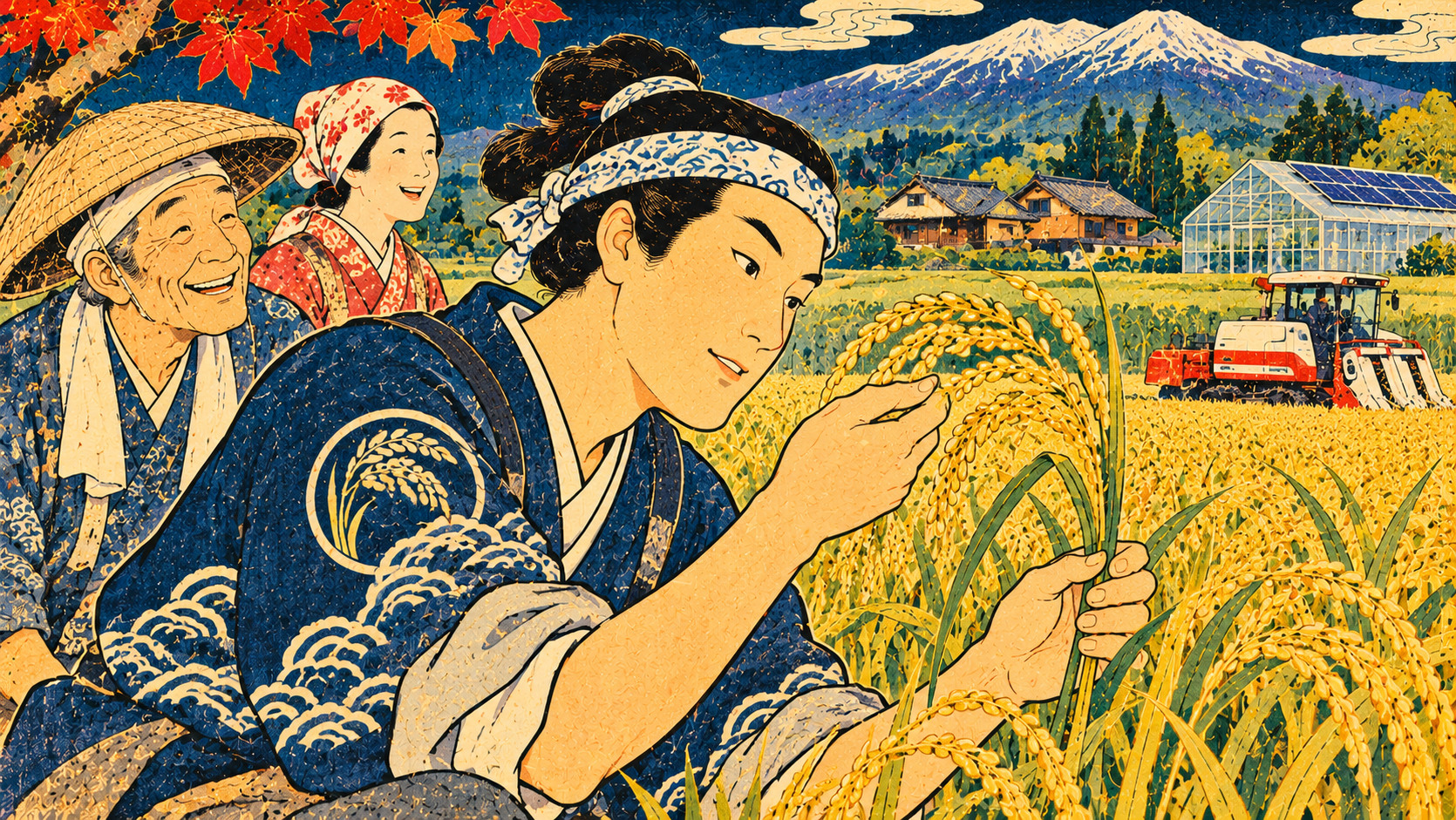
At a rice field in Mitsuke, Niigata Prefecture, high-school students have done more than pose for a seasonal photograph. They have planted Omachi sake rice and joined a chain of work that extends from farming to brewing, packaging and retail. A farmers’ cooperative, a brewery, a wholesaler, the school and municipal officials each supply something that the others cannot. The result is a commercially sold sake—not just a model village on a government slide.
On October 28, 2026, distributor Niigata Shuhan announced that the Ministry of Agriculture, Forestry and Fisheries had certified its participation in the collaborative project. Mitsuke City highlighted the partnership again at its November 2 mayoral briefing. The latest development offers a useful way to ask a bigger question: when Japan’s countryside loses workers and residents, can companies help preserve the ordinary economic functions that allow communities to exist?
Meet the partners behind the rice
The Omachi initiative brings together Niigata Shuhan, Farm Oguriyama in Mitsuke, Nakagawa Shuzo in neighboring Nagaoka, Niigata Prefectural Mitsuke High School and local government participants. The school has described representatives explaining the purpose of the project to incoming first-year students. Municipal reporting says pupils took part in planting, harvesting, brewing activities and designing a product label.
Each link matters. Someone must manage the land and the crop. A brewer needs specialized facilities and the ability to control quality. A wholesaler must navigate the distribution system, retailers and customers. The school can make regional work visible to young people who may otherwise know little about the businesses around them. None of these functions is interchangeable, and a partnership is credible only when the work is actually carried out.
The product exists. Its wider economic effect is less certain
The participating distributor identifies the finished product as Koshino Hakugan Junmai Daiginjo Omachi. According to company and city statements, it has been sold through local outlets and adopted as a gift associated with Japan’s furusato nozei hometown-tax system. That is a meaningful step beyond a press conference: the collaboration has put a product into ordinary commercial circulation.
But public announcements do not establish the number of bottles sold, the net income earned by the farmers, the operating margin at each stage or whether participation increased the number of people willing to farm in the long term. Those measures would be essential before calling the product a demographic rescue. Commercial availability is evidence of execution, not yet proof of lasting revitalization.
What the government certificate really means
MAFF’s certificate recognizes activities in which businesses commit money, technology or people to addressing rural challenges. The ministry lists initiatives such as increasing the value of regional agricultural goods, mobilizing outside participants and building local agreement around land use. The Niigata project fits the general idea of bringing multiple organizations into an agricultural and community-development effort.
The distinction between an activity certificate and a measured outcome is easy to miss. MAFF has separately developed an impact-certificate program intended to assess demonstrated social and environmental effects. An activity certificate should not be read as a government guarantee of higher incomes, improved employment or population growth. Nothing in the materials reviewed establishes that this particular project has received the separate impact certificate.
How a classroom project becomes a local supply chain
Mitsuke High School has documented the project moving from one school year to the next, while the city reported the May 27, 2026 planting by students. The process teaches that the value of a crop is not confined to harvest time: it is shaped by processing, presentation, regulation, distribution and the ability to find paying customers.
One should resist an attractive but unsupported conclusion, however. Students who experience farming do not necessarily become farmers, or decide to remain in their hometown after graduation. Education can create knowledge and attachment without changing the local employment market. Its benefits need to be assessed on their own terms rather than folded into a fictional migration success story.
The arithmetic behind Japan’s agricultural challenge
Japan’s 2025 agricultural census counted about 1.036 million core agricultural workers in individual farming households. Their average age was 67.7; roughly seven in ten were at least 65. The number is less than half the approximately 2.4 million recorded in 2000. Older farmers still carry an enormous stock of experience, but the long-term labor problem is unmistakable.
What is lost when a farmer retires is not merely a crop. Water channels must be cleared, field boundaries managed, machinery maintained, buyers found and deliveries arranged. In some settlements, daily commerce and services are also fragile. A compelling rural-development strategy must keep track of these mundane tasks rather than assuming that tourism, branding or one premium bottle can solve them all.
In Shimane, a company took on the business of community life
A very different experiment has unfolded in the Hida district of Yasugi, Shimane Prefecture. E-Hida Company, a community-rooted enterprise, was created around a resident-authored plan containing 88 ideas for the district’s future. MAFF’s published case study describes work ranging from farm operations and drone spraying to remote-controlled weed management and loach cultivation in poorly drained rice fields.
It also describes mobile retail serving older residents, shopping support and activities connecting children to local festivals. The enterprise illustrates an alternative interpretation of “economic development”: the business may be important not only because of what it sells, but because of the services that keep a place habitable for its remaining population.
A village company takes years to earn trust
A March 2026 research paper from MAFF’s policy institute traces E-Hida to a voluntary organization formed in 2016 and incorporated the next year. The account emphasizes how a local organization earns legitimacy among residents and builds the authority to coordinate work that households once managed individually. That history is vital: incorporation did not magically create community agreement.
Nor is a single village company a universal template. Rural districts differ in landholding, governance, labor supply and access to markets. Services such as elder shopping support may produce social value without generating enough revenue to stand alone. An assessment has to examine the financial structure and the degree to which public support or volunteering makes it possible.
The rural RMO model and its complications
Japan’s rural regional management organization, usually called a rural RMO, is intended to integrate farmland maintenance, use of local resources and everyday living support. MAFF identifies the problem clearly: as small settlements lose households, the collective labor needed to maintain the landscape and sustain daily services becomes more difficult to organize.
That means partnerships require governance, not just sponsorship. Who decides which fields are maintained? Who speaks for residents who are not farmers? Who controls the brand, the land and any profits? Will a private participant stay when conditions deteriorate? Outside expertise can be valuable while still needing accountability to the people who live with the consequences.
Five ways to tell whether collaboration is working
A serious scorecard would track at least five outcomes: what farmers and local employees actually earn; how much farmland remains in production or good condition; whether younger participants find sustained work; whether essential services become more reliable; and whether the organization can survive leadership turnover or the end of subsidies.
Such evaluation can expose difficult tensions. A retailer may create a successful premium brand while growers receive only a small share of the margin. A village shop may be socially indispensable but commercially unprofitable. A popular school project may teach valuable skills without influencing the population balance. Each is important; none should be allowed to stand in for all the others.
The real test arrives after the ceremony
The Mitsuke sake project and E-Hida Company are not interchangeable. One connects agricultural production, education, brewing and distribution. The other attempts to sustain the functions of an entire small community. Their common lesson is that the tasks of rural survival cannot always be left to a single farm family, a single municipal office or a single company.
The news this week is a certificate and a public presentation. The outcome that will matter next year is less photogenic: fields still cultivated, bills paid, knowledge passed along, customers returning and residents able to buy groceries. Japan’s rural future will depend less on the number of partnerships announced than on the institutions that keep doing the work after the announcements have faded.
Sources and reporting method
Documentary reporting from official materials available through November 3, 2026. The article does not infer undisclosed sales, farmer incomes or migration outcomes.
- Mitsuke City: November 2 mayoral briefing
- Niigata Shuhan: October 28 certification announcement
- Mitsuke City: students planting Omachi rice, June 1, 2026
- Niigata Prefectural Mitsuke High School: Omachi project account
- MAFF: Rural contribution activity certificate
- MAFF: Activity certificate versus impact certificate
- MAFF: 2025 Census of Agriculture and Forestry
- MAFF: Sustainable agricultural structure and workforce
- MAFF: E-Hida Company and community-building award
- MAFF Policy Research Institute: E-Hida case study (March 2026)
- MAFF: Rural regional management organizations
- Statistics Bureau: Population estimates