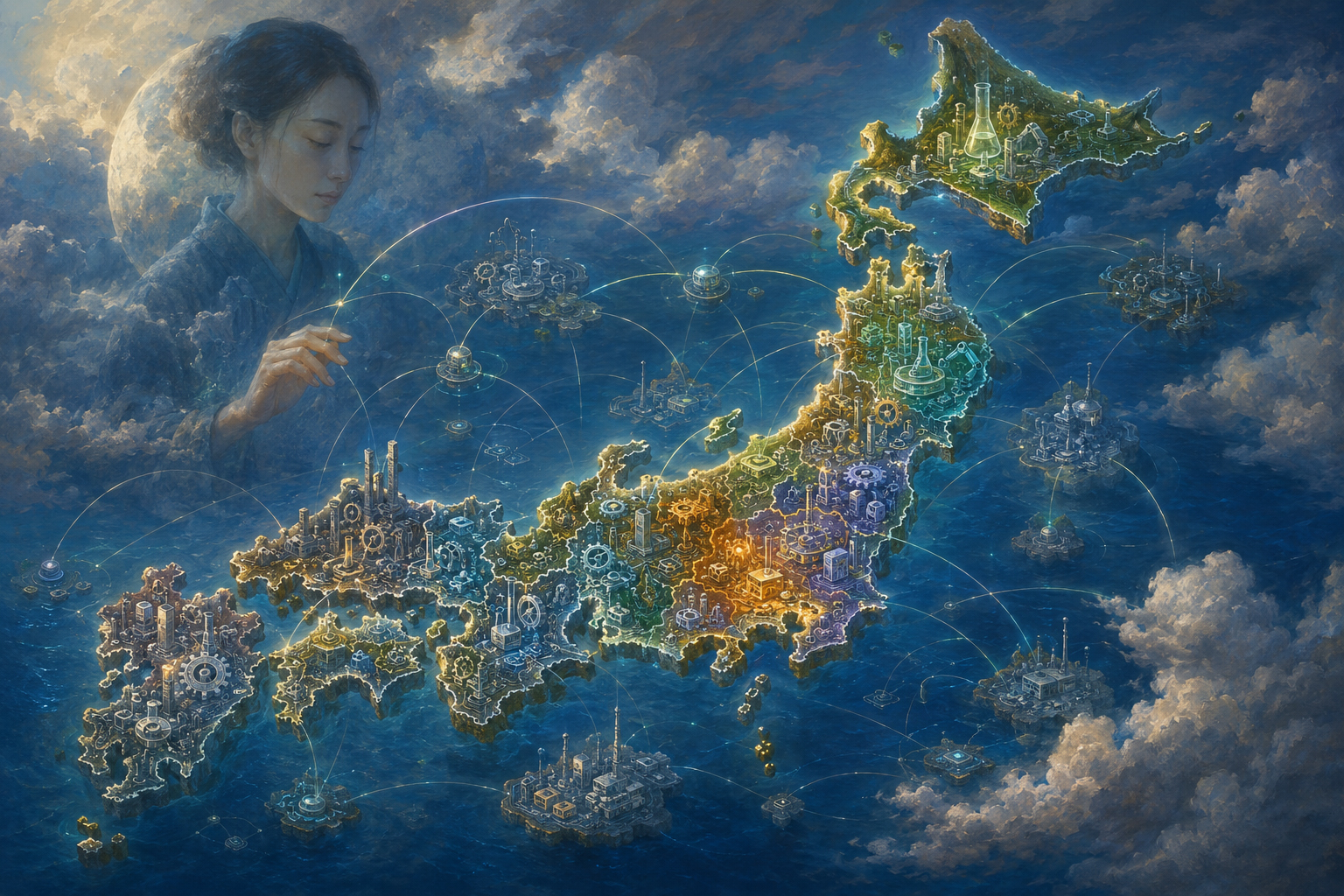
Most maps of Japan show prefectural borders, mountains, railways, airports, temples, factories and coastlines. But there is another map underneath the visible one: a map of what each region knows how to make. It is not only where companies are headquartered. It is where technological routines, suppliers, engineers, schools, machine shops, laboratories and production know-how have accumulated over time.
A June 2026 paper titled “Technological Fitness and Regional Growth in Japan” tries to make that hidden map visible. The researchers used about 3.9 million registered corporate patents filed from fiscal 1981 through fiscal 2015. They assigned patents to prefectures using applicant addresses, mapped international patent classifications into 35 technology classes, and built a network connecting Japan’s 47 prefectures to the technologies in which firms there had patented.
Then they applied a Fitness-Complexity algorithm. The purpose was not merely to count patents. The question was deeper: which regions have diversified and sophisticated technological capabilities, including capabilities that are not common everywhere? The paper then tested whether those scores were associated with subsequent real gross regional product per capita growth over the following five years.
The answer matters because Japan is searching for growth beyond Tokyo, beyond old industrial policy, beyond tourism and beyond slogans. If regional technological fitness helps explain future growth, then Japan’s local future is not just a demographic question. It is also a capabilities question.
Patent counts are not enough
Counting patents is easy. A prefecture has many or few. A firm files often or rarely. A university is active or not. But a patent count alone can mislead. A large number of incremental patents in a common field does not mean the same thing as a smaller number of patents in complex, less widely held technologies. What matters is not just quantity. It is the architecture of capability.
Technological fitness tries to capture that architecture. A region scores better when it combines breadth with sophistication. It is valuable to be present in many technological areas, but it is especially valuable to be present in areas that relatively few other regions can handle. The logic is related to economic complexity: places grow not only because they do more things, but because they can do harder-to-replicate combinations of things.
Think of an automotive region. It is not just assembling cars. It contains suppliers, materials knowledge, electronics, testing, logistics, quality systems, tooling, robotics, software and skilled workers. A pharmaceutical or medical-device region is not just a lab. It has regulatory knowledge, hospitals, clinical networks, specialist suppliers and patient pathways. A precision-machinery region is not just metal cutting. It has measurement culture, process control, tolerances and customer relationships.
Japan’s industrial history has always been regional
The research method is new, but the underlying idea is old. Japan’s industrial growth has always been regional. In the Meiji era, state-led modernization built factories, railways, ports, mining districts and schools that anchored different kinds of production in different places. Silk, textiles, shipbuilding, steel, mining, chemicals and machinery all had geography.
After World War II, the Pacific Belt became Japan’s growth corridor. Keihin, Chukyo, Hanshin, Setouchi and Kitakyushu formed the great industrial spine. Cars, steel, petrochemicals, shipbuilding, machine tools and electronics grew through dense regional clusters. The Japanese miracle was national in name, but local in practice.
Regional specializations multiplied. Aichi became an automotive universe. Hamamatsu mixed instruments, motorcycles, optics and manufacturing culture. Kyoto combined ancient craft, universities, electronics, materials and precision. Osaka and Hyogo retained deep machinery, chemical and pharmaceutical roots. Kyushu’s semiconductor story joined automobiles and Asia-facing logistics. Hokuriku carried textiles, machinery, pharmaceuticals and precision processing. Suwa, Tsubame-Sanjo, Higashi-Osaka and many smaller districts built capabilities that outsiders often underestimate.
After the bubble burst, Japan’s regional capabilities became less visible. Factories moved abroad. Supplier networks were squeezed. Population aged. Young people left. Local banks became cautious. But knowledge did not vanish overnight. The question is whether Japan can identify these capabilities before they disappear, and whether it can connect them to the next wave of growth.
Why some prefectures pull ahead
The study’s central claim is not that any one prefecture is permanently destined to win. Instead, it suggests that sophisticated technological capability is associated with later growth. The relationship is clearest in panel models that control for prefecture and time effects, and it appears stronger for lower-income prefectures, where there may be more room for expansion.
That is important. It means regional technology is not merely a trophy for already-rich places. It may be a growth engine for places that have hidden capability but have not yet converted it fully into income. A prefecture with modest income but a sophisticated technological portfolio may have more potential than a simple population or tourism ranking would show.
The key is adjacency. Regions rarely leap successfully from nothing into an unrelated frontier industry. They grow by moving from what they already know into nearby domains. Textile knowledge can lead to advanced fibers and medical materials. Metalworking can lead to semiconductor equipment components. Automotive supplier skills can lead to robots, batteries and mobility systems. Food processing can connect to biotech, packaging, logistics and export branding.
Regional growth also depends on circulation. If companies, universities, technical colleges, local governments, banks and customers remain sealed off from one another, knowledge stays trapped. If people move across institutions, prototypes get made, failures are discussed, and customer problems are translated into product ideas, technological fitness rises.
Tokyo matters, but Tokyo is not the whole story
Tokyo is powerful. It concentrates headquarters, finance, policy, universities, media, startups, lawyers, patent professionals and global investors. But Japan’s technical depth is not located only in the capital. Much of Japan’s productive knowledge sits in regional factories, supplier networks, industrial towns and specialized mid-sized companies.
That matters in the AI and semiconductor age. A software pitch deck cannot build a lithography component, battery material, precision robot joint or medical device. Hardware still needs suppliers. Advanced manufacturing still needs measurement. AI infrastructure still needs power, cooling, chips, sensors, optics, logistics and disciplined production.
This is where Japan’s regional map may become newly valuable. The country’s aging industrial districts are often described as old. But some of them contain exactly the production knowledge that new strategic industries require. The challenge is not to preserve them as museums. The challenge is to connect them to new markets, new tools and new capital.
Regional revitalization cannot live on tourism alone
Japan’s local policy often leans toward tourism, migration campaigns, hometown tax promotions, food branding and festivals. These can help. They build pride, attract visitors and create visible energy. But long-term regional income also requires productivity. It requires technology, exportable services, manufacturing depth, advanced agriculture, healthcare, energy systems, logistics and digital capability.
Tourism brings people. Technology raises income. The two can work together, but they are not the same thing. A town can be beautiful and still have few career paths for engineers. A prefecture can have famous food and still struggle to retain young specialists. If Japan wants regional revitalization to mean more than weekend travel, it must build serious local capability strategies.
That begins with knowing what each region already has. Which technologies appear in the local patent record? Which are rare nationally? Which firms are connected to which universities? Which suppliers quietly serve global customers? Which local companies have no brand recognition but hold critical process knowledge? The most important regional asset may be something locals have long treated as ordinary.
The human story behind a patent map
Patent data can feel cold. Numbers, classification codes, addresses, filing dates, applicants. But behind every patent is a person or team. An engineer who changed a process. A small firm that survived by solving a customer’s impossible problem. A university researcher who stayed in the region. A technician who understood a machine’s sound. A family company that kept a niche alive through decades of pressure.
Technological fitness is partly the accumulation of those lives. In Japan, much knowledge has lived inside companies rather than on public stages. It is practical, tacit and process-heavy. It is found in how a factory handles defects, how a supplier negotiates tolerances, how a technician polishes a component, how a firm documents quality for a demanding customer.
Population decline threatens this knowledge. When a company closes without succession, more than jobs disappear. Routines disappear. Customer relationships disappear. Apprenticeship chains disappear. Local technological fitness can erode silently. A policy that saves only buildings but not knowledge is not enough.
AI may widen the gap — or give regions a second chance
AI could make regional disparities worse. Large metropolitan firms have easier access to talent, data, capital and consultants. If rural and regional companies cannot adopt new tools, they may fall further behind even when their core technical knowledge remains strong.
But AI could also give regions leverage. Translation, design support, simulation, documentation, quality analysis, overseas sales support and patent search can help small regional firms punch above their weight. A metalworking firm can improve inspection. A machinery company can model maintenance. A food producer can forecast demand. A medical-device supplier can handle regulatory documentation more efficiently.
The promising path is not “bring AI companies to every prefecture” as a slogan. It is to layer AI onto existing regional strengths. Each prefecture should ask: what do we already know how to make, and what digital tools would multiply that capability?
What policymakers should take from this
The implication is not that every prefecture needs a fashionable startup campus. Nor does every region need the same subsidy menu. The lesson is more specific: find the region’s existing technological capabilities, identify adjacent opportunities, and build the bridges needed to turn those capabilities into income.
That means regional technology maps. It means intellectual property support that is practical, not ceremonial. It means connecting technical colleges, universities and small manufacturers. It means helping local firms reach overseas customers. It means public procurement that gives regional companies a chance to prove new technologies. It means patient capital for firms that are not flashy but are deeply capable.
It also means wages and careers. Technology lives in people. If regional technical jobs are underpaid or closed to young talent, knowledge will not renew. Local revitalization depends not only on grants and buildings, but on whether a talented 25-year-old can imagine a serious life in a regional engineering company.
Japan.co.jp view
“Technological fitness” sounds academic, but the idea is simple: places grow from what they know how to do. Japan’s prefectures are not blank spaces waiting for generic development plans. They are layered ecosystems of skills, suppliers, schools, firms, machines and memories.
The next map of Japan should not be drawn only by population size, tourist numbers or real estate prices. It should also be drawn by hidden capability. Which regions can make hard things? Which can combine technologies? Which can move from old strengths into new industries? Which are losing knowledge before they realize its value?
Japan’s problem is often described as aging. That is true. But it is also a knowledge-transfer problem. The country must decide whether regional technical memory will fade with retiring workers, or whether it will be connected to AI, global markets, new capital and new careers.
The new research offers a useful lens. Japan is not one innovation economy. It is 47 prefectural innovation stories. Some are loud. Some are quiet. Some are fading. Some are waiting for the right connection. The job now is to find the quiet ones before the lights go out.
Reader takeaways
| Question | Answer |
|---|---|
| What happened? | A 2026 study used about 3.9 million corporate patents to measure technological fitness across Japan’s 47 prefectures. |
| What is technological fitness? | A measure of how diverse and sophisticated a region’s technological capabilities are. It is not just a patent count. |
| Why does it matter? | The study reports a positive association between technological fitness and later real gross regional product per capita growth. |
| What does it mean for regions? | Prefectures should build from existing technical strengths into adjacent industries rather than copy generic development strategies. |
| Japan.co.jp view | Regional revitalization should be read through technology, knowledge transfer and capability—not tourism and population alone. |
Sources and references
This article draws on the 2026 paper “Technological Fitness and Regional Growth in Japan,” related research on economic complexity among Japanese prefectures, OECD work on rural innovation in Japan, Japan Patent Office material on regional intellectual property strategy, and WIPO work on patent and knowledge diffusion trends.
- arXiv: Technological Fitness and Regional Growth in Japan.
- arXiv: Economic complexity of prefectures in Japan.
- OECD: Enhancing Rural Innovation in Japan.
- Japan Patent Office: Regional Intellectual Property Strategy.
- WIPO: Global trends of technological knowledge diffusion.