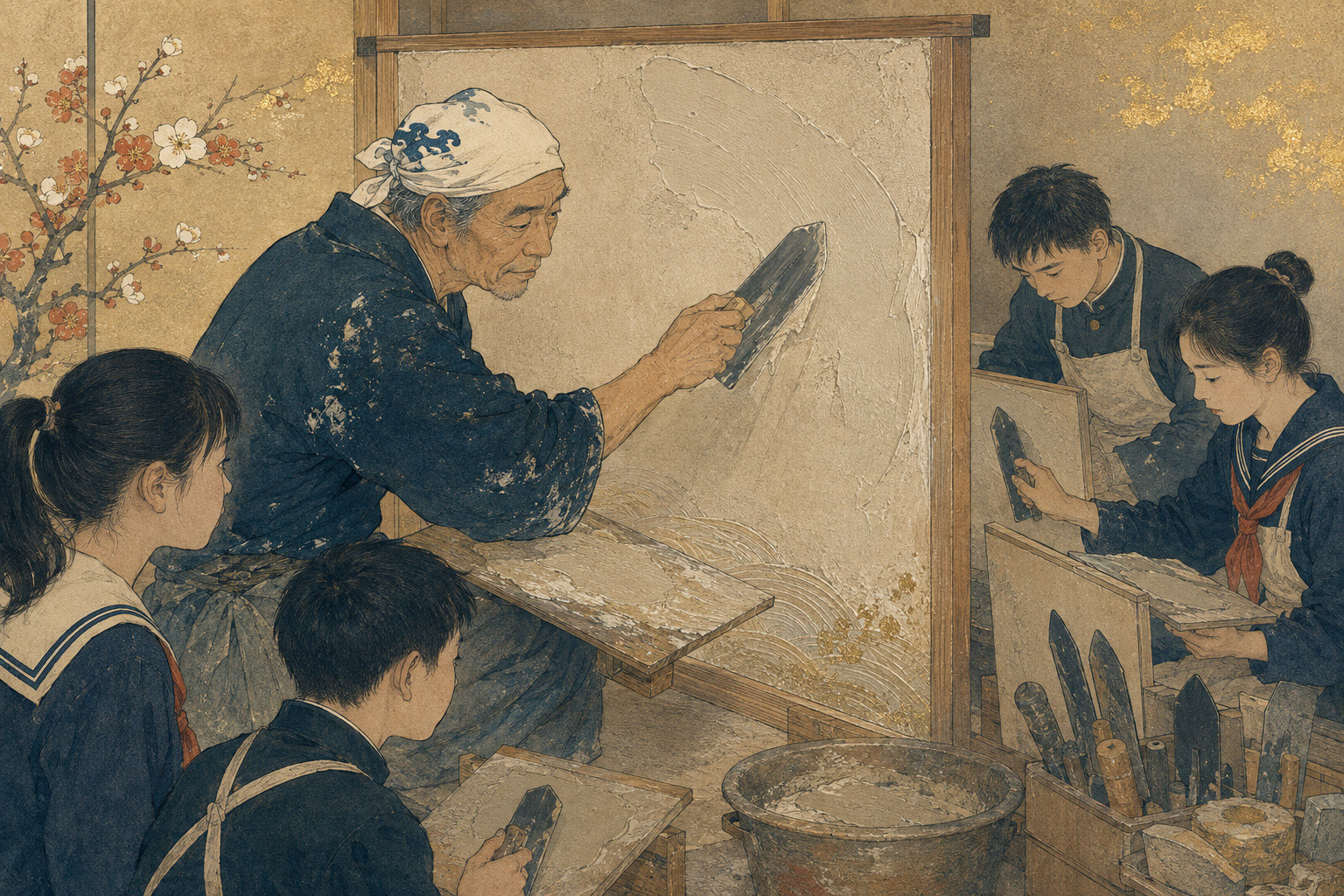
The material looks obedient until the student tries to move it. It will sit on the hawk, cool and heavy. Then the wrist turns, the trowel meets the board, and the mixture either bunches into a ridge, tumbles to the floor or leaves a translucent bald patch where a wall was supposed to begin.
A plasterer makes the same movement look almost careless. The blade arrives at a shallow angle. Pressure changes across the stroke. A wet mound becomes a plane; the edge closes without a seam. The difference is not strength. It is a chain of tiny judgments—water, grain, suction, thickness, temperature, the sound under steel—made faster than they can be narrated.
That was the proposition inside a classroom at Tohoku Bunka Gakuen University on June 18. Rentec, a specialist contractor whose roots in Sendai reach to 1964, brought trowels, boards and working knowledge to roughly 30 first-year students. The exercise was part career education, part argument about the future: there are kinds of intelligence that become legible only when a hand meets an uncooperative material.
The university said the session invited students to think about work and experience an industry whose skilled tasks are difficult to replace with artificial intelligence. The phrase is bold and should not be mistaken for a scientific forecast that no robot will ever plaster a wall. Mixing, pumping and spraying have long been mechanized. What the students encountered was the stubborn remainder—the variable surface, the wet edge and the responsibility for deciding when “flat” is truly finished.
A craft that disappears when it succeeds
Plastering has a publicity problem built into the work. A carpenter’s joints may remain readable; tiles declare themselves one by one. A well-made wall erases the gestures that made it. Once dry, it becomes “the background”—the quiet surface behind a painting, a meal or a meeting. The worker leaves the frame.
Modern consumers may know shikkui, the white lime finish of castles and storehouses, or admire an earthen tea-room wall without knowing the occupation that connects them. The Japanese word is sakan. Stories about its name range from court offices and palace builders to an honor supposedly bestowed in antiquity. The neat etymologies are less secure than popular accounts suggest. What is certain is that the specialized role is old, and that its boundaries kept expanding.
Today’s plasterer may spread earth, lime plaster, gypsum plaster, cement mortar or synthetic finish. The same trade can level a concrete floor, repair a damaged substrate, make a curved staircase, form decorative relief, prepare a surface for tile, or finish an expanse so calm that no tool mark remains. Job tag, the government occupation-information service, lists not only trowels but brushes, rollers, mixers, spray equipment, mortar pumps, winches and conveyors.
That range helps explain why a school demonstration matters. “Plasterer” is not a familiar button on a career website. It is a family of material problems encountered at full scale, under deadlines, among other trades. A teenager cannot infer it from the final photograph. The trowel turns an invisible occupation into a physical question: could I learn to do that?
What is actually inside a Japanese wall
Traditional earth construction is not a coat of mud painted on timber. In one classic sequence, split bamboo or reeds are tied into a lattice known as komai. Base earth mixed with chopped straw is pressed through and around it. After drying, cracks and irregularities are corrected with intermediate coats. Finer earth, sand, fiber and other locally adjusted ingredients build toward the final surface. Each layer must be compatible with the one below it.
Shikkui is different. Its principal binder is slaked lime; traditional preparations may add hemp fiber and a cooked seaweed paste that improves workability and water retention. Recipes vary by region, purpose and conservation specification. As lime cures, it reacts with carbon dioxide and slowly returns toward calcium carbonate—the chemistry of stone translated into a thin white skin.
Cement mortar, made primarily from cement, sand and water, brought another set of possibilities: harder exterior coats, concrete finishing, large urban work and repair. Gypsum and modern resin finishes added still more. “Natural” and “modern” are not two sealed camps. A working contractor must understand new substrates, performance requirements and safety rules while preserving techniques for old materials that behave nothing like a bagged compound.
| Finish or layer | Typical role | What the hand must judge |
|---|---|---|
| Earth base and intermediate coats | Build thickness around a lattice; level and prepare the wall | Moisture, fiber, adhesion, drying cracks and timing between layers |
| Fine earth finish | Color and texture for rooms, including tea architecture | Grain, pressure, direction, edge control and the desired trace of the tool |
| Shikkui lime plaster | Bright, durable finish associated with castles, temples, houses and storehouses | Suction, thinness, polish, corners, weather and carbonation during cure |
| Cement mortar | Floors, exterior bases, concrete work, repairs and substrates | Mix consistency, level, compaction, curing and crack control |
| Decorative modern finish | Custom textures, relief, polished surfaces and contemporary interiors | Repeatability where needed—and deliberate variation where it is the design |
The trowel is therefore not a paintbrush with a metal blade. A plasterer changes its angle and pressure to transfer material, compress it, cut an edge, close pores or raise texture. Different sizes and shapes reach corners, curves and broad fields. The blade also returns information. Drag changes when a layer has tightened. A faint scraping can reveal an aggregate particle or a high spot. Much of the lesson travels through the tool before it becomes language.
From earth shelter to castle white
The history of Japanese plastering begins before the occupational title. Public craft histories trace its origins to prehistoric earth building: people shaped protective surfaces from the ground beneath them long before there were guilds, wage schedules or steel trowels. With temple and palace construction, wall making became specialized, layered and bound to organized building sites.
Ancient Buddhist architecture required surfaces for enclosure, protection and painting. Over centuries, builders refined earthen substrates and lime finishes within timber frames. The wall was generally not the primary load-bearing mass familiar from stone architecture. It filled, screened and protected spaces made by posts and beams. That difference helped produce a particularly Japanese conversation between heavy earth and visible timber.
Tea architecture altered the cultural status of imperfection. In medieval and early-modern rooms, earth was not merely something to hide under white. Its grains, subdued color, straw, shadows and trowel traces could carry atmosphere. A surface might be deliberately soft, rough, polished or clouded. The plasterer became, in effect, an author of light.
Castle towns and frequent urban fire gave lime and earth another duty. Thickly protected timbers and pale shikkui surfaces helped defend storehouses and castle structures from flame and weather. The raised white grid of namako-kabe—lime-plastered joints over dark tiles—became both a protective system and one of the most recognizable patterns of merchant districts. Fire resistance did not make every traditional building fireproof, but plaster was a serious line of defense around combustible frames.
The Meiji period did not retire the trade. Western-style banks, public buildings and residences demanded imitation stone, cornices, ceilings and ornament. Portland cement and new tools widened the field. Japanese plasterers absorbed foreign forms into an occupation already accustomed to adjusting mixtures and surfaces. Some specialties later separated into tile setting, spraying and other trades, but the modern city was also a plasterer’s workshop.
Prehistory Earthen building establishes the basic act: shape local ground into enclosure and protection.
Ancient temple age Organized timber construction develops layered walls and plastered surfaces for sacred architecture.
Medieval–early modern Tea rooms elevate earth’s grain, color and imperfection into an aesthetic language.
Castle-town Japan Earth and shikkui protect storehouses, walls and fortifications; regional finishes proliferate.
Meiji modernization Cement, Western ornament and urban public buildings expand the trade’s vocabulary.
Postwar decades Wet plastering grows with construction, then loses ordinary wall area to boards, panels and wallpaper.
2020 Traditional architectural craft skills including sakan plastering enter UNESCO’s Representative List.
The postwar bargain: faster walls, fewer hands
Japan’s reconstruction and high-growth years first created enormous work for plasterers. Concrete buildings needed mortar, floors needed leveling, houses needed walls. But industrial construction also changed the bargain. Factory-made boards and panels arrived uniform, dry and ready to fasten. Wallpaper could cover gypsum board without waiting for multiple wet coats to cure. Exterior siding reduced weather dependence. Schedules became easier to predict.
Dry construction was not a cultural conspiracy against craft. It answered urgent needs for speed, scale, cost control and standardized performance. It also shifted skill into factories, product systems and installation. The consequence for plastering was cumulative: fewer square meters in ordinary houses, fewer employers able to carry apprentices through slow early years, and less public contact with the trade.
The decline cannot be explained by materials alone. Japan’s construction workforce has aged, rural populations have contracted, and young people have more educational and occupational choices. Small specialist subcontractors face volatile workloads and limited training capacity. At the same time, clients still expect flawless work, sites still open early, materials still impose their own clock, and weather can rearrange a week.
The contradiction is that scarcity can coexist with shrinking market share. Japan may use less hand plaster per average new room and still lack qualified people for the surfaces that remain. Cultural-property repairs, custom interiors, curved work, restorations and difficult concrete corrections do not vanish because the mass market chooses board. They become harder to staff.
- 59,890 is the plasterer employment count produced from the 2020 national census on the government’s job tag page—not a live 2026 headcount.
- 7.03 is the fiscal 2024 active-job-opening ratio recorded through Hello Work. It signals many openings relative to applicants, not seven guaranteed jobs for every individual.
- Job tag warns that wage and age statistics can map to broader occupational classifications. They should not be treated as a perfect census of plasterers alone.
- Short-term site-demand surveys and long-term workforce decline measure different things. A quiet month does not rebuild an apprenticeship pipeline.
A three-to-ten-year problem
The occupation is unusually exposed to gaps in recruitment because competence takes time. In a job tag survey asking experienced respondents how long a new entrant needs after joining to work at the ordinary level without special support, 38.9% selected three to five years and 19.4% selected five to ten. These are practitioner perceptions, not a legal timetable, but they capture the scale of the investment.
An apprentice begins with logistics: protection, cleanup, mixing, carrying, preparing substrates and learning the site’s sequence. Then come straight strokes on a practice board, corners, thickness, levels and materials that set at different speeds. Work that looks repetitive is building a library of failure. Too much water weakens or delays. Too little prevents transfer. A layer applied before the substrate is ready may crack or detach weeks later, after the worker has left.
Japan has formal routes as well as informal learning. Entry itself generally requires no particular academic credential or license. Workers can train in companies and vocational schools, and the national skills-testing system certifies plastering skill. A common progression runs from apprentice to skilled plasterer, work leader and foreman; some move into construction management or open their own business. Rentec’s recruitment information explicitly says qualifications are not required at entry and can be earned afterward.
That is a more accessible story than the old image of a silent master who withholds secrets until a disciple has carried buckets for years. But accessibility is not the same as ease. A training company pays wages while a beginner is slow, pairs them with a productive veteran, supplies practice space and absorbs mistakes. Rentec’s new Sendai office includes two training rooms intended for student interns and new plasterers. That detail may matter more to succession than any nostalgic speech: skill needs a wall on which failure is affordable.
Why the classroom is becoming a jobsite
Rentec’s June workshop was aimed at university first-years, not only students already committed to architecture. That is significant. Career education normally asks young people to describe strengths, research industries and imagine a future self. Plastering collapses the abstraction. Within minutes a student receives unambiguous material feedback. The wall is uneven. The mortar fell. The second stroke is better.
A March 13 class at Tokyo Metropolitan Tanashi Technical High School shows the model in a more specialized setting. With support from Nishitani Kogyo, first-year architecture students rotated through four class periods. Each worked under a skilled plasterer, trying a thin finish and a mortar coat on practice walls. The school reported that students struggled even to load mortar on the trowel before attempting to spread it flat. They then watched professionals’ economical movements at close range.
Other construction outreach programs combine plastering with scaffolding, machinery and related trades. Their immediate value is not a conversion rate. A child or teenager may never enter construction. The workshop still restores basic literacy about how buildings are made. It also breaks two stereotypes at once: that manual work is mindless, and that traditional work is frozen in the past.
For employers, the risk is staging a beautiful hour that conceals the difficult week. Responsible outreach must eventually show the whole occupation: early starts, dust control, protective equipment, team coordination, lifting, weather, deadlines and pay systems—as well as artistry, independence and pride. Rentec publishes a typical day beginning with an 8 a.m. safety meeting and hazard prediction before work. That ordinary schedule is part of the truth students deserve.
| A workshop can show | It cannot prove in one day |
|---|---|
| The resistance of material and the precision of a trained stroke | That every participant is suited to full-time site work |
| A visible path from beginner practice to national skill certification | That wages, benefits and schedules are attractive at every employer |
| The creativity inside a construction trade | That school outreach alone will reverse demographic decline |
| A first relationship with a local company and working craftspeople | That interest will survive without visits, internships and paid training |
What machines can carry—and what they still cannot feel
Plastering has never been untouched by technology. Powered mixers replace exhausting hand mixing. Pumps and conveyors move mortar. Spray equipment covers large surfaces. Laser levels reveal deviation. Digital estimation, scheduling and building models can reduce waste before a trowel reaches the wall. The romantic image of unchanged handcraft erases this long collaboration with machines.
Robotic systems can also apply and finish predictable materials on standardized planes. Their advantage grows in factories and repetitive new construction, where geometry, substrate and mix can be controlled. Such automation may be necessary in a country with fewer workers, especially for heavy, hazardous or monotonous stages.
The hard cases are the ones buildings produce constantly: a substrate that absorbs unevenly, a repair that must join old material without advertising the seam, a curved junction, a protected historic surface, a client who points at a sample and asks for “the same mood, but quieter.” The specification underdetermines the answer. The worker samples, adjusts and judges.
Even there, “AI-proof” is a slogan, not a guarantee. Vision systems, force sensing and adaptive control will improve. The sensible question is which tasks should be automated and which knowledge the system must preserve. If a robot can carry, mix or rough-apply material, a smaller number of plasterers may spend more time on diagnosis and finish. If automation removes beginner tasks without creating a new learning ladder, however, the trade could lose the very stages through which judgment develops.
The school board offers a useful correction to both hype and nostalgia. The student does not beat a machine by being human. The student begins to learn why a wall is a changing physical system. Technology becomes valuable when it extends that understanding rather than pretending the material has no surprises.
Heritage is not a museum category
In 2020, UNESCO inscribed Japan’s “Traditional skills, techniques and knowledge for the conservation and transmission of wooden architecture” on its Representative List of the Intangible Cultural Heritage of Humanity. Sakan plastering was among the techniques. The element was expanded in 2025. The international recognition matters, but its wording matters more: the heritage is not a collection of perfect walls. It is the knowledge required to conserve and transmit them.
That knowledge includes ingredients and hands, but also supply chains. Traditional construction needs appropriate earth, lime, fiber, bamboo, timber, bark, grass and other materials in sufficient quality. It needs specialists who understand adjacent trades and can coordinate a repair. Japan’s Agency for Cultural Affairs supports selected conservation techniques and material-source programs because a master craftsperson without suitable material cannot reproduce historic work.
Conservation also exposes a central misunderstanding about old buildings. Longevity does not mean freedom from maintenance. UNESCO notes that Japan’s hot, humid climate requires regular repair and cooperation across trades. A wall that has survived centuries may contain accumulated decisions: which damaged part to retain, how to match a local soil, whether a later repair has historical value, how new work can be distinguished without becoming visually intrusive.
Those are not skills learned from a festival demonstration alone. Yet the demonstration may start the chain. A student touches earth, visits a contractor, enters paid training, learns ordinary mortar and later specializes. The path from classroom board to temple wall is neither automatic nor short. It is at least imaginable.
- Honest access: workplace visits, short placements and paid internships that show real conditions.
- Structured practice: training walls, measurable stages and instructors with time to teach.
- A viable job: predictable wages, safety, social insurance, rest days and a visible route to greater responsibility.
- Living demand: conservation, repair and contemporary design commissions that use skill instead of merely praising it.
The wall after the lesson
Rentec began as the Shugo Kikuchi Plastering Shop in Sendai’s Miyagino Ward in 1964. It became Rentec in 2000 and entered its seventh decade carrying a trade older than the corporate form around it. The company’s outreach is therefore not charity detached from business. It is an attempt to make a future workforce possible.
The students at Tohoku Bunka Gakuen University were not asked to preserve fourteen centuries in an afternoon. They were asked to move wet material across a board. That scale is important. Grand appeals to save tradition can make craft feel like a burden inherited from the dead. A trowel makes it a present-tense problem with a visible result.
Perhaps one participant remembers the mixture falling. Another remembers the clean sound of the professional’s blade. A third notices, years later, that the white corner of a storehouse is not simply “old Japan” but somebody’s controlled line. None of those outcomes appears in recruitment statistics.
Some participants may apply. Most will not. A serious program should measure internships, hires and retention, while accepting that cultural knowledge spreads more widely than employment. The public that commissions, maintains and values skilled work also has to be trained.
At the end of a successful job, the plasterer cleans the blade and leaves behind a surface that no longer appears wet, difficult or contingent. The labor disappears again. The workshops in Sendai and Tokyo interrupt that disappearance for a few hours. They show young people the moment before a wall becomes background—and ask whether one of them might learn to finish it.
Reporting notes and principal sources
This article uses public information checked through August 11, 2026 at 8:06 AM Japan Standard Time. The June 18 event, participant scale and exercise are from Tohoku Bunka Gakuen University. The Tokyo class is separately documented by the metropolitan school. National employment and recruitment figures come from the Ministry of Health, Labour and Welfare’s job tag service and refer to the years stated; they are not estimates of the August 2026 workforce. Historical descriptions synthesize public craft, government, industry and heritage sources. Popular stories about the origin of the word sakan are not presented as settled etymology.
- Tohoku Bunka Gakuen University: June 18, 2026 visiting workshop with Rentec
- Rentec: company history from the 1964 Shugo Kikuchi Plastering Shop
- Rentec: the plasterer’s work and a typical site day
- Rentec: entry, training and qualification information
- Mori House: Rentec’s new office and two plastering training rooms
- Tokyo Metropolitan Tanashi Technical High School: March 2026 plastering class
- Ministry of Health, Labour and Welfare job tag: plasterer work, training, employment and recruitment data
- UNESCO: traditional skills for conserving and transmitting Japanese wooden architecture
- Agency for Cultural Affairs: Japan’s nomination of traditional architectural craft techniques
- Japan Plasterers’ Association: plaster walls, timber architecture and building safety
- Japan Plasterers’ Association: 50th National Plastering Skills Competition
- Yokohama Skills and Culture Center: public history of the plastering occupation
- Ministry of Land, Infrastructure, Transport and Tourism: contemporary Tokyo earth-wall house
- Ministry of Land, Infrastructure, Transport and Tourism: Kawagoe townhouse and craft transmission
- Japan Federation of Construction Contractors: long-term construction workforce trend
- LIXIL: wet, precast and dry construction methods in modern finishing work