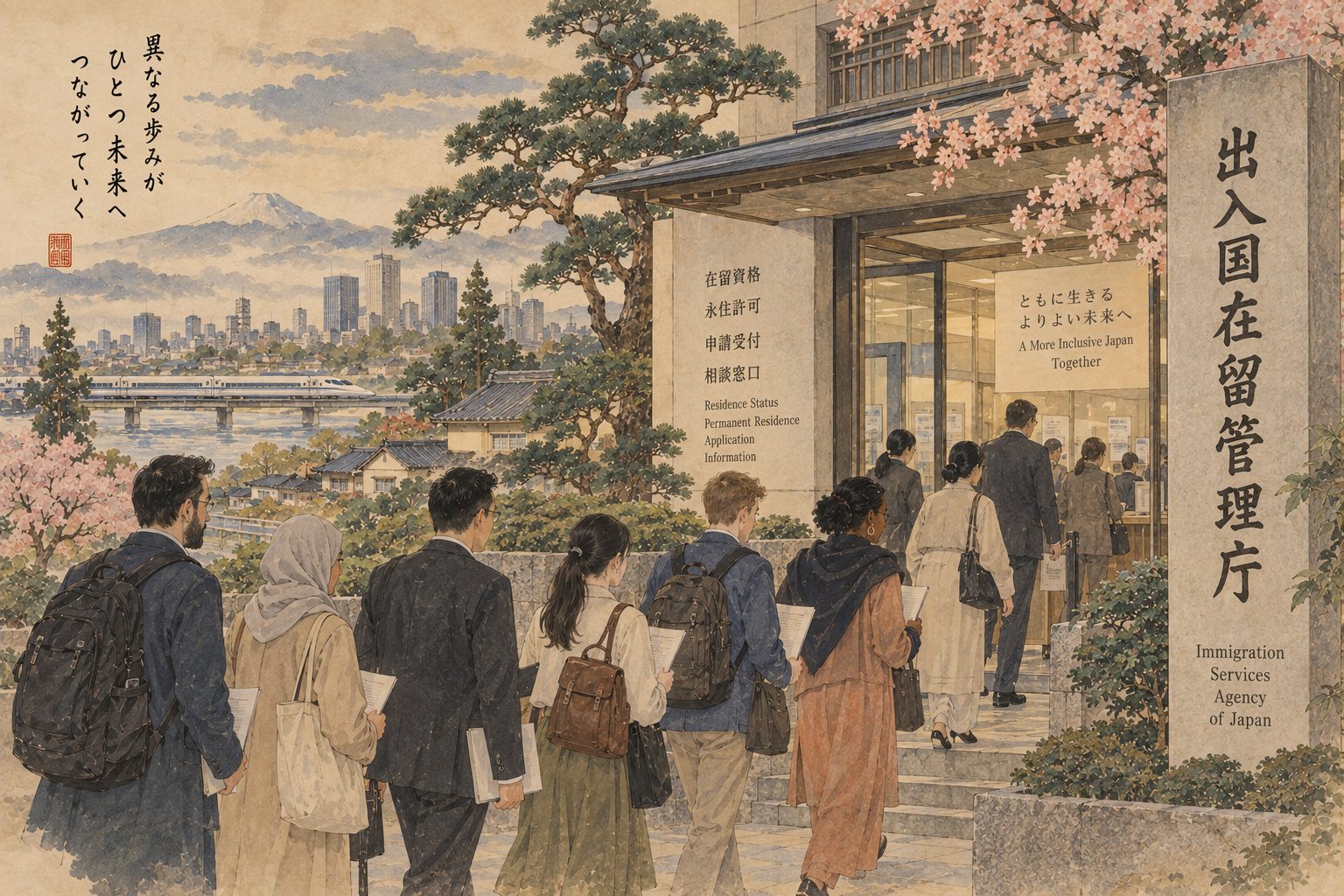
For a foreign resident who has built a career, paid taxes, raised a family and made Japan home, permanent residence can be the most important immigration status short of naturalization. It removes restrictions on the type of work a person may do and eliminates the need to renew a fixed period of stay, while allowing the holder to retain foreign nationality.
Japan has now rewritten the guidelines governing that status. On October 1, the Immigration Services Agency published a substantially expanded permanent-residence framework covering household income, pension participation and future benefits, Japanese-language ability, understanding of Japanese systems and rules, and school attendance for school-age children. The agency describes permanent residence as Japan’s most stable residence status, ordinarily intended for people whose long-term base of life will remain in the country.[1]
The first thing to understand: not every new rule started on October 1
The publication date and application date are different. According to the Immigration Services Agency, applications filed—or planned for filing—between April 1, 2026 and March 31, 2027 remain under the February 24, 2026 guideline except that the new October provisions on income apply. The complete October 1 framework applies to applications from April 1, 2027.[2]
That means it is inaccurate to say that every current permanent-residence applicant suddenly became subject to a B1 Japanese-language requirement on October 1, 2026.
The legal foundation remains three broad tests
Japan’s Immigration Control and Refugee Recognition Act continues to organize permanent residence around three core concepts: good conduct; sufficient assets or skills to maintain an independent livelihood; and a finding that granting permanent residence is in Japan’s interests. Certain spouses and children of Japanese nationals, permanent residents and special permanent residents receive statutory exceptions from some of those requirements.[1]
The new guidelines do not replace those three concepts with a single examination. What changes is the degree of detail used to explain how officials will evaluate them.
Income: benchmarked against Japanese households
Under the revised livelihood standard, applicants must be expected to support themselves now and in the future without becoming a public burden, under economic conditions at least comparable to Japanese residents. Assessment is generally conducted at the household level.[3]
The guideline says household annual income should, in principle, have continuously reached a level above the average income of Japanese households of the same household size. Income can generally be combined among people who share a residence and household finances, although separately independent adult household members may be assessed differently.[3]
There is no universal published number such as “earn ¥X million and approval is automatic.” Household size matters, and the guideline also emphasizes continuity and the prospect of future stability.
Pensions: from payment history to retirement sustainability
Japanese pension and health-insurance compliance already mattered in permanent-residence cases. The new guideline goes further by discussing the applicant’s full pension enrollment history, employment pattern, contribution period, historical earnings and current income in estimating future pension benefits.[1]
The shift is significant. Officials are not being told merely to ask whether premiums were paid. The framework asks whether an applicant’s lifetime economic trajectory is likely to support stable living after retirement without excessive public dependence.
Japanese: B1 becomes an explicit integration factor
For applications under the full framework from April 2027, the agency says it will consider whether the applicant has Japanese ability at approximately B1 or above under Japan’s national Japanese-language education framework. B1 broadly corresponds to an intermediate ability to understand the main points of familiar social and daily-life topics and communicate experiences, plans and views with some independence.[4]
The rule is not absolute. The guideline lists circumstances in which requiring B1 from the applicant may not be necessary or appropriate, including certain highly skilled foreign professionals and their family members, people who have completed at least six cumulative years of Japanese primary or secondary education, and certain children of permanent residents born in Japan.[4]
The permanent-residence guideline itself does not say that only one named test can prove B1. In other immigration contexts, the agency has treated examples such as JLPT N2, an N3 pass with a total score of at least 104, and BJT Business Japanese Proficiency Test scores of 400 or more as B1-equivalent evidence. Applicants will still need to follow the permanent-residence document instructions applicable when they file.[5]
Understanding Japan’s systems and rules
The revised guideline also makes understanding Japanese institutions and rules an explicit consideration. That does not by itself create an immediate written civics examination.
But the direction of policy is clear. In explaining the sharp increase in immigration fees, the agency says additional revenue will help fund measures including consideration of programs through which foreign residents can learn Japanese and understand Japanese systems and rules, as well as improved information and consultation services.[6]
Why children’s school attendance is now listed
The new framework separately lists school attendance of school-age children as a consideration. This moves permanent-residence assessment further beyond the applicant’s individual job and tax record and toward the stability of the family’s life in Japan.
The agency says permanent-residence decisions can take account of family-level stability and the applicant’s long-term integration into the community. Listing children’s schooling makes that social dimension more visible, though the guidelines continue to require case-by-case overall assessment rather than a single automatic rule.[1]
Taxes and social insurance were already important
One misconception is that Japan has suddenly decided to examine tax and pension compliance for the first time. The February 2026 guideline already required proper fulfillment of public obligations, including taxes, public pension premiums, public health-insurance premiums and immigration-law notification requirements.[7]
A 2024 amendment to immigration law, taking effect April 1, 2027, expressly adds compliance with immigration-law duties and payment of taxes and public charges to the statutory text governing permanent residence. The Immigration Services Agency says that change largely places into law matters that had already been considered under existing guidelines.[1]
The general 10-year residence rule remains
As a general principle, permanent-residence applicants still need 10 consecutive years in Japan, including at least five years under qualifying work or residence statuses. Exceptions remain for spouses of Japanese or permanent residents and for highly skilled professionals, among other categories.[7]
Ten years has never meant automatic entitlement. Permanent residence is legally granted at the discretion of the minister of justice after the applicant’s overall circumstances are assessed. The October guideline is intended to make that discretion more predictable by revealing more of the factors behind it.
Permanent residence is not citizenship
A permanent resident remains a foreign national. Unlike ordinary work-status holders, permanent residents face no restriction on their permitted activities or fixed period of stay and normally do not undergo periodic status-renewal reviews. They remain subject to immigration-law residence management, however. Naturalization is different: it grants Japanese nationality and ends the person’s status as a foreign resident under immigration law.[8]
The 2024 immigration-law amendment set the stage
The broader permanent-residence overhaul grew out of legislation passed in 2024. That amendment created additional grounds, effective April 2027, under which permanent-resident status can potentially be revoked or changed where a resident intentionally fails to pay taxes or social-insurance premiums or commits certain other violations.[9]
Both houses of the Diet adopted supplementary resolutions calling for especially careful operation so that the interests of people already deeply settled in Japan are not unjustly harmed, and instructing authorities to consider factors such as the degree of settlement and seriousness of violations. The Immigration Services Agency consequently issued a separate revocation guideline on October 1, 2026, scheduled to begin operation on April 1, 2027.[9]
The entry rules and revocation rules are legally distinct, but together they amount to a substantial redesign of Japan’s permanent-residence system from April 2027.
The approval fee also jumped from ¥10,000 to ¥200,000
A separate change took effect immediately on October 1. A person who applies for permanent residence from that date and is approved must pay ¥200,000. Applications accepted by September 30 remain subject to the previous ¥10,000 fee even if approval comes later. Applicants meeting designated hardship or other special criteria may qualify for reduction of the permanent-residence fee to ¥20,000.[10]
The agency says higher immigration fees will help finance not only processing costs but wider immigration-management measures, digitalization, refugee protection and support, irregular-stay enforcement and programs aimed at social integration and understanding of Japanese systems.[6]
Two policy goals that pull in different directions
The agency’s own guideline presents permanent residence in two ways at once. It is a highly stable legal status that requires particularly careful examination. It is also an incentive that can help Japan attract foreign professionals who contribute to the country and compete internationally for talent.[1]
That tension reflects Japan’s demographic position. The country increasingly depends on foreign workers and internationally mobile professionals as its population ages and labor shortages deepen. At the same time, the government is placing greater emphasis on long-term compliance, language, social insurance and integration for people who want the most secure immigration status available without becoming Japanese citizens.
What this means for a future applicant
The practical message is that simply counting years in Japan will become an even less useful way to judge readiness for permanent residence. Household income must be stable. Pension history will matter as a long-term financial record. Tax and insurance payments need to be timely. From April 2027, Japanese ability and evidence of integration become more visible components of the overall case.
But the guideline is not a mechanical points table. Exceptions remain, statutory family provisions remain and the agency repeatedly says applications are judged on their individual circumstances as a whole.
Permanent residence has never been a status automatically awarded after ten years. The October revision makes the bargain more explicit: Japan is offering an unrestricted, indefinite residence status to people expected to place their long-term lives in the country, and it wants more evidence—economic, administrative, linguistic and familial—that the relationship is sustainable.
Sources
- Immigration Services Agency, Permanent Residence Permission Guidelines, revised Oct. 1, 2026
- Immigration Services Agency, Permanent Residence Permission — transition dates
- Revised guideline, independent livelihood and household-income provisions
- Revised guideline, Japanese-language ability provisions
- Immigration Services Agency examples of evidence treated as B1-equivalent in residence procedures
- Immigration Services Agency, Oct. 1, 2026 fee-revision Q&A
- Permanent Residence Permission Guidelines, revised Feb. 24, 2026
- Immigration Services Agency, Permanent Residence System Q&A
- Immigration Services Agency, Guidelines on Revocation of Permanent Resident Status
- Immigration Services Agency, permanent-residence application fees