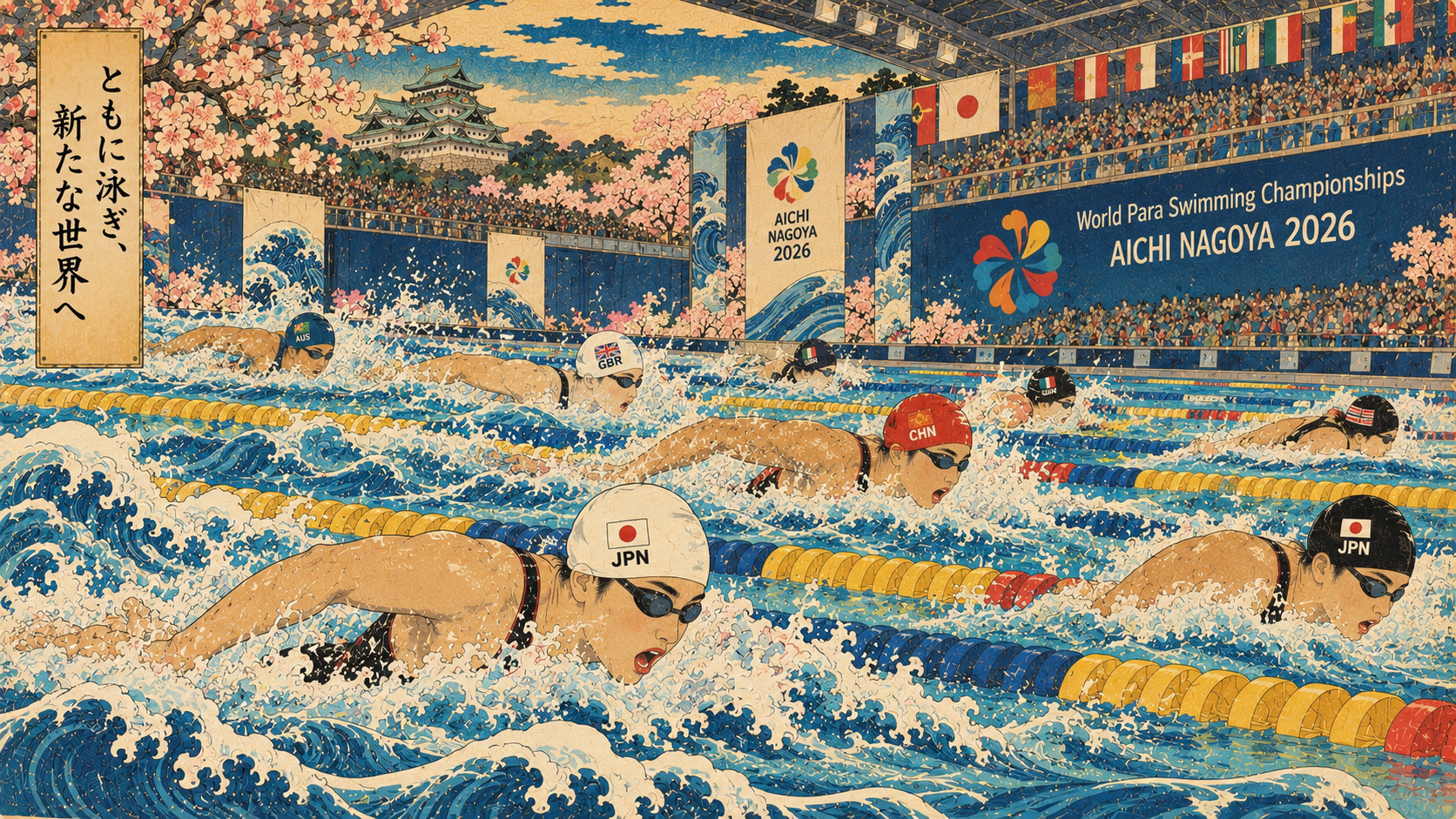
The races, not merely the medals
At Nagoya’s Rainbow Pool, Japanese para swimmers have offered a vivid answer to a familiar sporting question: what does a successful national program look like when it must support athletes with very different bodies, techniques and competition classifications? A federation medal board lists golds in freestyle, breaststroke, backstroke and individual medley, won by established Paralympians and younger competitors. They cannot be reduced to a single performance model.
A medal board with seven entries
The Japan Para-Swimming Federation’s team page lists Takayuki Suzuki as a gold medallist in the men's 50-metre freestyle S4 and 50-metre breaststroke SB3; Ayano Tsujiuchi in the women's 100-metre freestyle S13 (also marked S12 in the federation entry); Genki Saito in the men's 100-metre breaststroke SB13 (also marked SB12); Eisho Minai in the men's 200-metre individual medley SM10; and Aira Kinoshita in the women's 200-metre freestyle S14 and 100-metre backstroke S14. That is seven event wins across five athletes in the accessible federation listing. It is not a certified final Japanese swimming medal total for a competition scheduled through October 23, and some class labels in the federation's summary require checking against each official event result.
Aira Kinoshita makes the stopwatch speak
The Japan Federation for Swimmers with Intellectual Disabilities provides unusually clear individual documentation. It says Kinoshita won the S14 200-metre freestyle on October 19 in 2 minutes 9.80 seconds, a Games record. On the second competition day she won the 100-metre backstroke in 1:09.21; teammate Riku Sato took silver in 1:10.24. Those are separately reported results, not estimates reconstructed from a medal graphic. The Paris 2024 delegation roster uses the written name 木下愛萊; the current federation's public results use 木下あいら. Both refer to the athlete Aira Kinoshita, and the article follows the spelling used for the 2026 event.
A veteran still delivering
Suzuki represents an unusually long arc in Japanese para swimming. A competitor since the Athens 2004 Paralympics, he won an individual breaststroke title at Beijing 2008. At the Tokyo 2020 Games, held in 2021, he claimed the S4 100-metre freestyle gold and medals in all five events he entered. His continuing appearance atop the 2026 Asian Para Games medal listing is notable not because longevity guarantees victory, but because racing at this level requires repeated adaptation to changes in conditioning, opposition and classification rules.
The meaning of S, SB and SM
Para swimming's letters denote stroke or event families: S for freestyle, backstroke and butterfly; SB for breaststroke; SM for individual medley. The accompanying numbers describe sport classes established through classification procedures. They are not numerical league tables of athletic quality. Different impairment groups and functional effects are assessed under the applicable rules. Comparisons must therefore be made within the relevant class and event rather than by placing raw times from all classes on one unqualified ranking.
Not one kind of swimming
A 50-metre freestyle sprint is a different problem from a 200-metre individual medley. The first rewards explosive starts and efficiency over a short distance; the second demands technique through multiple strokes and transitions. The breaststroke categories use separate SB designations because the functional requirements differ from other strokes. A strong national squad must match technical coaching and preparation to each athlete and event. A medal table displays results; it does not by itself reveal the training methods that produced them.
A longer history than Tokyo
Japanese para swimming did not begin with the Tokyo Games. Suzuki's Athens and Beijing appearances offer one line of continuity, while institutional records show the breadth of the national Paralympic swimming team at Tokyo 2020. The home Games nevertheless mattered as an international showcase: the Japanese Paralympic Committee says Suzuki took a medal in each of his five events, and swimmer Miyuki Yamada helped open Japan's medal campaign. At Paris 2024, the Japanese Paralympic Committee and the two swimming federations selected a team through a defined national trial and recommendation process. This historical foundation makes Nagoya more than a sudden accumulation of medals.
Two federations, one competitive stage
Japan's representative information is split across the Japan Para-Swimming Federation and the Japan Federation for Swimmers with Intellectual Disabilities. Their respective pages document athletes, events and results. That division matters to readers interpreting lists: a federation's page can include or link athletes managed through another federation, and a hurried count risks missing swimmers or counting the same medal twice. The governing bodies' named entries are a sound starting point, but a final complete tally should be reconciled against the official event-by-event results.
The support system behind a performance
The intellectual-disability federation published a support roster that includes a head coach, impairment-specific coaching teams, trainers, video staff, a dietitian, a psychologist and administrative support. This demonstrates the range of roles planned around the delegation, not proof that any particular service caused an individual victory. Athletes also train with clubs, coaches and supporting employers outside national-team camp. Evaluating Japan's system requires following those relationships, the funding available to developing swimmers and routes from junior competition to senior international selection.
Home advantage, without an automatic explanation
Nagoya gives Japanese swimmers familiar logistics and a domestic audience, but claims of a measurable home advantage would require comparing athlete performances with prior seasons and relevant competitors. A gold medal alone cannot establish whether travel, crowd support or a new training intervention made the difference. It is more responsible to ask how home staging helps make para sport visible, whether young people can find accessible local pools and whether attention translates into long-term participation.
Records have to be read precisely
A competition record, an Asian record, a national record and a world record are different claims. Kinoshita's 200-metre freestyle performance is described by her federation as a Games record. We do not upgrade that into a world record. Similarly, the federation's ongoing medal board establishes listed medal events, but not an end-of-Games total before the swimming schedule closes. In an event crowded with multiple classifications, results need their full event names and designations to be meaningful.
What Nagoya can leave behind
The lasting measure of these Games will not be confined to the podium. The questions for Japan are how many swimmers can access regular, suitably supported training; whether coaches and facilities are distributed beyond major cities; and whether athletes can build sustainable careers. Those questions remain open. What is already documented is a set of distinctly earned wins, from Suzuki's short-course events to Kinoshita's double and the victories of Tsujiuchi, Saito and Minai. The performances deserve more than an unsourced cumulative number.
The Japanese Paralympic Committee documents Suzuki’s five medals at Tokyo 2020 and Kinoshita’s selection for Paris 2024. Those facts provide historical context, not a causal explanation for a particular race in Nagoya. No interview, private training log or independently audited federation-wide medal count was available for this report.
Sources and reporting basis
Results compiled from federation pages and dated announcements available at the research cutoff of October 21, 2026 (JST). The competition continues through October 23; results are not a final tally.