Osaka Team Accelerates Protons to 132 MeV on a Moving Electric Wave
A 16-layer graphene target, a 1.5-picosecond LFEX pulse and AI analysis of millions of detector images allowed researchers to accelerate a small population of protons to 132 MeV—about half the speed of light.
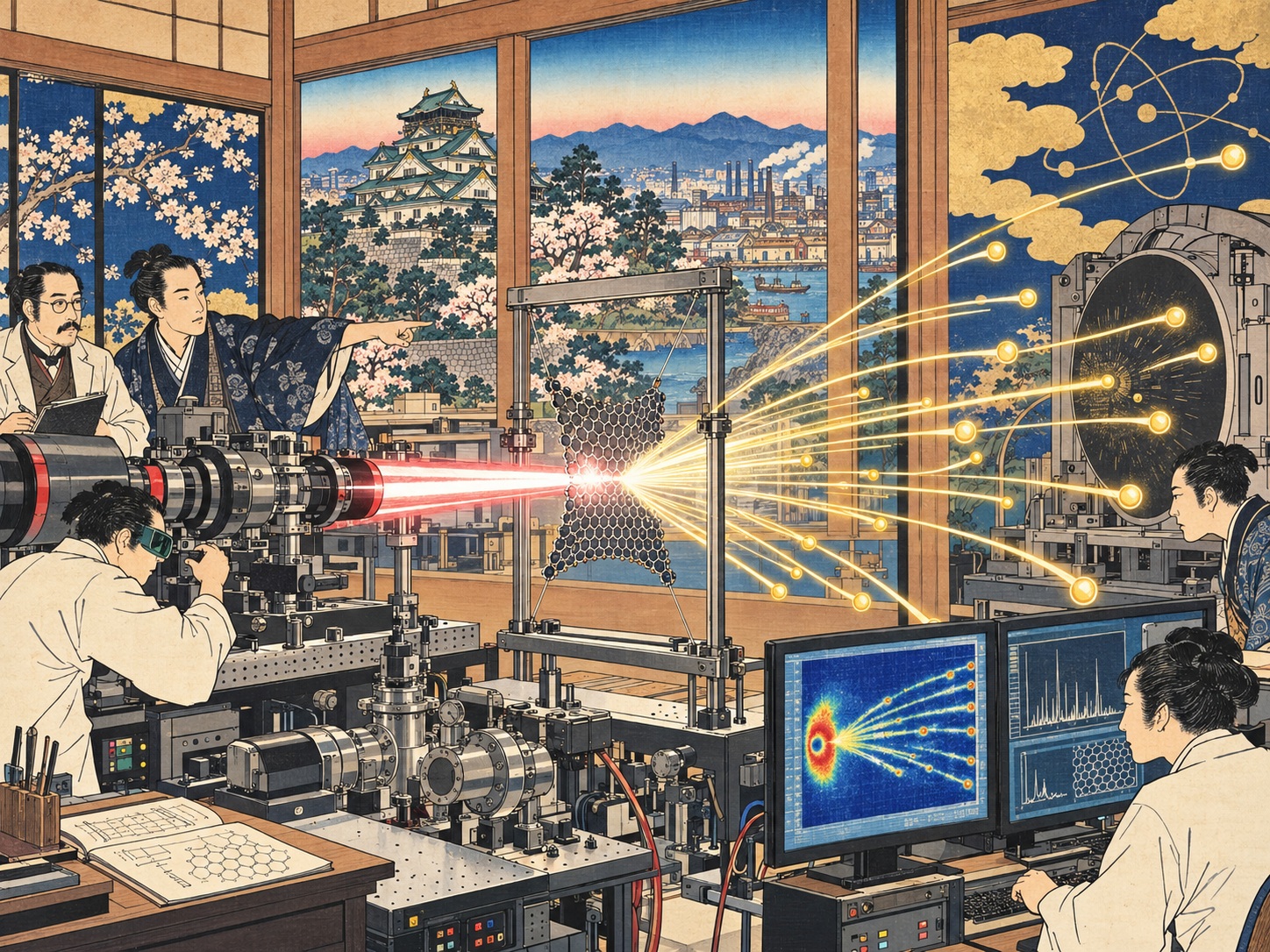
OSAKA. A team led by researchers at the University of Osaka has demonstrated a counterintuitive route to higher-energy laser-driven protons: instead of relying only on an ever more violent instantaneous push, keep the particles trapped in an electric field that moves with them and accelerate them for longer.
The result was a proton energy of 132 megaelectronvolts, or MeV, corresponding to roughly half the speed of light. The international collaboration was led by Takumi Minami, a specially appointed assistant professor at the University of Osaka’s Graduate School of Information Science and Technology, and Yasuhiro Kuramitsu, a professor in the Graduate School of Engineering, together with Wei-Yen Woon of National Central University in Taiwan, Yuji Fukuda of Japan’s National Institutes for Quantum Science and Technology, and a large group of collaborators in Japan and overseas.
The work was published on October 2 in Progress of Theoretical and Experimental Physics under the title “Proton Surfing Acceleration via Propagating Electrostatic Waves Induced by Intense Laser Irradiation on Large-Area Suspended Graphene.”
A different way to think about acceleration
Particle accelerators conventionally use carefully controlled electric fields to raise the energy of charged particles over repeated stages. The problem is that ordinary accelerator structures cannot sustain arbitrarily large electric fields: beyond a point, materials suffer electrical breakdown and discharge. Reaching higher energies therefore tends to require longer machines.
Laser-plasma acceleration offers another possibility. When an intense laser strikes matter, it can turn the target into plasma—a mixture of free electrons and ions—and create electric fields far stronger than those tolerated by solid accelerator structures. For more than two decades, researchers have explored whether those fields can become the basis of compact sources of protons and heavier ions for physics, materials research and, eventually, medicine.
Much of the global effort has focused on compressing laser energy into extremely short pulses of only tens of femtoseconds. The shorter the pulse, the higher the peak intensity can become. The Osaka experiment explored the other side of the equation. Its LFEX pulse lasted about 1.5 picoseconds, long by ultra-intense-laser standards, with an average intensity around 1×10¹⁹ watts per square centimeter.
The central question was simple: if the acceleration field can remain coupled to the proton for longer, can time and distance compensate for a lower peak intensity?
Graphene solved the target problem
That idea creates a formidable materials problem. Efficient laser-ion acceleration often favors targets only a few nanometers thick. But ultrathin targets are extraordinarily vulnerable to the weak “prepulse” that precedes a laser’s main pulse. A prepulse that would be inconsequential for a thicker foil can heat, deform or destroy a nanometer-scale target before the main laser pulse arrives.
The Osaka group has spent years developing large-area suspended graphene, or LSG, specifically for this regime. Graphene is a sheet of carbon only an atom thick in its ideal form, combining extreme thinness with high mechanical strength and excellent electrical and thermal conductivity. In an LSG target, graphene is suspended over a microscopic opening so that both sides of the film face vacuum.
The researchers tested targets of different layer counts. Under the conditions used here, a 16-layer target—about 16 nanometers thick in effective measured thickness—produced the highest proton energy. That result matters because it shows that “thinner is better” is not a complete rule. A target that is too thick cannot be heated through effectively by the laser. A target that is too thin contains too little carbon-ion plasma to sustain the accelerating structure. The optimum lies in the interaction between target thickness and laser pulse.
The electric field moved, and the protons moved with it
Particle-in-cell simulations provided the mechanism behind the measurements. As the laser interacts with the graphene, the target becomes plasma. Electrons and the heavier carbon ions respond differently. The resulting charge separation creates an intense electric field ahead of the carbon-ion plasma.
Because the 1.5-picosecond laser continues heating the expanding plasma, that field does not simply appear and vanish. It propagates forward. Protons can become trapped in it and travel with it—hence the researchers’ description of “surfing acceleration.”
In the simulation, energetic protons stayed coupled to the propagating field for more than three picoseconds and over roughly 0.3 millimeters before reaching 132 MeV. Those are tiny distances and times in ordinary life, but long compared with many conventional laser-ion acceleration processes, which can occur over only tens to hundreds of femtoseconds and distances on the order of hundredths of a millimeter.
The significance is therefore not merely that the team created a powerful field. It created a field whose motion extended the useful acceleration phase.
| Element | Result | Why it matters |
|---|---|---|
| Laser | LFEX, about 1.5 ps | Relatively long pulse for high-intensity ion acceleration |
| Average intensity | ~1×10¹⁹ W/cm2 | Not a simple peak-intensity record attempt |
| Target | 16-layer LSG, ~16 nm | Balances thinness with durability and plasma density |
| Maximum proton energy | 132 MeV | About 50% of the speed of light |
| Acceleration duration | >3 ps in simulation | Long interaction with the moving field |
| Acceleration distance | ~0.3 mm in simulation | Extended “surfing” phase |
AI was essential to seeing the rarest protons
Producing a high-energy particle is only half the experiment. The other half is proving that it was there.
The team relied heavily on CR-39 solid-state track detectors. When energetic ions pass through CR-39, they leave microscopic damage trails that become visible after chemical etching. The detector is highly sensitive—down to individual particles—but the price of that sensitivity is an enormous image-analysis burden.
To find the rare high-energy events, the researchers used a convolutional neural network to classify particle tracks across millions of microscope images. In one high-energy measurement, the neural network achieved 99.2% precision, according to the university’s public account of the work. That analysis allowed the team to distinguish proton tracks extending to 132 MeV from background particles and noise.
This is a crucial qualification to the headline number. The paper states that the number of protons in the highest-energy tail was several orders of magnitude lower than in some other major laser-proton experiments. The experiment therefore did not produce a high-current 132-MeV beam ready for practical use. Its achievement was demonstrating the acceleration mechanism and reliably identifying a very small population of protons at that energy.
A research line that began years earlier
The 2026 result builds on a longer Osaka program around suspended graphene targets. In 2022, Kuramitsu and collaborators reported high-energy ion acceleration using LSG only a few nanometers thick. The attraction was clear: an atomically thin material offered the low areal density favored by laser acceleration while retaining enough strength to survive conditions that destroy many other ultrathin targets.
Subsequent work investigated how layer count, pulse duration and laser intensity should be matched. In 2025, a related collaboration involving QST, Osaka and other institutions used graphene-based targets coated with gold and the J-KAREN-P laser to accelerate carbon ions to 1 gigaelectronvolt. That was a different ion species, laser system and acceleration regime, but it reinforced a broader strategy: engineer the target as carefully as the laser.
The University of Osaka’s Institute of Laser Engineering has also listed a 2026 joint-use project titled “Generation of GeV protons using intense laser and graphene.” The title is a useful indication of the longer-term direction. At 132 MeV, the present experiment is still far below 1 GeV, but it supplies an experimentally tested mechanism that might be combined with future improvements.
Why compact accelerators matter
The attraction of laser-driven ion sources is not that a tabletop device will suddenly replace every synchrotron. It is that plasma can sustain acceleration fields many orders of magnitude stronger than conventional structures, creating the possibility of shortening at least part of an accelerator chain.
Japan already has a concrete engineering program in this direction. QST has been developing a laser-driven ion injector as part of its “Quantum Scalpel” concept for a smaller, more advanced heavy-ion cancer-treatment system. In 2023, QST and industrial partners announced a prototype laser-driven ion injector intended for integration testing.
The Osaka result is relevant to that long-term ambition, but it should not be mistaken for a clinical milestone by itself. A medical accelerator needs much more than a record particle energy. It requires high particle numbers, tight beam quality, repeatability, high repetition rates, rapid energy control, precise dose delivery, robust diagnostics and stringent safety systems.
The paper itself underscores one of those gaps: the 132-MeV component is sparse. Raising usable beam current while retaining energy and stability is a separate challenge.
Another application: recreating cosmic acceleration in the laboratory
High-energy ion beams are also tools for basic science. Astrophysicists still do not fully understand how cosmic rays are accelerated to extreme energies in shocks, magnetic turbulence and other violent plasma environments. Those processes occur on scales and at distances that cannot be manipulated directly.
High-power lasers allow researchers to create miniature plasma systems in the laboratory. If ions can be pushed into increasingly relativistic regimes, researchers can test models of shock acceleration and plasma dynamics under controlled conditions. Kuramitsu’s group has long worked in this field of laboratory astrophysics, making the 132-MeV result part of a scientific program broader than accelerator engineering alone.
Toward an experiment that optimizes itself
The AI component points to a second technological trajectory. The team is developing online detectors for the highest-energy ions. Combine those with automated image analysis and a laser system capable of repeated shots, and a future experiment could form a feedback loop.
A shot is fired. The detector measures the result. Software estimates the particle-energy distribution. An optimization algorithm chooses the next pulse or target condition. The experiment fires again. Instead of researchers manually exploring a huge parameter space, the system searches it autonomously.
That vision remains ahead of the current experiment, but it explains why machine learning matters beyond analyzing a backlog of microscope photographs. It could become part of the control architecture of high-repetition laser laboratories.
What remains unresolved
There are basic physics questions as well as engineering ones. The particle-in-cell simulations used to explain the surfing mechanism describe plasma dynamics, but they do not fully model the solid-state and quantum processes through which the laser prepulse interacts with graphene before it becomes plasma. The paper says the team is introducing time-dependent density functional theory to address that part of the problem.
There is also a scale problem. More energy is useful only if the number, quality and reproducibility of accelerated particles improve with it. Repetition rate, target delivery, laser efficiency and real-time diagnostics will all determine whether the technique can leave the laboratory.
Still, the experiment changes the design space. The path to higher ion energy need not be only an arms race in instantaneous laser intensity. If a particle can stay trapped in a strong field that moves with it, time becomes another accelerator component. In Osaka, a sheet of graphene only nanometers thick made that moving field possible, and AI made the rarest protons visible.
Sources
- National Institutes for Quantum Science and Technology, October 2, 2026 press release
- University of Osaka Graduate School of Information Science and Technology, October 2, 2026
- Takumi Minami et al., Progress of Theoretical and Experimental Physics 2026, 103J01
- University of Osaka, 2022 suspended-graphene ion-acceleration research
- University of Osaka, 2025 carbon-ion acceleration to 1 GeV
- Institute of Laser Engineering 2026 joint-use research projects
- QST, prototype laser-driven ion injector for the Quantum Scalpel program