Two turns, two deaths
At two intersections in southern Osaka on October 10, centuries-old festival traditions collided with the unforgiving physics of heavy moving structures. Wooden danjiri floats overturned in separate incidents in Izumisano and Izumiotsu. Two male participants died; 16 others were injured. The events have reopened a difficult question for communities whose festivals embody identity, craftsmanship and collective effort: how can the ceremonies survive without treating serious injury as an unavoidable price of tradition?
The first incident: Izumisano, 10:55 a.m.
According to reporting attributed to Osaka Prefectural Police, a float overturned while turning right at an intersection in the Nagataki district of Izumisano at about 10:55 a.m. A 51-year-old local company executive died and seven male participants, ranging in age from their teens to their fifties, were injured. Kyodo identified the deceased as Takahiro Oku. Police are still investigating exactly what happened before the vehicle tipped; the existence of a sharp turn does not alone establish individual fault or the full mechanical sequence.
The second: Izumiotsu, 1:20 p.m.
At approximately 1:20 p.m., another float overturned during a right turn at an intersection in the Miyamachi district of Izumiotsu. A 48-year-old office worker from neighboring Izumi died, and nine other male participants were injured. TV Asahi identified the victim as Shingo Kondo. Taken together, the two incidents injured 16 people in addition to the fatalities. Police said spectators were not injured. Reports describe both men who died as serving a counterweight role on the side of their floats to help resist overturning during a turn.
The extraordinary challenge of yarimawashi
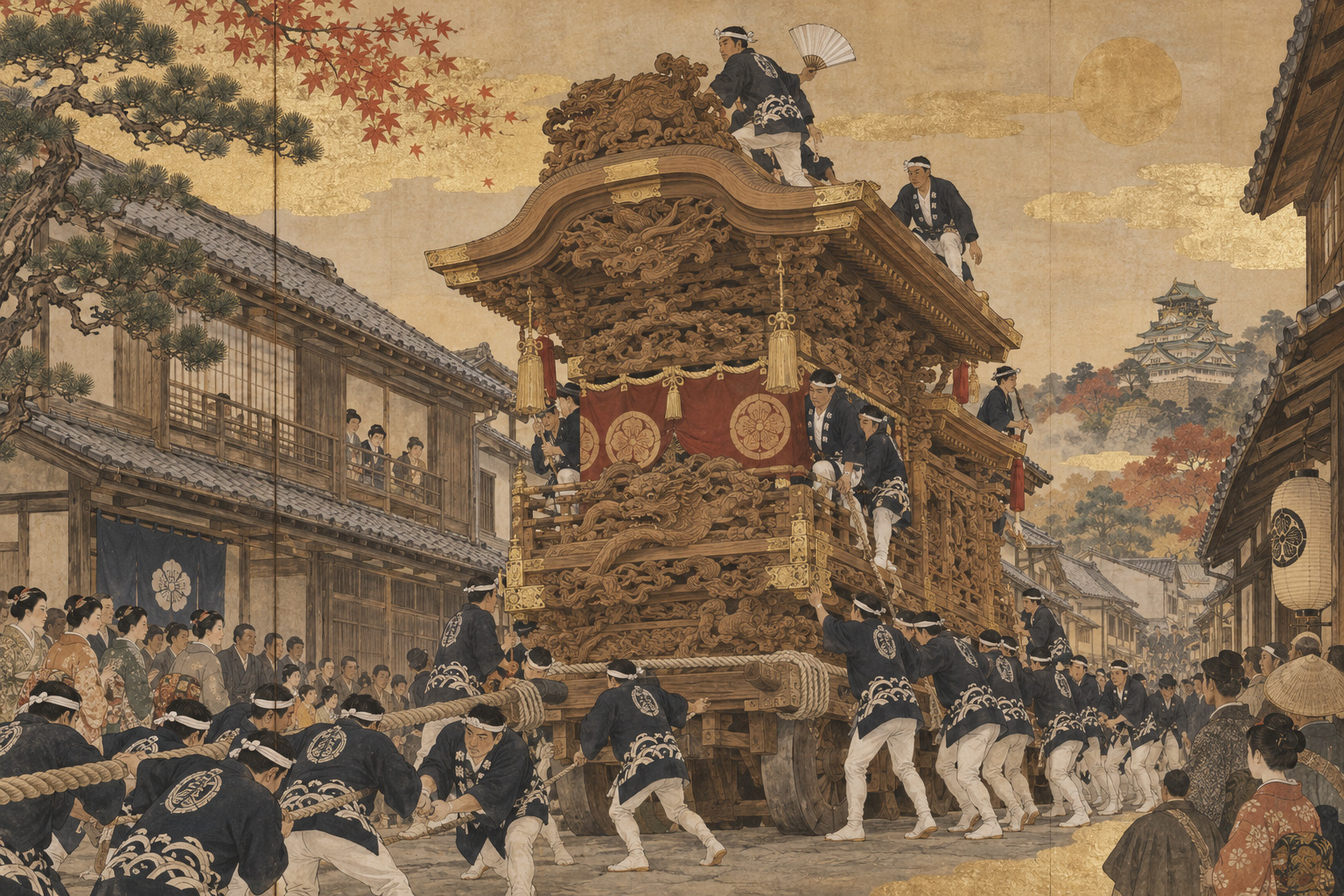
The signature cornering maneuver known as yarimawashi calls for a heavy float to change direction swiftly at a street corner. Kishiwada City’s official explanation describes the front steering levers, which help check wheel motion, and a rear steering assembly whose timing must be coordinated precisely. The physics are straightforward but unforgiving: momentum carries the vehicle forward while the team must redirect its mass. Speed, geometry, the float’s center of gravity, road conditions and the synchronized actions of participants all matter. No verified investigation has yet isolated which of these factors caused either October 10 accident.
The float is a human coordination system
A danjiri is not pulled by a single undifferentiated crowd. Kishiwada’s guide identifies rope leaders and pullers, specialized teams at the front and rear steering levers, performers atop the roof who signal direction, and musicians who help shape the rhythm of the procession. As many as 20 to 30 people may work the rear steering apparatus in the Kishiwada tradition. This elaborate choreography helps explain why safety is not just a matter of individual judgment. It is a system of communication, timing, training and mutual reliance.
Four tonnes moving through a narrow street
Jiji reported the floats involved as approximately four meters high and four tonnes in weight. Danjiri designs differ by district, and those dimensions should not be assumed to apply to every festival vehicle. Many are richly carved wooden structures held in great esteem by neighborhoods that maintain them for generations. Their beauty does not cancel their mass. Responsible preservation must make room for the fact that a celebrated artifact becomes a moving hazard when a maneuver goes wrong.
A heritage older than modern Osaka
The best-documented local history traces the Kishiwada Danjiri Festival to a harvest prayer associated with lord Okabe Nagayasu in 1703, during the Edo period. Over time, the ceremony evolved into the elaborate processions that now draw visitors from beyond Japan. The fatal accidents, however, did not occur in Kishiwada; they took place in Izumisano and Izumiotsu. Kishiwada’s municipal historical materials illuminate the broader tradition but cannot stand in for the specific rules or decisions governing the two affected festivals.
Why the festivals matter to neighborhoods
For many participants, the festival begins long before the float moves. Kishiwada City describes neighborhood associations, youth organizations, experienced stewards and children’s groups that rehearse roles and contribute to civic life across the year. Learning to pull a rope is also a way to learn the names, obligations and history of one’s community. The resulting attachment means that a simplistic choice between abolishing a dangerous practice and leaving everything unchanged is unlikely to lead to durable solutions.
Safer turns need evidence, not slogans
A serious review would measure street geometry, turning radius, surface conditions, float construction, speed, weight distribution, signaling and the position of participants during the maneuver. Options worth evaluating include turn-specific speed limits, revised access to vulnerable positions, coordinated drills, clearly assigned stop authority and protected emergency access. These are possible safeguards for analysis, not proven remedies for the two accidents. Each requires testing against the mechanics and organization of the particular festival.
The strength and limits of self-governance
Kishiwada’s official account describes senior festival stewards, designated float operations leaders and annual meetings that set routes and rules. That structure reflects hard-earned local knowledge. After a fatal event, however, effectiveness must be demonstrated through records and review: maintenance and inspection logs, training completion, near-miss reporting, documented route assessments and external technical expertise where warranted. The task is neither to strip communities of all agency nor to exempt festival operations from careful scrutiny.
What investigators have not established
The public reporting available for this article does not identify a definitive mechanical cause, a specific violation of operating rules, or who, if anyone, bears legal responsibility. The precise speed, condition of each float, signal sequence and performance of its crew at the moment of each incident remain matters for investigation. This report also does not present a direct interview with the organizers of the affected festivals. The facts justify questions about safety, not accusations unsupported by the inquiry.
The most faithful way to preserve tradition
A procession is a living relationship between people, objects and place, not a museum display. Its survival depends on the willingness to learn when an inherited practice produces intolerable harm. October 10 left two families bereaved and 16 more participants injured. Mourning those losses, establishing the facts and acting on what investigators learn would not betray the tradition. It would honor the people whose work makes the tradition possible.
Sources and further reading
- 時事通信:大阪・泉佐野市と泉大津市のだんじり横転事故(2026年10月10日)
- 共同通信:2人死亡、16人負傷(2026年10月10日)
- テレビ朝日:事故後の現場報道(2026年10月11日)
- 岸和田市:だんじり祭の歴史
- 岸和田市:曳行時の役割
- 岸和田市:だんじり用語辞典
- 岸和田市:祭礼の組織・運営
- 岸和田市:2026年の祭礼日程
- Jiji / Japan Times:Two die and 16 hurt
Sources reviewed October 12, 2026 (JST). Police findings and direct responses from affected organizers remain pending. Kishiwada municipal sources describe the regional tradition, not the operating rules of the two affected events.