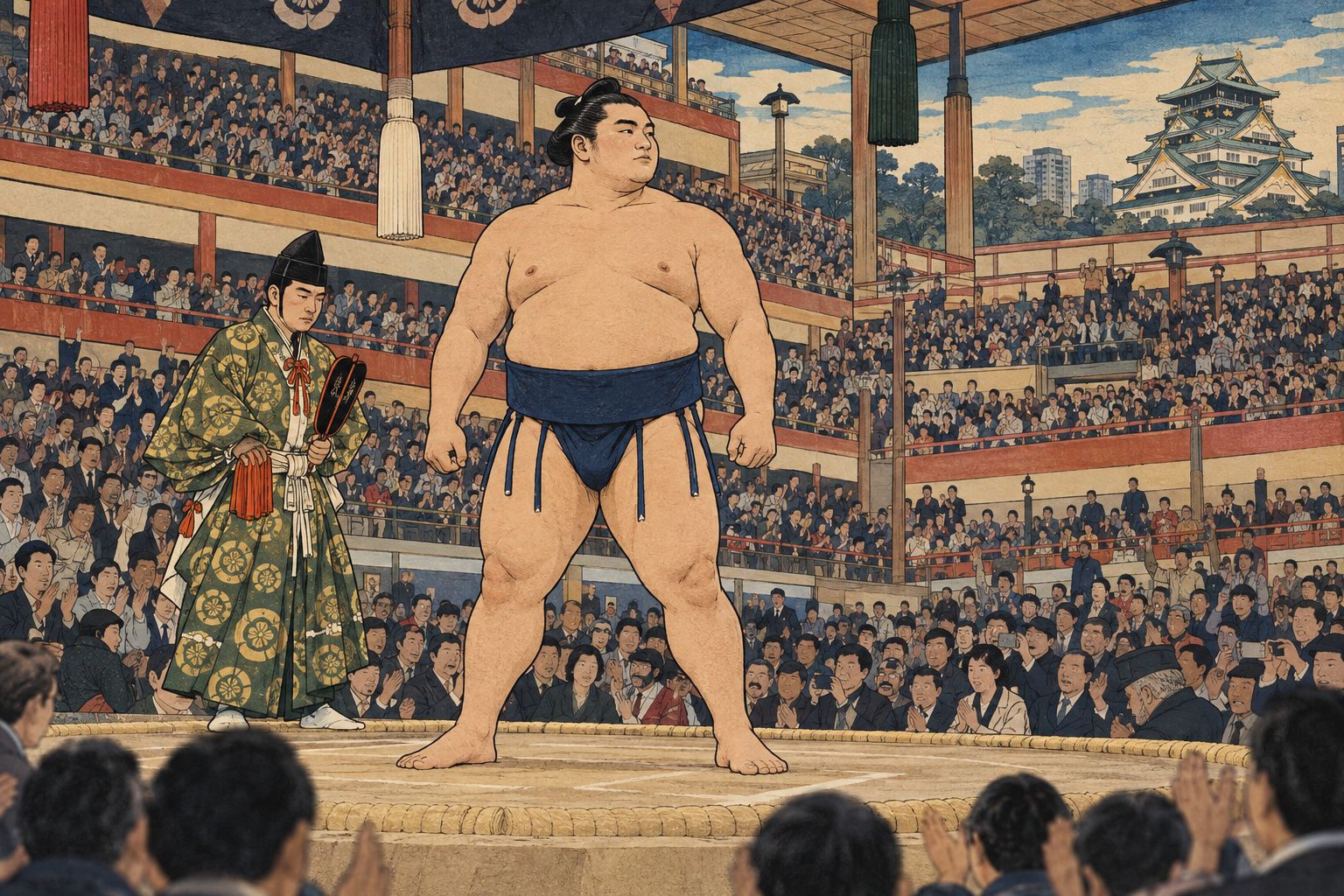
Onosato’s sixth championship came down to one scheduled bout, with none of the cushion he had built earlier in the tournament left to protect him. On September 27 at Tokyo’s Ryogoku Kokugikan, the yokozuna defeated ozeki Aonishiki by tsukidashi, a thrust-out, to finish the Autumn Grand Sumo Tournament at 12–3.[1],[4]
It was his first title since September 2025. The significance was more than another addition to an unusually fast-moving career: after a spring withdrawal, an entire tournament missed and a modest winning return in July, he was a champion again.[2]
The title was decided in regulation
Both wrestlers entered the final day at 11–3. Onosato’s win moved him to 12 victories and left Aonishiki at 11–4. This was a winner-takes-title meeting in the regular schedule, not an extra championship playoff after the scheduled bouts had finished.[2],[3],[4]
The official winning technique matters. The Japan Sumo Association defines tsukidashi as driving an opponent outside the ring with forceful open-handed thrusts to the chest or shoulders. It emphasizes forward footwork as well as the hands. It is a distinct technique from oshidashi, generally rendered as a push-out.[5]
That result gives the final exchange its essential character: Onosato finished the championship race by taking his opponent out with an attacking technique. It does not establish what he had planned beforehand, and this report does not attribute an unverified tactical explanation to him.
Two routes to the same final-day record
Onosato’s official September scorecard shows defeats on day four against Takayasu, day 13 against Kirishima and day 14 against Kotozakura. From 11–1 after 12 days, he slipped to 11–3. The title could no longer be secured by relying on the advantage accumulated earlier.[2]
Aonishiki reached the same position from the opposite direction. He lost on days four, five and six, then won eight straight bouts from day seven through day 14. Counting the official results, he recovered from 3–3 to 11–3. The final-day showdown existed because he kept winning while Onosato stalled.[3]
This is what made the finish compelling. A late stumble by a leader is only half a title race; another wrestler has to turn the opportunity into pressure. Onosato answered that pressure in the one meeting that settled the championship. Aonishiki’s final defeat should not obscure the sustained run that made it necessary.
Six titles chart a rapid ascent
| Tournament | Rank | Record |
|---|---|---|
| May 2024 | Komusubi | 12–3 |
| September 2024 | Sekiwake | 13–2 |
| March 2025 | Ozeki | 12–3 |
| May 2025 | Ozeki | 14–1 |
| September 2025 | Yokozuna | 13–2 |
| September 2026 | Yokozuna | 12–3 |
The first arrived in May 2024, only his seventh professional tournament. His alma mater, Nippon Sport Science University, described it as the fastest first championship for a wrestler who had entered professional sumo through the makushita-tsukedashi route. That qualification matters: it is not a claim that no wrestler under any entry route had won sooner.[7]
The Japan Sumo Association approved his elevation to become the 75th yokozuna on May 28, 2025. His university reported that the promotion after 13 tournaments was the fastest since 1909. The decision followed consecutive championships that March and May.[6],[8]
Promotion approval and the first tournament at the new rank are different dates. He first competed as a yokozuna in July 2025, then won his first title at that rank in September. This latest championship is his second as a yokozuna. His title record also shows three consecutive wins in the September tournament, from 2024 through 2026.[2],[6]
The preparation behind the speed
Born Daiki Nakamura, Onosato comes from Tsubata in Ishikawa Prefecture. Now 26, he belongs to Nishonoseki stable, whose master is former yokozuna Kisenosato. The stable is based in Ami, Ibaraki. His professional debut was in May 2023.[6],[10]
His rapid progress did not begin with an inexperienced athlete discovering competition. A university profile records a collegiate championship in his first year and amateur national titles in his third and fourth years. Four years at university preceded the compressed sequence of promotions that made him widely known.[9]
In an interview conducted on August 28, 2025, and published by the university in April 2026, he described the shift from choosing training to meet his needs as a student toward close attention to basic sumo exercises after turning professional. Those remarks provide background to his development; they were not made after this September’s title and should not be presented as his explanation of the winning bout.[9]
The distinction helps keep a comeback story grounded. An earlier account of training can illuminate an athlete’s approach without proving which exercise, adjustment or private decision produced a later result. Onosato’s competitive record supplies the clearer evidence of what changed this year.
What the comeback does—and does not—prove
His March 2026 record was no wins, four losses and 11 absences. One of those losses was a forfeit, so the record does not mean he lost four completed bouts in the ring. He missed all 15 days in May, returned for a 9–6 finish in July and then won this championship.[2]
Those stages are different achievements: returning to competition, completing a tournament with a winning record, and sustaining a title challenge through the last day. September establishes that he has returned to championship-winning performance. It is not a medical assessment that every physical concern has disappeared.
The opponent makes the result more substantial. Aonishiki, 22, is a Ukraine-born member of Ajigawa stable and had won the preceding July tournament at 12–3. His September challenge was therefore the continuation of a recent championship-level performance, not a surprise appearance by a peripheral contender.[3]
For Onosato, the remaining question is consistency. The championship does not erase the two late defeats; it shows that he could stop that sequence when the title depended on doing so. Future tournaments will test whether he can repeat the winning form across successive campaigns.
A champion’s career reaches beyond the ring
Tsubata’s response to his rise offers a concrete example of his local significance. In 2025 the town announced a parade and public report-back event celebrating his yokozuna promotion. That is a record of an earlier milestone, not an announcement of a new celebration for this victory.[11]
The career now has a different shape from the story of a prospect moving rapidly through the ranks. There is no higher rank waiting above yokozuna. The work is to keep producing results at the level already reached, through changing form and interruptions to competition.
Onosato’s sixth title is therefore best understood as a return achieved under pressure. He entered the last bout level with an opponent who had won eight straight, after losing twice himself. He left with the decisive twelfth win. The speed of his ascent remains remarkable; this championship adds evidence of what he can do after that ascent has ceased to be straightforward.
