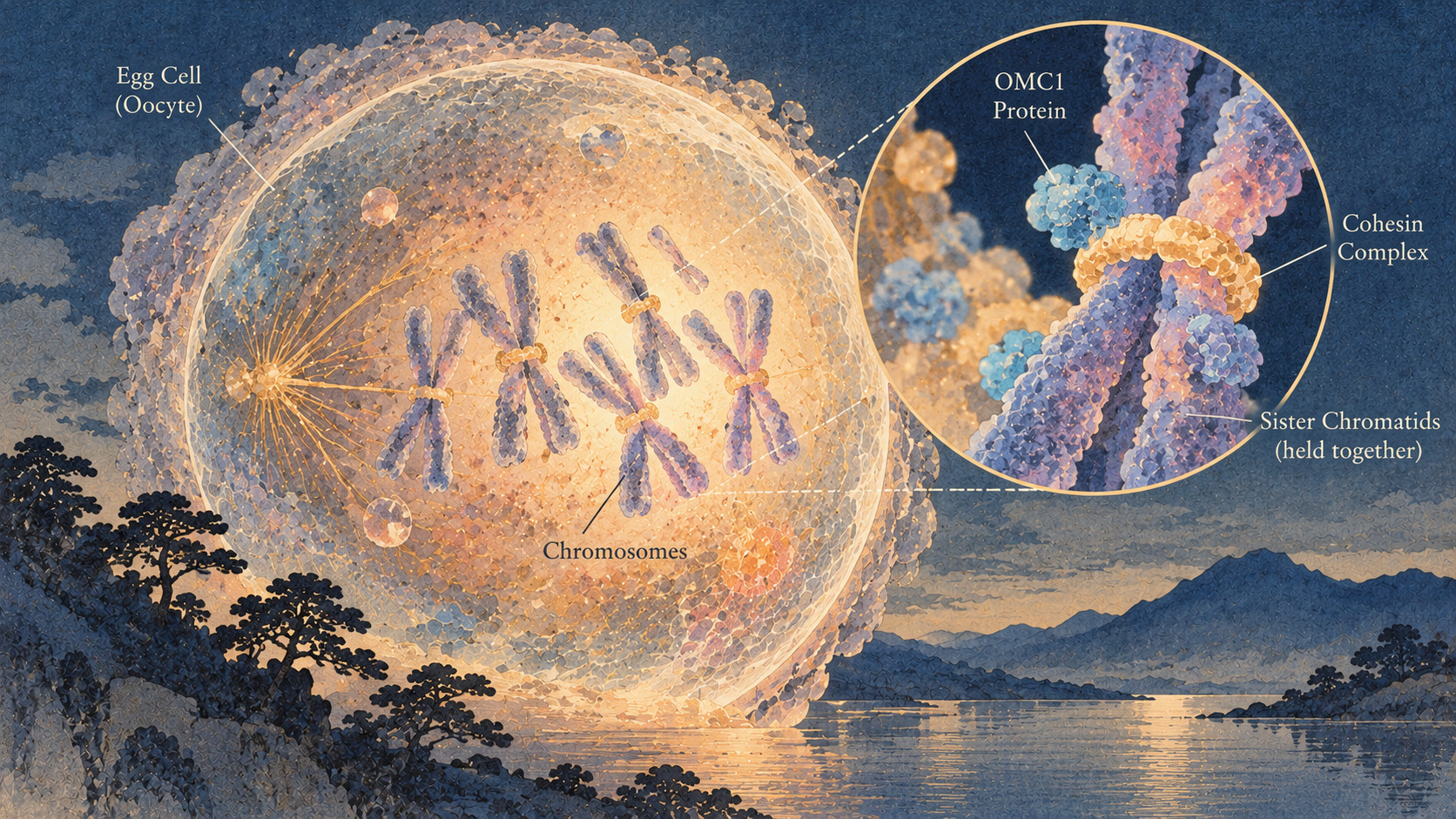
Not a claim to reverse egg aging: a discovery about how fragile chromosome connections are protected over time.
A molecule built to protect a long wait
Unlike most cells that divide on a short schedule, mammalian egg cells begin a specialized division process before birth and may pause for decades. Their chromosomes must remain joined in precisely the right way throughout that extraordinary wait. A Japanese research collaboration has now identified a protein called OMC1 that helps preserve the molecular machinery responsible. The finding, published in Nature Aging on October 29, 2026, and announced by Chiba University, RIKEN and Kumamoto University the next day, offers a new explanation for an enduring puzzle in reproductive biology.
The real discovery—and the limits
The study does not report a fertility drug, an anti-aging intervention, or a way to prevent chromosome disorders in people. Its most direct causal evidence comes from experiments in mice. What it demonstrates is that OMC1 is essential for maintaining chromosome cohesion in mouse oocytes, and that removing it produces defects resembling important aspects of natural egg aging. The distinction matters because advances in understanding biology often precede clinical applications by many years, if an application becomes possible at all.
The chromosome “glue” that must endure
After DNA is copied, each chromosome consists of sister chromatids that need to remain connected until the proper stage of cell division. Cohesin is a protein complex that helps maintain that connection; REC8-containing cohesin is particularly important in meiosis, the specialized division that produces eggs and sperm. If the connections weaken too early, chromosomes can segregate incorrectly and eggs may have an abnormal number of chromosomes, a state called aneuploidy. Such errors contribute to infertility, pregnancy loss and some congenital chromosomal conditions.
A century of chromosome science
Scientists established the outlines of meiosis through cytological observations around the turn of the twentieth century. The molecular era later identified cohesin complexes and the meiosis-specific REC8 subunit, making it possible to study how chromosome attachments are created and released. But the female reproductive system poses an unusually difficult maintenance problem: an oocyte may have to safeguard chromosome cohesion from fetal development until a woman reaches adulthood. Discovering what preserves that machinery over time is a different question from discovering how it is assembled in the first place.
OMC1: a keeper, not simply a builder
OMC1 stands for Oocyte Meiotic Chromosome protein 1. The authors found it associated with REC8-containing chromosome axes from fetal oocyte stages through adult maturation. Their experiments indicate that OMC1 is largely dispensable for the initial assembly of meiotic chromosome structures, but important for keeping chromosomal REC8 in place later. That is a meaningful mechanistic distinction. The protein appears to support preservation of an existing molecular system rather than simply switching it on at the beginning.
What happened when scientists removed it
The team generated mice lacking functional Omc1. Even in young adult animals, their oocytes showed diminished chromosomal REC8, weaker cohesion and more chromosome-segregation abnormalities. Some features resembled naturally aged eggs, including changes in sister-centromere separation. The paper also documented differences from natural aging: for example, the centromere-associated protein CENPA remained largely intact in the knockout model. The results identify a specific contributor to cohesion loss, not a universal explanation for everything that happens as eggs age.
Why a molecular system is vulnerable over decades
The prevailing model holds that much of the REC8 cohesin responsible for the long-term attachments in mammalian oocytes is not readily replenished during prolonged meiotic arrest. Proteins that cannot be replaced efficiently create a special maintenance challenge: small losses can accumulate over time. OMC1 now appears to be one of the safeguards protecting chromosomal REC8 from premature depletion. This does not mean every molecule in the system is literally immutable, but it explains why maintaining cohesion can be more difficult than constructing it.
A partial rescue, not a clinical treatment
To probe whether newly made OMC1 could help, researchers injected Omc1 messenger RNA into adult knockout-mouse oocytes. Under selected experimental conditions, chromosomal REC8 levels rose compared with control-injected knockout oocytes, but remained below wild-type levels. Higher doses also delayed progression through meiosis. These are useful functional experiments, showing a relationship between OMC1 and cohesion, yet they cannot establish the safety or effectiveness of injecting material into human eggs. No human fertility treatment was tested.
Why reproductive age changes the stakes
Mammalian oocytes initiate meiosis during fetal life and remain arrested until they mature. With increasing maternal age, the period of arrest lengthens and chromosome-segregation errors become more common. Cohesion loss is an important part of that story, but other contributors include spindle behavior and changes in cellular organization. This research gives scientists a candidate mechanism to investigate more deeply; it is not a test that predicts an individual patient’s reproductive prospects, and it cannot reduce an individual experience to a single protein.
A multi-institutional effort
The collaboration involved Chiba University researchers including professor Kei-ichiro Ishiguro, lecturer Ryuki Shimada and researcher Sakie Iisaka; RIKEN Center for Biosystems Dynamics Research investigators including Tomoya S. Kitajima and Shuhei Yoshida; and researchers associated with Kumamoto University. Iisaka and Yoshida are credited as equal contributors to the first-author work. The published article identifies its experimental methods, animal-ethics approvals and funding sources. It also discloses a pending joint patent application naming several authors and their institutions as inventors—an important transparency point when assessing eventual commercial possibilities.
Questions for the next generation of research
Does OMC1 preserve chromosome cohesion through the same pathways in human oocytes? How does the protein behave over decades, and what other mechanisms reinforce or undermine its protective role? Can modifying those pathways ever be done safely, without interfering with the carefully timed separation of chromosomes? These are questions rather than claims of medical success. They call for studies in additional systems and careful assessment of biological and ethical constraints before any clinical conclusions.
The significance is in maintenance
The most striking aspect of OMC1 is not an imagined miracle cure. It is the biological feat it helps explain: the reproductive system maintaining a fragile molecular connection through a potentially decades-long pause. By identifying one of the guardians of that connection, Japanese researchers have given the field a more precise place to look. For now, the result belongs to fundamental science—and that is substantial news in its own right.
Sources and verification
Based on the October 29 peer-reviewed study and primary institutional announcements. Mouse experiments are distinguished from human applications.