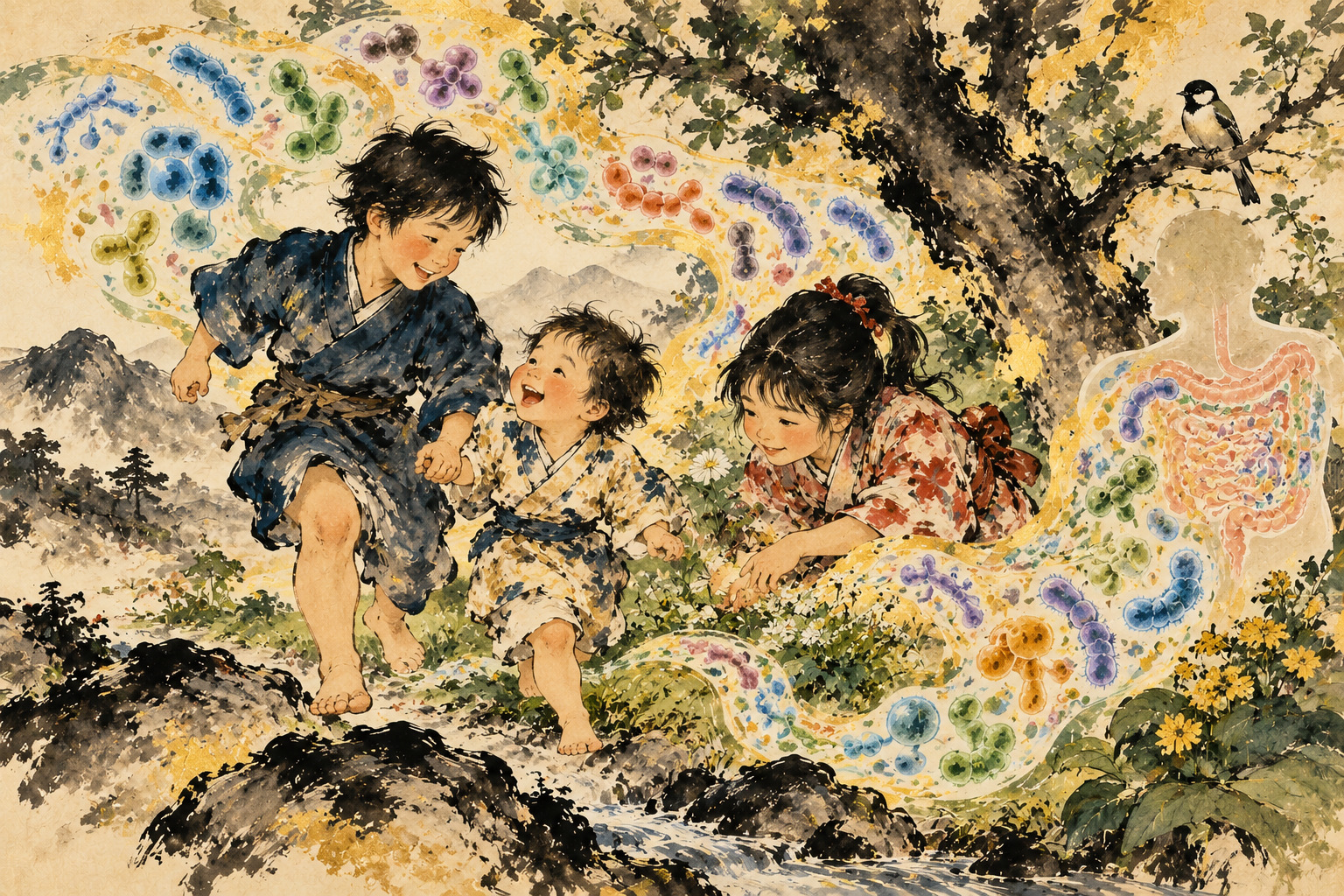
A sibling’s presence may leave a microbial signature. It is not proof of a healthier child.
A family relationship, visible in bacteria
The influence of an older brother or sister may extend beyond games, shared meals and childhood quarrels. In a new Japanese population study, the number of older siblings was associated with patterns in the gut microbial communities of children aged two and four. The finding is intriguing not because it proves a sibling makes a child healthier—it does not—but because it provides an unusually detailed picture of how the family environment and microbial development coexist.
Researchers from RIKEN, Tohoku University, Chiba University and collaborating institutions published the study in Pediatric Research on October 14, 2026, and announced it publicly on October 16. Their question was precise: could sibling structure be linked to distinct communities of intestinal bacteria and the products those bacteria generate?
Two ages, hundreds of samples
The project drew on an additional study within the Japan Environment and Children’s Study (JECS), a nationwide birth cohort established to examine how environmental exposures relate to children’s health. The investigators analyzed stool microbial data from 903 children at age two. Of those, 684 also supplied usable samples at age four. At the earlier age, 38% had one older sibling and 20% had at least two.
Rather than judge microbiomes as simply good or bad, the team applied statistical clustering to identify three recurring community types, or enterotypes. They also measured fecal short-chain fatty acids: compounds such as propionate and butyrate that microbes produce through metabolism and that can participate in intestinal and immune processes. Stool concentrations, however, do not give a simple readout of production or absorption elsewhere in the body.
The central finding, without the hype
One microbial profile—enterotype 1—had the lowest Shannon diversity index and lowest fecal propionate among the three groups. Its defining bacterial signature involved the Ruminococcus (Mediterraneibacter) gnavus group. Compared with enterotype 2, children with one older sibling had lower adjusted odds of being classified in enterotype 1: 0.49 at age two and 0.45 at age four. With two or more older siblings the corresponding adjusted odds ratios were 0.32 and 0.22.
Those numbers are not the chance that a particular child will develop a disease. They are relative comparisons from a model adjusted for measured differences including socioeconomic status, birth circumstances and household factors. Nor should they be read as a universal rule: many children without siblings will have diverse microbial communities, and many with siblings will follow different patterns.
Three microbial communities, not three health grades
The investigators described enterotype 2 as having relatively high Faecalibacterium abundance and enterotype 3 as characterized by Ruminococcus. At age two, 46% of samples fell into type 1 and 43% into type 2. By age four, type 2 accounted for 50% and type 3 for 35%. The distribution is consistent with substantial community change during early childhood, though it does not establish a fixed developmental sequence for every individual.
Diversity itself is nuanced. A Shannon index reflects both the richness and balance of measured organisms; a higher number is not a standalone clinical diagnosis, much less a guarantee of better health. The study evaluated bacterial composition and metabolites, not a trial of any treatment or dietary intervention.
Antibiotics explain only a modest portion
Could differences in antibiotic exposure account for the sibling association? The team investigated possible intermediary factors and found that recent antibiotic use at age four might explain a modest fraction. The reported mediated share was approximately 9.1% for children with one older sibling and 2.9% for those with at least two, with uncertainty around those estimates.
Importantly, a statistical “direct” pathway does not mean the researchers directly observed microbes moving between siblings. Unmeasured shared exposures, daycare patterns, food, parental behavior and other factors may also matter. This research is not a reason to disregard medical advice or avoid appropriately prescribed antibiotics.
A longer history: from hygiene to microbial ecology
The observation resonates with a much older scientific debate. In 1989, epidemiologist David Strachan reported an association between family size and hay fever, helping launch what became known as the hygiene hypothesis. Popular accounts often reduced that idea to “more germs are better.” Modern research is more careful: immune development interacts with a complex microbial and social environment, and neither infection nor dirt should be romanticized.
The new study moves the discussion from a broad epidemiological pattern toward measurable microbial profiles in early childhood. But it does not establish that the observed patterns mediate lower allergy risk, or that introducing siblings—or particular bacteria—would prevent illness. Those questions require different studies and clinical outcomes.
Why the Japanese cohort matters
JECS offers researchers a rare opportunity to examine children followed through distinct ages within a carefully established population framework. A repeated measurement in hundreds of children provides more perspective than a single snapshot. Still, the stool-sample subgroup may differ from the wider national cohort, and those retained at age four differed in some characteristics from children without a follow-up sample.
The authors used statistical adjustments and mediation methods, but observational research cannot rule out residual confounding or determine every mechanism. The analysis of bacterial communities also does not fully capture fungi, viruses, microbial activity or all the forces shaping intestinal ecosystems. A measured association is a foundation for further investigation, not a clinical recommendation.
What parents—and policymakers—can actually take away
The responsible takeaway is not that families should have more children to improve a microbiome, buy supplements or deliberately expose toddlers to infection. Family decisions have personal and social dimensions that cannot be reduced to an intestinal biomarker. Reliable healthcare, nutrition, appropriate antibiotic treatment and a safe home remain important regardless of sibling status.
For scientists, the next steps include testing whether the associations hold in other populations, separating shared environmental exposures from possible microbial transmission, and connecting longitudinal microbiome changes to specific health outcomes. For everyone else, the study offers a subtler picture of childhood: family life shapes a world that is partly invisible, and science is only beginning to describe its intricate connections.
Further reporting and corrections
This independent report draws on the peer-reviewed paper and institutional announcements. No exclusive researcher interview was conducted. Corrections or additional evidence are welcome through our contact page.