The ~30% improvement concerns the pier head—not the entire bridge schedule.
The bridge begins with a temporary problem
A spectacular bridge across a river or mountain valley starts with a less glamorous challenge: constructing a safe working platform at the top of a concrete pier. Before engineers can extend the deck outward, crews must support equipment, reinforcing steel, formwork and fresh concrete high above the ground. Japanese contractor Obayashi says a new method, announced October 13, can simplify that difficult first stage. Its Krabbe Wagen method reorganizes how standard bridge form travelers are positioned, avoiding the large temporary brackets and support scaffolding typically used to build the pier head.
The headline number needs a boundary
Obayashi compares a conventional 140-day pier-head construction schedule with 100 days for its method, a saving of 40 days, or around 29%. The company describes the benefit as approximately 30% shorter construction time with less labor. Crucially, that figure applies to the pier-head sequence illustrated in its comparison. It is not a promise to shorten the entire bridge project by 30%, and the company has not provided a project-wide cost reduction, independent safety statistics or a standard worker-hour saving applicable to all sites.
A short primer on prestressed concrete
The PC in the Japanese announcement stands for prestressed concrete, a system that deliberately introduces compressive forces into concrete to improve its performance under bending and tension. It enabled engineers to span greater distances while controlling cracking and deflection. Developed and commercialized over the twentieth century, prestressing became central to highway and railway bridge construction, including in postwar Japan. Not every PC bridge is made the same way: Obayashi’s new technique addresses the pier-head portion of bridges assembled using balanced cantilever construction.
How a bridge grows out from a pier
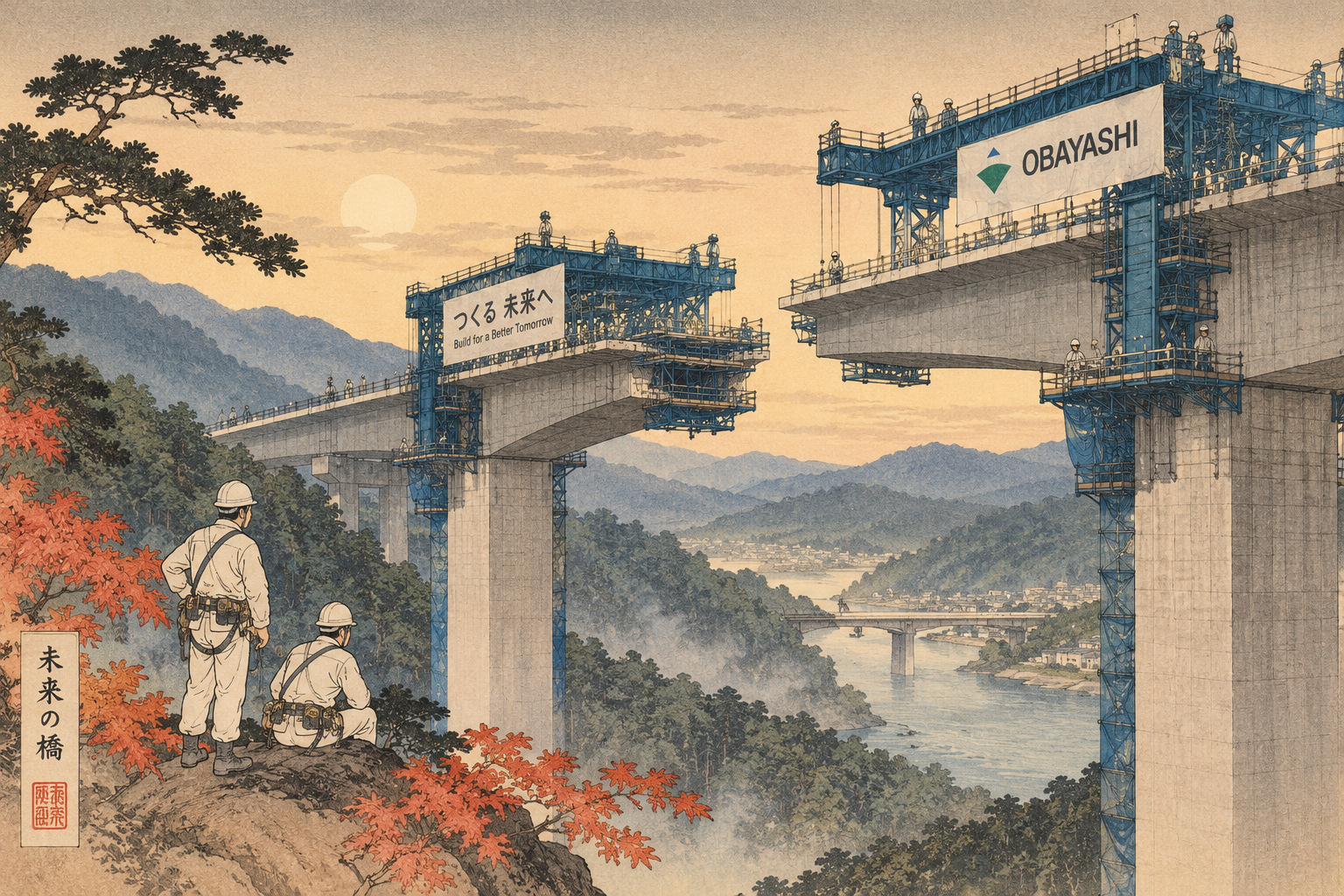
In balanced cantilever construction, builders extend the superstructure in successive segments on opposite sides of a pier. Specialized movable form travelers hold the formwork for each pour and advance as the concrete gains sufficient strength and is prestressed. Working outward from the central support reduces dependence on extensive temporary falsework erected from a riverbed or deep valley. But the technique creates a staging puzzle at the beginning: two travelers need room to operate around the top of a pier before the completed deck exists.
Why that first platform is so burdensome
The conventional response has been to build a pier head wide enough for both travelers, using substantial temporary brackets, scaffolds and support frames. Erecting and dismantling those supports can involve labor-intensive work at height. Obayashi’s breakdown assigns 48% of the conventional pier-head work to assembly and disassembly of scaffolding and support work. This is the specific bottleneck the company is targeting, rather than a wholesale reinvention of the prestressed-concrete bridge.
Three stages instead of one wide first pour
The new sequence is straightforward in concept. First crews construct a central pier-head portion no wider than the pier itself. They install one form traveler and use it to build the extension on one side. Once that extension creates more space, they install a second traveler in a carefully offset arrangement and construct the other side of the pier head. Only after the pier head is complete do the two travelers revert to their normal positions for the conventional balanced-cantilever sequence. The innovation lies as much in changing the order of construction as in modifying equipment.
The engineering detail: rearranging the load-carrying members
Obayashi says the main members of opposing form travelers are positioned to avoid interference. These members carry forces from the traveler into the concrete. An added sliding mechanism allows crews to move them back to their conventional positions after pier-head work. According to the company, relatively minor alterations to existing equipment make the approach potentially attractive even after a project has been awarded. But the geometry of each pier, construction-stage loads, temporary stability and equipment clearances must still be engineered for the site.
Safety by eliminating hazardous operations
The safety argument is more interesting than simply asking workers to take extra care. Removing the need to assemble and dismantle large elevated support structures can reduce exposure to high-risk work. In the hierarchy of construction safety, eliminating an operation may offer stronger protection than relying only on harnesses, briefings and procedures. Yet the developer has not published a measured reduction in falls, incidents or near misses attributable to the new method. Its safety benefit is plausible and mechanically explainable, not a statistically verified outcome across a fleet of projects.
Why this matters in an aging construction workforce
Japan has spent years grappling with construction labor shortages, the aging of skilled trades and pressure to reduce excessive working hours. Overtime restrictions expanded to the construction industry in 2024, raising the importance of realistic schedules and more productive methods. Prestressed-concrete bridge work brings multiple crews and technical specialties together in demanding sequences. Reducing temporary-work tasks could free qualified workers for core operations, although the staffing impact will depend on project conditions and scheduling.
The historical lineage of a modest-looking invention
Bridge innovation is often associated with record spans, new alloys or giant lifting machines. Yet the balanced cantilever itself grew out of an incremental twentieth-century engineering tradition: prestressing, segment-by-segment concrete construction and better movable formwork. Earlier projects demonstrated how construction sequencing determines both efficiency and temporary structural behavior. Obayashi’s contribution belongs to that lineage. It does not replace prestressed concrete or form travelers; it rearranges a difficult start-up sequence to use familiar tools in a different way.
A practical adoption advantage—and its limits
Equipment compatibility is commercially important. A technique requiring a bespoke traveler or major redesign may be unattractive after a contractor wins a job. Obayashi emphasizes that its adjustments are relatively small and that its modified travelers can return to ordinary use. But procurement decisions also depend on engineering certification, the costs of design checks and fabrication, operator training, insurance and contractual responsibility. The announcement does not state the additional hardware cost, the number of completed field deployments or a quantified return on investment.
Potential interest outside Japan
Cantilever construction is used internationally where geography makes ground-supported falsework impractical. A method that reduces temporary structures could interest bridge contractors from mountainous regions to major river crossings. Still, Japan’s design requirements, earthquake considerations and available traveler fleets differ from those elsewhere. Exporting a method requires drawings, calculations and convincing field records that satisfy local owners and regulators, not merely a favorable schedule diagram.
The data still needed
Obayashi plans to apply Krabbe Wagen in prestressed-concrete bridge projects and continue related productivity research. Before the industry can judge its broader significance, several questions deserve answers: Which completed projects have used it? What were the measured crew-hours, actual duration and safety observations? Which pier geometries and construction load cases can it accommodate? How easily can another contractor adapt the mechanism? Such details will determine whether a promising sequence becomes a widely adopted standard.
The invisible innovation
Travelers crossing a finished bridge will not see the temporary scaffolds that were avoided—or remember how the concrete first grew from its central pier. Yet those unseen construction decisions shape a project’s cost, schedule and risks. Krabbe Wagen is a reminder that modern infrastructure innovation is sometimes less about the object that remains than about the dangerous, expensive work that never had to happen.