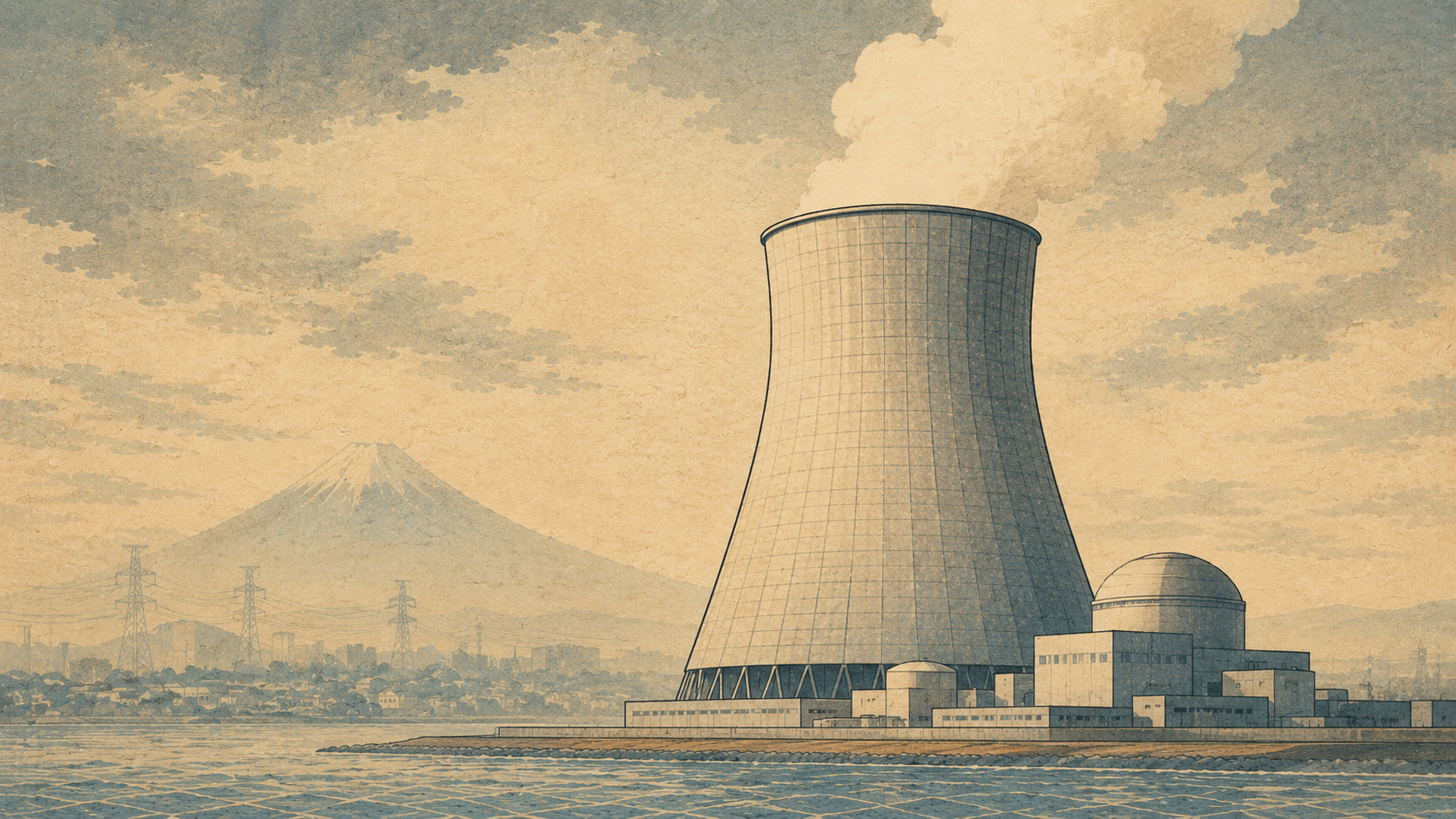
A target for replacing nuclear reactors is never just an energy-policy target in Japan. It carries the memory of March 11, 2011. It carries Fukushima Daiichi, evacuation zones, contaminated water, compensation, decommissioning and the long political silence that followed. So when Japan’s utilities welcomed the government’s new roadmap for replacing aging nuclear reactors, the story was not simply about megawatts. It was about whether a country that lost trust in nuclear power can build a new social contract around it.
The new roadmap matters because it gives numbers to a question Japan had avoided for years. According to public reporting, the Ministry of Economy, Trade and Industry has suggested Japan may need to rebuild two to five aging reactors by the 2040s and a cumulative 11 to 14 by the 2050s. The replacement capacity could reach roughly 16 gigawatts. Behind the numbers are AI data centers, semiconductor fabs, electrification, decarbonization and the cost of imported fossil fuels.
For utilities, the numbers are a signal they have long wanted. A nuclear reactor is not a plant that can be ordered like a gas turbine. It requires a site, local consent, regulatory review, design work, skilled labor, suppliers, financing, fuel policy, evacuation planning and a long political runway. If Japan wants next-generation reactors in the 2040s, the work has to begin now.
What a replacement target really means
This is different from restarting existing reactors. A restart means taking a plant that already exists, upgrading it to post-Fukushima standards and navigating the regulator and local politics. A replacement target is a deeper decision. It asks whether nuclear power is merely a bridge for the 2030s or a core power source for Japan in the 2050s.
In February 2025, Japan’s cabinet approved the Seventh Strategic Energy Plan. The plan set a FY2040 electricity mix of 40–50% renewables, around 20% nuclear power and 30–40% thermal power. It also moved away from the post-Fukushima language of reducing dependence on nuclear energy “as much as possible” and toward a policy of maximizing nuclear use, with safety as the premise.
The replacement roadmap is the next logical step. Restarts alone cannot preserve nuclear capacity forever. Many reactors will age toward the 60-year operating boundary. If Japan wants nuclear power to remain around 20% of electricity after 2040, it cannot only keep extending the life of old reactors. Somewhere, at some point, it must build new ones.
Why utilities welcomed the target
The industry’s support is not only ideological. Nuclear is a sector that decays when it stops. Engineers retire. Students choose other fields. Manufacturers close or shrink specialized production lines. Construction companies lose experience. Once a supply chain is broken, rebuilding it can take a generation.
Nuclear construction involves pressure vessels, steam generators, turbines, control systems, seismic engineering, emergency power, filtered vents, fuel handling and radiation protection. Japan once had one of the world’s strongest nuclear-industrial bases. After Fukushima, new domestic construction largely froze. For young engineers, nuclear no longer looked like a growing career.
That is why utilities want more than a slogan. They want a bankable policy framework: capacity mechanisms, long-term decarbonized power auctions, government-backed financing, clear regulation and local support. Without those, a numerical target can remain only a number.
Before Fukushima: nuclear as the power of a growth state
Japan’s nuclear story began with energy insecurity. A resource-poor island nation could not build a modern industrial economy on imported oil and coal alone. Research began in the 1950s, and commercial reactors followed in the 1960s and 1970s. The oil shocks gave nuclear power even greater strategic weight.
Utilities, the old Ministry of International Trade and Industry, manufacturers, universities, local governments and construction companies built a system that later critics would call the “nuclear village.” At the time, however, nuclear power looked like a sovereign technology. It promised stable baseload electricity, lower fuel-import vulnerability and carbon-free generation before climate policy became a household phrase.
Yet the system carried hidden weaknesses: local subsidies, overconfidence in risk models, closeness between regulators and promoters, unresolved spent fuel, uncertain evacuation plans and a tendency to treat dissent as a public-relations problem. Long before 2011, the cracks were there.
March 11, 2011: the day the story broke
The Great East Japan Earthquake, tsunami and Fukushima Daiichi accident shattered Japan’s nuclear consensus. Station blackout, core damage, hydrogen explosions, evacuation, decontamination and a long decommissioning process turned the language of nuclear power from “stable supply” to “broken trust.”
After the accident, Japan shut down its reactors and leaned heavily on fossil-fuel generation. LNG, coal and oil imports rose. Electricity costs and the trade balance felt the impact. Emissions policy also became harder. But the answer was never as simple as turning reactors back on. The public wanted to know who would be responsible, who would tell the truth, whether evacuation plans were real and whether the same institutional culture remained.
Japan created the Nuclear Regulation Authority and introduced tougher post-Fukushima rules. Tsunami defenses, backup power, severe-accident measures, anti-terrorism facilities and seismic reviews became central. But tougher regulation and restored trust are not the same thing.
AI and data centers changed the demand story
It is too simple to call the late-2020s nuclear turn a return to the pre-Fukushima past. Something else changed: power demand. For years, Japan looked like a country of flat or declining electricity consumption because of population decline and efficiency gains. AI, semiconductor fabs, data centers, electrification and industrial reshoring are challenging that assumption.
Generative AI creates a large power load behind the screen. Data centers need electricity not just for chips, but for cooling, backup systems, communications and power quality. Semiconductor fabs also need huge volumes of stable electricity. Rapidus in Hokkaido, chip investment in Kyushu and cloud growth around Tokyo and Osaka all push utilities to think differently about the grid.
If demand rises while Japan is also trying to decarbonize, the government has to consider renewables, transmission, storage, low-carbon thermal power and nuclear power together. Nuclear is one answer, not the only answer. Japan’s problem is that every option has constraints.
Can renewables do it alone?
Nuclear supporters argue that renewables alone cannot provide the stable industrial power Japan needs. The country is mountainous, densely populated and short of flat land. Solar power depends on daylight and weather. Offshore wind requires ports, grids, fisheries coordination and lower costs. Batteries and demand response are improving, but large-scale system balancing remains a challenge.
Critics argue that nuclear is expensive, slow to build, dangerous in a severe accident and burdened by unresolved waste. They say money directed toward reactor replacement would be better spent on grids, storage, efficiency, demand response and regional renewable energy. They also argue that extending or replacing reactors can crowd out faster climate solutions.
There is no easy winner in this debate. Nuclear power is low-carbon and stable, but carries social and accident risks. Renewables are safer and scalable, but need grids and storage. Thermal power is flexible, but depends on imports and emits carbon. Japan’s energy policy is not a contest between ideal options. It is a comparison of constraints.
The politics of where to build
The central question is where new reactors would go. The Seventh Strategic Energy Plan opened the way for next-generation reactors at existing nuclear sites where old reactors are being decommissioned. That is politically and technically more realistic than building on entirely new sites: the grid, port access, local relationships and emergency-planning structures already exist.
But existing sites are not easy sites. Host communities have depended on nuclear employment and tax revenue, but they also carry the closest accident risk. A replacement decision becomes a decision about the region’s future. Will young people stay? Are evacuation roads enough? How will hospitals and elderly-care facilities move? Is the tsunami assumption credible? These are not questions that can be answered by a glossy brochure.
The small cracks that destroy trust
The biggest danger to nuclear policy is not only a major accident. It is the accumulation of small failures: bad data, late reporting, unclear explanations, weak evacuation assumptions, opaque regulation and the sense that local voices are being managed rather than heard. Once those cracks spread, even the phrase “next-generation reactor” will not persuade people.
Recent controversies over safety assessments and plant communications show how fragile the trust base remains. Technical safety can be reviewed by experts. Social safety exists only when communities believe the system will tell them the truth. For Japan.co.jp, this is the heart of the story. Nuclear power’s greatest opponent is not only the anti-nuclear movement. It is the distrust nuclear institutions created themselves.
The promise and limit of next-generation reactors
Government and industry now talk about “next-generation innovative reactors.” The phrase points to improved safety, passive systems, severe-accident mitigation, better efficiency, load-following potential and, in some cases, smaller modular designs. Technically, the industry wants to show that a new reactor would not be the same as a pre-2011 reactor.
But the word “next-generation” cannot create trust on its own. Residents want to know what happens in an accident, who orders evacuation, who provides information, where spent fuel goes, who pays decommissioning costs and whether power bills will really be lower. If Japan is going to talk about future reactors, it must also talk about future responsibility.
Electric bills and energy security
Politicians and industry leaders emphasize electricity prices and energy security. Japan imports most of its fossil fuels. Russia’s war in Ukraine, Middle East tension, LNG volatility and yen weakness all feed into household and industrial power bills. When the yen falls, imported fuel becomes more expensive.
Nuclear power has relatively low fuel-cost exposure and can provide steady low-carbon electricity. In climate policy, it is being revalued globally. If Japan wants to attract AI data centers and semiconductor investment, it needs power that is not only available but stable, low-carbon and predictable. That is the strongest economic argument for nuclear replacement.
But cost arguments must be transparent. Nuclear costs include construction, decommissioning, accident response, waste disposal, regulation and local measures. It is not enough to compare only fuel costs. If the public is asked to support new reactors, it deserves a full accounting.
The world is asking the same question
Japan is not alone. The United States is considering major support for nuclear supply chains as data-center demand rises. France is trying to rebuild nuclear momentum. China, India and South Korea continue to develop nuclear capacity. The International Energy Agency has said global nuclear generation is heading toward new highs as countries look for low-carbon power.
But Japan’s case is different. Japan is earthquake-prone. It remembers tsunami risk. It is the country of Fukushima. Its nuclear policy will always require a higher standard of trust, evacuation planning and regulatory independence than most countries face.
Japan.co.jp’s view
The replacement target can be understood as realistic energy policy. In the age of AI and semiconductors, electricity demand is rising. Overdependence on imported fuel is risky. Decarbonization cannot be avoided. Even if renewables are expanded aggressively, grids and storage remain constraints. It is difficult for Japan to remove nuclear from the policy toolbox entirely.
But the largest challenge is not technical. It is trust. Utilities are right to welcome a long-term signal. Whether the public welcomes it is another matter. Japan cannot forget Fukushima, hide information, push risk onto host communities, postpone waste decisions or blur responsibility in an accident. Without those foundations, a new reactor would stand on old distrust.
Replacing nuclear reactors is not only a matter of concrete and steel. It is a test of whether the state, utilities and communities can rebuild a contract that broke in 2011. If Japan truly wants next-generation nuclear power, the first thing it must replace is not the reactor. It is the trust.
| Issue | How to read it |
|---|---|
| Policy target | Two to five replacements by the 2040s, 11 to 14 cumulatively by the 2050s. |
| Industry support | A long-term signal for workforce, supply chains and financing. |
| Energy background | AI data centers, semiconductor fabs, electrification, fuel imports and decarbonization. |
| Biggest obstacle | Not construction technology, but post-Fukushima public trust and local consent. |
| Japan.co.jp takeaway | Before building new reactors, Japan must rebuild accountability, evacuation credibility, waste policy and transparency. |
Sources and references
This article is a long-form analysis based on government documents, public reporting, international energy research and nuclear-industry data. Nuclear policy can change with regulatory review, local consent, power demand, fuel prices and technology development.
- Reuters: Japan utilities welcome nuclear replacement targets, seek stronger policy support.
- Reuters: Japan proposes rebuilding ageing nuclear plants to meet power demand.
- METI: Cabinet Decision on the Seventh Strategic Energy Plan.
- Agency for Natural Resources and Energy: Outline of the Seventh Strategic Energy Plan.
- World Nuclear Association: Nuclear Power in Japan.
- International Energy Agency: The Path to a New Era for Nuclear Energy.
- Nippon.com: Japan’s Energy Plan shifts nuclear policy from reduction to maximization.